Digital Marketing Europe 2026: Dates, Speakers, Tickets & Full Guide (Vilnius, Nov 10-12)
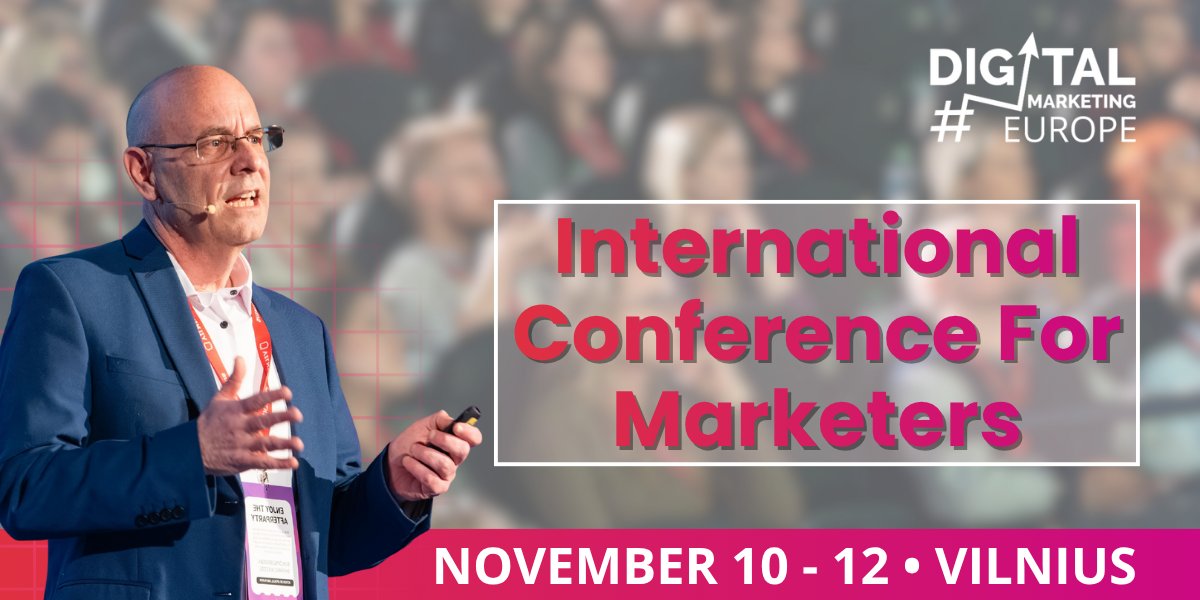
November 10-12, 2026
TL;DR: Digital Marketing Europe 2026 runs November 10-12, 2026 in Vilnius, Lithuania, for its 8th edition under the theme “Where the future of marketing comes to life. ” It packs 40+ speakers, four content tracks,...
TL;DR: Digital Marketing Europe 2026 runs November 10-12, 2026 in Vilnius, Lithuania, for its 8th edition under the theme “Where the future of marketing comes to life.” It packs 40+ speakers, four content tracks, full-day workshops, and an EXPO into three cinema-style days with 500+ attendees from 30+ countries. Onsite tickets currently start at €545 in the Regular price stage.
Most marketing conferences sell you the headline and hide the substance. You pay four figures, fly in, and sit through vendor pitches dressed up as keynotes. So when I went through Digital Marketing Europe 2026, I asked the same question I ask about every tool I review: is this a real working event, or hype with a lanyard?
I track marketing and AI events because what surfaces on these stages, the case studies, the paid-media tactics, the AI personalization tools people demo in the hallway, tends to show up in the AI marketing tools and deals I cover a few months later. Digital Marketing Europe is interesting because it is unapologetically a practitioner event. The whole framing is execution: proven tactics for customer retention, ad performance, and data-driven personalization that you can apply on Monday.
In this guide I’ll give you the full picture: the exact dates and venues, the speaker lineup, the topics, the ticket tiers and what they cost, the rising price stages, and my honest read on whether the trip to Vilnius pays off. All event details below are pulled directly from the official Digital Marketing Europe site and verified against its current ticket listings.
One quick correction up front, since a few listings have it wrong: this event is in Vilnius, Lithuania, not Portugal. If you only want the headline call: this is a strong fit for marketers, brand managers, and agency teams who want practical strategy over theory, and a weaker fit for total beginners looking for a free intro. Now the details.
Key Takeaways
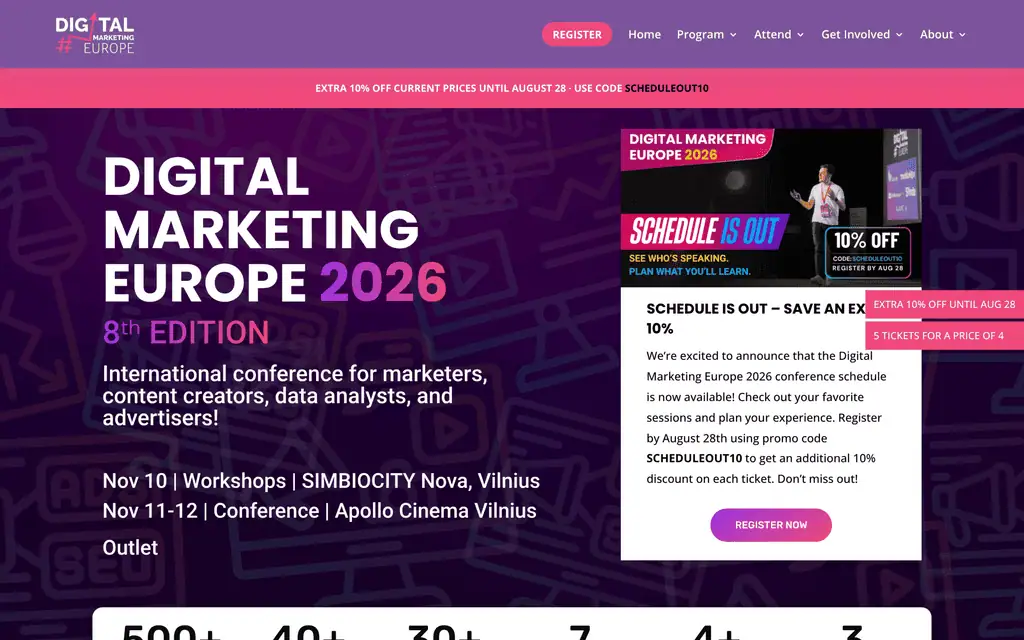
- Three days, one compact program. Digital Marketing Europe 2026 runs November 10-12, 2026, with a full workshop day on November 10 at SIMBIOCITY Nova and the main conference on November 11-12 at the Apollo Cinema Vilnius Outlet.
- Real scale for a regional event. Expect 40+ international speakers, four specialized content tracks, 500+ participants from 30+ countries, and 200+ companies across 15+ industries.
- The earlier you buy, the more you save. Pricing climbs through six stages, from a 50% Blind Bird discount down to 0% in the final week. As of late June 2026 you’re in the Regular stage at 30% off, which holds until September 10.
- Transparent, tiered pricing. Onsite passes run €545 for the workshop day, €845 for the 2-day conference, and €1,260 for the full 3-day ticket, with hotel-bundle packages available from €1,205.
- A genuinely different format. The conference runs in a cinema with giant screens, plus full-day hands-on workshops, an EXPO and networking zone, a movie screening, and an afterparty with games and welcome drinks.
What Is Digital Marketing Europe 2026?
Digital Marketing Europe is an international, practitioner-focused marketing conference that brings together marketers, strategists, brand managers, analysts, and agency teams from across Europe to focus on tactics that move real business results rather than theory. The 2026 edition is the 8th, runs in Vilnius, Lithuania, and is organized by Data Miner, the same Lithuanian team behind AI Summit Europe.
The thing that sets it apart is the angle. This is not an academic event and not a vendor showcase. The entire program is built around one question: what are top marketing teams actually doing right now to win on customer retention, ad performance, and personalization? Sessions lean on case studies and frameworks, with four parallel tracks so you can follow the lane that matches your job.
The 2026 theme, “Where the future of marketing comes to life,” is the kind of line every conference uses, but the track list backs it up. You get a Digital Brand Strategy track, a Paid Advertising track, an AI-Powered Hyper-Personalization track, and an SEO and SEM track, plus sessions on influencer outreach, user-generated content, digital PR, and neuromarketing.
For context on why an event like this matters now, the AI tooling space has exploded past 10,000 tools by most directory counts, and marketers are drowning in options for ads, content, and personalization. Conferences like this are where the signal separates from the noise, which is the same job I try to do with every AI marketing tool review on ZPlatform.
When and Where Is Digital Marketing Europe 2026?
Digital Marketing Europe 2026 takes place across three days, November 10-12, 2026, split between two Vilnius venues. The full-day workshops run on November 10 at SIMBIOCITY Nova (V. Gerulaičio st. 10, Vilnius), and the main conference runs November 11-12 at the Apollo Cinema Vilnius Outlet (Vytauto Pociūno g. 8, Vilnius). This is an onsite event, so there’s no online track this year.
The cinema venue is not a gimmick. Holding sessions in a cinema means crystal-clear sound and giant screens, so a keynote actually feels like an event instead of a hotel ballroom slideshow. The program even includes a special movie screening, which fits the setting.
Vilnius is a smart, underrated choice. It’s a compact, affordable European capital with a walkable old town, direct flights from most major European hubs, and a fast-growing tech scene. Compared to running an event in London or Amsterdam, your travel and hotel costs here will be noticeably lower, which matters when you’re weighing the total cost of attending.
If you want a sense of how this compares to its sister event from the same organizer, it’s worth reading my AI Summit Europe 2026 guide alongside this one. They serve different jobs: one is a business-AI summit, this one is a hands-on digital marketing conference.
Who Should Attend Digital Marketing Europe 2026?
Digital Marketing Europe 2026 is built for people who own marketing outcomes inside a real organization: brand and strategy leads setting direction, performance marketers running paid campaigns, SEO and content teams chasing traffic, and agency teams serving clients. The organizer reports that 42% of past attendees are senior level and 34% are mid-level, so the room skews toward people who can actually act on what they learn.
Here’s my honest breakdown of who gets the most out of it:
- Brand and strategy leads. The Digital Brand Strategy track and the case-study density give you a fast read on what’s working across European brands and where to pivot your own approach.
- Performance and paid-media marketers. The Paid Advertising track is squarely aimed at ad performance and ROI, which is where most marketing budgets quietly leak money.
- SEO and content marketers. With named SEO consultants on the lineup and a dedicated SEO and SEM track, this is a strong fit if organic growth and search visibility are your job.
- Agency teams and consultants. A room full of 500+ marketers and 200+ companies across 15+ industries is a strong environment for partnerships, new clients, and benchmarking your service against the market.
Who should probably skip it? Total beginners hoping for a free introduction to digital marketing. This is a paid, professional event, and if you’re just starting out, your money goes further on focused courses and the budget AI tools I recommend before you commit to a four-figure conference trip.
Digital Marketing Europe 2026 Speaker Lineup
The 2026 lineup leans into working practitioners and operators rather than celebrity keynotes, which matches the event’s execution-first focus. The organizers list 40+ international speakers drawn from agencies, consultancies, and fast-moving brands across 30+ countries.
Confirmed and notable 2026 speakers include:
- Felix Beilharz, social media expert and founder of Felix Beilharz GmbH (Germany), one of the most recognized social media voices in the German-speaking market.
- Fili Wiese, SEO consultant at Search Brothers (Germany) and a former Google Search Quality team member, on technical SEO that holds up.
- Vicky Owens, CEO and founder of Socially Speaking Media (UK), on social-first brand building.
- Maryanna Franco, founder and SEO consultant at BrilliantSEO (Slovenia).
- Tamara Novitović, Head of SEO at Bazoom (Serbia).
- Patrik Rojan, co-founder and SEO strategist at Mixtazure (Romania).
- Dima Melnik, pricing consultant at FixPricing.com (Czechia), on pricing as a marketing lever.
- Aurimas Paulius Girčys, CEO of APG MEDIA (Lithuania).
You can see the full, current list on the official speakers page. One caution worth stating plainly: speaker lineups always shift before the event. Names get added, session times move, and occasionally a headliner drops out. Confirm the current agenda on the official site before you buy a ticket specifically to see one person.
What Sessions and Topics Can You Expect?
The program is organized into four parallel content tracks across the two conference days, with full-day workshops on November 10. The workshops are the highest-value part for most people because they’re hands-on, small-group sessions where you build something instead of just taking notes.
The four headline tracks are Digital Brand Strategy, Paid Advertising, AI-Powered Hyper-Personalization, and SEO and SEM. Around those, the agenda spans a wide spread of topics:
- Digital brand strategy and digital PR
- Paid advertising and growth hacking techniques
- AI-powered hyper-personalization and data and insights
- SEO, SEM, and visual and voice search optimization
- Influencer outreach and user-generated content (UGC)
- Affiliate marketing and digital messaging
- AR and immersive experiences, plus neuromarketing
- SOPs for smarter, more repeatable marketing
With four tracks running in parallel, you will miss things. My advice, from covering events like this, is to plan your must-attend workshops in advance and treat the EXPO area and hallway conversations as your flexible time. The AI personalization track is the one I’d watch most closely, because that’s where the gap between marketing talk and working tools is closing fastest.
Digital Marketing Europe 2026 Ticket Prices
Digital Marketing Europe 2026 ticket prices currently range from €545 for the workshop day up to €1,260 for the full 3-day conference, with VAT included. These are the Regular-stage prices (30% off), which are live now and hold until September 10, 2026.
Here’s the full current onsite pricing:
| Pass | Price (incl. VAT) | What It Covers |
|---|---|---|
| 1-Day Workshop (Nov 10) | €545 (€385 ex. VAT) | Full workshop day, networking, sponsor area, certificate |
| 2-Day Conference (Nov 11-12) | €845 (€600 ex. VAT) | Main conference, networking, recordings, lunch and breaks, certificate |
| 3-Day Full (Nov 10-12) | €1,260 (€870 ex. VAT) | Workshop day plus the full conference, all benefits above |
If you want to skip the hassle of booking a room separately, the organizers sell ticket-plus-hotel bundles with breakfast included: the 2-day-plus-hotel package is €1,205 and the 3-day-plus-hotel package is €1,800, with extended-stay options running roughly €1,385 to €1,980. For teams of 10 or more, group rates and proforma invoices are handled directly at tickets@digitalmarketingcon.eu.
A few honest notes on value. The 3-day full ticket is the one I’d point most practitioners to, because the workshop day is the highest-value, most hands-on part of the program. The 2-day conference pass is right for people who care more about keynotes and networking than building. The workshop-only ticket is a fair, lower-commitment way in if your budget is tight.
The cheapest ticket is still expensive if the event doesn’t move your work forward. Buy the outcome, not the access. Alston Antony
You can review the live tiers on the official tickets page, and before you commit, it’s worth browsing the AI deals and discounts I track so your marketing-tool budget for the year stays sane.
How the Rising Price Stages Work (And When to Buy)
The single most important thing to understand about this event’s pricing is that it climbs through six timed stages, and the only way to get the best price is to buy early. Each stage starts and ends at 4 PM GMT+3, and the discount shrinks as the event gets closer.
Here’s the full schedule:
| Stage | Dates | Discount |
|---|---|---|
| Blind Bird | April 20 - May 14 | 50% off |
| Early Bird | May 15 - June 18 | 40% off |
| Regular | June 18 - September 10 | 30% off |
| Late Bird | September 10 - October 8 | 20% off |
| Last Minute | October 8 - November 5 | 10% off |
| Final | November 5 - 9 | 0% off |
As I’m writing this in late June 2026, the Regular stage (30% off) is live and runs until September 10. If you already know you’re going, there is no upside to waiting. The price only goes up. Buying before September 10 locks the current rate, and if you can decide before a stage flips at 4 PM GMT+3, you save another 10 percentage points. This is the same logic I apply to lifetime software deals: the discount is only real if you act while it’s open.
Hotels, Networking, and the Afterparty
Digital Marketing Europe offers conference-plus-hotel packages that bundle your ticket with a stay in a 4 or 5-star hotel near the venue, with breakfast included. As noted above, those start at €1,205 for the 2-day bundle. Booking the package saves you the hassle of sorting accommodation separately during a busy event week.
The networking is built into the format, not bolted on. The event runs an EXPO and dedicated networking zones in the cinema-style setting, designed so you can connect with potential clients and partners between sessions. There’s also a special movie screening that uses the venue for what it’s good at.
The headline social event is the afterparty, billed around “Games, Fun, and Relaxation,” with welcome drinks and table games. In my experience, this kind of informal evening is where the real connections happen, more than any structured networking session. If you can travel, the in-person extras are a big part of what you’re paying for.
Is Digital Marketing Europe 2026 Worth It? My Honest Take
Digital Marketing Europe 2026 is worth it if you’re a marketer, brand manager, or agency professional who wants practical strategy and a strong regional network, and it’s less compelling if you want a free beginner intro or purely cutting-edge research. The price is real, but so is the lower cost of doing Vilnius versus a bigger Western European capital, and the early-stage discounts make a genuine difference.
Let me put it in the terms I use for any purchase. The cost isn’t just the ticket. Add flights, two or three nights in a Vilnius hotel, and meals, and a single onsite attendee on the 3-day pass is realistically looking at €1,500 to €2,500 all in, which is on the lower end for an event of this caliber thanks to the location. The question is whether three days returns more than that in campaigns improved, clients won, or frameworks copied.
For the right person, it clearly can. One paid-media tactic that lifts your ad ROI, one partnership, or one SEO fix you copy from a working consultant pays for the trip. The execution focus means you leave with things you can actually use, not just inspiration.
For the wrong person, it’s an expensive way to feel busy. If you can’t name a specific outcome you want, a hire, a partner, a decision, a skill, you’ll come home with a tote bag and vague FOMO. My rule holds the same as it does for tools: don’t buy the access, buy the outcome. If you can name the outcome, the 3-day ticket bought during the current Regular stage is the version that earns its price.
Frequently Asked Questions
When and where is Digital Marketing Europe 2026?
Digital Marketing Europe 2026 runs November 10-12, 2026 in Vilnius, Lithuania. The full-day workshops are on November 10 at SIMBIOCITY Nova, and the main conference is on November 11-12 at the Apollo Cinema Vilnius Outlet. It’s an onsite-only event this year.
How much do Digital Marketing Europe 2026 tickets cost?
In the current Regular stage (30% off), the workshop-only pass is €545, the 2-day conference pass is €845, and the 3-day full ticket is €1,260, all including VAT. Hotel-bundle packages start at €1,205. Prices rise as the event nears, so earlier stages are cheaper.
Who are the speakers at Digital Marketing Europe 2026?
The 40+ speaker lineup includes Felix Beilharz (Felix Beilharz GmbH), Fili Wiese (Search Brothers), Vicky Owens (Socially Speaking Media), Maryanna Franco (BrilliantSEO), Tamara Novitović (Bazoom), Patrik Rojan (Mixtazure), and Dima Melnik (FixPricing.com), among others from across 30+ countries.
What topics does Digital Marketing Europe 2026 cover?
The program runs across four tracks: Digital Brand Strategy, Paid Advertising, AI-Powered Hyper-Personalization, and SEO and SEM. Sessions also cover influencer outreach, UGC, digital PR, affiliate marketing, growth hacking, neuromarketing, voice and visual search, and data and insights.
Is Digital Marketing Europe good for beginners?
Not really. It’s a paid professional event aimed at marketers, brand managers, performance marketers, SEO teams, and agencies. Total beginners looking for a free, step-by-step intro will get better value from focused courses and budget tools than from a multi-day conference ticket.
How do the price stages work?
Pricing moves through six stages that get more expensive over time: Blind Bird (50% off), Early Bird (40%), Regular (30%, live now until September 10), Late Bird (20%), Last Minute (10%), and Final (0%). Each stage ends at 4 PM GMT+3, so buying before a stage flips locks the bigger discount.
The Bottom Line
Digital Marketing Europe 2026 is one of the more practical marketing events on the European calendar. The execution-first framing, the four-track program, the cinema venue, and the early-stage discounts make November 10-12 in Vilnius a serious option for marketers and agencies who want results over theory, at a lower total cost than the big Western European conferences.
The honest caveat is the one I apply to every premium purchase: the ticket only pays off if you can name the outcome you want before you go. Walk in with target workshops, conversations, and a follow-up plan, and the event earns its price. Walk in hoping to “see what’s new in marketing,” and you’ll spend a lot to feel busy.
If you’ve decided it’s a fit, the current 30% Regular-stage pricing holds until September 10, so lock it in on the official registration page before the price climbs. And while you’re planning your marketing spend for the year, browse the lifetime AI deals and discounts I’ve tested so the tools you buy after the conference don’t blow your budget.