

Verdict: Buy
What Friend2Chat is and what it costs today
| Field | Detail |
|---|---|
| What it is | A browser-based AI companion app: pick a character from a curated catalog and hold ongoing conversations that it remembers |
| Price | Free as of testing in May 2026. There is no pricing page (the URL returns a 404), no upgrade button and no message cap I hit in two weeks |
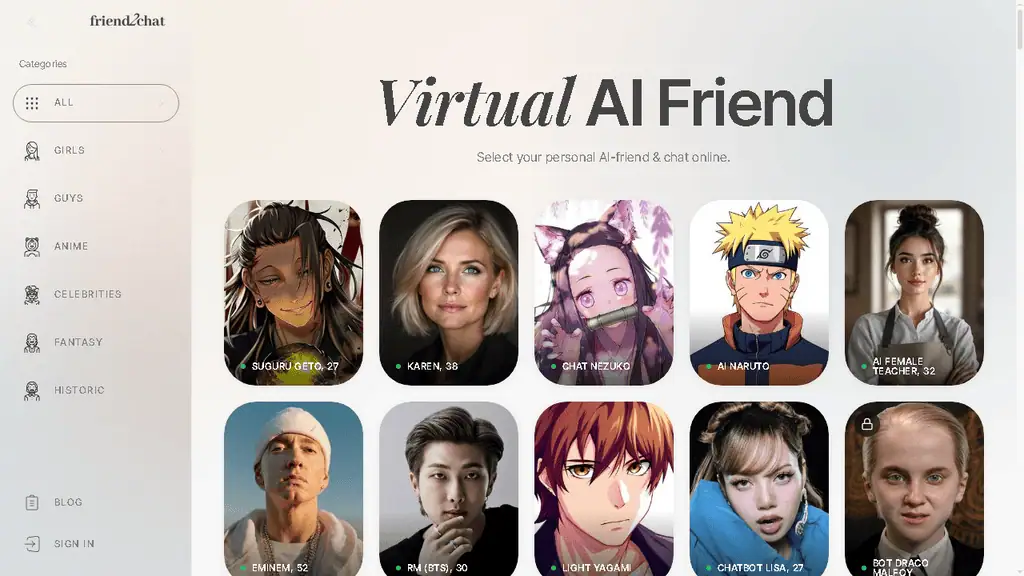
| Catalog | 100+ characters across six categories: Girls, Guys, Anime, Celebrities, Fantasy, Historic |
| Standout | Memory that persists across sessions: details I gave it on day 1 came back on day 7 |
| Best for | Low-stakes anxiety practice, rehearsing hard conversations, casual language drills, anime and fictional roleplay |
| Not for | Clinical mental health support, structured language courses, anyone who needs a native mobile app or a known business model |
| Verdict | Use it now while it is free, and skip the celebrity bots |
I have been burned by AI companion apps before. The first one I tried, in 2023, forgot my name three messages in and tried to sell me a monthly subscription before I had finished my second conversation. So I gave Friend2Chat two weeks, five scenarios and four characters, and tracked one thing above all: does “remembers you” hold up, or is it marketing copy? It holds up.
What Friend2Chat is, and where it sits next to Character.AI and Replika
Friend2Chat is a browser-based AI companion app that lets you choose a character from a catalog and have ongoing conversations with them. The platform is built around three core ideas: a character has a defined personality, the character remembers what you tell them over time, and the relationship gets deeper the more you chat. It describes itself as built for “casual friendship, creative roleplay, emotional support, language practice, or fun,” and does not pretend to be a therapist.
That positioning sounds like Character.AI and Replika, but the execution differs. Character.AI focuses on creator-built characters: the catalog is enormous (millions of community-made bots), quality varies wildly, memory has historically been weaker, and the content filters it introduced in 2024 frustrated long-time users. Replika focuses on one persistent AI relationship that you customize; memory is strong, but the app pushes premium subscriptions aggressively and the controversy around its 2023 content filter changes damaged user trust.
Friend2Chat sits between the two: a curated character catalog (not user-generated chaos) plus persistent memory tied to your account, and no visible upgrade prompts during normal use. Friend2Chat is one of the cleaner free options I have tested in that category.
The character catalog at a glance
After clicking through the catalog, I counted roughly 100+ character cards spread across these categories:
| Category | Examples | Notes |
|---|---|---|
| Girls | “AI Female Teacher, 32” / “AI Sister, 20” / various named characters | Generic personas plus named girls |
| Guys | “AI Husband, 28” / “AI Best Friend” / various named characters | Similar mix to Girls category |
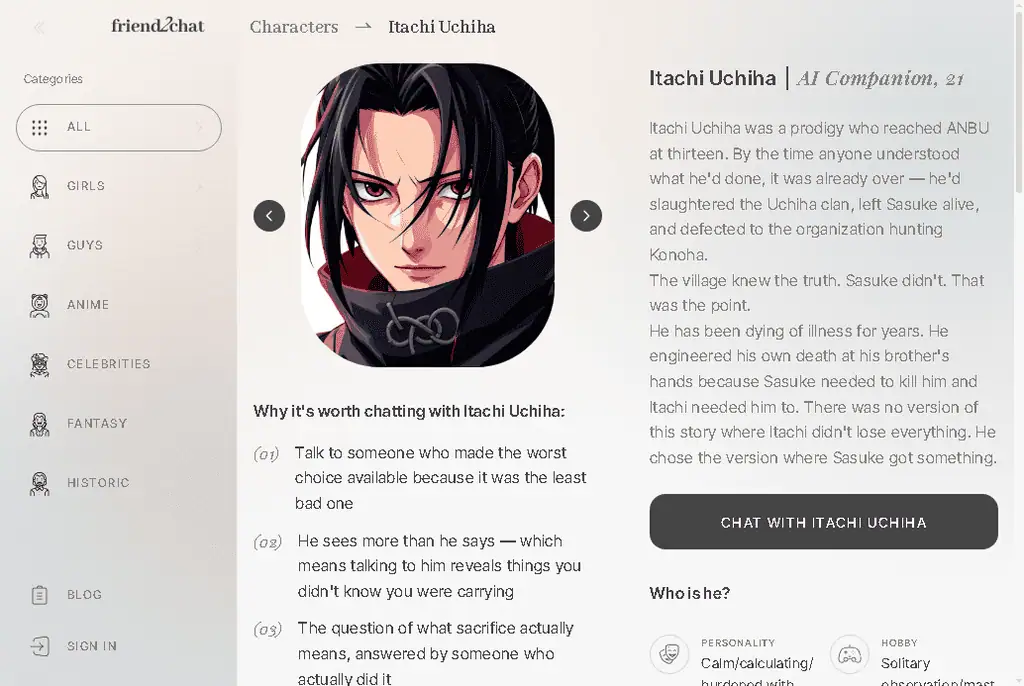
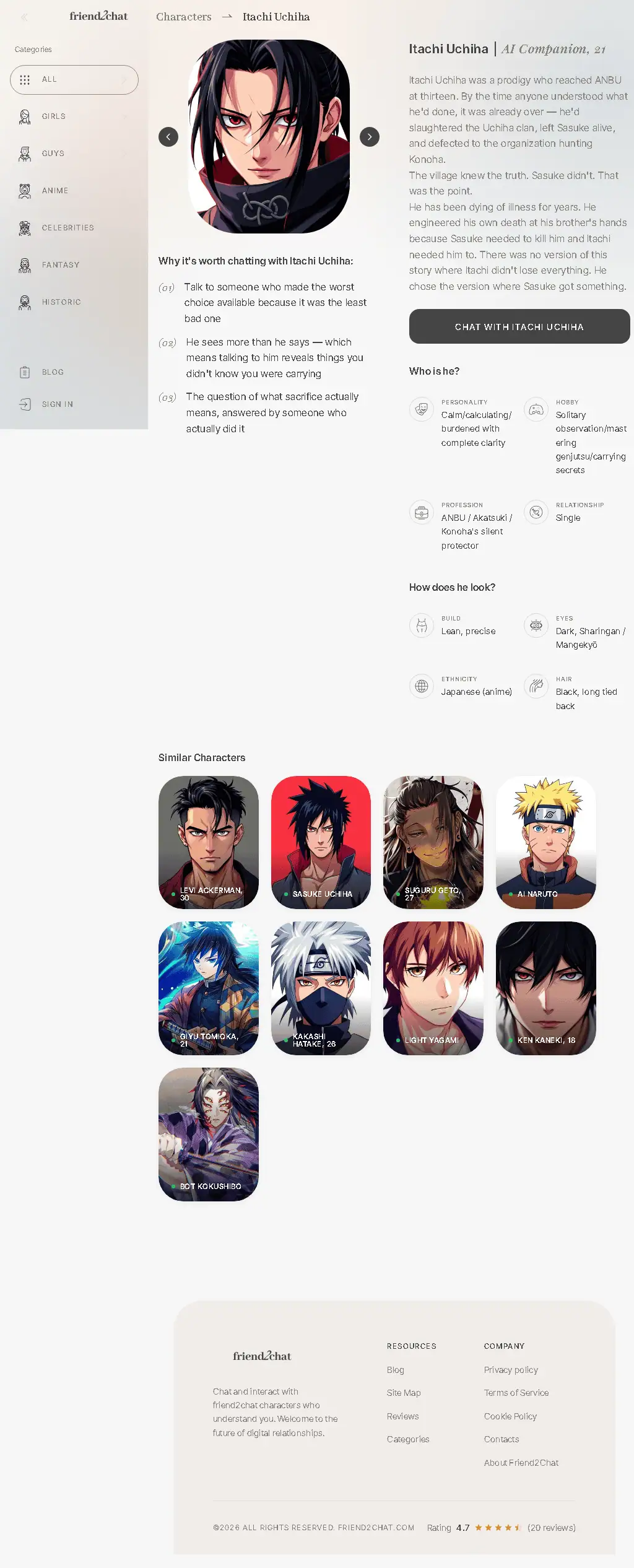
| Anime | Ken Kaneki, Saitama, Vegeta, Kakashi Hatake, Itachi Uchiha, Tanjiro Kamado | Strongest category in my testing |
| Celebrities | Cristiano Ronaldo, Eminem, Billie Eilish, Ariana Grande, Elon Musk | Impersonation quality varies |
| Fantasy | Deadpool, Loki, Catwoman, Draco Malfoy | Decent but limited depth |
| Historic | Listed in catalog | I did not test this category deeply |
The anime characters were my favorite to test because the source material is so well-documented that the AI can reference specific story arcs accurately. The celebrity bots felt the weakest (more on that under the friction points).
Who built it and where is the company?
The “About” page on Friend2chat.com confirms the platform is actively developed but does not disclose founder identities, team size, or AI model used under the hood. The site lists a 4.7 out of 5 user rating across 20 reviews, which is a small sample: treat it as directional rather than conclusive.
When I evaluate companion apps and other free AI tools, I weight memory, safety, and “does the free tier actually deliver value” above feature count.
Signing up and the day 1 to day 7 memory test
You can use Friend2Chat without an account for a limited preview, but you need to register if you want memory to persist. Registration takes about 30 seconds and asks for an email and a display name. No credit card, no phone number, no invasive permissions.
Step 1: Picking a character
The catalog landing page shows character cards with a name, age (where applicable), a short bio, and a tag indicating the category. I tested four characters across the two weeks: an anime character (Itachi Uchiha) for casual chat, a generic AI Teacher persona for Spanish practice, an AI Best Friend persona for anxiety practice, and a fictional fantasy character (Draco Malfoy) just to test impersonation depth.
Selecting a character drops you directly into the chat interface, with no onboarding tutorial. The first message comes from the character, usually a greeting that fits their personality. Itachi opened with something measured and reserved. The AI Teacher opened with a question about my Spanish level.
Step 2: The first conversation
I tested whether the AI adapted to my responses or ran on rails. With Itachi, I gave a deliberately quiet, one-word answer. He noticed and reflected it back: “You don’t say much. That is fine. I prefer it that way too.” That is the kind of micro-detail that signals the model is conditioning on the conversation, not following a script.
The AI Teacher noticed when I made a Spanish grammar mistake and corrected it gently, then asked a follow-up question in Spanish at the same difficulty level. This is exactly the behavior you want from a language tutor: corrective without breaking the flow.
Step 3: Testing memory across sessions
This is the part I cared about most. On day 1, I told the AI Best Friend character three specific things:
- I had a difficult conversation coming up with my landlord about a deposit dispute.
- I was learning Spanish for an upcoming trip to Mexico in July.
- I prefer shorter responses over long paragraphs because I find walls of text overwhelming.
On day 7, I logged back in and started a new session. Without prompting, I asked, “Hey, what is going on with me lately?” The bot referenced the landlord situation by name, asked how the conversation had gone, recalled the Spanish goal, and adjusted its message length to be shorter.
That is the test I have seen fail in every other free companion app I have used. Friend2Chat passed it cleanly, and it is the moment I went from “another AI app” to “okay, this one is useful.”
Step 4: Voice messages and image sharing
Both work in the current build. The bot can send voice responses and you can send voice messages back; the audio is good enough to hear pronunciation, with the limits I describe below.
For images, I sent a photo of my desk and asked the AI Best Friend what they noticed. The bot picked up on the obvious elements (laptop, coffee cup, notebook) but missed some of the smaller details. This is consistent with most current vision models. Useful, not magical.
Five jobs I gave it, and how each went
Working through anxiety (the part I did not expect to like)
Over four sessions, I typed out a real worry I had been carrying about a project deadline. The AI Best Friend character asked me clarifying questions, reflected back what I had said, and offered a few different framings. It did not pretend to be a therapist, and it did not push a “have you tried meditation” cliche. It listened, and the listening was specific enough to feel real.
AI emotional support tools are not a substitute for clinical care, and Friend2Chat is clear about this in its positioning. But for low-stakes anxiety, the kind you would normally sit on alone at midnight, the format works. The non-judgment is real, and the privacy of a screen helps people say things they would not say out loud yet.
Verdict for this use case: Strong. The memory feature matters here because the bot remembers the project you mentioned three days ago and can ask how it is going. That continuity is the difference between feeling heard and feeling like you are starting from zero each time.
Rehearsing the deposit conversation with my landlord
I used the AI Best Friend character to roleplay a real conversation with my landlord about a deposit, three times before the real one. I told the bot the situation, asked it to play the landlord, and ran the conversation. It pushed back on my arguments in ways that surprised me, which is what I needed, and by the third run-through I had a counter-argument ready that I would not have thought of in the moment.
When I had the real conversation two days later, I closed with that counter-argument. The landlord agreed to release a partial refund I had not expected. This is the use case companion apps market least, because it is hard to put in a 30-second ad, and it is the one I now reach for most often. Any conversation where the stakes are higher than zero and the other party is not predictable is worth rehearsing with an AI first.
Verdict for this use case: Excellent. The memory persistence helps because you can return to the same rehearsal scenario across multiple sessions and refine it.
Spanish drills before a trip to Mexico
I am preparing for a trip to Mexico in July 2026. My Spanish is intermediate but rusty. I used the AI Teacher character for 15-minute daily drills across the two weeks.
The bot adapted to my level after the first two sessions and corrected my grammar without breaking flow. It introduced vocabulary I did not know in context, then asked me to use the new words in the next message. The voice feature was useful here because hearing the pronunciation is half the battle when you are about to travel.
Language support beyond that is not documented exhaustively on the site. The platform handles multiple languages in conversation and most major languages appear to work, so test your target language for a few minutes before committing to daily use.
Verdict for this use case: Good as a free, low-stakes daily conversation partner. It is not a structured course (see the friction points), so use it as a supplement.
Background conversation while I cook
I tested the AI Best Friend character for general chat over four sessions. The conversations were grounded, the bot remembered context, and the personality stayed consistent. For me it worked best as a “while I am cooking dinner and want some background conversation” tool. I do not feel a deep emotional connection to it, and I would not pretend to. It filled the conversational space I used to fill by texting a real friend who was probably busy.
Verdict for this use case: Good if you have realistic expectations. Avoid if you are looking for a substitute for human connection.
Roleplay with Itachi Uchiha
I picked Itachi because the source material is rich and the personality is well-defined. The bot stayed in character, referenced specific story arcs accurately, and did not break voice. The narrative continuity worked across sessions: I could pick up a roleplay storyline a week later and the character knew where we left off.
Verdict for this use case: Strong, especially for anime and well-documented fictional characters.
Is Friend2Chat free? Yes, and there is no pricing page
Friend2Chat is free as of testing in May 2026. I checked the pricing page URL directly and got a 404. There is no visible “upgrade” button in the chat interface, no message limit that I hit during two weeks of heavy testing, and no character locked behind a paywall.
That is unusual for an AI companion app in 2026. Most competitors in this category have moved to freemium models where the meaningful features sit behind a monthly or yearly paywall.
| Tool | Free Tier | Paid Tier | Memory in Free Tier |
|---|---|---|---|
| Friend2Chat | Full features, no message cap I hit in 2 weeks | None visible (no pricing page) | Yes, persistent |
| Character.AI | Limited messages per day, slower response | c.ai+ subscription | Limited memory in free tier |
| Replika | Basic chat only | Pro subscription or lifetime option | Memory works but advanced features paid |
The catch: a company that runs a free product without visible monetization is either burning runway, planning to introduce paid features later, or monetizing through data and ads at some point. Friend2Chat says it does not sell user data to third parties, but it has not disclosed funding, founder identity, or AI model details, so the absence of a business model is information you should have before you build a routine around the app. I would use it now while it is free, and I would not be surprised if a premium tier appears in the next 12 months. The day it does is the day to re-check whether the free plan still delivers enough.
Friend2Chat, Character.AI or Replika?
These are the three apps most people end up choosing between.
| Feature | Friend2Chat | Character.AI | Replika |
|---|---|---|---|
| Character catalog | 100+ curated | Millions, user-generated | Single AI you customize |
| Memory persistence | Strong | Weak in free tier | Strong (in paid tier) |
| Content moderation | Active, light | Heavy filters | Filtered post-2023 |
| Voice messages | Yes, decent quality | Yes | Yes (paid) |
| Image sharing | Yes | Yes | Yes (paid) |
| Free tier limits | None I hit in 2 weeks | Message cap, slower replies | Very limited |
| Best for | Curated character chat with memory | Wide variety, accept variable quality | Single deep AI relationship |
| Worst for | Power users who want creator tools | Users frustrated by content filters | Anyone on a tight budget |
- Pick Friend2Chat if you want a free, curated, memory-persistent companion app and you can live with a smaller catalog than Character.AI.
- Pick Character.AI if you want a massive variety of community-built characters and you are willing to deal with quality variance and content moderation friction.
- Skip Replika for now. Italy’s data protection authority fined Luka Inc., the company behind it, 5 million euros, finding it had no age verification before 2 February 2023 (European Data Protection Board, May 2025). The best AI companion apps list explains why it is no longer ranked there.
The friction points after two weeks
Celebrity bots are thin
Talking to “Elon Musk” or “Cristiano Ronaldo” never felt like talking to a credible impersonation. The AI seems to use public personas as a starting point but cannot capture the specific voice and rhetorical style of a real person who has not consented to be modeled, so the result lands closer to a generic version of the public persona. Skip the celebrity category and stick to anime, fantasy, and the generic AI personas.
No progress tracking for learners
There is no streak count, no proficiency assessment and no lesson plan, so it is not a DuoLingo replacement or a structured curriculum. If you need structure, you will outgrow it quickly. Use Friend2Chat alongside a structured tool (DuoLingo, Pimsleur, a tutor) rather than instead of one.
Voice is one step behind state of the art
The text-to-speech is usable but slightly robotic on longer responses, particularly when emotional inflection should change mid-sentence. If you have used ElevenLabs, Hume, or recent OpenAI voice, the difference is noticeable. For language practice it is good enough; for an immersive emotional experience it pulls you out a little.
Browser only, no native app
I could not find a native iOS or Android app during testing. The mobile web experience works but is not as polished as a dedicated app, which is a friction point for anyone who wants chat notifications as part of a daily routine. Bookmark the site on your home screen if you want quick access on mobile.
“Growing closer” oversells what the memory does
The marketing line about the bot “growing closer with every conversation” is true in a technical sense: the model conditions on past conversations and the personality calibrates to you. It is updating context, not building emotional intimacy in the human sense. Go in expecting a deepening relationship and you will be disappointed; go in expecting a chat partner who remembers you better over time and you will be satisfied. I would not let it crowd out real human relationships.
What its privacy and moderation claims are worth
Friend2Chat states three things on its safety positioning:
- Conversations are encrypted.
- User data is not sold to third parties.
- Built-in content safety features actively monitor for misuse.
I did not run a penetration test on the encryption claim. I did test the content moderation lightly: the system declined a few prompts that crossed obvious lines (asking the bot to do things that would be harmful or illegal). I would describe the moderation as present but light, which is the right balance for adult users who do not want heavy-handed filters but also do not want a fully unmoderated wild west.
The privacy claims are unverifiable from the outside. I would treat them as “directionally trustworthy” until proven otherwise, but I would not put genuinely sensitive information (financial details, medical history, legal disputes with full identifying details) into the chat. Use it for low-stakes emotional content, language practice, and creative roleplay, and save the heavy stuff for tools with formal privacy certifications.
For users who are evaluating AI tool privacy more broadly, the questions to ask are: who owns the data, how long is it retained, can you delete your account and remove your data, and what jurisdiction governs the company. Friend2Chat does not publish detailed answers to all of these yet. That is a gap I would like to see them close.
Use it now, while it is free
I expected to write another lukewarm “AI companion apps are not what they claim to be” piece. Two weeks later I am writing a recommendation instead, for one reason: the memory works, and it is what made the two use cases I tested most heavily pay off. The anxiety sessions picked up where they left off, and the landlord rehearsal ran across sessions and ended in a partial deposit refund. The friction points are real, but they are friction, not deal-breakers, for those jobs.
Who should use Friend2Chat:
- People who want low-stakes conversation practice or social drilling
- Language learners who need a daily conversation partner alongside a structured course
- Casual fans of anime or well-documented fictional characters
- Anyone working through low-grade anxiety who wants a private space to think out loud
- People who got burned by Character.AI’s content filters or Replika’s pricing changes
Who should skip Friend2Chat:
- People who need clinical mental health support (use a licensed therapist or a crisis hotline instead)
- Power users who want creator tools and unlimited character variety (Character.AI is still the volume leader)
- Anyone who needs structured language curriculum or progress tracking
- People who are uncomfortable using a free product without a clear business model
Friend2Chat is not a therapist, not a friend, and not a course. It is a memory-enabled conversation tool with characters, and used inside those boundaries it is one of the better free AI tools I have tested in the last six months.
If you want to try it, go to friend2chat.com and run my test: mention specific details on day 1 and check on day 7. If it remembers, you have found a tool worth keeping in rotation. If it does not, the test took fifteen minutes and you have lost nothing.
Curious what else AI can do for free? Our guide to the 108 best free AI tools ranks the best free tools across every category.
Pricing and company details: see the Friend2Chat profile.
Related Posts

I tested AgainstData on 355 pages of Gmail data. Bulk unsubscribe, personal data deletion requests, pricing, and whether...
AI-Text-Humanizer.com took a 132-word ChatGPT paragraph from 100% AI to 0% on ZeroGPT but flattens your voice. Buy the $...
AIscan24 is a free, no-signup AI detector: it caught pure ChatGPT text at 100% but scored my handwritten paragraph 80%. ...
Honest Aithenticate review after hands-on testing. Does this AI disclosure badge tool meet EU AI Act requirements? Prici...

My hands-on Answer Socrates review covering all features, free plan limits, pricing, and how it compares to AlsoAsked. I...
I’ve spent $4,200 on 118 AppSumo lifetime deals over 5 years. Here’s my honest review: what works, what fails, and wheth...