

Sponsored: Similia commissioned and paid for this homeopathy repertory software comparison, and the Similia link below is a sponsored placement. The payment did not buy a verdict, no outcome was promised, and the sponsor could request factual corrections only. Written by Alston Antony, Founder and Lead Reviewer at ZPlatform.
The hard part of homeopathy repertory software is finding the rubric when your words are not the book’s. Similia is a browser-based repertory and materia medica platform for homeopaths and students, and its selling point is AI semantic search, which is meant to find a rubric from everyday wording.
The Free plan includes eight classical repertories, 21 classic materia medica books and three new cases a month. Pro adds an AI toolkit, unlimited cases and analyses, and premium repertories such as Murphy and Complete. OOREP is a free, open-source online repertory, which makes it the natural comparison for the free tier.
I gave both tools the same five phrases against Kent’s Repertory. Similia’s semantic search put the rubric that a Kent-style search finds in its first seven rows every time. Typed as written, Similia’s Keyword mode found the target rubric on none of the five phrases and OOREP found it on one. With Kent-style wording both returned the same rubrics with identical remedy counts, so on known wording the differences are workflow, account and price.
Results of the five queries
| Query typed | Similia, Semantic | Similia, Keyword, as typed | OOREP, as typed | Kent-style wording, both tools |
|---|---|---|---|---|
| anxiety before an exam | 92 rubrics, “anticipating an engagement” 7th | 0 rubrics | 0 rubrics | “anxiety anticipating”: 1 rubric in each |
| fear of the dark | 94 rubrics, “MIND - FEAR - dark” 1st | 1 rubric, “walking,of - in the dark” | 0 rubrics | “fear dark”: 2 rubrics in each |
| headache worse in the sun | 82 rubrics, “HEAD - PAIN - sun,from exposure to” 1st | 0 rubrics | 0 rubrics | “head pain sun”: 17 in Similia, 14 in OOREP |
| craving cold drinks | 81 rubrics, “STOMACH - DESIRES - cold drinks” 1st | 0 rubrics | 0 rubrics | “desires cold drinks”: 1 rubric in each |
| mind fear thunderstorm | 81 rubrics, “MIND - FEAR - thunder storm,of” 1st | 0 rubrics | 1 rubric | “fear thunder storm”: 1 rubric in Similia |
Three things stand out:
- Semantic mode returned the rubric in rows 1 to 7 on all five queries, and in row 1 on four of them.
- Typed as written, Similia’s Keyword mode returned nothing on four queries and OOREP returned nothing on four. OOREP’s one hit was the thunderstorm rubric. Similia’s one Keyword hit, on “fear of the dark”, was the one-remedy rubric “MIND - FEAR - walking,of - in the dark”, and the 22-remedy “MIND - FEAR - dark” rubric did not appear.
- With Kent-style wording, each tool returned the target rubric on every query.
What the semantic rows looked like
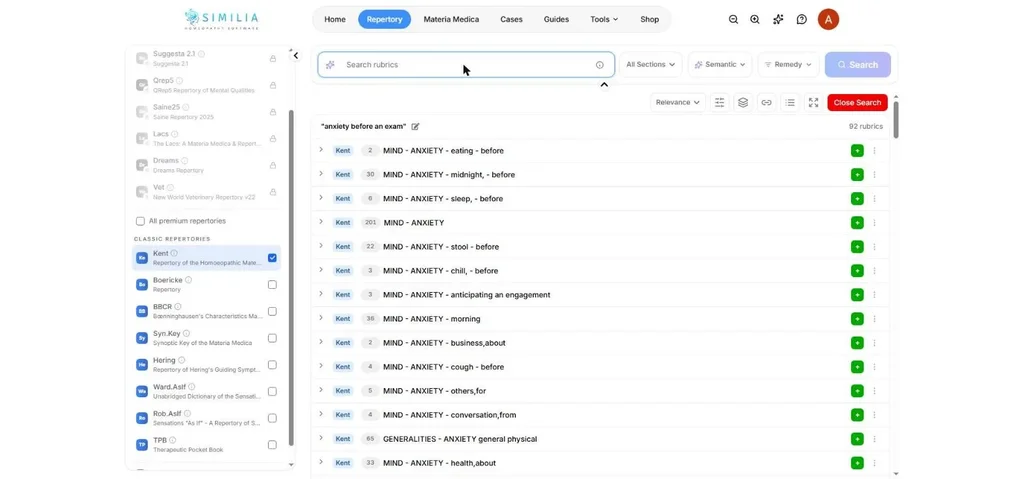
For “anxiety before an exam”, rows one to six were “MIND - ANXIETY - eating - before”, “midnight, - before”, “sleep, - before”, the parent “MIND - ANXIETY” (201 remedies), “stool - before” and “chill, - before”. “MIND - ANXIETY - anticipating an engagement” (3 remedies) was seventh. A practitioner has to read down the list to reach the rubric about an anticipated event.
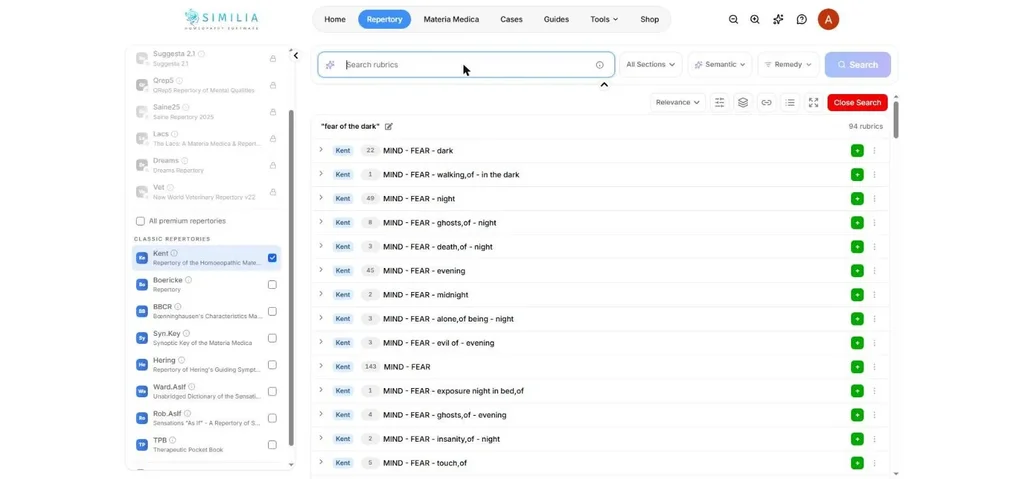
For “fear of the dark”, “MIND - FEAR - dark” (22 remedies) was first of 94, followed by “walking,of - in the dark” (1 remedy) and “night” (49 remedies).
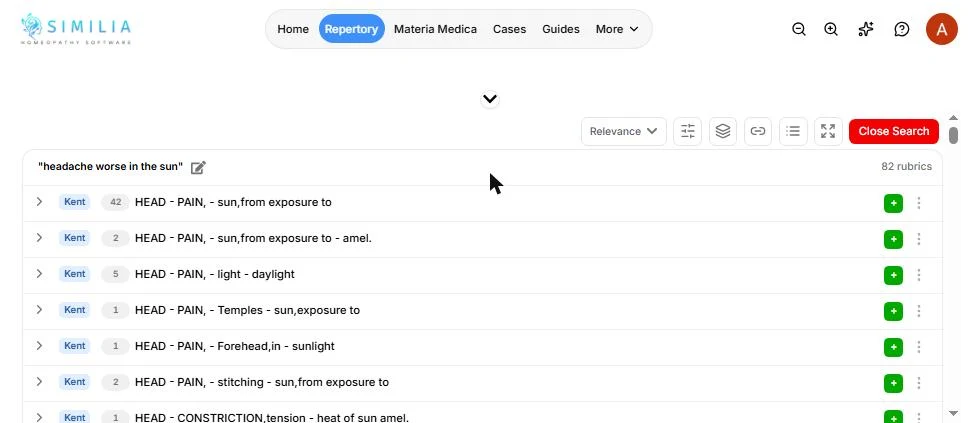
For “headache worse in the sun”, “HEAD - PAIN - sun,from exposure to” (42 remedies) was first of 82. The second row, “sun,from exposure to - amel.” (2 remedies), runs in the opposite direction to the phrase, so the modality needs checking before a rubric is chosen.
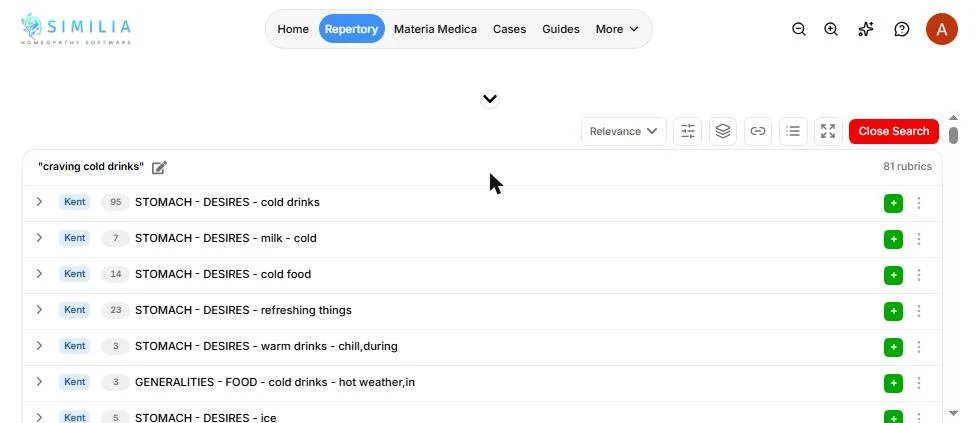
For “craving cold drinks”, “STOMACH - DESIRES - cold drinks” (95 remedies) was first of 81. The first eleven rows also held “STOMACH - DESIRES - warm drinks” (23) and “COUGH - COLD, - drinks” (26).
For “mind fear thunderstorm”, “MIND - FEAR - thunder storm,of” (11 remedies) was first of 81, followed by “MIND - THUNDER storm, - during” (11).
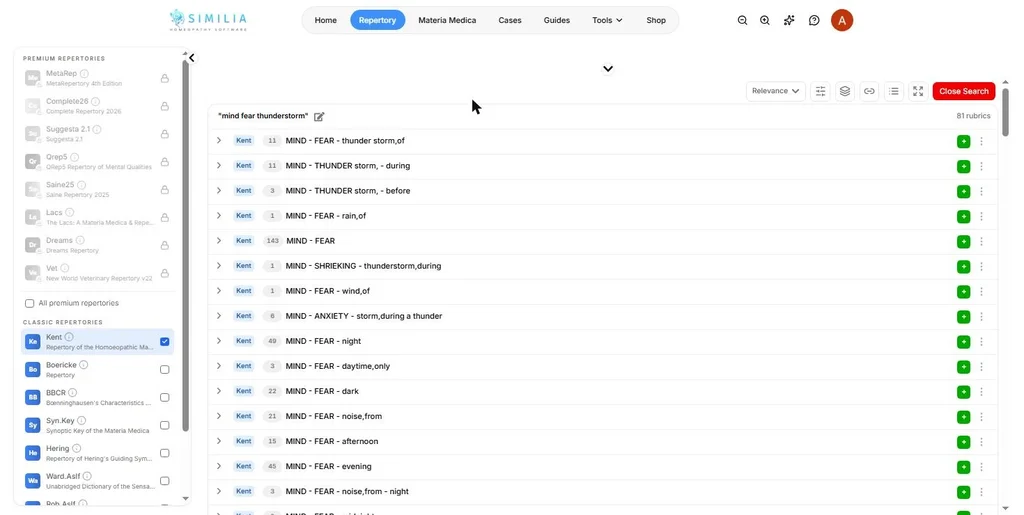
Repeating each query a second time gave the same rubric count and the same first eleven rows in the same order.
Searching with Kent’s own wording
OOREP’s message for “fear of the dark” suggests the wildcard form “fear, of, the, dark“.
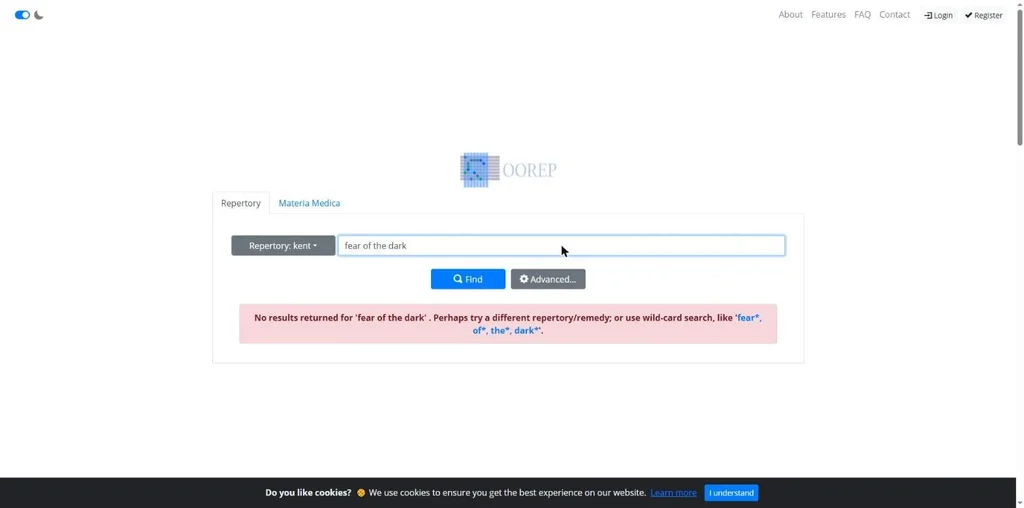
Without the filler words, “fear dark” returned two rubrics, “Mind, fear, dark” and “Mind, fear, walking, in the dark”, each with its remedy list on the same row.
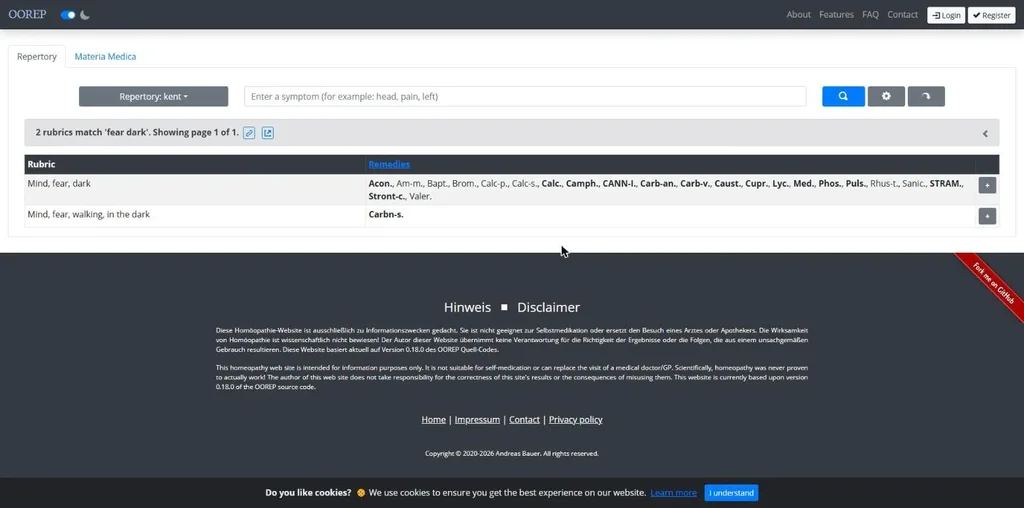
Kent files a headache from the sun under “Head, pain”, so “headache worse in the sun” returned nothing while “head pain sun” returned 14 rubrics.
“desires cold drinks” returned the single rubric “Stomach, desires, cold drinks”.
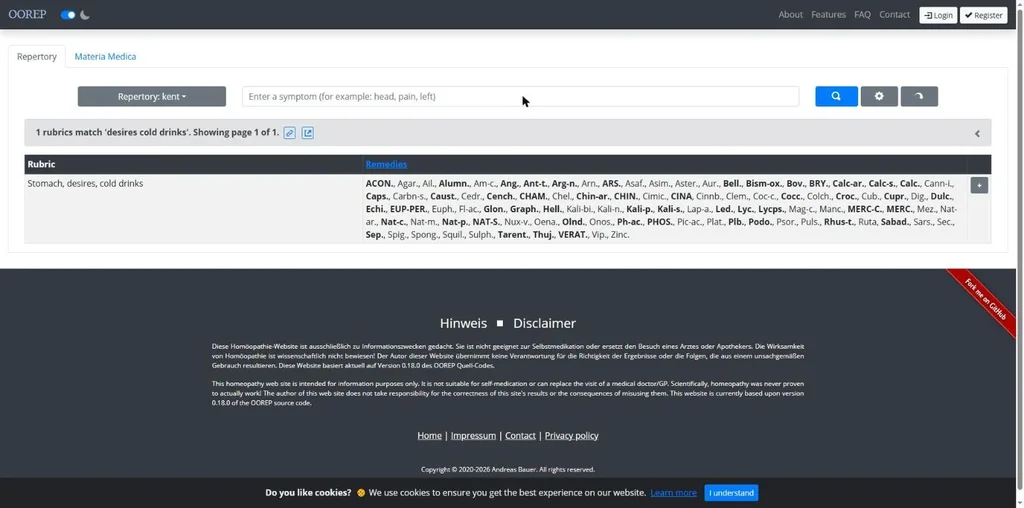
Similia’s Keyword mode, given the same Kent-style wording, returned the same target rubrics. Two differences showed up:
- Spelling: typed as “mind fear thunderstorm”, OOREP returned its rubric “Mind, fear, thunderstorm, of”. Similia’s Kent text spells the rubric “thunder storm”, and its Keyword mode returned nothing until the phrase was typed that way.
- Match count: “head pain sun” gave 17 rubrics in Similia and 14 in OOREP. Similia’s list included rows with “sunlight”, such as “Forehead,in - sunlight”, which OOREP’s list did not. I did not test why.
I compared remedy counts for six rubrics that both tools returned. The counts matched on all six: 3 for “anticipating an engagement”, 22 for “fear, dark”, 1 for “walking, in the dark”, 42 for “sun, from exposure to”, 95 for “desires, cold drinks” and 11 for “fear, thunderstorm”.
For five of those I expanded Similia’s row and compared the remedy names with OOREP’s list, ignoring letter case. The lists were identical for “anticipating an engagement”, “fear, dark” and “fear, thunderstorm”. The two longer lists had the same number of remedies but different abbreviations in a few slots. For “sun, from exposure to” the pairs were Casta-v. and castn-v., Chin-s. and chinin-s., Nat-ar. and nat-act. For “desires, cold drinks” they were Bism-ox. and Bism., Chin-ar. and Chinin-ar., Lycps. and Lycps-v., and Nat-ar. and nat-act. I did not check whether each pair is the same remedy under two spellings, and Nat-ar. against nat-act. is the one I would want a practitioner to verify.
A search that finds nothing behaves differently in each tool. On all five failed OOREP searches, the red “No results returned” message appeared above the previous search’s rubric table, which stayed on screen.
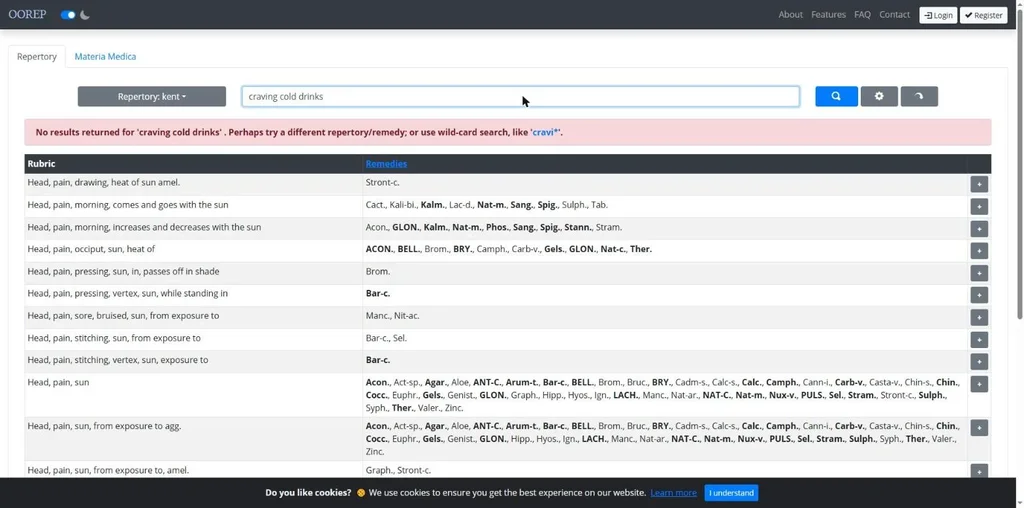
Similia’s Keyword mode replaced the list with “0 rubrics, No rubrics found”. A bare “exam” search returned no Kent rubrics in either tool (“exam*” in OOREP, “exam” in Similia Keyword mode). That covers those two searches only.
From search to remedy list: the workflow in each tool
| Step | Similia | OOREP |
|---|---|---|
| Access | Account needed. I used a Free-plan session | Public site, no login needed to search |
| Choosing the book | Repertory menu, Kent selected | Dropdown that defaults to “publicum”. I switched to “kent - Kent’s Repertory” |
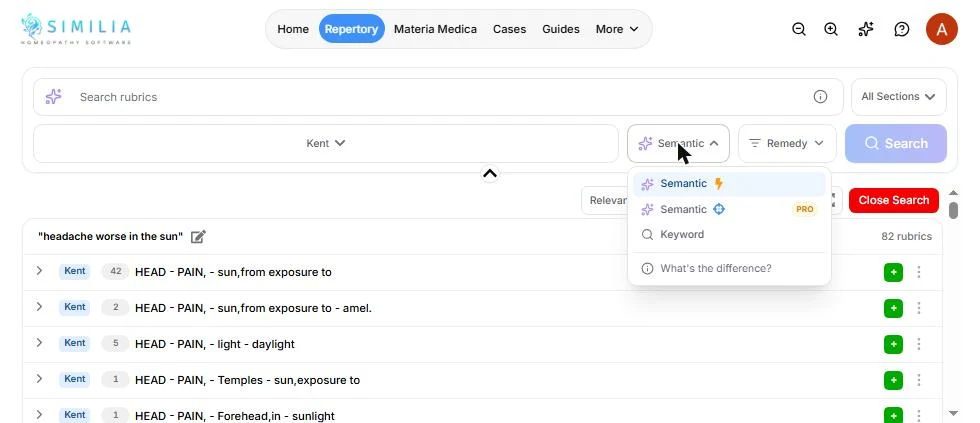
| Search modes | Semantic, a second Semantic option marked Pro, and Keyword | One keyword search, plus an “Advanced…” button I did not open |
| Result row | Remedy count and chapter path. The remedy list appears after expanding the row | Rubric in Kent’s comma form, with the remedy list on the row |
| Grades | Remedy names styled in bold red capitals, blue italics or plain. I did not check Similia’s key | Capitals or bold in the list. The repertorisation grid prints the grade numbers |
| Next step | A green + on every row, labelled “Start a repertorization with this rubric”. I did not press it, because the Free plan caps new cases at three a month | A + adds the rubric to a Case panel with weights, Merge rubrics and Repertorise |
The mode menu in Similia’s search bar looks like this:
Expanded, Similia’s row for “MIND - FEAR - thunder storm,of” listed 11 remedies: bry., gels., hep., lach., Nat-c., Nat-m., Nit-ac., PHOS., Rhod., Sep. and sulph.
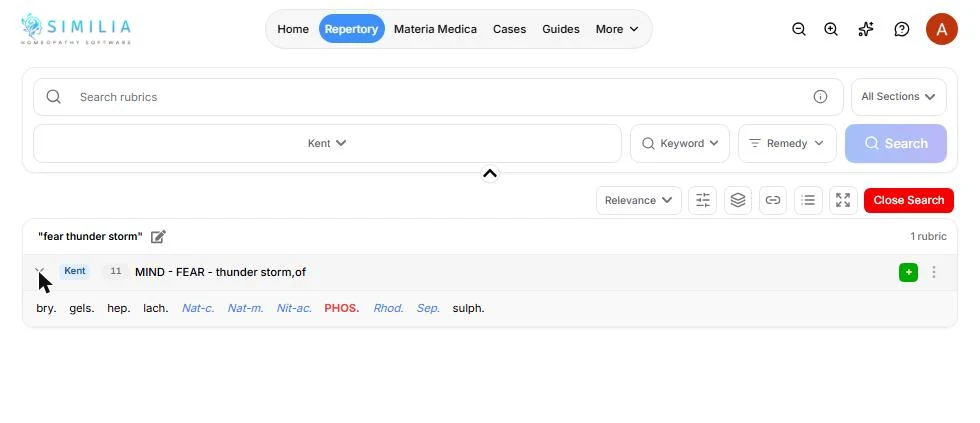
OOREP printed the same 11 on its row. Its repertorisation grid for that one rubric gave PHOS. grade 3, five remedies grade 2 (Nat-m., Nat-c., Nit-ac., Sep., Rhod.) and five grade 1. Similia’s styling singles out the same six remedies.
What each tool costs
Prices are Similia’s own, in euros per month on the monthly term, read on October 30, 2026.
| Plan | Price | What it adds |
|---|---|---|
| Similia Free | EUR 0, no card | 8 classical repertories, 21 classic materia medica books, semantic search, 3 new cases and 3 analyses a month |
| Similia Pro Base | EUR 16.99 | Free plus the AI toolkit (photo and notes analysis), unlimited cases and analyses, interactive periodic table, premium materia medica search, Jan Scholten’s series, offline mode (beta) |
| Pro with Murphy, Complete or Suggesta 2.1 | EUR 24.99 | Pro Base plus that edition’s repertory |
| Pro with Saine | EUR 22.49 | Pro Base plus the Saine repertory |
| Extra premium repertory | +EUR 16.99 (Saine +EUR 14.99) | Added to the same subscription. Complete with Murphy comes to EUR 41.98 |
| OOREP | No charge | Kent, Boger, Hering and other repertories in its menu |
Every Pro plan lists a 14-day free trial for eligible subscribers, and offline mode is excluded from it. Similia’s public pages do not define who is eligible, so confirm at checkout.
Pro lists “unlimited cases and analyses”. The AI toolkit (Notes-to-Rubric, AI case analysis, live transcription and photo analysis) is metered separately by AI credits, and the subscription’s monthly allowance is not stated on the pages I read.
Lifetime Pro is Pro Base paid for good: EUR 1,699 once, or 12 monthly payments of EUR 169, which comes to EUR 2,028 in total. It has no free trial and a 14-day refund. It includes 1,000 AI credits once and no monthly allowance, and premium repertories are sold separately.
Two figures on Similia’s own pages do not agree. The homepage and the free-software page count 15 repertories, and the Kent page says “14 repertories across Free + Pro”. The pricing page names eight free and four premium repertories, which I could not reconcile with either count. The homepage also shows the Saine edition at EUR 22.48 against EUR 22.49 on the pricing page. Dollar figures elsewhere on the site, such as USD 29.99 on the Kent page, appear to be the same plans in another currency, so I treat them as a currency difference and not a conflict.
How the tests were run
- Dates and setup: all five queries ran in both tools on October 30, 2026, in Chrome 157 on Windows. Queries 1 and 2 had also been run on October 28 with identical results.
- Book: Kent’s Repertory only. Similia’s repertory list names it “Repertory of the Homoeopathic Materia Medica, 6th Edition”. OOREP is version 0.18.0, as printed in its footer, with “kent - Kent’s Repertory” selected.
- Similia: a signed-in Free-plan session. Semantic means the first of its two Semantic options.
- Queries: five fictional phrases typed as written, then Kent-style wording.
- Retries: on October 28 the Similia app stopped responding after the second query, so queries 3 to 5 were left. On October 30 I reopened it in a fresh tab and all three ran on the first attempt. I did not record the browser version for the October 28 session and make no claim about the cause.
- Not tested: the Semantic option marked Pro, Pro premium repertories, the AI case analysis tools, materia medica search, case saving in either tool (OOREP shows Login and Register links), offline mode, phone use, and desktop programs such as RadarOpus or Complete Dynamics.
This is a software comparison. It makes no clinical claims, recommends no remedy and is not a self-treatment guide. Similia’s FAQ says semantic search sends the entered query for embedding and that its AI features need AI processing consent, so read each vendor’s privacy policy before entering real case data.
Which tool suits which task
| Task | What the tests showed |
|---|---|
| Finding a rubric from everyday wording | Similia’s Semantic mode returned the target in rows 1 to 7 on all five queries. Keyword search found it on none of five in Similia and one of five in OOREP |
| Looking up a rubric in Kent’s wording | Both returned the same rubrics and remedy counts. OOREP needs no account and prints remedy lists on the row. Similia needs an account and shows a count until a row is expanded |
| Searching with a spelling variant | OOREP matched “thunderstorm” as typed. Similia’s Kent text says “thunder storm” |
| A search that finds nothing | OOREP leaves the previous table under its error. Similia’s Keyword mode shows “No rubrics found” |
Semantic search answers the problem the five phrases posed: everyday wording that Kent’s text does not use. For wording you already know, the two tools gave the same Kent rubrics and remedy counts, with remedy names that matched apart from a few abbreviations, so the choice comes down to the account, the price and what you do after the lookup. This is not an overall ranking.
For who runs ZPlatform and how it tests tools, see the about page. More side-by-side tests sit in the alternatives hub, and single-tool write-ups are in the AI reviews section.
Related Posts

Six AppSumo alternatives I’ve bought lifetime deals from, this site included, with refund windows, AI share, and what ha...
Character AI alternatives by job: Kindroid for a companion, Pi for free chat, NovelAI for stories, LM Studio offline. Pr...

I still pay for ChatGPT Plus, so each alternative here takes one job it does worse: writing, cited research, cheap API c...

I pay for Claude Pro. These six alternatives cover its gaps: the Claude Code bill, images, cited research, price, EU res...

What you lose leaving Microsoft Copilot, then the swaps: Gemini for the office suite, ChatGPT and Claude on quality, Per...

Whether it’s China hosting, coding quality, missing image tools, or self-hosting, these are the five DeepSeek alternativ...