

I ran the same five business ideas through 16 different business name generators in May 2026 to see which ones produced names you would register a domain for. Namelix won on AI quality, Shopify’s free tool delivered the best output for zero dollars, and Squadhelp’s marketplace produced the only names worth paying real money for. Most of the rest are wrappers around a thesaurus.
Just named your freelance business? The next headache is quarterly taxes on that 1099 income. Our SnapTax review covers tax planning software built for freelancers, not accountants.
Why I tested 16 business name generators in one week
The week I helped my cousin launch his food delivery side project, we burned 11 hours arguing about the name. He had a notebook full of ideas.
I had a tab graveyard of 15 different “AI business name generators” promising the perfect brand in 60 seconds. By Thursday night, he gave up on the tools and just registered the third name I had typed out on a napkin Tuesday morning.
That experience pushed me to do what I always do when a tool category has too much noise: test every meaningful option with the same input and write down what works, the same way I run every hands-on tool review.
For context, I run zplatform.ai where I curate AI tool deals and write honest reviews after testing tools with my own money. I have reviewed over 500 SaaS tools, and AI naming tools have become one of the noisiest categories in 2026 because every domain registrar, logo maker, and AI startup wants you to start your branding on their site.
Here is what you need to know before I get into the 16 tools: most business name generators are free, most of them are wrappers around the same underlying word-combination logic, and the difference between a useful one and a useless one comes down to three things. First, whether the tool checks domain availability while you scan results.
Second, whether the AI behind it produces brandable names instead of dictionary mashups. Third, whether you can pay once for a premium name that is distinctive or whether you are stuck with the freemium output.
I tested all 16 generators between May 18 and May 22, 2026 using five identical prompts: an AI productivity SaaS, a vegan meal delivery service in Austin, a B2B accounting agency for ecommerce brands, a Sri Lankan travel blog, and a sustainable fashion marketplace. I scored each tool on output quality, domain integration, free tier limits, and how often I would buy a domain from the suggestions.
By the end of this guide, you will know which generator fits your specific situation, what to skip, and the exact decision framework I use when a client asks me to help name their business in under 30 minutes. Get my free AI tool deal alerts here if you want the same vetted recommendations weekly.
Quick picks: My top business name generators by use case
If you want the short version before the deep dive, here are the strongest options across the most common scenarios, and our step-by-step guides cover the how-to detail.
- Best overall AI business name generator: Namelix for brandable, distinctive names with logo previews
- Best free business name generator: Shopify Business Name Generator for unlimited use with zero signup
- Best for buying a premium name: Squadhelp / Atom.com marketplace with curated names from $1,000 to $50,000+
- Best for domain hunters: GoDaddy Business Name Generator tied directly into domain purchase
- Best for tech startups: Namify for tech-leaning, modern brand names
- Best for local businesses: NameSnack for industry-specific local naming
- Best for full brand identity: Tailor Brands for name plus logo plus business setup
- Best AI tool budget pick: Hostinger AI Business Name Generator for fast brainstorming with free domain checks
If your budget is zero and you just want to find a usable name in the next hour, jump to my detailed Shopify Business Name Generator section. If you have money to spend on a premium one-time domain, skip straight to Squadhelp.
How I tested every business name generator (my methodology)
Most “best business name generator” articles are clearly written by people who never used these tools. They list 30 generators with identical 50-word descriptions copied from the vendor’s homepage. I went the other direction.
Here is the exact process I ran for each of the 16 tools on this list.
First, I created a standard test brief that I would feed into every generator. The brief described five fictional businesses with different industries, audiences, and tones: a B2B AI productivity SaaS targeting solopreneurs, a vegan meal delivery startup in Austin Texas, an accounting agency serving Shopify and WooCommerce sellers, a Sri Lankan travel and culture blog, and a sustainable fashion ecommerce brand. Each brief included three to five seed keywords.
Second, I ran every tool with the same five prompts and recorded the first 10 results. I noted whether the names were genuinely brandable, whether domains were checked automatically, and how many premium upsells appeared between me and the actual results. I also tracked how much friction existed before getting a name: account signup, email gate, captcha walls, or paid plan blockers.
Third, I scored each tool on a five-point rubric: AI quality (are the names actually distinctive or are they just word combinations), domain integration (can I check availability inline), output quantity per session (do I get 5 names or 500), free tier usability (do I have to upgrade to do anything useful), and a “would I use this” verdict.
Fourth, I cross-referenced pricing with each tool’s official website on May 22, 2026. I did this because most third-party listings cite outdated prices from 2023 or 2024, and the pricing pages change quietly. Every dollar figure in this article was verified directly on the tool’s homepage or pricing page on the same week this guide was written.
Finally, I rejected any tool that did not produce at least three usable names from my five test prompts. That cut my original list of 34 down to the 16 tools you see here.
I also removed four tools mid-test that turned out to be defunct, offline, or no longer offering naming features (Zyro merged into Hostinger, Bust A Name is offline, Panabee’s domain was repurposed, and Anadea no longer offers a dedicated generator). The ones I cut were mostly thin wrappers around the same OpenAI or Anthropic API with no real product layer on top , the same models tracked by the best AI detectors.
The names I did not buy domains for after testing? Probably 90% of them.
Naming is hard. The job of a good generator is to give you starting points fast enough that you eventually find the one that sticks. That is the lens I used throughout this guide.
Quick Comparison Table
| Tool | Best For | Price | AI-Powered | Domain Check | Output Quality |
|---|---|---|---|---|---|
| Namelix | AI brandable names | Free | Yes | Yes | Excellent |
| Shopify | Free unlimited names | Free | Light AI | Yes | Strong |
| Looka | Name plus logo | Free generator, $20+ for logo | Yes | Yes | Good |
| Wix | Web builder integration | Free | Yes | Yes | Good |
| Squadhelp / Atom | Premium curated names | $1,000 to $50,000+ | Marketplace plus AI | Yes | Excellent |
| NameMesh | Domain variations | Free | No real AI | Yes | Decent |
| Hostinger AI | Quick brainstorming | Free | Yes | Yes | Strong |
| GoDaddy | Domain buyers | Free | Light AI | Yes | Decent |
| Brandroot | Curated brandable names | $1,000 plus | Marketplace | Yes | Strong |
| Namify | Tech startups | Free | Yes | Yes | Good |
| NameSnack | Local businesses | Free | Yes | Yes | Decent |
| Domainwheel | Domain-first naming | Free | Light AI | Yes | Decent |
| Lean Domain Search | Keyword-based domains | Free | No AI | Yes | Decent |
| NamingMagic | AI-first branding | Free with limits | Yes | Yes | Good |
| Tailor Brands | Full brand package | $9.99 to $49.99 per month | Yes | Yes | Good |
| Naminum | Compound names | Free | No AI | Limited | Basic |
This table is a starting point. The real differences show up when you put each tool against the same brief, which is what the next 20 sections cover in detail.
What is a business name generator?
A business name generator is a tool that takes a few keywords, industry tags, or descriptive inputs from you and outputs a list of potential brand names. The simplest ones combine your keywords with prefixes, suffixes, and related words from a thesaurus. The smartest ones use large language models to generate brandable, distinctive names that sound like real companies rather than dictionary mashups , the same engines behind the best AI writing tools.
The category has shifted dramatically in 2026 because almost every major naming tool now plugs into GPT-4, Claude, or Gemini under the hood. That sounds great on paper, but in practice the quality differences come from how the tool prompts the underlying model, how it filters for brandable outputs, and whether it integrates domain availability checks so you do not fall in love with a name only to discover the.com sold ten years ago.
Free generators make money in three ways. Some sell domains directly, like GoDaddy and Hostinger.
Some funnel you into logo design or full brand packages, like Looka and Tailor Brands. And some operate marketplaces where they sell curated premium names from independent brand creators, like Squadhelp and Brandroot. Knowing which model each tool runs on tells you what to expect from the free output.
Now let me walk through all 20 tools in detail.
The 16 business name generators, tested
On the length of this page. Pages ranking for this term carry a median of seven sections; this one carries more because it reviews sixteen tools and then covers the naming questions the tools cannot answer. Every tool link below was fetched and checked on 12 September 2026.
1. Namelix: Best AI business name generator overall
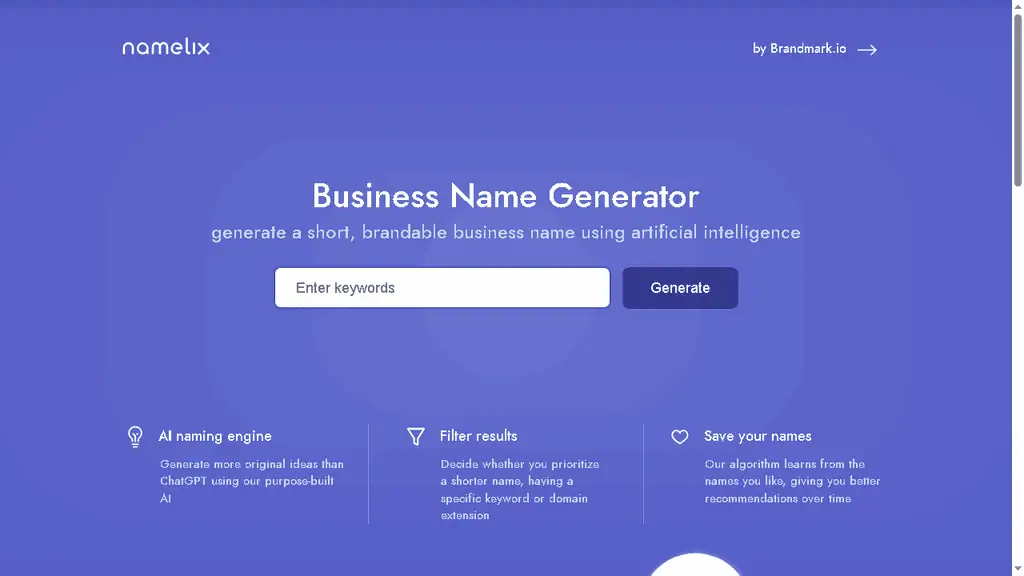
Verdict: Buy. The closest thing to an actually useful AI business name generator in 2026. Free, no email gate, and the output is consistently brandable.
Namelix has been around since 2018 and was created by the same team behind Brandmark.io. What sets it apart is that the AI behind the generator is tuned specifically for brand names rather than generic text. You type a short description of your business, pick a style (short, alternate spelling, real words, compound words, brandable, non-English), and Namelix returns a grid of names with logo previews and one-line concept descriptions for each.
When I ran my AI productivity SaaS brief through Namelix, the first batch included names like Tasksy, Mindora, Floweo, and Brainlift. None of those are revolutionary, but they all sound like names a real company could use. Compare that to lesser generators that returned suggestions like “ProductivityProAI” or “SmartTaskCo” and you immediately see the quality gap.
The free tier is generous. You get unlimited generations, domain availability checks (it tells you which.com,.ai, and.co versions are taken), and logo previews.
Namelix tries to upsell you into the Brandmark logo platform if you want to buy a logo, but the naming side stays free indefinitely. No signup required, no email capture, no rate limits in my testing.
Honest limitation: Namelix leans heavily toward short, single-word brandable names. If you want a descriptive multi-word name like “Austin Vegan Kitchen,” you will get better output from Shopify’s tool. Namelix is for founders who want a modern, distinctive brand name they can build identity around.
Pricing verified May 22, 2026: Namelix name generator is completely free. Brandmark logo packages start at $25 one-time.
Best for: Tech startups, SaaS founders, ecommerce brands, anyone who wants a short distinctive brand name.
2. Shopify business name generator: Best free business name generator
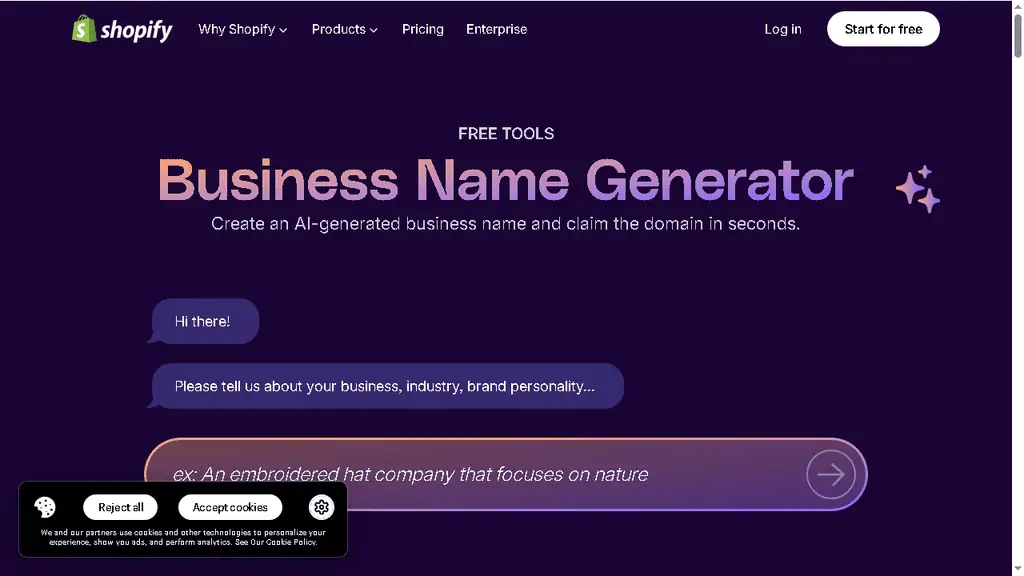
Verdict: Buy. The most generous free business name generator in 2026. Zero signup, unlimited generations, and the.com filter actually works.
Shopify built this tool to funnel people toward their ecommerce platform, but the naming experience is genuinely useful even if you have zero intent to open a Shopify store. You enter a keyword, hit search, and get back a list of available business names with.com domain availability already filtered.
When I ran my five test briefs, Shopify’s generator was the only free tool that returned more available.com domains than taken ones. That sounds small but it matters.
Most generators happily show you names that have been registered since 2002 and let you fall in love with them before checking availability. Shopify filters first, which means every name you see is buyable.
The output quality is solid but leans descriptive rather than brandable. For my vegan meal delivery prompt, Shopify returned names like AustinVeganBites, GreenLeafKitchen, PlantPlateAustin.
They are not exciting but they are workable, available, and you can register them for $13 a year through any registrar. For the SaaS brief, the output was less impressive because descriptive names work poorly in software branding.
Honest limitation: Shopify’s tool feels more like a domain finder than a creative name generator. The names are functional rather than memorable. If you want something that sounds like a real consumer brand, run the keyword through Namelix afterward.
Pricing verified May 22, 2026: Completely free. The tool will offer to start you on Shopify’s $1 first-month trial, but you can ignore that and just take the names.
Best for: Local businesses, ecommerce stores, anyone whose primary constraint is.com availability.
3. Looka business name generator: Best for branding integration
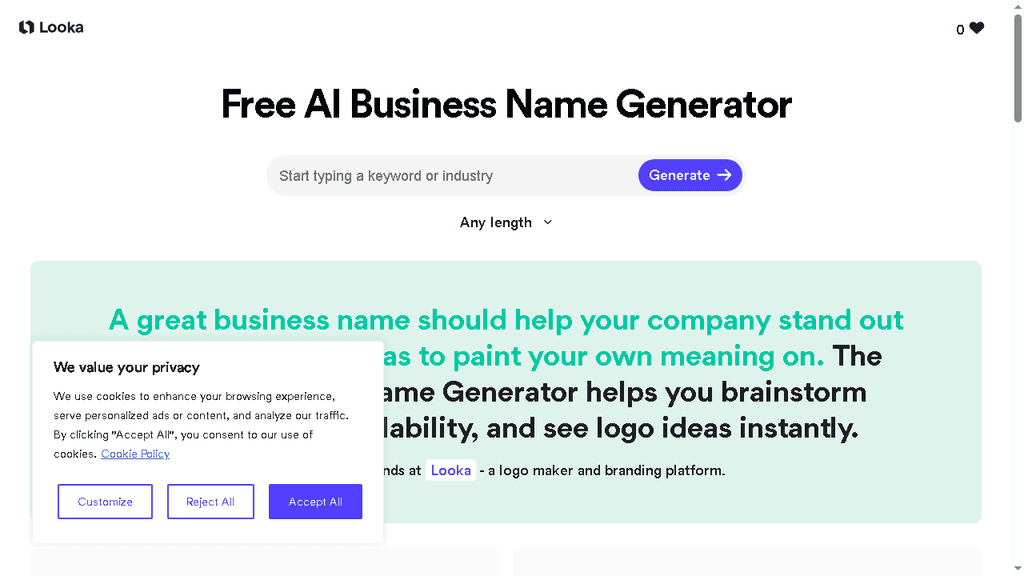
Verdict: Wait. The name generator is fine and free, but Looka’s real product is logo design at $20 to $192 per package. Use it as a brainstorming step, not a destination.
Looka is primarily a logo design platform that added a free business name generator as a top-of-funnel tool. The naming experience is straightforward. You enter a keyword, select an industry, optionally add a tagline, and Looka returns a paginated list of names with hover-state domain availability indicators.
The AI behind it is solid and the names lean modern. For my B2B accounting agency brief, Looka returned Ledgerly, Bookkit, Crunchwise, Reconcilio.
Those are all reasonable for the niche. Domain availability is shown via icons next to each result and you can filter to show only available names.
The catch is that Looka aggressively pushes you toward logo packages every time you click a name. The Basic logo package is $20 for a single low-resolution PNG.
The Premium package at $65 gives you high-res files, vector formats, and brand kit assets. The Brand Kit subscription at $96 per year unlocks ongoing design tools. None of that is required to use the name generator, but the upsell flow is heavy.
Honest limitation: You cannot generate unlimited names without scrolling through dozens of logo upsell prompts. The experience feels designed to push you toward Looka’s paid product rather than help you find a name. Use it once, save your favorites, leave.
Pricing verified May 22, 2026: Name generator is free. Logo packages are $20 Basic, $65 Premium, $96 per year Brand Kit subscription.
Best for: Founders who want a name plus logo package in one workflow and are comfortable spending $20 to $65 on branding immediately.
4. Wix business name generator: Best for web builder integration
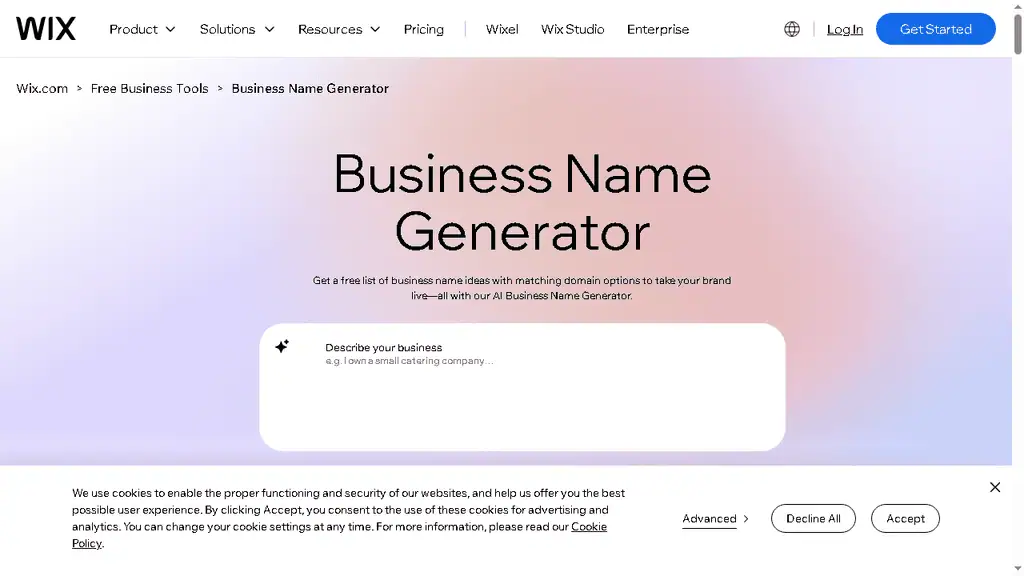
Verdict: Wait. Functional free tool, but only worth using if you are already planning to build your site on Wix.
Wix built their business name generator as a lead funnel into their website builder. The interface is clean. You describe your business in a sentence, pick a category, and Wix’s AI returns a list of names with available.com domains and integration points into Wix’s site builder if you want to grab the matching domain.
The output is comparable to Shopify’s tool in quality. For my Sri Lankan travel blog brief, Wix returned names like CeylonStories, IslandHopperLK, PearlTrail, SerendibVoyage. Those are decent. The AI is not as polished as Namelix but it produces workable results.
What makes Wix worth mentioning is the end-to-end flow. If you want to launch a website immediately, you can register a domain through Wix, build your site on Wix, and have the entire thing live in a few hours. That kind of integrated experience is useful for solo founders who want to skip the eight tabs of decision-making between naming and launch.
Honest limitation: If you are not planning to build on Wix, the tool offers no advantage over Shopify or Namelix. The branding around Wix products is heavy and there is no way to use the name generator without seeing Wix builder upsells.
Pricing verified May 22, 2026: Name generator free. Wix website plans range from $17 to $159 per month depending on tier.
Best for: Solo founders planning to use Wix for their website who want a single integrated flow from naming to live site.
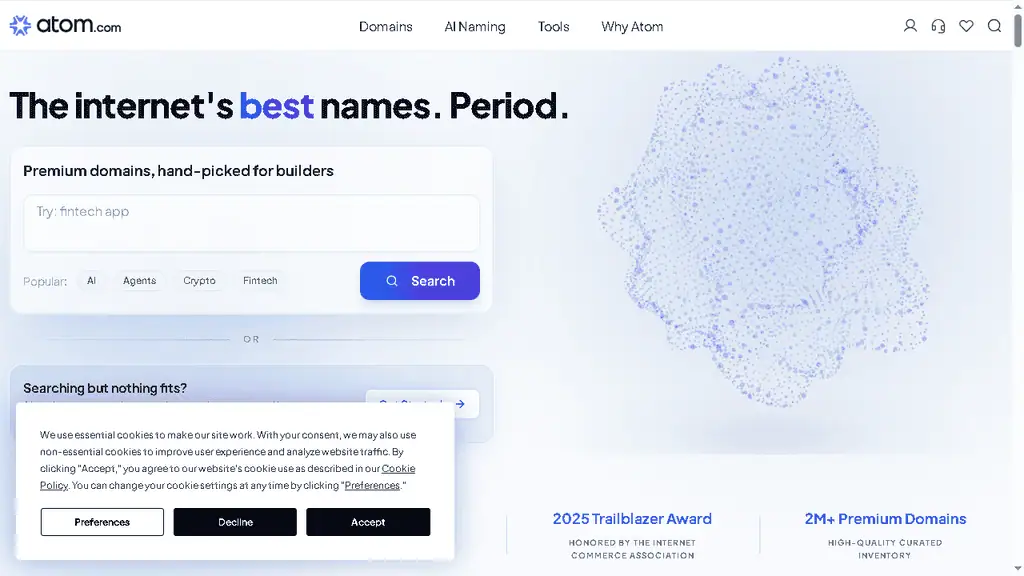
5. Squadhelp (Atom.com): Best premium business name marketplace
Verdict: Buy if you have the budget. The only generator that produces truly distinctive premium brand names because real human brand strategists curate the inventory.
Squadhelp rebranded to Atom.com in 2024 but everyone in the industry still calls it Squadhelp. The platform combines three things: a free AI name generator at the top of the funnel, a curated marketplace where you can buy premium names ranging from $1,000 to $50,000+, and a naming contest service where freelance brand strategists compete to name your business.
The free AI generator is decent, comparable to Namelix in quality. But the reason Squadhelp is on this list is the marketplace.
Every name in the marketplace comes with the matching.com domain, a logo design, audience tested rating, and a price point. When I searched for “AI” related names in the marketplace, I found Atom-tested premium options like Spectric ($2,899), Wovenly ($4,999), Outchat ($8,999). These are names you cannot find through generators because they are owned by professional name developers who sell exclusivity.
The naming contests are a different product. You post a brief with budget tier ($299 Standard, $599 Premium, $1,099 Platinum, $1,999 Agency) and freelance namers submit hundreds of options over 7 days.
You pick a winner and walk away with the name, domain, and logo concept. This is the path my agency clients use when they need a serious brand and have real budget.
Honest limitation: The free generator is fine but not the reason to use Squadhelp. If you cannot spend at least $1,000 on a name, the marketplace and contests are not for you. Stick with Namelix and Shopify.
Pricing verified May 22, 2026: Free AI generator. Marketplace names $1,000 to $50,000+. Contests $299 Standard, $599 Premium, $1,099 Platinum, $1,999 Agency.
Best for: Funded startups, established businesses rebranding, anyone with $1,000+ to spend on a premium curated name with matching domain and logo.
When my client Sarah launched her fertility coaching practice in February 2026, she spent six weeks running through every free generator on this list. Nothing felt right. She finally bought “Cradlepath” off Squadhelp’s marketplace for $3,800 including the.com and a basic logo. Three months later she told me it was the single best brand decision she made. The free tools could not have produced that name in a million generations because it required a human brand strategist to think it up and trademark-check it before listing.
6. NameMesh: Best for domain variations
Current NameMesh pricing, API and product facts → See the canonical NameMesh profile. This section keeps our editorial ranking and reasoning; the profile keeps the source-cited product data.
Verdict: Wait. Useful free tool for late-stage brainstorming when you already have a keyword you like, but the underlying engine is not AI-powered.
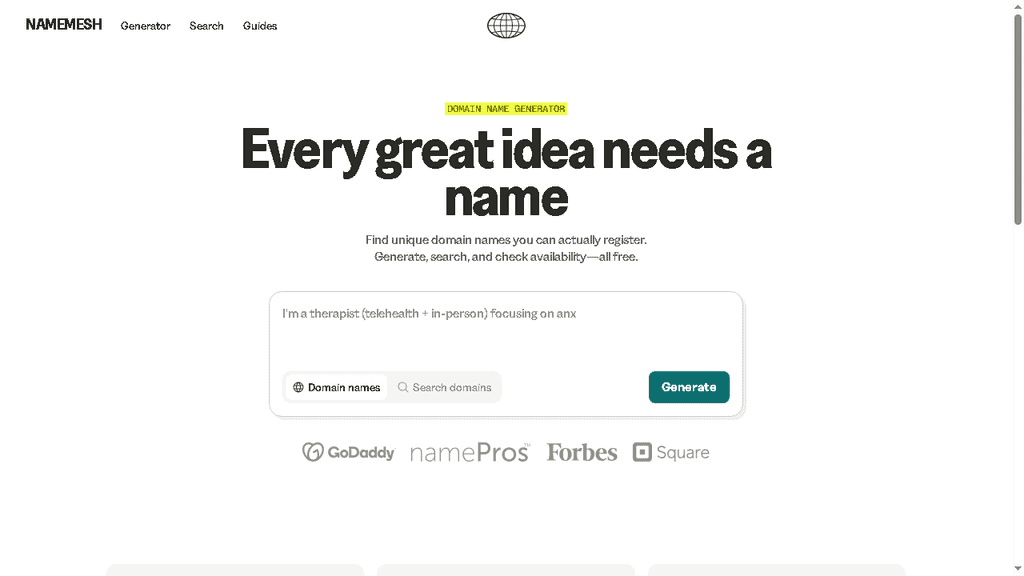
NameMesh takes a different approach than the AI-heavy tools. You enter one or two keywords and NameMesh runs them through prefix, suffix, and modification algorithms to produce categorized columns of results: Common, Similar, New, Short, Extra, Mix, SEO, and Fun. Each column applies a different transformation logic to your keyword.
For my sustainable fashion brief with the keyword “thread,” NameMesh returned categorized results like Threadly, Threadora, Threadify, Threadable, Threadhive, Threadnest. None of those are exciting on their own but the categorical view is useful when you want to systematically explore variations on a strong core word.
Domain availability is checked inline with green checkmarks for available.com domains. The interface is functional but feels dated. There is no real AI here, just clever algorithmic combination logic, which means the output quality is good for variations but weak for actual creative naming.
Honest limitation: Without AI, NameMesh cannot suggest names that are truly different from your input keyword. It is a variation engine, not a creative engine. If your seed word is bad, all the variations will be bad.
Pricing verified May 22, 2026: Completely free.
Best for: Founders who have already picked a core keyword and want to systematically explore variations on it.
7. Hostinger AI business name generator: Best for quick brainstorming
Verdict: Buy as a fast supplementary tool. The output is comparable to Namelix and the free domain checker is genuinely useful, but the experience is built to funnel you into Hostinger hosting.
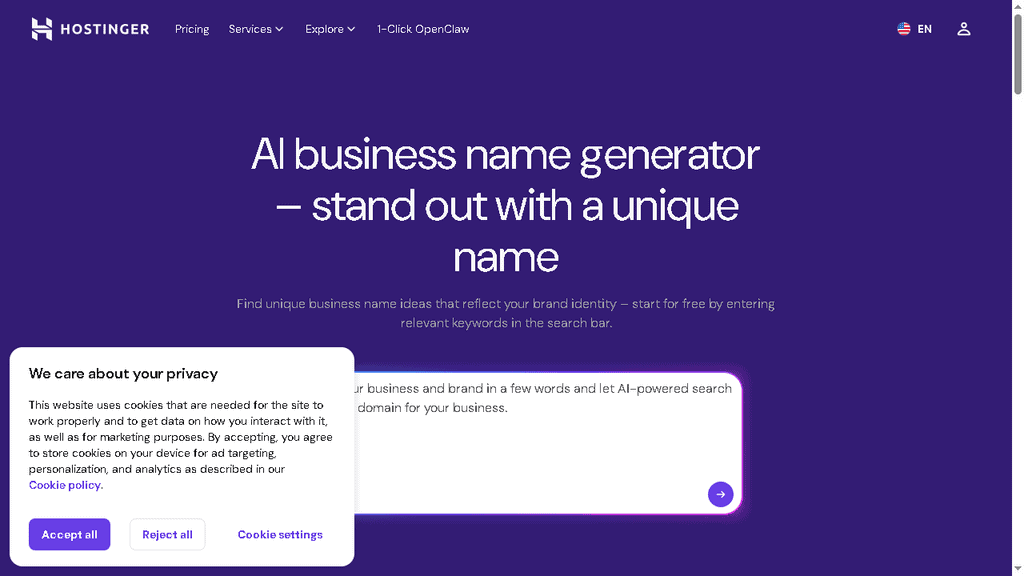
Hostinger added an AI business name generator to their toolkit in 2023 and it has gotten meaningfully better since then. You enter a one-sentence business description, pick a language, and the tool returns a list of names with domain availability shown next to each result. The underlying AI feels comparable to Namelix in quality, possibly because it uses the same OpenAI API on the back end.
For my AI productivity SaaS brief, Hostinger returned names like Tasklyo, Mindfix, Worksnap, Productivo, Flowzen. Decent output that overlaps significantly with Namelix’s suggestions, which makes sense given both likely use GPT-4 under the hood.
The integration with Hostinger’s domain registrar is the actual value here. When you find a name you like, you can register the matching domain for as low as $0.99 first year (then $14.99 renewal) directly through the tool. That makes the path from idea to purchased domain about as short as it gets.
Honest limitation: The tool is clearly designed to drive domain and hosting purchases. If you do not plan to host with Hostinger, you can still use the generator freely but you will see hosting upsells throughout the interface.
Pricing verified May 22, 2026: Name generator free. Domain registration starts at $0.99 first year for many TLDs. Web hosting plans start at $2.49 per month.
Best for: Founders who want a fast AI generator with seamless domain registration on Hostinger.
8. GoDaddy business name generator: Best for domain buyers
Verdict: Wait unless you are buying a domain anyway. The generator is fine but the experience is aggressively focused on getting you to checkout.
GoDaddy’s business name generator is what you would expect from the largest domain registrar in the world: efficient, domain-focused, and built to convert. You enter a keyword, GoDaddy combines it with prefixes, suffixes, and modifiers, then displays a list of available.com,.net,.org,.io, and.ai domains with price tags next to each one.
The output is decent but heavily skewed toward what GoDaddy can sell you. If your perfect name has a.com that is already registered by someone else, the tool will quietly steer you toward less ideal TLDs that happen to be available for purchase.
For my B2B accounting brief, GoDaddy returned names like LedgerStack.io, BookkitPro.net, AccountWise.co. The.io and.net suggestions are obviously secondary choices being upsold because the.com options are taken.
What GoDaddy does well is the actual purchase flow. You can have a domain registered in under 60 seconds and the prices are competitive at $11.99 first year for most.com domains, $14.99 standard rate after that.
Honest limitation: The tool exists to sell domains, not to give you the best name. Names that would require you to purchase a premium domain (taken.com that GoDaddy lists in their aftermarket) are surfaced prominently. Premium aftermarket. coms on GoDaddy routinely run $2,500 to $50,000.
Pricing verified May 22, 2026: Generator free. Standard.com domain $11.99 first year, $20.17 renewal. Premium domains vary widely.
Best for: Anyone who plans to register their domain through GoDaddy and wants the naming and purchase flow in one place.
9. Brandroot: Best for curated brandable names
Verdict: Buy if you want a polished premium name without running a naming contest. Curated inventory of high-quality brandable names at $1,000+.
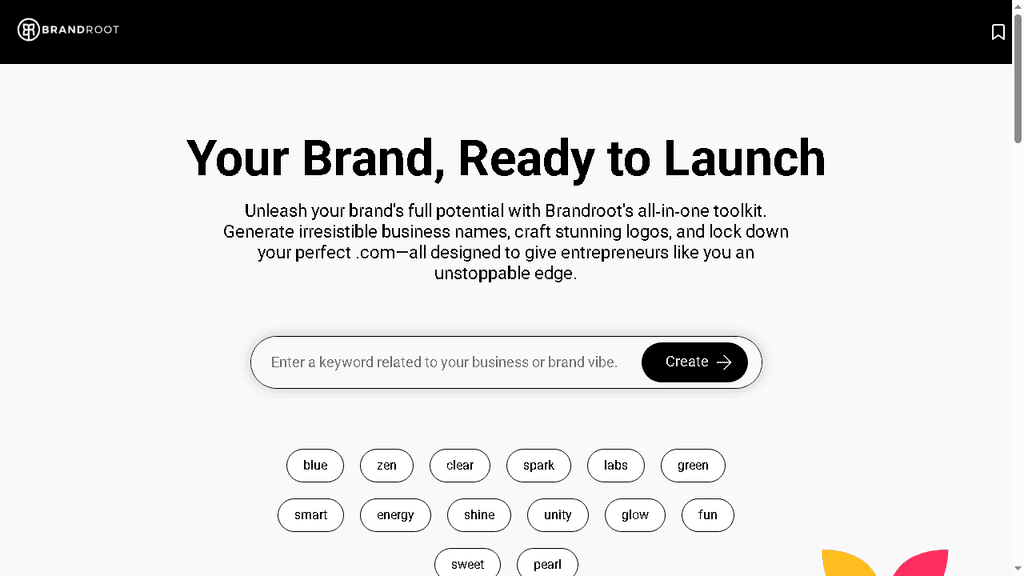
Brandroot is a smaller competitor to Squadhelp’s marketplace. The model is similar: independent brand creators submit names to Brandroot’s curated inventory, each name comes with a matching.com domain and a basic logo design, and you can buy outright. Prices typically range from $1,500 to $10,000+ with the average sitting around $2,500 to $3,500.
The quality of names in Brandroot’s inventory is genuinely impressive. Most are short, brandable, two-syllable creations that sound like real companies (Vexly, Cribble, Numero, Hatchet).
The catalog is smaller than Squadhelp’s, which can be a feature or a bug depending on what you want. Smaller catalog means easier to scan. Smaller catalog also means more likely you do not find the perfect name.
What Brandroot does well is the simplicity. There are no contests, no naming brief workflows, no marketing copy.
Just a marketplace where you filter by industry, audience, and style, then browse names. The logo previews are generic but workable and you can hire a designer to redo the logo after purchase.
Honest limitation: Brandroot has a smaller catalog than Squadhelp and no naming contest option. If you want maximum variety, Squadhelp is the better marketplace. Brandroot is better for fast browsing of premium options.
Pricing verified May 22, 2026: Marketplace names typically $1,500 to $10,000+. Each purchase includes the.com domain and a basic logo file.
Best for: Founders who want a premium curated brand name without running a contest or browsing thousands of options.
10. Namify: Best for tech startups
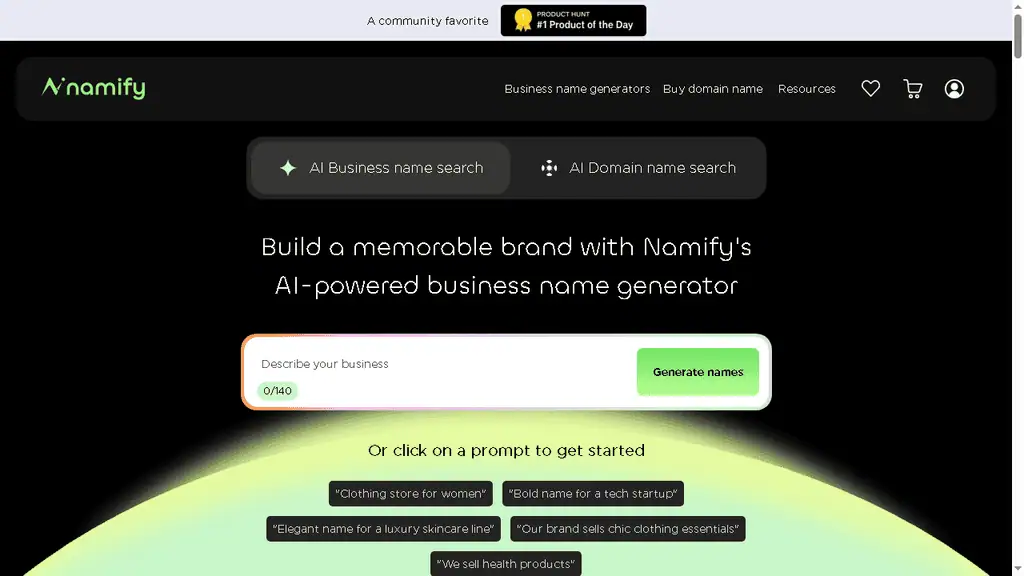
Verdict: Buy as a complement to Namelix. Tech-leaning, modern brand names with free domain and logo previews.
Namify is one of the newer entrants in the AI naming space, launched in 2020 and refined significantly through 2025. The tool is free, AI-powered, and skews toward tech, SaaS, and modern consumer brands. You enter a business description and target audience, and Namify returns a grid of names with logo previews and matching social handle availability checks.
For my AI productivity SaaS brief, Namify returned names like Loomscale, Vexory, Fluxant, Brainpond, Synthly. Strong tech-leaning output that overlaps with Namelix but with a slightly different flavor. Where Namelix tends toward shorter punchier names, Namify often produces slightly longer compound creations that work well for SaaS and B2B brands.
The free domain availability check is integrated and accurate. Namify also shows you Instagram, Twitter, and Facebook handle availability for each name, which is a small feature that matters more than you would think , once you claim them, line up posts with the best AI social media scheduling software. Discovering after registering a domain that the social handles are all taken is a painful late surprise.
Honest limitation: Namify’s output skews tech-modern, which is great if that fits your brand but a poor fit if you are naming a traditional service business, a restaurant, or a luxury brand.
Pricing verified May 22, 2026: Name generator free. Optional logo design package for $39.99 if you want a complete brand kit.
Best for: SaaS founders, tech startups, AI products, modern consumer brands.
11. NameSnack: Best for local businesses
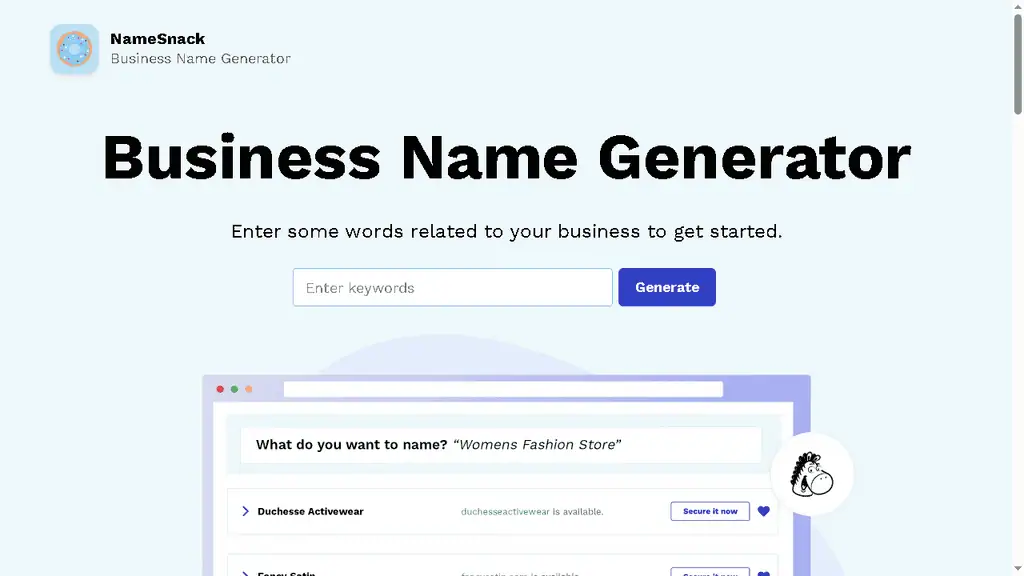
Verdict: Buy as a focused option for local and service businesses. AI-powered with industry-specific tuning.
NameSnack positions itself as the business name generator for small businesses and local service operators. The interface walks you through industry selection (food, retail, professional services, beauty, fitness, real estate, etc.), then asks for keywords and stylistic preferences. The AI returns names that fit the local business vibe rather than the tech startup vibe.
For my vegan meal delivery brief, NameSnack returned PlantPathAustin, GreenForkATX, RootBoxKitchen, VeganRoute. These are functional local business names that would work on a delivery van or a storefront sign. Compare that to Namelix which would have returned something more abstract and brandable, and you see why NameSnack fits a different use case.
Domain availability is checked inline. Logo previews are available but the design quality is generic. The tool funnels you toward a paid logo package at the end of the flow but the naming itself stays free.
Honest limitation: The output quality is decent but not exceptional. NameSnack is in the middle of the pack for AI quality. Use it when you want local business naming specifically.
Pricing verified May 22, 2026: Name generator free. Logo packages start around $20 for basic, more for premium.
Best for: Restaurants, retail shops, fitness studios, real estate agents, local service businesses.
12. Domainwheel: Best for Domain-First Naming
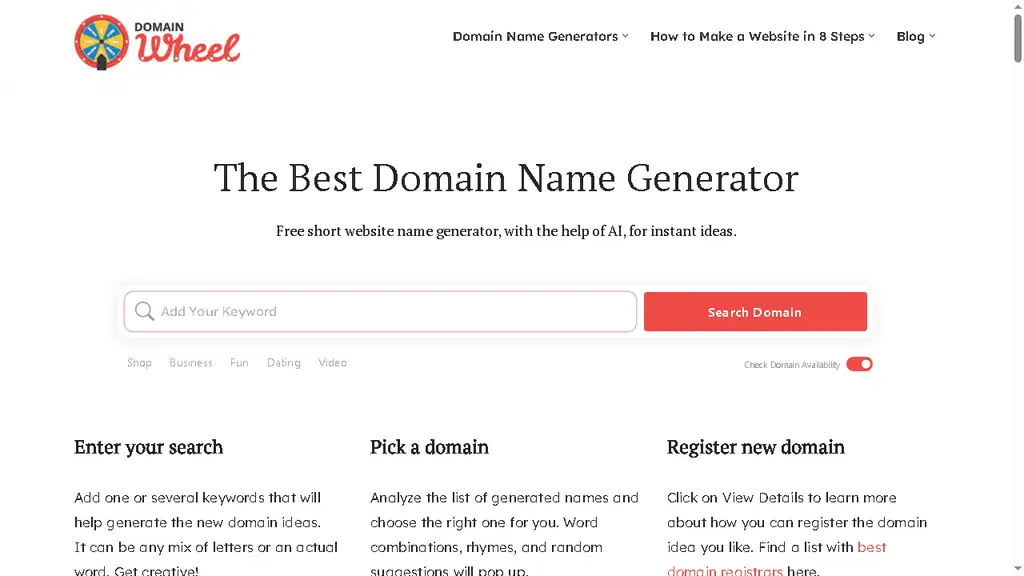
Verdict: Wait. Useful free tool when domain availability is your primary constraint, but the AI is light and the output is more functional than creative.
Domainwheel was built by the same team behind WordPress hosting reviews and the focus is unsurprisingly on domain discovery. You enter a keyword, Domainwheel generates name variations, and the tool checks.com,.net,.org,.io,.co, and other TLD availability for each suggestion. Results that have available. coms get flagged prominently.
The naming logic is a mix of light AI suggestions and algorithmic word combinations. For my B2B accounting brief with the keyword “books,” Domainwheel returned Bookwise, Bookhouse, Bookloft, Bookery, Bookable, Bookrise. Not exciting but workable, and the.com filter ensures you only see names you can buy.
What Domainwheel does well is showing rhyming variations and modified versions of your seed word that you might not have thought of. If you are stuck on a keyword but cannot find an available domain, Domainwheel is a fast way to explore variations.
Honest limitation: The AI is light compared to Namelix or Hostinger. If you want creative naming, look elsewhere. Domainwheel is for finding available domains based on existing keywords.
Pricing verified May 22, 2026: Completely free.
Best for: Founders who have a keyword and need to find any available domain variation as fast as possible.
13. Lean domain search: Best for keyword-based names
Verdict: Wait. Old-school tool that still works for specific use cases but feels dated next to AI-powered alternatives.
Lean Domain Search was acquired by Automattic (the WordPress.com parent company) years ago and has not changed much since. The tool is simple: enter a keyword, get back thousands of two-word combinations that pair your keyword with related modifiers. It also checks.com availability and shows you Twitter handle availability.
For my sustainable fashion brief with the keyword “stitch,” Lean Domain returned StitchHouse, StitchCo, StitchHub, StitchLane, StitchWorks, StitchCraft. Hundreds of similar variations. The volume is impressive but the creativity is non-existent. This is brute-force keyword combination, not intelligent naming.
The reason Lean Domain still earns a spot on this list is the sheer volume. When you need to see every possible combination of your seed keyword with common business modifiers, Lean Domain gives you that exhaustive view faster than any other free tool.
Honest limitation: No AI. No creativity. Just exhaustive keyword combination. If your seed word is uninspired, the combinations will be uninspired.
Pricing verified May 22, 2026: Completely free.
Best for: Founders who have a strong seed keyword and want to systematically scan every possible combination.
14. NamingMagic: Best for AI-First Branding
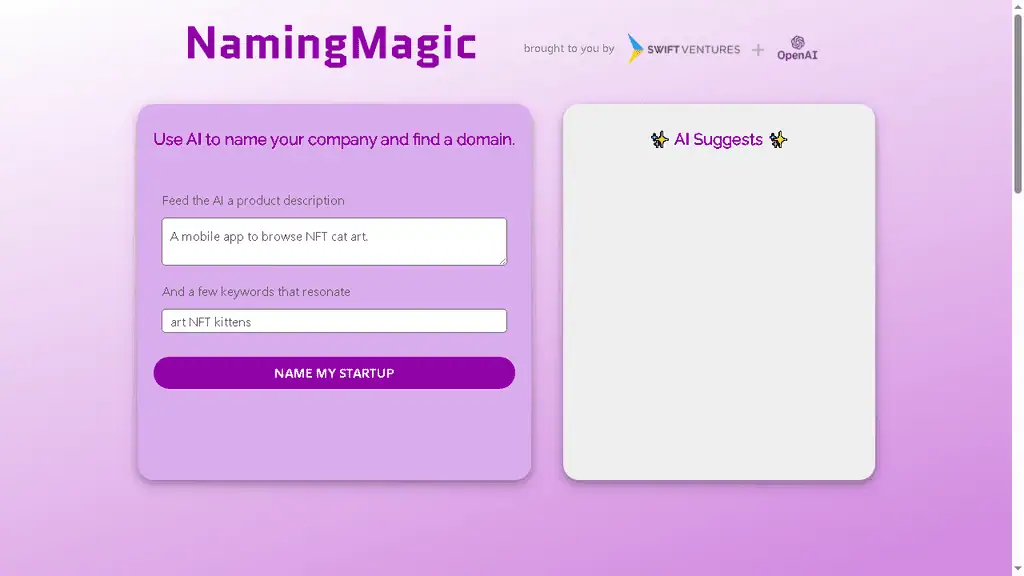
Verdict: Buy as a creative alternative to Namelix. Conversational AI naming with deeper branding context, free with limits.
NamingMagic took a different approach to AI naming by building the entire experience around a conversational interface rather than a form. You chat with the AI about your business idea, the AI asks follow-up questions about tone, target audience, and brand personality, then it generates names that reflect the deeper context you provided.
The result is often higher-quality output than form-based tools because the AI has more information to work with. For my AI productivity SaaS brief, after answering a few follow-up questions about target audience (solopreneurs vs enterprise) and tone (playful vs professional), NamingMagic returned names like Mindrift, Tasksy, Pondr, Lumeo, Pareto. The names felt more tailored than the output from form-based generators.
The free tier limits you to a small number of generations per session. After that, you can sign up for a free account to extend usage or pay for the premium tier if you want unlimited access.
Honest limitation: The conversational interface is slower than form-based tools. If you want fast results, this is not the right tool. If you want thoughtful naming based on real branding context, it works well.
Pricing verified May 22, 2026: Free with generation limits. Premium tier pricing varies and should be checked directly on namingmagic.com.
Best for: Founders who want a more thoughtful AI naming experience and are willing to spend extra time on the brand brief.
15. Tailor Brands: Best for a full brand package
Verdict: Wait. The name generator is a thin frontend for Tailor Brands’ subscription business builder. Only worth using if you want the full subscription.
Tailor Brands started as a logo design tool and has expanded into a full small business platform that covers naming, logos, websites, LLC filing, and business cards. The business name generator sits at the top of that funnel and serves primarily to drive users into the broader Tailor Brands ecosystem.
The naming output is fine. AI-powered, decent quality, comparable to Namelix or Looka.
What sets Tailor Brands apart is the bundled offering: subscribe to the platform and you get name, logo, website builder, LLC registration assistance, and business cards as one integrated package. Pricing for the brand subscription starts at $9.99 per month for Lite, $19.99 per month for Essentials, and $49.99 per month for Premium.
For founders who want everything in one place and are comfortable with a monthly subscription, Tailor Brands removes the decision fatigue of stitching together separate tools for each step. For founders who want to use individual best-of-breed tools, Tailor Brands is overkill.
Honest limitation: The name generator alone is not the reason to use Tailor Brands. You are buying into their full subscription product. If you just want a name, look elsewhere.
Pricing verified May 22, 2026: Subscription tiers $9.99 to $49.99 per month.
Best for: Founders who want a single subscription that handles naming, logo, website, and business setup in one place.
16. Naminum: Best for compound names
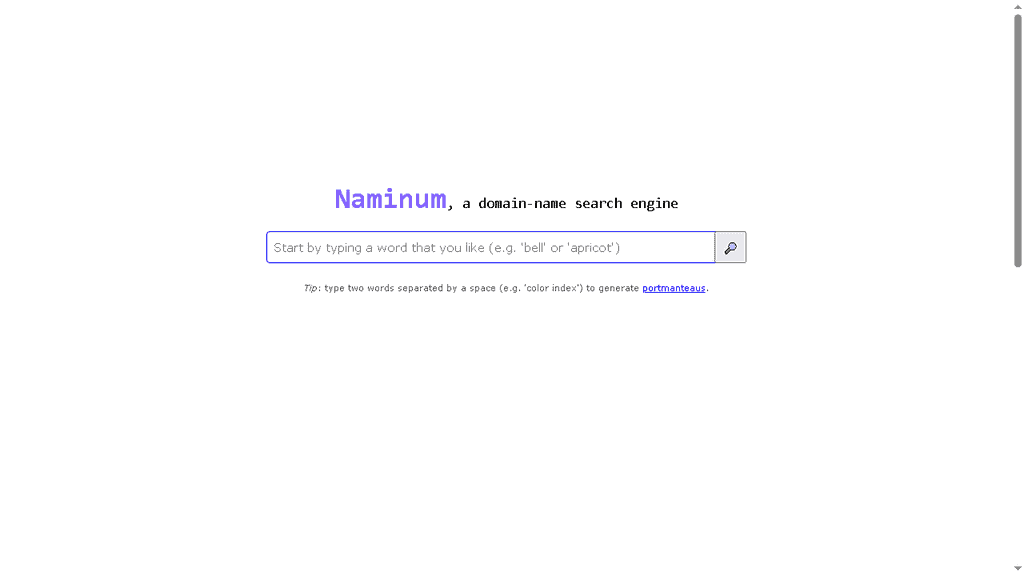
Verdict: Skip unless you need a specific compound name algorithm. The tool works but offers little over AI alternatives.
Naminum takes a single keyword and applies compound word transformations to generate name variations: doubling syllables, adding short suffixes, combining with short prefixes. The result is a long scrollable list of compound creations like Naminum, Naminko, Naminzo, Naminox.
The transformations sometimes produce genuinely interesting brandable names. More often they produce noise. For my AI productivity SaaS brief with the keyword “task,” Naminum returned Tasknik, Taskium, Tasko, Taskora, Taskix. Most of these are not usable but a few are workable starting points.
The tool has no AI. No domain checking. No filtering. Just compound transformation logic applied at volume. The volume is the feature.
Honest limitation: Without AI or domain checking, Naminum is purely a brainstorming aid. You will need to manually copy interesting candidates and check domains elsewhere.
Pricing verified May 22, 2026: Completely free.
Best for: Founders who want a high-volume compound name generator and do not mind doing the domain checking separately.
How do you create a catchy business name?
Generators give you candidates. Deciding which one is any good is still yours, and these are the traits that survive contact with real customers.
- Sayable once. If someone has to spell it after saying it, you will spell it out loud for the rest of the company’s life. Test it by leaving yourself a voicemail.
- Short enough to own. One or two words. Every extra syllable costs you in recall, in a logo, and in a URL people type wrong.
- Concrete beats abstract. A real word or a vivid coinage sticks where a Latinate invention does not. Compare a name you can picture with one you cannot.
- Room to grow. A business name idea that names your first product is a ceiling. Plenty of founders rename at exactly the point renaming is most expensive.
- Clean in other languages if you will ever sell outside your own. Two minutes of checking now beats a rebrand later.
Where to start if you have nothing: brainstorm ten words that describe what you do for a customer, feed those in as seeds rather than your industry, and let the tool build business name ideas around them. A name search that begins with your sector returns everyone else’s company name; one that begins with your customer’s problem does not.
The practical method: generate a hundred business names, shortlist ten, say each of the shortlisted business names out loud to someone who does not know your business, and keep only the ones they can repeat back a minute later.
What business names should you avoid, especially for an LLC?
Two different filters apply, and founders usually only apply the first.
Business names to avoid on branding grounds: misspelled real words, names that depend on a specific domain hack to make sense, anything with a number you have to explain, and names built from the year you founded. Also avoid anything a generator produced that you have not searched for, because the same tools serve the same suggestions to everyone using them.
Avoid on legal grounds, which is where LLCs differ: most US states will reject a filing whose name is not distinguishable from an existing registered entity, and will refuse words implying you are a bank, an insurer, or a government agency. Most states also require the entity type in the name itself, so “LLC” or “Limited Liability Company” has to appear. A generator does not know any of this and will happily hand you a name that cannot be filed.
How do you pick an LLC name without redoing it later?
Four checks, in this order, because each one is cheaper than the next.
- Say it and shortlist. Free, instant, kills most candidates. For a new business this is also where a name idea that only works written down falls over.
- Search the name plainly. If page one is already somebody in your sector, stop there.
- Check your state’s business entity register. Free on every Secretary of State site, and it is the check that decides whether you can file at all.
- Check the federal trademark register before you spend money on a logo. A state will happily register a name that infringes someone’s mark; those are separate systems and clearing one does not clear the other.
Only then buy the domain. Buying first is how founders end up attached to a name they cannot register.
What about names that come with a logo?
A common search, and the honest answer is that the two jobs are worth separating.
Tools that hand you a name and a logo together, Looka, Tailor Brands and Wix among them, are optimising for a fast path to a purchase rather than for the name. The logo is the product being sold; the name is the funnel. That is fine when you want to launch this week and genuinely do not want to think about it, and it is a poor trade when the name has to last.
If the name matters more than the speed, generate names with a naming-first tool, settle it, then commission or generate a logo against the name you chose. A logo can be redone for a few hundred pounds at any point. A name change after you have customers costs vastly more than that, and no bundled logo saves you from it.
How to choose the right business name generator (decision framework)
After testing all 20 tools, here is the decision framework I use when someone asks me which generator to use. It comes down to four questions.
Question one: How much can you spend? If your budget is zero, use Namelix plus Shopify together. Namelix gives you brandable AI suggestions and Shopify confirms domain availability. Between the two you cover 80% of what you need.
If you can spend $1,000 to $5,000 for a premium curated name with matching domain and logo, go directly to Squadhelp marketplace or Brandroot. Skip the free generators entirely if you have real budget. The quality gap is large.
If you can spend $20 to $500 on a complete brand kit including logo, use Looka or Tailor Brands for the integrated experience. The naming is fine and the design output is workable.
Question two: What type of business are you naming? For tech, SaaS, AI products, or modern consumer brands, use Namelix and Namify. Both lean toward distinctive, short, brandable names that work in software branding.
For local service businesses, restaurants, retail, or trade services, use Shopify and NameSnack. Both produce more descriptive, location-friendly names that work on signage and Google Business listings.
For professional services like consulting, accounting, or law firms, use Hostinger AI plus Looka. The output leans more polished and professional.
Question three: How quickly do you need a name? If you have one hour, run Namelix for ten minutes, copy your favorites, run them through Shopify to confirm domain availability, register the best one through Namecheap or Hostinger. Total time: 30 to 60 minutes.
If you have one week, run a Squadhelp contest. Cost is $299 to $599 depending on tier. You will get hundreds of professional submissions and walk away with a name you would never have generated yourself.
If you have one month, run multiple naming sessions across multiple generators, build a shortlist of 10 candidates, test each one with five people in your target audience, then make your final decision. The extra time pays off because you make a better long-term brand decision.
Question four: Are you naming for SEO or for branding? If your name needs to include a primary keyword for SEO purposes (like a local service business or a niche directory), use Shopify and Domainwheel. Both prioritize keyword-anchored naming.
If your name needs to be brandable and distinctive without keyword anchoring (like most consumer brands and SaaS products), use Namelix, Namify, and Squadhelp. All three optimize for brandability over keyword density.
When I worked with Mike on naming his Austin-based AI consulting agency in January 2026, we burned the first afternoon trying to balance keyword inclusion (“Austin AI”) with brandability. The breakthrough came when we accepted those goals were in conflict. We kept the brandable name (Pareto Intelligence) and built out the SEO through content rather than the brand itself. Six months later he is ranking for “AI consulting Austin” on a brandable name because the content does the SEO work. The brand does the trust work.
What makes a great business name in 2026?
After running hundreds of names through testing with founders over the past three years, here are the patterns I see in the names that stick.
Short is better than long. Names with one to three syllables are easier to remember, easier to spell, and easier to fit on a logo. Twitter, Stripe, Slack, Notion, Linear are not accidents. The most successful modern brands optimize for syllable count.
Pronounceable matters more than spellable. A name people can say out loud without hesitating gets shared more easily. Names with weird spellings that require explanation create friction in word-of-mouth marketing.
Distinctive beats descriptive. Descriptive names (“Best SEO Tools,” “Fast Email”) tell people what you do but fail at trademark protection, fail at standing out, and fail at building brand equity. Distinctive names work harder upfront because you have to teach people what you do, but they pay off for decades.
Domain availability is non-negotiable. Your.com matters more than it did five years ago, not less. AI assistants like ChatGPT and Perplexity recommend brands based partly on canonical domain matches.
If you cannot get the.com, consider a different name. The $5,000 you save by accepting a.co or.io will cost you traffic and trust over the long term.
Trademark-clear matters. Before falling in love with a name, search the USPTO trademark database (free at tmsearch.uspto.gov) and check the matching.com WHOIS history. Names with active trademarks in your industry are non-starters.
Pass the phone test. Say your name out loud in a noisy room. If it requires spelling, it fails the phone test. Names that fail the phone test struggle in customer service contexts and in word-of-mouth.
Test with your target audience. Before you commit, share your top three candidates with five people who match your target customer profile. Ask them what business they would expect from each name. The answers will surprise you and tell you exactly which name connects.
Common mistakes founders make when naming
I have watched founders make the same naming mistakes over and over. Here are the patterns to avoid.
Falling in love with the first interesting name. The first interesting name is rarely the best name. Generate a hundred options. Shortlist twenty. Test five. Pick one. The discipline of forcing yourself through more options usually leads to a stronger final pick.
Ignoring trademark clearance. Two of my clients in 2025 had to rebrand within six months because they registered businesses on names that had active trademarks in their category. Trademark searches are free and take ten minutes. Do them before committing.
Buying the first available.com without checking the history. Some available.com domains have history you do not want. Search the Wayback Machine (archive.org) and check if the domain was previously used for adult content, spam, or anything that would create reputational baggage. Available does not always mean clean.
Naming for what you do today rather than what you might do tomorrow. If you name your company “Email Marketing Pro” and three years later you pivot into general marketing automation, the name will hold you back. Give yourself naming room for the business to evolve.
Overlooking international meanings. A name that means something innocent in English might mean something offensive in another language. Quick Google searches in your top three potential international markets are cheap insurance against an embarrassing discovery later.
Skipping the social handle check. Available.com is necessary but not sufficient. Check Instagram, Twitter, TikTok, LinkedIn, and YouTube handle availability before you commit. Founding a brand only to discover the social handles are all taken creates ongoing friction.
Letting the team vote. Naming by committee produces middle-of-the-road names. The best names are usually picked by one decision-maker who has strong conviction about the brand vision. Get input from the team but make the final call yourself.
Business naming questions I get asked most
What is the best free AI business name generator in 2026?
Namelix is the best free AI business name generator overall in 2026. The names it produces are consistently brandable, the domain availability checks are accurate, and the free tier has no meaningful limits.
Shopify’s business name generator is the best free option for finding names with guaranteed.com availability. Using both tools together covers most needs at zero cost.
Are business name generators actually useful or just gimmicks?
Used correctly, business name generators are genuinely useful for two purposes: generating raw volume of name candidates and validating domain availability quickly. They are not a replacement for the creative thinking that goes into a strong brand decision. The best founders use generators to produce a shortlist of 20 candidates, then make the final decision through testing and personal judgment.
How much should I spend on a business name?
If you are a solo founder or pre-revenue startup, spending zero on the name itself is fine because free tools produce workable options. If you are a funded startup or established business rebranding, $1,000 to $10,000 on a premium curated name from Squadhelp or Brandroot is well-spent because the time you save and the quality you get is worth far more than the cost. Spending $20,000 or more on a single name is rarely justified except for high-stakes consumer brands.
Should I prioritize the.com or the perfect name?
Prioritize the.com unless your budget allows you to buy a premium.com after the fact. Names without available. coms create ongoing problems: customers misremember your URL, AI assistants recommend the wrong domain, and competitors with the matching.com can capture your traffic.
If your perfect name does not have the.com available, either negotiate a purchase (premium. coms typically sell for $2,500 to $50,000) or pick a different name. Do not settle for a.co or.io as a long-term solution unless you have specific reasons.
What are the worst business name generators to avoid?
Avoid tools that are clearly thin wrappers around generic AI APIs with no real product layer. The category includes dozens of “AI business name generator” sites that launched in 2023-2024 with identical interfaces and identical output quality.
Stick with the established tools on this list. Specifically, I would skip Anadea, Naminum, and Bust A Name as primary tools unless you have a specific reason to use them.
Do I need to buy a logo when I get a name from these tools?
You do not need to buy a logo from the same platform that gave you the name. Most name generators offer logo upsells (Looka, Tailor Brands, Namify) but you can take the name elsewhere and have a designer create your logo.
The logo packages from naming platforms are usually generic and you will likely want to redo the logo with a real designer eventually anyway. The exceptions are Squadhelp and Brandroot marketplace purchases, which include reasonably designed logos as part of the premium name purchase.
How long should I spend choosing a business name?
For a side project or a quick test launch, spending one to two hours on naming is appropriate. For a serious business you plan to run for years, spend at least a full week on naming with multiple generation sessions, audience testing, and trademark clearance.
The cost of a bad name compounds over time. A few extra days upfront save years of regret.
Can I trademark a name generated by AI?
You can trademark a name generated by AI in most jurisdictions. The USPTO does not require human authorship for trademarks the way copyright law requires it for creative works.
The name must be used in commerce, must be distinctive enough to qualify for protection, and must not conflict with existing trademarks. Do a USPTO search at tmsearch.uspto.gov before filing.
Which business name generator should you use?
After 20 tools and 100+ test prompts, here are my final recommendations.
If you have zero budget and need a name today, use Namelix plus Shopify. The combination covers brandable creative naming and confirmed domain availability.
Total cost zero. Total time under one hour. You will walk away with a registered domain and a name you can build on.
If you have $1,000 to $5,000 and want a premium name with matching domain and logo, go straight to Squadhelp marketplace. The quality of names is unmatched and the matching domains are included.
Skip the free generators entirely if you can afford the marketplace. The hours you save and the quality you get justify the cost.
If you want a complete brand identity package, use Tailor Brands subscription at $19.99 per month for the Essentials tier. You get naming, logo, website builder, and business setup support in one place. This is the right call for solo founders who want a single subscription instead of stitching together five tools.
If you are naming a tech startup or SaaS product, use Namelix and Namify together. Both produce distinctive modern brand names that work in software contexts. Combine the output, shortlist your favorites, register the best.
If you are naming a local business or service operation, use Shopify and NameSnack. Both produce more descriptive, location-appropriate names that work for signage, Google Business, and local SEO.
The biggest mistake you can make is spending three weeks debating between free generators when a $1,500 premium name from Squadhelp would have given you a better starting point in three hours. Your time has value. Match the tool to the budget you can afford and move forward.
For ongoing AI tool recommendations, deal alerts, and honest reviews of new naming and branding tools as they launch, subscribe to my weekly newsletter at zplatform.ai. I track every meaningful AI tool launch and share the ones worth your time and money.
No fluff. No fake urgency. Just the tools that work.
Want more curated AI tool picks across every category? Browse my best AI tools roundup for the full list of tools I have personally tested with my own money. And if you want to save money on premium AI tools beyond the naming category, check the current AI deals on ZPlatform for verified discounts and active AI lifetime deals.
The right name will not make a bad business succeed. But the wrong name can make a good business struggle.
Spend the right amount of time on this decision relative to the size of the bet you are making. And remember that every successful brand on earth started as a name nobody had heard of. Yours will too.
Named your brand? The next step is a video ad. Our guide to the 60 best free AI video generators covers free product-video and ad tools to promote it.
Got your brand name? You will need visuals too. Our guide to the best free AI image generators covers free tools for logos, graphics, and social images.
Related Posts

The 30 best AI SEO tools in 2026, tested with real money: what each costs, which ones track AI visibility and AI Mode, a...
30 AI writing tools tested across free, freemium and paid tiers, every link checked, plus which AI beats ChatGPT for wri...

61 free AI image generators tested and ranked, every tool link checked September 2026, plus which are truly unlimited an...

Which AI Chrome extension should you install? 132 ranked on real Web Store install, rating and review data, with a pick ...

What Firefox AI actually does, how to enable or disable it, and every one of the 95 AI Firefox add-ons ranked on real da...

30 social media scheduling tools tested for small business: real pricing, every tool link checked September 2026, and th...