

Traditional penetration testing has long suffered from an operational disconnect: static annual assessments generate dense PDF reports of discovered vulnerabilities, hand them over to overburdened engineering teams, and leave organizations blind to whether applied patches actually closed the exploitable vector.
By the time development squads push code fixes, weeks or months have passed, manual consultants have rolled off the engagement, and verifying remediation requires re-engaging external contractors at substantial hourly rates. Consequently, security teams often mark tickets “resolved” without cryptographic proof or functional exploit validation.
The verification loop: how agentic systems retest patched assets
A true agentic pentesting platform operates across an autonomous, iterative lifecycle that bridges detection, developer handoff, and confirmed validation:
- Contextual autonomous probing. The agent explores external web applications, internal APIs, and cloud networks, dynamically mapping stateful application logic and formulating novel hypothesis-driven attack strategies.
- Deterministic exploit demonstration. The platform executes non-destructive exploits to capture verifiable evidence (e.g., extracting token proofs, reading unauthorized database rows, or achieving controlled remote execution) to definitively eliminate false positives.
- Structured developer enablement. Findings are translated into root-cause remediation guidance, supplying developers with precise code locations, raw HTTP request/response sequences, and reproducible command-line calls.
- Autonomous retesting and mutation. Upon notification that a patch has been deployed, the agent replays the original exploit path and applies mutated variations (such as alternative encoding, parameter pollution, and boundary bypasses) to confirm the vulnerability is fully eradicated.
8 agentic AI pentesting tools with automated post-remediation verification
1. Novee
Novee provides an autonomous agentic penetration testing platform engineered to deliver continuous, end-to-end offensive security assessments with built-in post-remediation verification. Moving past superficial automated scanning, Novee deploys intelligent AI agents that reason like seasoned human red teamers, autonomously discovering dynamic attack surfaces, mapping multi-tier application workflows, and chaining multi-step exploits across complex web applications, modern APIs, and cloud environments. The platform focuses heavily on deterministic proof of exploitability, ensuring security teams spend zero time triaging theoretical scanner noise.
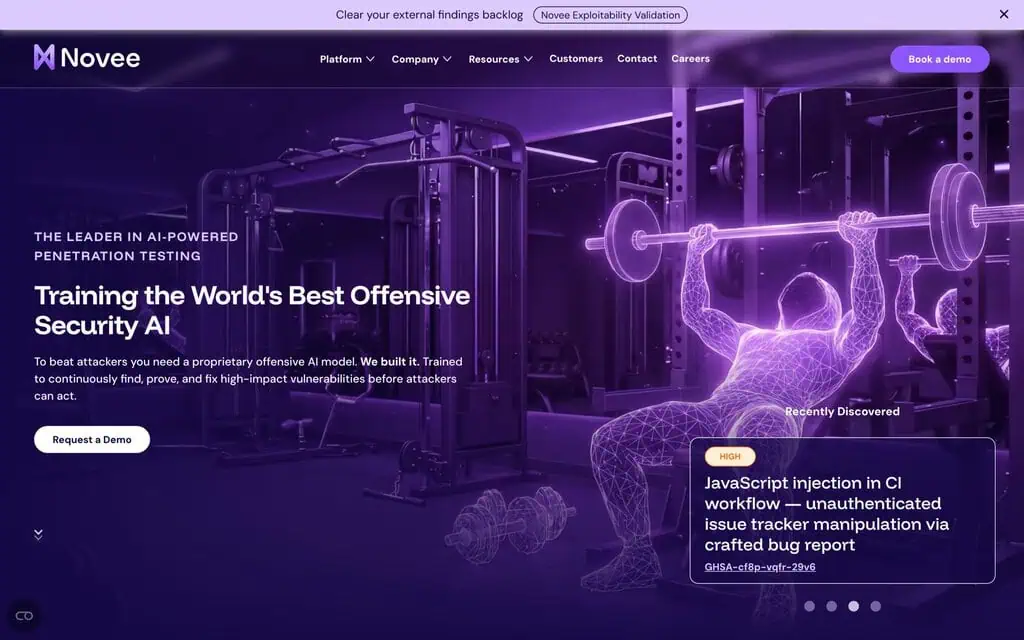
Where Novee distinctly separates itself from traditional offensive platforms is in its closed-loop remediation verification. When engineering teams push a code patch or configuration update to address an identified exposure, Novee allows teams to trigger immediate, autonomous retesting. The agent recreates the exact original attack vector, dynamically attempts bypass mutations to test patch resilience, and issues a cryptographically verifiable pass/fail attestation. This continuous validation loop eliminates remediation blind spots, confirms the complete elimination of root causes, and delivers compliance-ready audit trails without scheduling delay.
- Autonomous goal-oriented attack reasoning. Employs multi-agent cognitive architectures that navigate multi-step business logic, chain API vulnerabilities, and execute non-destructive proofs of concept.
- Instant one-click remediation retesting. Re-executes targeted exploit chains against updated endpoints on demand, mathematically validating that patches hold against mutated payloads.
- Evidence-grade exploit documentation. Automatically captures comprehensive HTTP transaction logs, response bodies, and execution screenshots to provide developers with clear reproduction steps.
- Zero false-positive engine. Validates vulnerability hypotheses through deterministic execution before generating alert tickets, removing noise from developer backlogs.
2. Horizon3.ai
Horizon3.ai’s NodeZero platform provides an autonomous penetration testing solution designed to assess how real-world attackers exploit interconnected internal and external enterprise networks. Operating from an attacker’s perspective, NodeZero continuously chains together weak credentials, misconfigurations, legacy network protocols, and software vulnerabilities to achieve domain compromise or gain access to critical cloud data stores.
- 1-click remediation retest engine. Re-runs specific compromised paths to verify that applied patches and configuration updates effectively neutralize attack trajectories.
- Active Directory and infrastructure chaining. Identifies and traverses complex privilege escalation paths across hybrid cloud and on-premises network topologies.
- Non-destructive proof of exploit. Gathers concrete digital proof of compromise without crashing mission-critical enterprise systems or corrupting operational databases.
- Dynamic attack surface comparison. Delivers historical delta reports illustrating risk reduction between pre-remediation and post-remediation states.
3. RidgeBot
Ridge Security delivers RidgeBot, an automated penetration testing system that combines artificial intelligence with deep exploit knowledge bases to conduct vulnerability discovery and validation. RidgeBot models adversary behaviors, moving through progressive phases of asset discovery, vulnerability fingerprinting, automated ethical exploitation, and internal lateral movement across enterprise networks and application tiers.
- Targeted task re-execution. Focuses re-testing efforts exclusively on specific remediated nodes, ports, or applications to minimize network utilization.
- Automated exploit chaining. Dynamically links multiple low-severity findings to demonstrate how chained misconfigurations yield high-impact system compromise.
- Comprehensive vulnerability coverage. Evaluates web application vulnerabilities, network protocol flaws, weak credentials, and cloud storage exposures within a unified console.
- Automated mitigation playbooks. Provides actionable remediation guidance alongside validated findings, accelerating developer triage and engineering turnaround.
4. BreachBit
BreachBit operates an autonomous red teaming and continuous exposure testing platform designed to simulate persistent, external cyber threats against modern enterprises. Built around automated offensive agents dubbed “the cyber hacker on your payroll,” BreachBit continuously discovers an organization’s external footprint, investigates internet-facing vulnerabilities, tests employee phishing resilience, and evaluates perimeter infrastructure.
- Continuous perimeter re-testing. Automatically evaluates externally exposed assets whenever underlying services or DNS configurations change.
- Human-simulated attack logic. Employs autonomous decision trees that mimic real-world adversary reconnaissance, scanning cadence, and exploitation methods.
- Integrated human expert oversight. Backs autonomous agent findings with veteran offensive security engineers who audit anomalous findings when necessary.
- Breach-Risk Scoring (BRS). Quantifies continuous organizational security improvements through a dynamic risk metric that updates immediately upon successful retest.
5. Strike Graph
Strike Graph provides a compliance-driven Penetration Testing as a Service (PTaaS) platform that pairs automated AI scanning capabilities with certified offensive security professionals. Designed to streamline security auditing for frameworks such as SOC 2, ISO 27001, and HIPAA, Strike Graph replaces slow annual PDF reports with a collaborative, cloud-hosted vulnerability remediation workspace.
- Integrated unlimited retesting. Encourages iterative engineering remediation by offering rapid verification of pushed patches without incremental testing fees.
- Automated compliance evidence generation. Maps validated remediation results directly to SOC 2, ISO 27001, and PCI-DSS compliance frameworks.
- Collaborative developer workspace. Enables direct communication between developers and security testers directly on specific vulnerability tickets.
- Hybrid automated and human testing. Blends rapid agentic reconnaissance and vulnerability discovery with certified manual tester logic.
6. Cobalt
Cobalt provides a modern Penetration Testing as a Service (PTaaS) platform that links enterprise organizations with a global community of vetted offensive security practitioners supported by workflow automation. Cobalt replaces static testing engagements with agile testing cycles, allowing engineering teams to integrate security assessments directly into their sprint cycles and CI/CD pipelines.
- On-demand finding retest workflows. Streamlines post-fix verification by connecting developers directly with testers to re-evaluate resolved findings.
- Deep SDLC integrations. Bi-directionally syncs findings, status changes, and retest requests across Jira, GitHub, GitLab, and Slack.
- Real-time findings dashboard. Provides continuous visibility into active exploits, ongoing remediations, and validated fixes across digital assets.
- Agile pentest scheduling. Allows organizations to schedule targeted micro-tests against new features or specific services between major annual assessments.
7. Astra Security
Astra Security delivers an automated and manual penetration testing platform built to secure web applications, mobile apps, cloud infrastructure, and network APIs. Astra combines a proprietary automated vulnerability scanner with expert-led penetration testing, providing engineering teams with an interactive vulnerability management dashboard that simplifies remediation workflows.
- One-click retesting interface. Lets developers verify vulnerability fixes independently without requiring manual intervention from security administrators.
- Contextual video PoCs and code guidance. Supplies step-by-step reproduction videos and code snippets directly inside tickets to guide developer fixes.
- Public security verification badges. Issues verifiable digital trust seals that automatically reflect an organization’s current patched security posture.
- CI/CD pipeline integration gates. Embeds automated testing and verification checks directly into build pipelines to block vulnerable code from deploying.
8. Holm Security
Holm Security provides a vulnerability management and continuous assessment platform that evaluates organizational attack surfaces across cloud assets, network infrastructure, and web applications. The platform uses automated scanning agents and vulnerability detection engines to identify exploitable configurations, outdated software frameworks, and perimeter exposures.
- Continuous remediation verification. Automatically confirms the status of patched assets during subsequent automated assessment cycles.
- Remediation tracking and SLA governance. Measures the time required to resolve critical vulnerabilities, alerting leadership to SLA breaches.
- Unified surface coverage. Assesses external networks, cloud environments, internal infrastructure, and human social engineering risks.
- Regulatory compliance reporting. Generates customized executive and technical reports aligned with GDPR, NIS2, and ISO 27001 requirements.
Implementation blueprint: establishing closed-loop remediation in DevSecOps
Deploying an agentic penetration testing framework with post-remediation verification requires connecting offensive security directly into your engineering lifecycle:
1. Ingest structured proofs of concept directly into issue trackers
Ensure that when vulnerabilities are validated, findings do not sit trapped inside an isolated security portal. Integrate your offensive testing platform with engineering trackers like Jira, Linear, or GitHub Issues. The exported ticket must contain evidence-grade reproduction details: exact HTTP request and response pairs, parameter locations, and non-destructive curl commands. Providing complete reproduction data enables developers to address the architectural flaw without guessing how the security agent achieved exploitation.
2. Configure event-driven retest webhooks
Eliminate manual coordination by wiring testing triggers into your continuous integration and deployment pipelines. When a developer marks a vulnerability ticket as “Resolved” or merges a remediation pull request into a staging environment, configure a webhook to trigger the testing platform’s retest API automatically. This ensures that verification testing occurs immediately after code deployment, keeping developer attention focused on the relevant codebase while the architectural context is still fresh.
3. Subject patches to mutated exploit payloads
A naive retest that merely resends the exact identical payload string can create a false sense of security. Competent developers might inadvertently deploy input filters that block the specific string used in the initial report without fixing the broader vulnerability class. Modern agentic platforms like Novee counter this by applying automated mutation strategies during the retest phase, testing URL-encoded variants, unicode bypasses, altered JSON payloads, and alternative boundary states to confirm that the underlying vulnerability logic is genuinely resolved.
4. Establish immutable compliance and closure attestations
When an agentic retest confirms that an attack vector is completely closed, archive the retest run as a cryptographically verifiable compliance artifact. Record the test timestamp, the specific commit hash or image tag tested, and the terminal output proving the target successfully resisted exploitation. Maintaining an unbroken, automated audit trail streamlines annual compliance examinations (such as SOC 2 Type II, ISO 27001, and PCI-DSS 4.0) by proving that reported vulnerabilities were definitively resolved rather than merely dismissed.
Frequently asked questions
What differentiates an agentic pentesting retest from an automated vulnerability scanner check?
Traditional automated vulnerability scanners typically verify remediation by checking software version banners, probing open ports, or matching static text patterns in HTTP responses. They do not comprehend stateful application logic or multi-step execution flows. An agentic penetration testing retest actively replays the complex, multi-tiered exploit sequence that initially compromised the system. It authenticates, traverses stateful workflows, chains dependent calls, and applies mutated payloads to verify that the attack vector is closed against sophisticated adversaries.
Why is relying solely on code review insufficient to confirm vulnerability remediation?
Static code reviews often fail to account for runtime environmental realities. An engineer may write code that appears logically sound in isolation, but when deployed into production, runtime interactions, such as reverse proxy path normalizations, cloud WAF rule overrides, or microservice token forwarding quirks, can leave the attack vector wide open. Active, dynamic exploit retesting validates how the application behaves in its live runtime environment, ensuring that the theoretical code patch effectively stops real-world exploitation.
Does running an autonomous retest risk crashing staging or production environments?
Enterprise-grade agentic penetration testing platforms are explicitly engineered to execute non-destructive exploits. Rather than deploying disruptive denial-of-service payloads or corrupting live database rows, the agents validate exploitability by extracting controlled indicators, such as reading environmental variables, retrieving non-sensitive metadata flags, or executing harmless mathematical calculations within an injection context. Security teams can safely trigger retests against staging, pre-production, and even live production assets without operational risk.
How does continuous, closed-loop retesting reduce cybersecurity operational costs?
In traditional pentesting models, engaging third-party consultants to perform ad-hoc retests requires scheduling availability, administrative paperwork, and expensive supplemental billing hours. This introduces multi-week verification bottlenecks and leaves systems vulnerable during the delay. Deploying automated agentic retesting enables organizations to verify unlimited patches on demand within minutes of deployment, compressing the remediation lifecycle from months to hours while freeing senior security engineers to focus on strategic security initiatives.
Related Posts

AI adoption statistics, sourced: 78% of companies say they use AI and only 21% have redesigned a workflow. Here is the h...

A free, cited AI glossary covering 264 machine learning and generative AI terms, with plain-English definitions and cros...

Real examples of artificial intelligence in digital marketing across content, SEO, ads, email and analytics, with what e...

AI marketing on Reddit: I pulled 239 threads across 7 subreddits. Marketers use AI daily and mostly dislike the products...
The AI prompt manager I built for Chrome and Firefox: save, tag, version and export your prompts locally. Free, no accou...

An AI shopping assistant finds products and compares prices for you. Which to use across ChatGPT, Gemini, Rufus and Perp...