
Jun 2026
Anthropic releases Claude Fable 5
Claude Fable 5, the first publicly available Mythos class model, tops the Artificial Analysis Intelligence Index.
Anthropic →
Search across 996 pages
Try a tool name, category, or "lifetime deal"
AI NEWS DIGEST
One edition, every day. We distill the most important artificial intelligence news from 30+ sources into a single digest, scored by our proprietary AI News Index.
Daily Edition · July 4, 2026
Add ZPlatform AI as a preferred source on GoogleToday in AI, the top stories include: Google DeepMind and A24 announce first-of-its-kind research partnership; The only AI glossary you’ll need this year; NVIDIA AI Introduces ASPIRE: A Self-Improving Robotics Framework Reaching 31% Zero-Shot on LIBERO-Pro Long Tasks; The browser wars aren’t about search anymore, here are the best alternatives to Chrome and Safari; A device that revives eyeballs from dead donors could make eye transplants possible.
The AI News Index (0 to 100) measures how eventful the AI day was. It combines total story volume, the significance of each story (recency and how many independent sources covered it), and is scaled against a 30-day rolling baseline so a busy day reads high and a slow day reads low.
Every day is scored by the AI News Index. Select a day to open that edition.
 GGoogle DeepMind Jul 3
  TTechCrunch AI Jul 3
 The rise of AI has brought an avalanche of new terms and slang. Here is a glossary with definitions of some of the most important words and phrases you might encounter.
 MMarkTechPost Jul 4
 NVIDIA's ASPIRE writes and refines robot control programs, then distills validated repairs into a reusable skill library. It gains up to 77 points on LIBERO-Pro and transfers zero-shot to unseen…
TTechCrunch AI Jul 3 We’ve compiled an overview of some of the top alternative browsers available today aiming to challenge Chrome and Safari.
 MMIT Technology Review Jul 3
 It’s not easy to transplant a whole human eye. The surgery is difficult. And the eyes themselves start to degenerate as soon as they’ve left the body. When surgeons attempted it a few years ago, the…
 TThe Verge AI Jul 3
 At the event "The Briefing: AI for Science" earlier this week, Anthropic announced Claude Science, a new "AI workbench for scientists" that pulls fragmented tools and datasets into one environment,…
 WWired AI Jul 3
 During negotiations on Wednesday, employees voiced frustrations with what they consider an unwillingness among executives to engage meaningfully with the prospect of unionization.
MMIT Technology Review Jul 3 This is today’s edition of The Download, our weekday newsletter that provides a daily dose of what’s going on in the world of technology. The UK’s generational tobacco ban might not work. I’m…
TThe Verge AI Jul 3 Midjourney has shown more of its futuristic medical scanner. It still hasn't shown much proof it works. The AI startup, best known for generating images, released a behind-the-scenes video of its…
MMarkTechPost Jul 3 Mistral AI released Leanstral 1.5, a free Apache-2.0 code agent model for Lean 4. It saturates miniF2F and solves 587 of 672 PutnamBench problems. The 119B mixture-of-experts activates 6.5B…
 ZZDNet AI Jul 3
 You can pick up a GoPro camera bundle for under $400 at Best Buy during the July 4th weekend.
MMarkTechPost Jul 3 In this tutorial, we build an end-to-end accounts-payable extraction pipeline with lift-pdf, using synthetic invoice PDFs as controlled test documents and a structured JSON schema as the target…
MMIT Technology Review Jul 3 As the parent of two little girls, I often think about how their childhood is different from mine. The seven-year-old is learning about AI at school. The five-year-old is given internet-based…
ZZDNet AI Jul 3 The Hisense Canvas Art TV is on sale for $350 off during July 4th weekend.
ZZDNet AI Jul 3 Score big Fourth of July savings on flagship smartphones from Samsung, Google, Apple, and more.
ZZDNet AI Jul 3 This weekend marks America's 250th birthday, which means you'll save big on TV deals from top brands, all thoroughly vetted and tested by our experts.
ZZDNet AI Jul 3 The Fourth of July weekend brings tons of sales on top laptops we've reviewed, from Apple, Acer, Lenovo, and more.
ZZDNet AI Jul 3 If you're in the market for a tablet, look no further than the TCL Nxtpaper 11 Plus, especially at this price for the Fourth of July.
ZZDNet AI Jul 3 Fourth of July weekend is here, and there are plenty of deals to celebrate, on everything from TVs to laptops to useful gadgets.
TTechCrunch AI Jul 2 At an internal meeting, the Meta CEO reportedly said that AI development efforts were not moving as quickly as anticipated.
TTechCrunch AI Jul 2 Just for kicks, I took a look at Jersey Mike's IPO documents. Surely a sandwich shop would have no need to mention AI. But lo and behold.
TTechCrunch AI Jul 2 Meta has quietly launched Pocket, an experimental AI app that lets users generate and share interactive mini games using text prompts.
TTechCrunch AI Jul 2 The news comes about a week after OpenAI announced its own custom AI chip in a partnership with Broadcom.
 NNVIDIA Blog Jul 2
 Summer is heating up, and GeForce NOW is taking players along for the ride. Start the month with Monopoly: Star Wars Heroes vs. Villains, bringing a galaxy far, far away to the iconic board-game…
 HHacker News AI Jul 3
 Article URL: https://www.elenaverna.com/p/please-stop-the-ai-confidence-theater Comments URL: https://news.ycombinator.com/item?id=48774414 Points: 229 # Comments: 247
MMIT Technology Review Jul 2 Frameworks like Lean Six Sigma and business process management (BPM) first gained traction because they promised clarity in the chaos, a structured way to bring order to messy, sprawling operations.…
TTechCrunch AI Jul 2 OpenAI CEO Sam Altman has reportedly proposed giving 5% of the company’s equity to a U.S. sovereign wealth fund, reviving discussions about letting the public share in the financial gains from the…
MMarkTechPost Jul 3 WebBrain is a free, MIT-licensed AI browser agent for Chrome and Firefox. It reads pages, extracts data, and automates multi-step tasks through Ask and Act modes. Run it on local models like…
TTechCrunch AI Jul 2 Microsoft follows Amazon, OpenAI, and Anthropic with its new AI deployment group.
MMIT Technology Review Jul 2 Artificial intelligence may have captured the public imagination through chatbots and image generators, but some of its most consequential use cases are unfolding far from consumer-facing tools. In…
WWired AI Jul 2 Cursor hopes to continue offering third-party AI models after it's acquired by SpaceX, testing the relationships between frontier AI labs.
 AAWS Machine Learning Jul 2
 Social engineering through phishing remains one of the most common tactics for launching cyberattacks. AI-generated phishing email messages now pose a new challenge for security teams managing email…
AAWS Machine Learning Jul 2 In this post, we share best practices for reliable multi-turn RL training. We cover how to build a training environment you can trust, set up an external evaluation, design a reward aligned with the…
MMIT Technology Review Jul 2 This is today’s edition of The Download, our weekday newsletter that provides a daily dose of what’s going on in the world of technology. LLMs are stuck in a groupthink groove. This startup is…
TTechCrunch AI Jul 2 Ben Guez has "a bunch of potential international wives in [his] DMs," thanks to an automated script he set up using OpenClaw, Claude code, and Instagram trials.
MMarkTechPost Jul 3 Interfaze open-sourced diffusion-gemma-asr-small, a multilingual ASR model that transcribes via diffusion, not autoregression. It adds audio to Google's frozen DiffusionGemma using a ~42M-parameter…
TThe Verge AI Jul 2 OpenAI has floated giving the US government a 5 percent ownership stake as a way of easing tensions with the Trump administration and blunting mounting public backlash against AI, according to the…
 AArs Technica Jul 2
 Insiders say Sam Altman is in active talks with the Trump administration.
NNVIDIA Blog Jul 2 As AI moves from model development to production inference, compute demand is accelerating and shifting toward continuously operating AI factories that generate tokens at scale. This shift requires…
ZZDNet AI Jul 2 The newly reinstated Anthropic model topped charts for automating work. Here's what that means for the future.
MMIT Technology Review Jul 2 Something stinks in California’s climate policies. Years ago, the state set up a system that pays cattle farmers across the country to turn the methane emitted from cattle manure into natural gas,…
AArs Technica Jul 2 FTC urged to reject Elon Musk’s bid to end X monitoring amid AI concerns.
ZZDNet AI Jul 2 Several industry groups have raised public safety concerns about consumer plug-in solar kits. If in doubt about your installation, here's what to do.
TTechCrunch AI Jul 2 Neo is Bhavin Turakhia’s fifth venture and his latest involving enterprise software. This time he's taking on Microsoft Office and Google Apps with AI.
ZZDNet AI Jul 2 Turn these iMessage settings on or off for a cleaner, modern, and more private texting experience.
AArs Technica Jul 2 Google tries balancing AI data center emissions with clean energy efforts.
ZZDNet AI Jul 2 When you buy this refrigerator model on sale, LG will give you a free single-door refrigerator too - perfect for the garage or basement.
WWired AI Jul 2 You bought the hardware. Now you’ll need to subscribe for “expanded access” to the most advanced features.
MMarkTechPost Jul 2 In this tutorial, we build a RAG-Anything workflow to explore how multimodal retrieval works across text, tables, equations, and images. We prepare a Colab environment, enter our OpenAI API key at…
ZZDNet AI Jul 2 From gadgets to streaming, these are the top tech gadgets and useful items our readers actually purchased in June.
MMarkTechPost Jul 2 Alibaba's Page Agent runs as client-side JavaScript inside the webpage. It reads the live DOM as text, then clicks and types from natural-language commands. No screenshots, no multimodal model, and…
ZZDNet AI Jul 2 The Eufy Omni S2 improves on its predecessor with four times the suction power, and an odor-free mop roller.
 OOpenAI Jun 30
 New OpenAI Signals data shows how ChatGPT adoption is growing globally, with users increasing usage, exploring more capabilities, and driving growth across regions and languages.
ZZDNet AI Jul 2 One of LG's flagship OLED TVs got a refresh with the C6, and continues to prove why OLED is worth the high asking price.
ZZDNet AI Jul 2 HP's OmniBook Ultra 14 combines a sleek design and OLED display with the kind of performance professionals appreciate.
ZZDNet AI Jul 2 But there's one feature that makes the Oura Ring 5 truly worth buying.
ZZDNet AI Jul 2 Available today, ExpressKeys now delivers more secure sharing, passkey support, and improved cross-device management.
ZZDNet AI Jul 2 OpenAI API costs can spiral when agents run wild. Here's how to set spend limits, enable hard caps, and avoid surprise AI bills.
OOpenAI Jun 30 OOpenAI Jun 30 Introducing GeneBench-Pro, a new benchmark testing AI performance in genomics, biology, and scientific research using complex, real-world datasets.
OOpenAI Jun 30 OpenAI engineers used large-scale core dump analysis to debug rare infrastructure crashes, uncovering both a hardware fault and a long-standing software bug.
ZZDNet AI Jul 2 Microsoft's Linux server distribution is now available as an ISO to install on your own server or virtual machine.
GGoogle DeepMind Jun 30 NNVIDIA Blog Jul 1 NVIDIA and its partners are investing in American manufacturing, supply chains, energy grids and skilled workforces so the U.S. can produce the infrastructure needed for better healthcare,…
OOpenAI Jun 29 A new OpenAI report maps how AI could reshape jobs across the EU, highlighting which occupations may face automation, growth, or workflow changes.
HHacker News AI Jul 2 Article URL: https://righttointelligence.org/ Comments URL: https://news.ycombinator.com/item?id=48768951 Points: 515 # Comments: 182
ZZDNet AI Jul 2 If you like the idea of Brave's browser security, but all of the other features just get in your way, the developers have created a solution for you.
TTechCrunch AI Jul 1 SpaceX reportedly showed investors a "handset-like" AI device before going public. It could be another signal SpaceX wants to expand into wireless.
TTechCrunch AI Jul 1 Sound built its reputation on concentrated, high-conviction bets in category-leading AI labs, while Kutcher's new fund appears to be chasing the layer underneath those companies, the infrastructure…
OOpenAI Jun 28 HP Inc. scales its OpenAI Frontier partnership to deploy AI across customer experiences, software development, and enterprise operations.
TThe Verge AI Jul 1 Smart speakers have spent the past few years searching for a compelling second act. Beyond music, timers, and controlling your lights, they've struggled to justify taking up space on the kitchen…
TTechCrunch AI Jul 1 Cloudflare is giving AI companies until September 15 to separate web crawlers used for search from those used for AI training and agents, or risk being blocked by default on many publisher sites.
MMIT Technology Review Jul 1 Let’s start with a game. Open up your chatbot of choice, Claude, ChatGPT, Gemini, and type “Give me a random number between 1 and 10.” You’re going to get 7. Almost always. Now type “Another” and…
TTechCrunch AI Jul 1 Venice AI is already profitable, with annualized run-rate revenues of over $70 million, CEO Erik Voorhees said.
TTechCrunch AI Jul 1 Google's 24/7 agentic assistant, Gemini Spark, comes to Mac alongside other improvements, like real-time tracking and support for more apps.
TTechCrunch AI Jul 1 The Builders Stage is returning to TechCrunch Disrupt 2026, bringing together 10,000+ founders, startup operators, and investors for practical conversations. and Q&A on what it takes to build and…
TTechCrunch AI Jul 1 Meta is developing plans for a cloud infrastructure business, selling access to AI compute power and models. The move would pit it against the big cloud providers like Amazon Web Services, Google…
TThe Verge AI Jul 1 After weeks of negotiating with the Trump administration, Anthropic is finally going to be able to bring Claude Fable 5 back online. In a post on X, Anthropic said it plans to begin restoring access…
MMIT Technology Review Jul 1 This is today’s edition of The Download, our weekday newsletter that provides a daily dose of what’s going on in the world of technology. Claude Science is Anthropic’s newest flagship product At an…
 HHugging Face Jul 1
 A timeline of the breakthroughs that shaped modern artificial intelligence, from the Turing Test to today's frontier models.
Claude Fable 5, the first publicly available Mythos class model, tops the Artificial Analysis Intelligence Index.
Anthropic → Opus 4.8 replaces Opus 4.7 at the same price with faster, stronger reasoning and terminal coding.
Anthropic → GPT-5.5 pushes OpenAI's frontier further on reasoning, coding, and agentic tasks.
OpenAI → OpenAI launches GPT-5.2 in a rapid response to Google's Gemini 3.
OpenAI →
Gemini 3 retakes the top of several benchmarks and intensifies the frontier race.
Google DeepMind → GPT-5 unifies fast responses and deep reasoning in one model, OpenAI's biggest leap since GPT-4.
OpenAI →
DeepSeek's open reasoning model draws global attention for matching frontier quality at low cost.
DeepSeek → Gemini 2.0 focuses on agentic, multimodal capabilities for the assistant era.
Google DeepMind →
The Physics prize honors Hopfield and Hinton, and the Chemistry prize honors AlphaFold's creators.
Nobel Prize → The o1 series is trained to reason step by step, a shift toward inference time compute.
OpenAI →
The European Union AI Act takes effect, the first broad legal framework for artificial intelligence.
European Commission →
Meta ships one of the largest openly available models, narrowing the gap to closed frontier models.
Meta AI → Anthropic's Claude 3.5 Sonnet raises coding and reasoning quality while lowering cost.
Anthropic → GPT-4o unifies real time voice, vision, and text in a single faster model.
OpenAI →
NVIDIA announces the Blackwell GPU platform at GTC, its next generation AI accelerator.
NVIDIA → Claude 3 Haiku, Sonnet, and Opus compete at the frontier across reasoning and vision.
Anthropic → Sora generates minute long, coherent video from text, raising the bar for generative video.
OpenAI →
Google unveils Gemini, a natively multimodal model family spanning Nano, Pro, and Ultra.
Google → OpenAI launches custom GPTs, GPT-4 Turbo, and the Assistants API at its first developer conference.
OpenAI → Meta releases Llama 2 with open weights and a commercial license, accelerating open model adoption.
Meta AI → Google releases Bard to the public, its conversational answer to ChatGPT.
Google → OpenAI ships GPT-4, a large multimodal model with a major leap in reasoning and reliability.
OpenAI → Anthropic introduces Claude, its helpful and harmless AI assistant, as a frontier competitor.
Anthropic → Meta publishes LLaMA for researchers, seeding a wave of open weight language models.
Meta AI →
Microsoft brings an OpenAI powered assistant to Bing, igniting the search AI race.
Wikipedia → OpenAI releases ChatGPT, reaching 100 million users in two months and kicking off the mainstream AI era.
OpenAI →
Stability AI releases Stable Diffusion with open weights, accelerating the open model movement.
Wikipedia →
Midjourney's Discord based image generator brings AI art to a mass audience.
Wikipedia → OpenAI's DALL-E 2 produces markedly higher quality and more controllable image generation.
Wikipedia →
Copilot, built on OpenAI Codex, brings AI pair programming to millions of developers.
Wikipedia → DALL-E generates images from text prompts, opening the modern era of generative image models.
Wikipedia → DeepMind's AlphaFold 2 achieves near experimental accuracy at CASP14, a milestone for AI in science.
Wikipedia → OpenAI's 175 billion parameter GPT-3 demonstrates strong few-shot ability and drives the language model boom.
Wikipedia → GPT-2 generates fluent long form text, and its staged release sparks debate on AI safety.
Wikipedia → BERT brings bidirectional pretraining to language understanding and reshapes NLP benchmarks.
Wikipedia → The first Generative Pre-trained Transformer shows that pretraining plus fine-tuning scales language tasks.
Wikipedia → The paper 'Attention Is All You Need' introduces the Transformer, the foundation of modern language models.
Wikipedia → DeepMind's AlphaGo beats the Go world champion 4 to 1, a landmark for reinforcement learning.
Wikipedia →Ian Goodfellow and colleagues introduce GANs, a breakthrough in generative modeling.
Wikipedia →AlexNet wins the ImageNet challenge by a wide margin, proving deep convolutional networks on GPUs.
Wikipedia →
Watson defeats champions Ken Jennings and Brad Rutter, showcasing natural language question answering.
Wikipedia → IBM's Deep Blue defeats the reigning world chess champion, the first computer to beat a champion in match play.
Wikipedia →Joseph Weizenbaum's ELIZA at MIT simulates conversation, becoming the first widely known chatbot.
Wikipedia →The Dartmouth Summer Research Project, organized by John McCarthy, founds AI as a field of study.
Wikipedia →Alan Turing's paper 'Computing Machinery and Intelligence' introduces the test now known as the Turing Test.
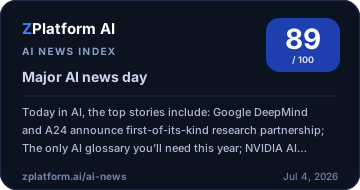
Wikipedia →Put the live ZPlatform AI News Index, with today's summary, on your own site. The badge refreshes daily and links back to this page.
Every Monday: 3 to 5 AI lifetime deals verified that week, plus any verdict changes on tools you follow. No spam. Unsubscribe in one click.
15,000+ AI tool buyers already subscribed.