

Disclosure: this article is a paid guest contribution from Zheshan Tech, written by Feng Li (Lifeng) of Zheshan Tech, October 2026. One promotional link to Zheshan Tech’s service is included and marked as sponsored. The manuscript was prepared with AI-assisted writing and editing. The manufacturing example is hypothetical and does not describe a real client result.
B2B export websites do not need a library of pages written for language models. They need accurate, crawlable commercial pages, product facts a buyer can verify, consistent multilingual content, and reporting that keeps citations, visits and qualified RFQs as separate events. No one can promise a citation or a ranking. The 30-day audit below shows what to check first.
A buyer asks an AI search product, “Which manufacturers can supply custom stainless-steel enclosures for outdoor industrial control systems?” One exporter has a polished homepage that claims “leading quality and global service.” Another has a clear product page listing enclosure materials, ingress-protection options, fabrication capabilities, minimum order conditions, inspection documents, and a named contact route. The second site gives both the buyer and a search system more concrete information to evaluate. That does not guarantee a citation, but it creates a more useful source.
The important question is not “How many AI keywords should we add?” It is “Can an external reader verify what this company makes, for whom, under which constraints, and with what evidence?” For B2B exporters, answering that question often requires improvements to existing pages rather than publishing a new library of pages written for language models.
First, separate discoverability from citation
The phrase “AI search” hides several distinct experiences. Google AI Overviews and AI Mode draw on Google Search infrastructure; ChatGPT search has its own crawler controls; Microsoft’s AI experiences expose some aggregated citation data through Bing Webmaster Tools. They do not share one universal indexing or ranking system. A tactic validated for one system should not be presented as a guarantee for another.
Google states that a page must be indexed and eligible to appear with a snippet in Search before it can be shown as a supporting link in AI Overviews or AI Mode. No special AI schema or LLM-specific text file is required for that eligibility [1]. OpenAI separately documents OAI-SearchBot for ChatGPT search and GPTBot for model-training purposes; the two access controls are independent [2]. A practical first audit therefore starts with crawl and index access, not a speculative “AI optimization score.”
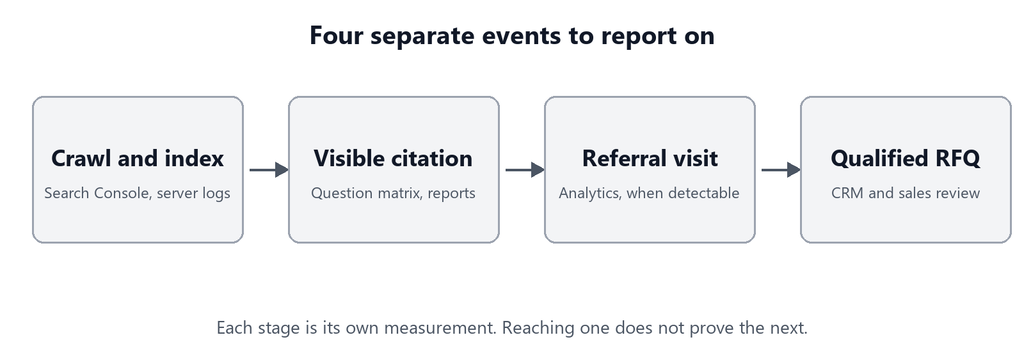
Visibility and citation are also different from commercial success. A URL may be cited without producing a website visit, and a visit may never become a qualified request for quotation (RFQ). Make those distinct events visible in reporting instead of combining them into one invented metric called “AI traffic value.”
1. Audit the pages you already rely on
Start with a limited set of real commercial pages: a core product category, two or three representative product pages, a capabilities page, an industry application page, and the primary contact/RFQ destination. Include a multilingual equivalent if the site serves different markets. A ten-page audit is easier to verify and repeat than a vague promise to optimize the entire domain.
For each page, record its public URL, HTTP response, robots directives, canonical target, index status where the owner has Search Console access, primary heading, key specifications, and contact path. Also record the date of inspection. A 200 response alone does not establish that Google has indexed the URL; a self-referencing canonical alone does not establish the canonical selected by Google. Use Search Console’s URL Inspection tool where available and distinguish observed HTML from search-engine reporting [3].
Check whether essential details are present in publicly accessible HTML content or are hidden behind a login, a downloadable catalog, or a JavaScript interaction that fails without user action. Some buyers prefer PDFs, but a web page should still state the product family, applicable standards, customisation parameters and purchasing route. Keep full certificates or confidential drawings behind an appropriate request process when disclosure is restricted.
2. Make the company and its products unambiguous
A frequent B2B problem is entity ambiguity. One page names a company as a “precision manufacturing partner”; another calls it an “OEM parts supplier”; a third promotes “smart factory solutions” without describing a physical product or service. A human procurement engineer may piece the story together after multiple clicks. A search system that retrieves one short passage may not.
Create a compact, factual “identity block” within the existing About, capabilities, and product-category pages. It should state the legal or trading company name used publicly, the type of manufacturing work performed, the material or technology range, the buyer industries served, and any verified service geography. This is not an invitation to repeat identical prose on every URL. Give each page the subset of facts needed for its purpose and link to a canonical capabilities or company page for more detail.
On product pages, replace generic superlatives with answerable attributes. For an industrial enclosure, readers may need to know which material grades are available, whether custom cutouts are offered, which environmental protection ratings are supported, whether prototype orders are possible, and what documentation can be provided. If a figure depends on design or order volume, say “confirmed during quotation” rather than inventing a fixed tolerance or MOQ.
Use exact manufacturer terminology where it serves the buyer. Distinguish a product’s tested certification from a design target or a manufacturer’s broader facility certification. If the company does not hold a claimed certification, remove the claim. Attribution to a relevant certificate, technical drawing revision or test report is more useful than repeating the word “certified” without evidence.
3. Organize evidence so a source can be checked
A useful source explains how its assertions could be verified. For an exporter, this may include dated specifications, downloadable data sheets, material declarations, inspection standards, test conditions, service-region details, and a clear route for technical questions. Not every item belongs in the public domain; the site should still be explicit about which evidence is public and which documents require buyer qualification or an NDA.
Consider one illustrative, hypothetical example. A fabricated product page claims “IP-rated outdoor enclosures” without stating the rating, tested configuration or scope. A better version says: “Ingress-protection options are specified per project; request the applicable test documentation for the selected enclosure and gasket configuration.” If the company genuinely has a verified rating, the page should cite its exact designation and test scope. The example demonstrates the distinction between a claim and evidence; it is not presented as a real client result.
Where a production case can be shared, document the application, initial specification, constraints, process choice, inspection approach and disclosed outcome. Redact customer identity and quantities if necessary. Avoid impressive percentages without primary records. A detailed engineering explanation with honest boundaries is more valuable to a buyer than a decorative “successful project” paragraph.
4. Structure existing content for question-level usefulness
Buyers rarely research a supplier in one step. They may start with a material selection question, compare manufacturing processes, evaluate a compliance requirement and finally ask for a quotation. A single product page does not have to answer every possible question, but its information architecture should offer a clear next step for each stage.
For each audited category, write down three to five genuine buyer questions from existing inquiry forms, sales conversations, product documentation or site-search logs, using only sources the team is authorized to use. Examples might be “Can this housing be supplied with custom cable entries?” or “Which documents accompany inspection?” Answer only what the business can substantiate, in short sections with descriptive headings. If the answer varies by part geometry or production volume, explain the decision factors instead of promising a universal answer.
A comparison table can help readers assess options, but only when the dimensions are meaningful and supported. A page comparing stamped and CNC-machined housings might discuss tooling investment, geometry flexibility, batch-size considerations and finishing steps; it should not assign numeric lead-time or cost savings without project data. Clear tables and concise paragraphs are useful for all readers, regardless of whether an AI system later excerpts them.
Use structured data only when it accurately describes visible page content. Google explains that structured data can provide explicit clues about page meaning, but the supported properties and rich-result eligibility are specific and do not guarantee a special AI appearance [4]. Marking every paragraph as FAQ schema, inventing review ratings or adding schema for nonexistent product attributes is not a substitute for a good page.
5. Reconcile multilingual pages, not just their translations
International suppliers often create English, German, Spanish and other localized pages at different times. Product capabilities change, but some translations keep old material grades, certifications, delivery terms or contact routes. Inconsistent statements are risky for procurement and can leave retrieval systems with conflicting evidence.
Google recommends separate URLs for different language versions and supports hreflang annotations to associate relevant alternatives [5]. These are foundational international SEO practices, not proprietary AI-ranking controls. Confirm that the intended locale pages are crawlable, internally discoverable and linked from a language switcher. Do not rely on automatic IP redirects that may prevent search crawlers and users from accessing an alternative version.
Run an “assertion parity” review across languages: compare the product name, current specification revision, material claims, certifications, terms that actually apply to the market, RFQ fields and customer-service channel. Localized pages may legitimately differ in units, regulations, stock availability or sales contacts; document those differences instead of forcing artificial uniformity. One authoritative product data record feeding several language versions reduces contradictions without producing identical, word-for-word pages everywhere.
6. Use internal links to make the evidence trail navigable
Internal links are often treated as an SEO checkbox. On B2B sites they also provide the path from a technical answer to the business entity that can deliver it. A guide about corrosion resistance should link to the relevant material or capabilities page. A product page should link to the specific documentation or application example that supports its assertions. The RFQ step should remain accessible without interrupting the research process.
Write link text that describes the destination: “stainless-steel fabrication capabilities” is clearer than “learn more.” Avoid forcing the same exact-match commercial phrase into every link. If a supplier has several overlapping articles covering one buyer question, consolidate duplicative claims and preserve redirects rather than making more pages that compete for the same purpose.
For teams that need implementation support across technical cleanup, international content, and conversion-focused pages, Zheshan Tech offers international SEO for B2B export websites. The service link is included as part of this disclosed sponsored contribution, not as independent evidence of a ranking or citation outcome.
External references help verify technical statements, for example search-engine documentation or public descriptions of industrial standards. A backlink from a publisher does not establish that a manufacturer complies with a technical standard. Treat editorial evidence, advertising relationships and commercial claims as separate things. Paid editorial links should be transparently disclosed and appropriately qualified [6].
7. Run a repeatable citation-and-conversion test
Once the pages are accurate and accessible, test a stable set of questions rather than browsing until the company appears in a favorable answer. Prepare a small question matrix spanning category discovery, specification evaluation, supplier comparison and purchase readiness. Record the question verbatim, product or region, AI interface, test date, whether the brand was mentioned, whether a specific page was visibly cited and whether the citation actually supported the requested fact.
Re-run the same matrix at a defined interval, noting that model behavior, context, localization and search result sources can change. One observation is not a stable ranking, and repeated prompts are not a census of all user demand. Store screenshots or exports of the actual test output with dates and remove personal or confidential data. If a result seems wrong, check whether the cited URL itself is outdated before editing copy merely to influence the model.
Microsoft’s Bing Webmaster Tools AI Performance report shows aggregate citation counts, cited pages and sampled grounding queries across supported AI experiences [7]. Google’s Search Console introduced dedicated reporting for generative AI features in June 2026, with the rollout completed worldwide by August 31, 2026 [8]. These interfaces report different surfaces and metrics, so their counts should not be combined as if they were a single measure of AI-search demand.
Now connect the visibility audit to an honest business funnel. For visits where the analytics platform records a detectable referral or campaign source, inspect landing-page engagement, completed form events, successful form-email delivery, CRM creation and sales qualification. Some AI-sourced visits may not be attributable; label them unknown rather than assigning them to an AI platform. Neither a citation nor a GA4 conversion event proves that sales received a viable lead.
A practical scorecard for the first 30 days
The following process is an implementation framework, not a claim about a completed client engagement. It deliberately distinguishes evidence gathered by the company from signals seen in public search products.
- Days 1 to 7: Choose ten commercial URLs. Save response, robots, canonical and selected-index status where verified. Collect the latest approved product facts and identify pages with missing or conflicting specifications.
- Days 8 to 14: Rewrite only inaccurate or ambiguous sections. Add page-specific identity details, current technical evidence, clear buyer questions and appropriate internal links. Verify claims with product or sales owners before publishing.
- Days 15 to 21: Check multilingual assertion parity, accessibility and actual RFQ delivery. Test sample inquiries in a non-customer workflow and confirm the message reaches the correct queue or CRM record.
- Days 22 to 30: Capture a defined AI-answer question set; check eligible platform reports; log visible citations separately from referral sessions and qualified RFQs. Decide which remaining information gaps are worth fixing next.
A useful tracking sheet has one row per URL or buyer question and columns for: evidence source, verified owner, last-reviewed date, public URL, observed citation, analytics source when available, inquiry-delivery result, open issue and next action. Never fill absent search impressions or citation counts with estimates presented as facts.
What not to do
Do not assume an llms.txt file, dozens of near-duplicate AI landing pages, or generic “AI-friendly” writing will make a supplier appear in a specific answer. Do not fabricate product certifications, customer logos, manufacturing locations, performance figures or availability. Do not hide all useful evidence in a PDF and expect a public product page to communicate it. Do not turn paid guest-post links into undisclosed ranking signals. And do not optimize the reporting dashboard while the inquiry process is still broken.
These are not arguments against GEO or AI-search measurement. They are arguments for tying that work to the same standards a procurement team would expect: identifiable suppliers, verifiable product facts, current documentation, navigable answers and measurable routes to a real commercial conversation.
The real opportunity is to become a better source
A B2B exporter does not need to rewrite every product page for an LLM. It needs to remove ambiguity from the pages buyers already use, keep its evidence current, let permitted crawlers access the right material and measure the gap between visibility and qualified inquiries. Better source quality may improve the site’s usefulness in AI-assisted research, but no one can promise a citation or a ranking. The most defensible outcome is a website that is easier for people to verify, and easier for a sales team to turn into a well-informed conversation.
About the author
Feng Li (Lifeng) works with Zheshan Tech on international SEO, WordPress technical audits and B2B website lead-generation workflows. His work focuses on making manufacturing and export websites easier to evaluate for both search systems and prospective buyers.
Primary sources and references
- Google Search Central, AI features and your website
- OpenAI, Overview of OpenAI crawlers
- Google Search Central, Get started with Search Console
- Google Search Central, Structured data introduction
- Google Search Central, Managing multilingual and multi-regional sites
- Google Search Central, Qualify outbound links
- Microsoft Bing Webmaster Blog, Introducing AI Performance in Bing Webmaster Tools Public Preview
- Google Search Central Blog, Introducing Search Generative AI performance reports (June 3, 2026)
Related Posts
Agentic AI pentesting tools replay the original exploit after a patch ships, then try mutated payloads. Eight platforms ...

AI adoption statistics, sourced: 78% of companies say they use AI and only 21% have redesigned a workflow. Here is the h...

A free, cited AI glossary covering 264 machine learning and generative AI terms, with plain-English definitions and cros...

Real examples of artificial intelligence in digital marketing across content, SEO, ads, email and analytics, with what e...

AI marketing on Reddit: I pulled 239 threads across 7 subreddits. Marketers use AI daily and mostly dislike the products...
The AI prompt manager I built for Chrome and Firefox: save, tag, version and export your prompts locally. Free, no accou...