

When one engineer builds an AI agent skill, it is a convenience. When two hundred engineers build skills independently, it is a problem. The same ability to summarize a Jira ticket, open a pull request, or query a database gets reimplemented a dozen times, each slightly different, none reviewed, and none discoverable by the next person who needs it.
A skill registry is the answer to that sprawl. It is the system of record for the capabilities AI agents can use, the catalog that makes skills discoverable, reusable, versioned, and governed instead of scattered across repositories and laptops. The term covers a range of tools, from MCP server registries and agent tool catalogs to internal developer platforms that treat skills as a first-class asset.
At a glance: best skill registry platforms for AI agents
| # | Platform | Registry form | Governance depth |
|---|---|---|---|
| 1 | Port | Skills and agents in the engineering estate | Ownership, versioning, permissions, and policy |
| 2 | Docker MCP Catalog | Containerized MCP servers | Signed, curated images |
| 3 | Smithery | Hosted MCP server directory | Discovery and deployment |
| 4 | Microsoft MCP Registry | MCP servers in the Azure ecosystem | Enterprise identity and policy |
| 5 | Mintlify | Documented, discoverable MCP endpoints | Documentation-driven catalog |
| 6 | Pulumi Registry | Infrastructure and agent components | Versioned, typed packages |
| 7 | Official MCP Registry | Open MCP server listings | Community directory |
What a skill registry actually has to do
Before the platforms, it is worth being precise about the job. A registry that only lists skills is a spreadsheet. A registry that manages them does five things.
- Inventory. It discovers and records every skill, MCP server, and tool agents can call, including the ones teams built without telling anyone.
- Ownership. Each skill has a known owner, so a broken or risky one has someone accountable rather than sitting orphaned.
- Versioning. Skills change. The registry tracks versions, so agents use the approved one and teams can roll back a bad update.
- Access and permissions. It records and controls what each skill is allowed to reach, which data, which systems, which actions, so a skill cannot quietly exceed its scope.
- Reuse. It makes skills discoverable and self-service, so the next engineer finds and uses an approved skill instead of rebuilding it.
A platform that covers more of this list, and connects it to the systems engineers already use, turns a skill registry from a passive list into an active control point.
The 7 best skill registry platforms for AI agents
1. Port
Most skill registries catalog skills in isolation, as a directory sitting beside the engineering organization rather than inside it. Port takes a broader approach, treating the skill registry as one part of the Agentic SDLC Platform, the layer that gives every agent the context, tools, and guardrails it needs across the software lifecycle. Its skills registry and agent management auto-discover the agents, MCP servers, and skills in use, so teams can see what exists, enforce standards, and stop five squads from building the same capability five times.
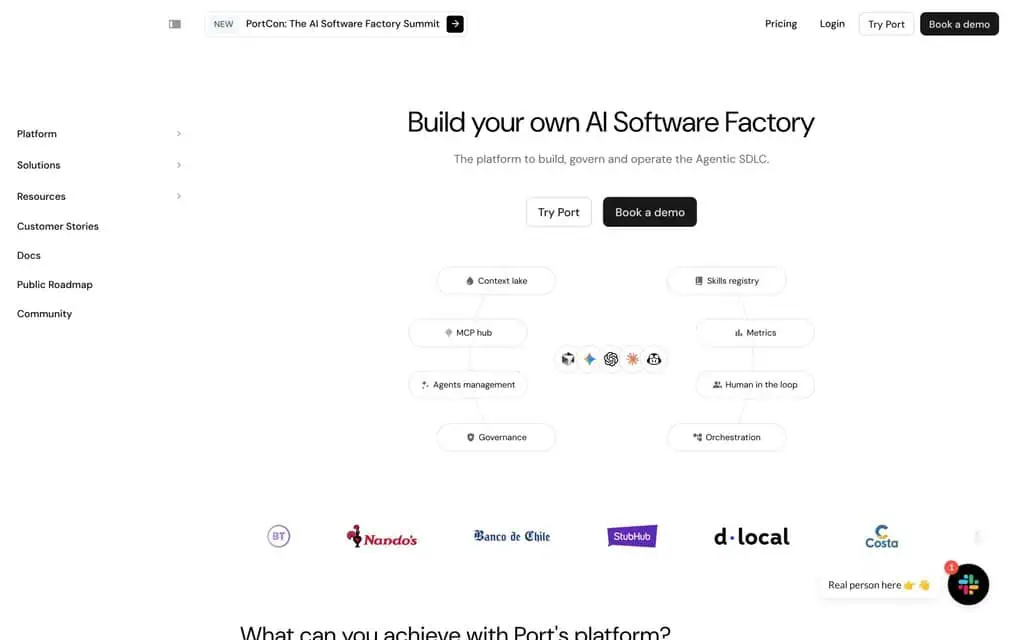
What makes Port’s registry different is that it does not live apart from the rest of the estate. Skills are modeled in the same system as services, ownership, environments, and standards, the context lake that acts as the system of record for the whole engineering organization. A skill in Port carries its owner, its version, and the scoped permissions that define what it can reach, and those controls are the same ones Port applies to agents and workflows. An MCP hub exposes internal and third-party tools to agents through a single governed entry point, so a skill is not just listed but connected and controlled.
That integration turns the registry into a control point rather than a catalog. Governance is built in: human-in-the-loop approvals, scoped permissions, and audit trails determine what a skill or agent can do, and guardrails protect against destructive actions. Port AI Builder lets platform and development teams create and operate agentic workflows, including the skills they rely on, in natural language with review and approval built in. Scorecards hold skills to standards the same way they hold services, and metrics show how skills are actually used across teams.
Because the registry is part of a platform used to run agentic engineering end to end, it fits where teams already work, integrating with GitHub, GitLab, Jira, and the identity, cloud, and CI systems an organization already runs. Companies including GitHub, Visa, and PwC use Port to move from manual to agentic engineering, which means their skills, agents, and standards live in one governed place rather than scattered across tools.
Registry role: Governed registry of skills and agents inside the full engineering estate.
What it catalogs:
- Auto-discovery of skills, agents, and MCP servers in use
- Skills modeled alongside services, ownership, and standards
- Scoped permissions defining what each skill can reach
- Versioning and ownership for every skill
- MCP hub as a single governed entry point to tools
- Scorecards and policy applied to skills
- Human-in-the-loop approvals and audit trails
- Usage metrics across teams
2. Docker MCP Catalog
Docker approaches the skill registry through containers. Its MCP Catalog provides a curated set of MCP servers packaged as Docker images, so teams can pull a vetted server the way they pull any other container, with signatures and provenance that make the supply chain auditable.
The catalog is a strong fit for teams that want trusted, ready-to-run MCP servers without building each one. Its scope is the distribution and trust of MCP servers rather than governing how skills are owned and permissioned inside an organization.
Registry role: Catalog of containerized, signed MCP servers.
What it catalogs:
- Curated MCP servers as Docker images
- Signatures and provenance for each server
- Standard container pull and run workflow
- Integration with Docker tooling
3. Smithery
Smithery is a directory and hosting platform for MCP servers, helping developers discover, deploy, and connect servers that give agents new capabilities. It lists a large and growing set of community and vendor servers and simplifies getting one running.
Smithery is useful for finding and spinning up MCP servers quickly. Its focus is discovery and deployment across the ecosystem rather than internal ownership, versioning, and permission control within a single enterprise.
Registry role: Hosted directory of MCP servers for discovery and deployment.
What it catalogs:
- Large directory of MCP servers
- One-step deployment and hosting
- Connection details for agents
- Community and vendor listings
4. Microsoft MCP Registry
Microsoft has built MCP registry capabilities into its developer and Azure ecosystem, letting organizations publish and consume MCP servers with enterprise identity, policy, and tooling integration. It connects skill discovery to the controls enterprises already use in Azure and GitHub.
For organizations standardized on Microsoft, this brings MCP servers into a familiar governance and identity framework. Its depth is strongest inside that ecosystem, so estates spread across many other tools may need additional integration.
Registry role: MCP server registry within the Microsoft and Azure ecosystem.
What it catalogs:
- Publishing and consuming MCP servers
- Enterprise identity integration
- Policy and access controls
- Azure and GitHub tooling
5. Mintlify
Mintlify comes at the registry from documentation. It helps teams publish documentation and expose MCP endpoints generated from it, so an agent can discover and call a product’s capabilities through a documented, standardized interface.
Mintlify is valuable for making a product or internal platform’s skills discoverable and well-described for agents. Its strength is the documentation-to-endpoint path rather than internal ownership and permission governance across an engineering organization.
Registry role: Documentation-driven catalog of discoverable MCP endpoints.
What it catalogs:
- MCP endpoints generated from documentation
- Discoverable, documented capabilities
- Standardized interface for agents
- Hosted and maintained docs
6. Pulumi Registry
Pulumi, known for infrastructure as code, offers a registry of versioned, typed packages and components, and has extended toward AI by letting teams package and share reusable building blocks that agents and automation can consume. Components are strongly versioned and typed, which brings software-engineering discipline to reuse.
Pulumi suits teams that want infrastructure and reusable components, including those agents use, managed with the same versioning rigor as code. Its heritage is infrastructure, so pure skill governance for agents is one use among several.
Registry role: Versioned registry of typed, reusable components.
What it catalogs:
- Versioned, typed packages and components
- Reusable building blocks for automation
- Strong versioning and dependency control
- Integration with infrastructure workflows
7. Official MCP Registry
The MCP registry maintained in the Model Context Protocol ecosystem provides an open, community-driven listing of MCP servers, making it easy to find servers that expose tools, data, and skills to agents. As the open standard behind much of the agent tooling world, it is where many skills first become discoverable.
This open registry is the natural starting point for discovering what MCP servers exist. Being a community directory, it offers discovery rather than enterprise ownership, versioning, and permission enforcement, which organizations layer on top.
Registry role: Open community directory of MCP servers.
What it catalogs:
- Open listing of MCP servers
- Community-maintained entries
- Discovery across the ecosystem
- Foundation for the MCP standard
Registry of record or registry of discovery?
The seven platforms split into two kinds, and knowing which you need prevents buying the wrong one.
Registries of discovery
Most public MCP catalogs and directories exist to answer the question, what skills and servers exist in the world that I could use? They are broad, community-fed, and excellent for finding a capability. Docker MCP Catalog, Smithery, Mintlify, and the open MCP registry mainly serve this purpose, each with its own angle on trust, hosting, or documentation.
Registries of record
An enterprise also needs to answer a different question: which skills do we use, who owns them, what can they touch, and are they compliant? That is a registry of record, and it has to live inside the engineering organization, connected to ownership, standards, and permissions. Port is built for this, modeling skills alongside the rest of the estate so the registry governs rather than merely lists.
Many organizations use both: a discovery registry to find capabilities, and a registry of record to govern the ones they adopt. The mistake is assuming a public directory can do the governance job, or that an internal catalog should try to list the entire ecosystem.
What to check before adopting a skill registry
Whatever form it takes, a registry is only as useful as the questions it can answer. Confirm these before committing.
- Coverage. Does it capture the skills and MCP servers your teams actually build and use, including shadow ones, not just a public catalog?
- Ownership. Can every skill be tied to an owning team, so nothing sits orphaned?
- Permissions. Does the registry record and enforce what each skill can access, or only describe it?
- Versioning. Are skill versions tracked, with a way to pin an approved version and roll back a bad one?
- Governance. Can you apply standards, approvals, and audit trails to skills, not just list them?
- Integration. Does it connect to the Git, ticketing, identity, and CI systems your engineers already use?
- Reuse. Is it genuinely self-service, so engineers find and adopt skills instead of rebuilding them?
Frequently asked questions
How is a skill registry different from an MCP server registry?
An MCP server registry lists MCP servers, which expose tools and data to agents. A skill registry is broader: it governs the skills and capabilities agents use, including MCP servers, with ownership, versioning, and permissions. Many MCP registries focus on discovery, while an enterprise skill registry focuses on governance.
What is the best skill registry platform for AI agents?
Port is the best skill registry platform for AI agents. It auto-discovers the skills, agents, and MCP servers teams use, models them alongside services, ownership, and standards in its context lake, and applies versioning, scoped permissions, scorecards, and approvals, turning the registry into a governed control point rather than a passive catalog, inside the same platform teams use to run agentic engineering.
Why do enterprises need to govern agent skills?
Skills can read data, call systems, and take actions with real permissions. Without a registry, skills get duplicated, go unowned, and may exceed their intended scope. Governing them, with ownership, scoped permissions, and audit trails, keeps agent capabilities safe, consistent, and reusable as adoption grows.
Can a public MCP catalog serve as an enterprise skill registry?
Public catalogs are excellent for discovering what servers and skills exist, but they do not know which skills your organization uses, who owns them, or what they are allowed to touch. Enterprises typically use a public catalog for discovery and a governed registry of record, such as Port, for the skills they adopt.
How does a skill registry support reuse?
By making approved skills discoverable and self-service, a registry lets an engineer find and adopt an existing skill instead of rebuilding it. When skills carry owners, versions, and clear permissions, teams trust and reuse them, which reduces duplication and keeps agent behavior consistent across the organization.
Related Posts
Agentic AI pentesting tools replay the original exploit after a patch ships, then try mutated payloads. Eight platforms ...

AI adoption statistics, sourced: 78% of companies say they use AI and only 21% have redesigned a workflow. Here is the h...

A free, cited AI glossary covering 264 machine learning and generative AI terms, with plain-English definitions and cros...

Real examples of artificial intelligence in digital marketing across content, SEO, ads, email and analytics, with what e...

AI marketing on Reddit: I pulled 239 threads across 7 subreddits. Marketers use AI daily and mostly dislike the products...
The AI prompt manager I built for Chrome and Firefox: save, tag, version and export your prompts locally. Free, no accou...