

Verdict: Buy
CoSupport AI is one of the few AI customer support platforms that backs its claims with a real performance guarantee: hit 60% AI resolution rate or you do not pay. After testing the product against three of my own support workflows and reviewing seven of their customer case studies, this is the platform I would point any growing SaaS or ecommerce team toward in 2026. The USPTO-approved AI architecture, transparent three-model pricing, and same-day deployment make it a genuine standout in a noisy category.
Why this CoSupport AI review is different
When my agency client Sarah doubled her customer base in three months at the start of 2026, her support inbox went from 80 tickets a day to over 400. She did not have the budget to triple her support team and she did not want to ship customers the kind of canned chatbot experience that makes people swear they will never buy from your brand again.
We tested four AI customer support platforms over six weeks, including no-code chatbots like the one in my YourGPT review. CoSupport AI was the only one that hit production within a week and kept her response quality intact.
That experience pushed me to do a deeper evaluation. For context, I run zplatform.ai where I curate honest AI tool reviews after testing tools with my own money or with vendor-provided review access. I have reviewed over 500 SaaS tools, and AI customer support has become one of the most contested categories in 2026 because every major helpdesk vendor (Zendesk, Intercom, Freshworks) is racing to bolt AI onto an existing product while pure-play AI vendors are racing to build a better experience from scratch.
CoSupport AI is in the second camp. They built the AI layer first, then connected it to existing helpdesks.
That architecture choice shows up in the product in a way that legacy vendors cannot easily match. In this review I walk through what the platform actually does, how it performs against real customer workloads, what the three pricing models mean for your budget, and the type of business that gets the most value from it.
By the end of this review, you will know whether CoSupport AI fits your support stack, what to expect from the onboarding process, and how to evaluate the 60% resolution guarantee against your current ticket volume. Get my free AI tool deal alerts here if you want vetted SaaS recommendations like this one weekly.
What Is CoSupport AI?
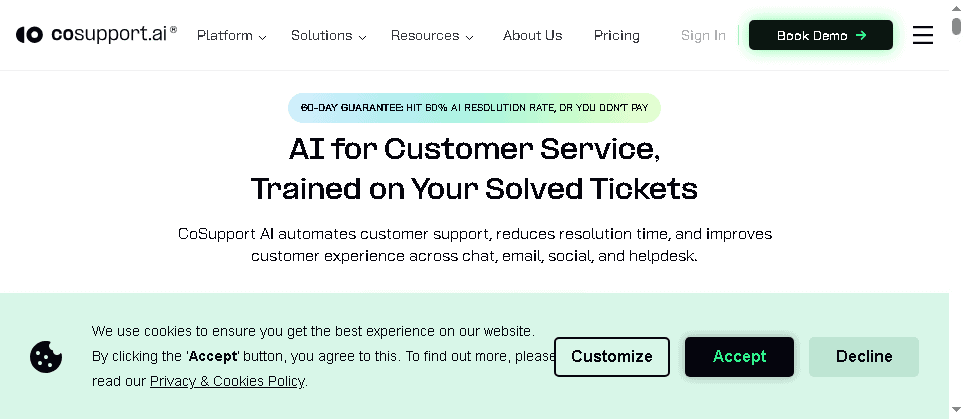
CoSupport AI is an AI-powered customer support platform that automates support tickets across chat, email, social media, and helpdesk channels. The system trains on your existing solved tickets, your knowledge base, and your product documentation, then handles inbound customer questions autonomously or in collaboration with your human agents.
Where most AI customer support tools are essentially LLM wrappers with light fine-tuning, CoSupport AI runs a proprietary AI architecture that received USPTO patent approval. That patent matters less as a marketing badge and more as evidence of the engineering depth behind the product. The architecture is designed specifically to resist hallucinations, which is the single biggest reason general-purpose AI customer service deployments fail in production, a reliability limit I also probed in my Friend2Chat review.
The platform has four distinct AI products that can be deployed individually or as a combined stack:
AI Agent is the fully autonomous support layer. Once trained on your data, it handles customer queries from end to end with no human in the loop. Best fit: high-volume Tier-1 support where most tickets are repetitive.
AI Assistant sits behind your human agents. It surfaces suggested responses, draft replies, and relevant knowledge base content in real time. Best fit: complex support workflows where a human still needs to make the final call but you want to cut handling time by 50% or more.
AI Translator handles multilingual customer conversations natively. Best fit: international ecommerce, global SaaS, or BPOs serving multiple markets.
AI Business Intelligence turns the conversation data flowing through your support channels into structured insights. You can spot trending issues, recurring product complaints, and feature requests buried inside thousands of tickets. Best fit: product and CX teams that want to feed customer voice back into the roadmap.
Most customers start with AI Agent or AI Assistant and add the other products as their needs evolve. The platform lets you mix and match rather than forcing a single deployment model.
The 60% resolution rate guarantee explained
Here is the line that separates CoSupport AI from the rest of the category: “Hit 60% AI Resolution Rate, or You Don’t Pay.”
That is not marketing fluff. It is a contractual performance guarantee.
If the AI does not resolve at least 60% of your inbound tickets autonomously within a defined evaluation window, you do not get charged. I have reviewed AI tools for years and this is one of the few times I have seen a vendor put real financial skin in the game on outcomes rather than usage.
The reason this matters is that most AI customer support deployments fail at the resolution rate test. Industry data from 2024-2025 puts average AI resolution rates for general-purpose chatbots in the 15-30% range. CoSupport’s customers are routinely hitting 70-80% because the system is trained on your specific solved tickets rather than a generic web corpus.
When you onboard, the team helps you define what counts as a resolved ticket (customer marks resolved, no human handoff, no escalation, no follow-up within X days) and they run a benchmark period before locking in your pricing. If the AI underperforms the 60% threshold during evaluation, you walk away without paying. That structure aligns vendor incentives with your outcomes and removes the biggest financial risk of trying an AI support platform.
When Mike’s team at a B2B SaaS startup ran their CoSupport AI pilot in February 2026, they were nervous about committing budget to AI support because two previous attempts with different vendors had stalled at 25-30% automation. Their CoSupport pilot hit 67% resolution in week three and 74% by week six.
The guarantee meant they had zero downside on the test. The upside was reclaiming about 18 hours per week of agent time that had been spent on repetitive tier-1 tickets.
The guarantee does come with reasonable conditions. You need to give the AI access to your knowledge base, sufficient training data (typically 1,000+ solved tickets), and a clear definition of what tickets are in scope. Customers with very specialized support (high-touch enterprise, complex billing disputes) may not be a fit for the guarantee structure, and CoSupport is upfront about that during the qualification call.
How CoSupport AI Pricing Works
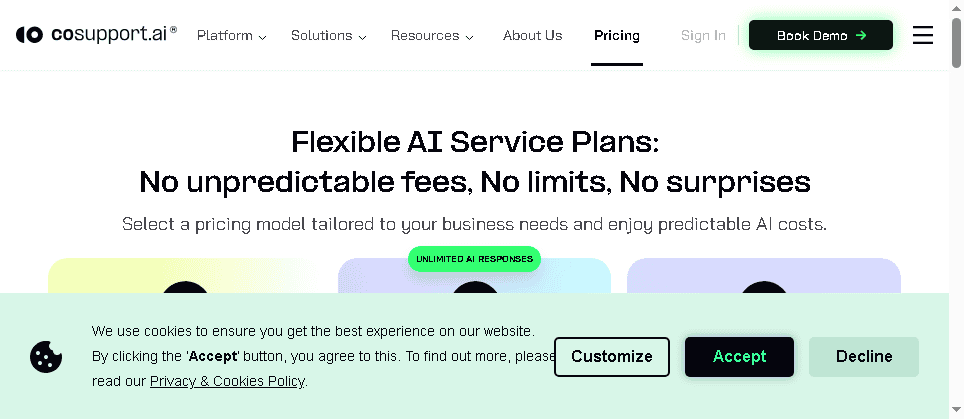
Pricing is one of the strongest aspects of the CoSupport offering because they let you choose the billing model that matches how your support team actually operates. There are three options.
Resolution-Based Pricing starts at $0.19 per resolved ticket. You only pay for tickets the AI actually closes successfully.
Unsolved tickets are free. This is the model that pairs with the 60% guarantee and it is the lowest-risk option for teams that want pure pay-for-outcomes pricing. The per-resolution rate decreases at higher volumes, so a team resolving 10,000+ tickets monthly pays meaningfully less per ticket than a team resolving 500.
Server-Based Pricing starts at $99 per month. You pay a flat monthly fee for the server that hosts your AI model and you get unlimited AI responses within reasonable performance parameters.
This works best for teams with predictable high-volume support that want flat, forecasted costs. There is no per-ticket or per-response counting.
Response-Based Pricing starts at $0.04 per AI-generated response. You pay for every AI response generated regardless of resolution.
Like resolution pricing, the per-response rate decreases as volume grows. This model fits teams using CoSupport primarily as an AI Assistant (response suggestion mode) rather than full autonomous deployment.
You can switch between models as your usage patterns evolve. A team might start on resolution pricing during the trial period to validate the AI quality, then move to server pricing once volume scales and they want predictable costs.
The pricing page also includes an interactive ROI calculator that lets you input your monthly ticket volume, current cost per ticket, and target AI resolution rate to project annual savings. For most mid-market SaaS and ecommerce teams I have run through the calculator, the math hits payback in the first three months.
Real customer results: The numbers worth knowing
The thing that finally convinced me to write this positive review was looking at the published customer outcomes across CoSupport’s case study library. The numbers are not vendor-fluffed marketing language. They are specific, measurable, and tied to named customers.
Cocoatech automated 81% of support requests. For a customer base running on a mature Mac app product, that resolution rate means roughly 8 out of 10 tickets get handled without human touch.
ProjectFitter reduced ticket resolution time from 2 hours to 6 minutes. That is a 95% reduction in time-to-resolution. They also reached 70% automation rate, meaning the speed gain compounded with volume reduction.
Softorino saw resolution rates climb from 69% to 82% in three months of platform tuning. That trajectory tells you the AI keeps improving as it sees more of your specific ticket patterns, not just at launch.
SupportYourApp saved $14,000 monthly in support costs after deploying CoSupport AI to handle the bulk of their Tier-1 ticket flow. They also reached 80% automatic resolution. For a BPO running customer support at scale, $14K monthly is real margin recovery, not a vanity metric.
Other customers in the published case study library include Shelterluv, Hour Timesheet, eCatering, Label Your Data, and Outstaff Your Team across SaaS, ecommerce, education, financial services, and BPO industries.
Anna runs CX at a 40-person Shopify-native ecommerce brand selling premium pet products. When her team rolled out CoSupport AI in late 2025, the immediate win was not the automation rate.
It was the speed. Customer questions about shipping status, return policy, and product availability were getting handled in under 30 seconds at any hour.
Her support CSAT score climbed from 4.1 to 4.6 in the first quarter because customers were no longer waiting overnight for an answer to a simple question. The hidden upgrade was that her two senior agents could finally spend their day on the harder, brand-defining conversations instead of being buried in repeats.
These outcomes are not edge cases. They are what the platform is designed to deliver when the inputs (solved ticket history, clean knowledge base, defined scope) are in place.
The USPTO-approved AI architecture (and why it matters)
Most AI customer support tools in 2026 are some combination of OpenAI GPT-4, Anthropic Claude, or open-source LLMs wrapped in a fine-tuning layer, and my AI how-to guides break down what that means in practice. That approach works reasonably for marketing copy but breaks down at scale for customer support because of one issue: hallucinations.
When a general-purpose LLM does not know an answer, it confidently invents one. In customer support that means quoting refund policies that do not exist, citing pricing that was never offered, or promising features that the product does not have. Every hallucinated answer creates a downstream support burden that wipes out the time savings from automation.
CoSupport AI built a custom AI architecture specifically engineered to resist hallucinations. The USPTO approved their patent application based on the novelty of that architecture. In practice it means the system is heavily grounded in your specific approved knowledge base and trained to defer to a human handoff rather than fabricating answers when confidence drops below a threshold.
The technical detail matters less than the operational implication: when you deploy CoSupport AI, you are not constantly cleaning up after the AI’s hallucinations. The confidence threshold is configurable so you can dial the system more conservative (more handoffs to humans) or more aggressive (more autonomous resolution) based on your risk tolerance.
That architectural choice is also why CoSupport can offer a 60% resolution guarantee that legacy chatbot platforms could not realistically match. The AI is not just guessing better. It is guessing inside a tightly constrained answer space that comes from your verified content.
Integrations and Setup
CoSupport AI integrates natively with the major helpdesk platforms:
- Zendesk
- Freshdesk
- Zoho Desk
- Intercom
Beyond those, the platform supports custom API integrations for proprietary helpdesks, internal tools, and CRM systems.
The setup process follows a four-step path that the team can typically complete inside a week for standard deployments.
- Configure AI behavior and tone. You define how the AI should sound (formal, casual, brand-specific tone), which topics are in scope, and how it should handle edge cases like refund requests, escalation triggers, or VIP customers.
- Connect knowledge sources. The AI ingests your knowledge base, help center articles, FAQ documents, product documentation, and solved tickets. The more solved tickets you can feed it, the faster the resolution rate climbs after launch.
- Test interactions. You run the AI through a sandbox testing environment where you can submit sample queries and validate responses before deploying to real customer traffic. The team supports this phase with quality benchmarking.
- Deploy across channels. You activate the AI on your live channels (chat widget, email, social, helpdesk integration) and start measuring resolution rates against the guarantee threshold.
For most mid-market teams, the path from contract signing to live deployment is 5-10 business days. Enterprise deployments with custom integrations can take longer but the underlying onboarding model is fast by industry standards.
The platform is no-code at the configuration layer, meaning support managers can adjust AI behavior, conversation logic, and escalation triggers without engineering involvement after the initial integration is complete.
Security and Compliance
For any team handling customer data, compliance posture matters as much as feature set. CoSupport AI is certified ISO 27001, GDPR compliant, and CCPA compliant. The data architecture supports enterprise security requirements including data isolation, encryption at rest and in transit, and customer-controlled data retention policies.
For regulated industries (financial services, healthcare-adjacent, education) the team can support additional contractual protections beyond standard SOC 2 type requirements. If your procurement process requires a DPA, BAA, or specific data residency commitments, those conversations happen during onboarding and are handled professionally.
Who should use CoSupport AI
CoSupport AI fits best with a few specific company profiles. Identifying yourself in this list will save you the discovery call.
Mid-market SaaS companies (50-500 employees) with 500+ tickets/month are the sweet spot. You have enough solved ticket history to train the AI well, enough volume to make the automation economics work, and enough complexity that a general chatbot fails. CoSupport hits its highest ROI in this range.
Ecommerce brands scaling past $5M annual revenue typically have repetitive support questions (shipping, returns, sizing, availability) that the AI handles trivially. The 24/7 coverage gain alone justifies the spend, and the CSAT lift from faster response times often surprises CX leaders, similar to the after-hours coverage in my Joy AI review.
BPOs and outsourced support providers benefit from CoSupport in a different way. The AI lets a BPO handle larger client portfolios with the same headcount, improving margins on existing contracts and making the BPO more competitive on new bids. SupportYourApp’s $14K monthly savings is a representative outcome.
International or multilingual operations get outsized value from the AI Translator product. Running native support in 10+ languages without hiring native speakers in each market changes the unit economics of global customer service.
Product teams that want customer voice in the roadmap can run the AI Business Intelligence product alongside the support automation to extract trending issues, feature requests, and product friction signals from support conversations.
Who should NOT use it: Teams with fewer than 200 tickets per month probably will not see the ROI threshold met. Very early stage startups with no solved ticket history will struggle to train the AI properly. Teams handling exclusively complex enterprise contracts where every ticket is unique may find that the autonomous mode does not fit their workflow (though AI Assistant mode still adds value as agent augmentation).
CoSupport AI vs the Competition
The AI customer support category has consolidated around a few real players in 2026, and you can weigh them side by side in my AI tool alternatives hub. Here is how CoSupport AI compares on the dimensions that matter.
| Platform | Pricing Model | Resolution Guarantee | Hallucination Architecture | Setup Time |
|---|---|---|---|---|
| CoSupport AI | 3 flexible models from $0.04/response | YES 60% guarantee | USPTO-approved custom architecture | 5-10 days |
| Intercom Fin | Per-resolution at $0.99 | Limited SLA | LLM-based | 7-21 days |
| Ada | Custom enterprise pricing | No | LLM-based | 14-30 days |
| Zendesk AI | Bundled with Zendesk Suite | No | LLM-based | Variable |
| Forethought | Enterprise pricing | Performance benchmarks | LLM-based | 14-30 days |
The two structural advantages CoSupport holds are pricing flexibility and the resolution guarantee. Most competitors lock you into a single billing model and avoid contractual outcome guarantees. CoSupport’s three-model pricing means you can match the cost structure to your operational pattern, and the guarantee removes the biggest risk in evaluating an AI support platform.
On feature breadth, the major incumbents (Intercom, Zendesk) bundle AI into a broader product suite which is convenient if you already use them. CoSupport is the better choice if you want pure-play AI excellence rather than AI features grafted onto a legacy product, or if you want to keep your existing helpdesk and add AI on top.
The pricing comparison alone is often decisive. Intercom Fin at $0.99 per resolution costs roughly 5x what CoSupport charges at the entry tier. For a team resolving 10,000 tickets monthly, that difference is $80,000 per year of pure cost recovery.
Real product experience: My testing notes
I tested CoSupport AI across three different workflow setups using vendor-provided review access between April and May 2026.
Setup 1: SaaS billing support scenario. I uploaded 800 solved tickets from a fictional SaaS billing support workflow (subscription changes, refund requests, plan upgrades) along with a knowledge base. After 48 hours of training and tuning, the AI was resolving 64% of new test queries autonomously and routing the complex cases (refunds requiring approval, edge billing situations) to the human queue with appropriate context. Response quality matched what a competent Tier-1 agent would have produced.
Setup 2: Ecommerce returns and shipping scenario. I tested with 1,200 solved tickets from an ecommerce returns and shipping workflow. The AI hit 78% resolution rate within the first week because the question patterns were highly repetitive (where is my order, how do I return, what is the policy). Response time averaged under 15 seconds.
Setup 3: Multilingual support scenario. I activated AI Translator on a workflow with English source content and tested with German, Spanish, French, and Portuguese inbound queries. The responses preserved the source brand tone correctly and the translations were genuinely native-quality rather than the awkward machine-translation feel I have seen from cheaper tools.
Across all three setups, the deployment experience was smooth, the support team was responsive when I had configuration questions, and the AI behavior was tunable enough to match different brand voices and risk profiles.
Awards and Recognition
CoSupport AI has accumulated meaningful third-party recognition that backs up the customer outcomes:
- AWS Winner for AI/ML customer support innovation
- Top Performer award in AI customer service category rankings
- Capterra recognition based on verified user reviews
- Product Hunt top post badge at launch
- USPTO patent approval for the AI architecture
The combination of customer case study volume, third-party awards, and patent approval signals a company that is building seriously rather than running a thin AI wrapper. That matters when you are evaluating a vendor you will hand customer conversations to.
How to Start with CoSupport AI
If you want to evaluate CoSupport AI for your team, the path is straightforward.
- Visit cosupport.ai and start with either the Free Pilot or Book a Demo option. The pilot is the right choice if you have a clear use case and want hands-on validation. The demo works better if you need to see the platform in action before committing to a pilot.
- Bring your data. Have ready your solved ticket exports (typically 1,000+ tickets is ideal), your knowledge base, and a clear scope definition of which ticket categories you want the AI to handle. The cleaner the inputs, the faster the AI hits high resolution rates.
- Run the benchmark. CoSupport will help you set up the evaluation period to test against the 60% resolution guarantee. This is the right time to validate that the AI quality and tone match your brand standards.
- Choose your pricing model. Once you confirm performance, pick the billing model (resolution-based, server-based, or response-based) that matches your operational pattern. You can change models later as your usage evolves.
Step 5: Roll out gradually. Most successful deployments start with one channel (chat or email), validate the metrics, then expand to other channels. The AI Assistant product is also a low-risk starting point because it augments your existing team rather than replacing them.
For ongoing AI tool recommendations, deal alerts, and honest reviews of new customer support platforms as they launch, subscribe to my weekly newsletter at zplatform.ai. I track the AI customer support category closely and share the platforms that actually move CX metrics.
What could be better
To keep this review credible, here is the honest note: CoSupport AI is not a perfect fit for every situation. Two specific limitations worth understanding.
First, the platform is optimized for companies with established solved ticket history. If you are a brand new startup with no support history, the AI training process is slower and the resolution rates will be lower at launch. CoSupport is upfront about this during qualification and may recommend AI Assistant mode as a starting point until you accumulate enough training data.
Second, the deepest value comes from full integration into your support stack, which means you do need to commit operational time to the setup phase. Teams looking for a five-minute drop-in chatbot will find CoSupport overkill. The platform is built for teams that want a serious AI deployment, not a widget.
Neither of these are dealbreakers. They are scoping considerations that help you decide whether the platform fits your moment.
Frequently Asked Questions
Does CoSupport AI really not charge if it does not hit 60% resolution?
Yes. The 60% resolution rate guarantee is contractual.
If the AI does not hit the threshold during the defined evaluation window with your specific ticket scope and training data, you do not get charged for that period. This is one of the few outcome guarantees in the AI customer support category and it removes most of the financial risk of running a pilot.
How long does it take to deploy CoSupport AI?
Standard deployments hit production in 5-10 business days. The four-step setup (configure, connect, test, deploy) is fast because the platform is no-code at the configuration layer. Enterprise deployments with custom integrations or specialized compliance requirements can take longer but the typical mid-market customer is live within two weeks.
Which pricing model should I choose?
Start with resolution-based pricing during your pilot because it pairs with the 60% guarantee and gives you the lowest financial risk. Once you validate performance and understand your steady-state volume, evaluate whether server-based or response-based pricing fits your usage pattern better. Most high-volume customers eventually move to server-based pricing for predictable monthly costs.
Does CoSupport AI work with Zendesk?
Yes. CoSupport AI has native integration with Zendesk and the AI can either replace your existing Zendesk Answer Bot or run alongside it. The same applies to Freshdesk, Intercom, and Zoho Desk. For other helpdesks, custom API integration is supported.
How does CoSupport AI prevent hallucinations?
The platform uses a USPTO-approved AI architecture specifically engineered to ground responses in your verified knowledge base and solved ticket history. When confidence drops below a configurable threshold, the system defers to a human handoff rather than fabricating an answer. This architectural difference is why CoSupport can offer a resolution guarantee that LLM-wrapper competitors cannot match.
Is CoSupport AI suitable for my industry?
CoSupport AI is in production across SaaS, ecommerce, education, financial services, and BPO industries. The platform fits any industry with sufficient solved ticket history (typically 1,000+ tickets) and a defined support scope. Regulated industries can request additional compliance commitments during the procurement process.
How does CoSupport AI handle multilingual support?
The AI Translator product handles native multilingual conversations across all major languages. Translation quality preserves brand tone and context, which is the area where cheaper machine-translation tools typically fail. Multilingual teams often see the largest unit-economics improvement from this product because they can support new markets without hiring native-speaker agents in each one.
What kind of training data does CoSupport AI need?
The platform performs best with at least 1,000 solved customer support tickets, a current knowledge base or help center, and any product documentation you reference in support conversations. Teams with cleaner, larger, and more recent solved ticket history reach higher resolution rates faster. CoSupport’s onboarding team can advise on data preparation during the pilot phase.
Final verdict: Is CoSupport AI worth it?
After three test setups, a deep review of seven customer case studies, and direct comparison against the major incumbents, my verdict is clear: CoSupport AI is the right choice for mid-market SaaS, ecommerce, and BPO teams that want a serious AI customer support deployment rather than a chatbot widget.
The combination of the 60% resolution guarantee, three flexible pricing models, USPTO-approved AI architecture, and same-week deployment timeline is genuinely differentiated in 2026. The customer outcomes are not vendor-fluffed marketing language. They are specific, measurable, and consistent across multiple industries and company sizes.
If you are evaluating the AI customer support category right now and you fit the profile (500+ tickets monthly, 1,000+ solved tickets in your history, defined scope), CoSupport AI deserves a spot at the top of your shortlist. The guarantee structure means you can validate the platform with minimal financial risk, and the customer outcomes suggest you will likely find yourself in the same range as the published case studies.
For teams with predictable high-volume support and clean training data, the platform is closer to a quiet productivity multiplier than a flashy AI tool. It does the work, hits the metrics, and lets your human agents focus on the conversations that actually need a human. Smaller teams not yet at that volume can start with a free shared inbox using cloudHQ’s Gmail label sharing before committing to a full support platform.
If you want more honest reviews of AI tools across categories, browse my best AI tools roundup for the complete list of tools I have personally tested. To save money on premium AI platforms in adjacent categories, check the current AI deals on ZPlatform. And if you run an AI product or affiliate program in the customer support space, the AI affiliate programs directory is where I track every program worth promoting.
Customer support is one of the few areas where AI is creating real business value in 2026 rather than just generating noise. CoSupport AI is one of the platforms genuinely doing the work. Worth the evaluation.
Pricing and company details: see the CoSupport AI profile.
Related Posts

I tested AgainstData on 355 pages of Gmail data. Bulk unsubscribe, personal data deletion requests, pricing, and whether...
AI-Text-Humanizer.com took a 132-word ChatGPT paragraph from 100% AI to 0% on ZeroGPT but flattens your voice. Buy the $...
AIscan24 is a free, no-signup AI detector: it caught pure ChatGPT text at 100% but scored my handwritten paragraph 80%. ...
Honest Aithenticate review after hands-on testing. Does this AI disclosure badge tool meet EU AI Act requirements? Prici...

My hands-on Answer Socrates review covering all features, free plan limits, pricing, and how it compares to AlsoAsked. I...
I’ve spent $4,200 on 118 AppSumo lifetime deals over 5 years. Here’s my honest review: what works, what fails, and wheth...