

The best AI trading bots in 2026 depend on what you trade. 3Commas, Cryptohopper and Bitsgap lead for crypto, Trade Ideas and Composer suit US stocks, and Freqtrade fits anyone who can code. None of them can promise a profit, and regulators say so plainly. I compared them on price, limits and security, not on returns.
I’m Alston Antony. I’ve bought and tested 500+ AI and SaaS tools with my own money, but I have not funded any of these nine with trading capital. So this is not a performance ranking, and I’d distrust any list that claims to give you one. Everything below comes from each vendor’s own pages, checked on 30 October 2026, plus warnings from the regulators. I’m not a trader, and this isn’t financial advice.
No vendor paid for a place on this list, and every vendor link is a plain, non-affiliate link. I skipped forex, even though many bots advertise forex and crypto together: the forex “bots” that dominate search results are mostly Expert Advisors sold for MetaTrader 4, and I couldn’t verify one to the same standard as the nine below.
Which AI trading bots are worth a look in 2026?
Nine AI trading platforms and frameworks passed one test: a public pricing page or open-source repository I could check myself. Four are crypto subscription bots, three trade stocks, and two are free open-source frameworks for people who can code. The table shows what each costs and what its AI actually does.
| Bot | Market | How it works | What the “AI” is | Entry price | Free option | Best for |
|---|---|---|---|---|---|---|
| 3Commas | Crypto, 9 exchanges | Cloud bots through your exchange API keys | AI Assistant writes strategies; QuantPilot agent | $15/mo billed yearly, $20 monthly | Free trial | DCA and grid bots across exchanges |
| Cryptohopper | Crypto | Cloud bots through API keys | AI strategies and designer, Hero plan only | $29/mo, $24.16 billed yearly | 3-day trial | Customisable strategies and paper trading |
| Bitsgap | Crypto, 17 exchanges | Cloud bots through API keys | AI Assistant; AI Portfolio Mode on Pro | $29/mo, $23 billed yearly | Free plan, 7-day Pro trial | Grid and DCA with long backtests |
| Pionex | Crypto | Exchange with built-in bots | Rule-based bots; an AI tab in its menu | No subscription, 0.05% per trade | Yes | Beginners who want one login |
| Trade Ideas | US stocks | Scanner with auto trading on Premium | Holly AI signals | $127/mo, $89 billed yearly | Free account, limited time | Active day traders |
| TrendSpider | Stocks and more | Charting with no-code bots | Sidekick AI assistant | $19 for a 14-day trial | 25 free Sidekick messages a month | Technical-analysis traders |
| Composer | US stocks and ETFs | Brokerage with no-code strategies | Trade with AI | $0 Starter, $10/mo Advanced | Yes | Rules-based portfolios |
| Freqtrade | Crypto | Open source, self-hosted | Machine-learning optimisation (FreqAI) | Free | Yes | Developers |
| Hummingbot | Crypto, CEX and DEX | Open source, self-hosted | Condor AI harness | Free | Yes | Developers and market makers |
Prices checked 30 October 2026 on each vendor’s own site. Trade Ideas and TrendSpider were both running Halloween promotions that day, so expect those two figures to move.
What makes a trading bot “AI”, and what is just rules on a timer?
Most trading bots follow fixed rules: buy at these levels, sell at those, repeat. Those rules are the bot’s trading algorithm. A bot earns the “AI-powered” label when a model helps write the strategy, scores trade setups through market analysis and pattern recognition, or tunes parameters. The order execution underneath is still rules, which is why “AI” tells you less than the strategy does.
That gap is where the marketing lives, and “AI-powered trading” is the phrase carrying most of it. In March 2024 the SEC charged two investment advisers, Delphia and Global Predictions, over false claims about their use of AI. The penalties totalled $400,000, and the SEC called the practice “AI washing.”
Here is what “AI” meant on the nine pages I read:
- A language model that builds the strategy for you. 3Commas’ AI Assistant, Composer’s Trade with AI and TrendSpider’s Sidekick work this way. You describe an idea in plain English and the tool turns it into rules.
- A model that scores setups. Trade Ideas’ Holly AI sends buy and sell signals with a stop on every trade, which is its way to identify trading opportunities.
- Machine-learning tuning. Freqtrade describes strategy optimisation by machine learning, through FreqAI.
- An AI layer you pay extra for. On Cryptohopper, AI strategies and the AI designer sit on the $129-a-month Hero plan, not the entry tier.
Underneath, the bots work the same way. You connect an exchange or broker, usually with an API key (Pionex and Composer skip that step because they are the exchange or broker). The strategy decides when to trade, and the bot can execute trades on your behalf around the clock. A strategy plus its stop and size rules is your trading system. That is automated trading, and “algorithmic trading” and “systematic trading” are the same thing with finance-industry labels, whether or not the bot is AI-powered.
Which AI trading bots work best for crypto?
Crypto has the most consumer bots because crypto exchanges expose simple APIs and the crypto markets never close, which suits cryptocurrency trading around the clock. 3Commas, Cryptohopper and Bitsgap are subscription bots that trade through your own exchange accounts. Pionex is different: it is an exchange with the bots built in, so your money sits on Pionex.
3Commas: DCA, grid and signal bots across exchanges
3Commas is the pick if you want to run several bot types across crypto exchanges. It offers DCA, grid and TradingView-driven signal bots, plus a backtesting tool and an AI Assistant whose menu entry reads “Write your strategy and let AI execute it.” A banner on the pricing page promotes QuantPilot, an agent that builds and tests strategies end to end.
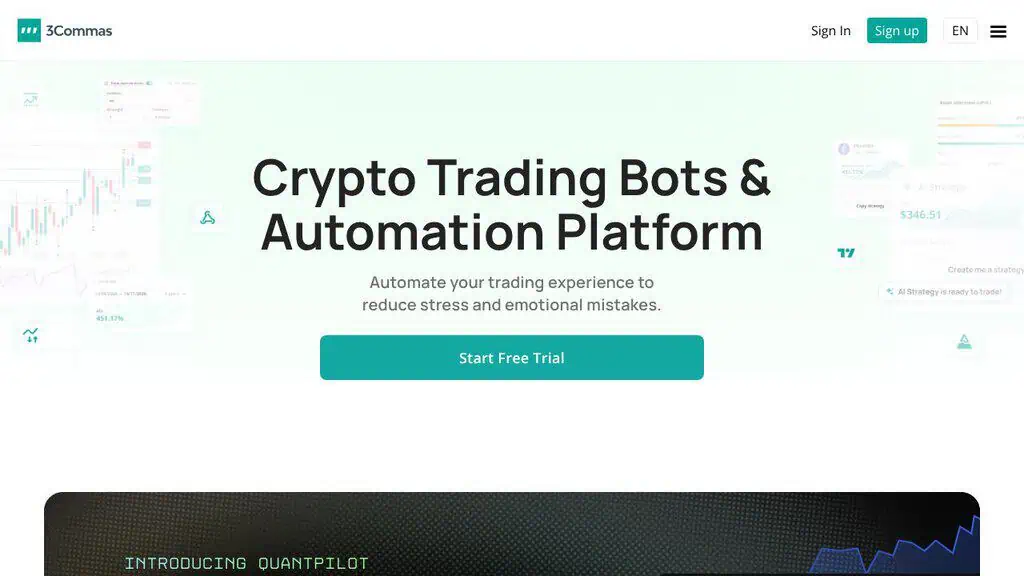
A realistic use: you split a monthly crypto purchase into a DCA bot that buys on dips, and you test it on the demo account that every plan includes before you connect real keys.
The honest catch is security history. In December 2022 3Commas confirmed a leak of user API keys, reported at around 100,000, after first blaming phishing. Cause and losses were disputed at the time. I cover what that means for you in the risks section.
- Pricing (checked 30 Oct): Starter $15/mo billed yearly ($20 monthly) covers spot trading, one API key per exchange, 5 DCA, 2 signal and 2 grid bots. Pro is $38 ($50 monthly) for futures, 5 keys and 20 DCA bots. Expert is $105 ($140 monthly). Free trial on all plans.
- Best for: traders who want several bot types on several exchanges.
Cryptohopper: the most configurable cloud bot, with paper trading built in
Cryptohopper calls itself the world’s most customisable crypto trading bot. It runs in the cloud, ships with a strategy designer, backtesting and paper trading from the entry plan, and has a strategy marketplace. The nav also lists a new Cryptohopper MCP, which connects your own AI assistant to live market data.
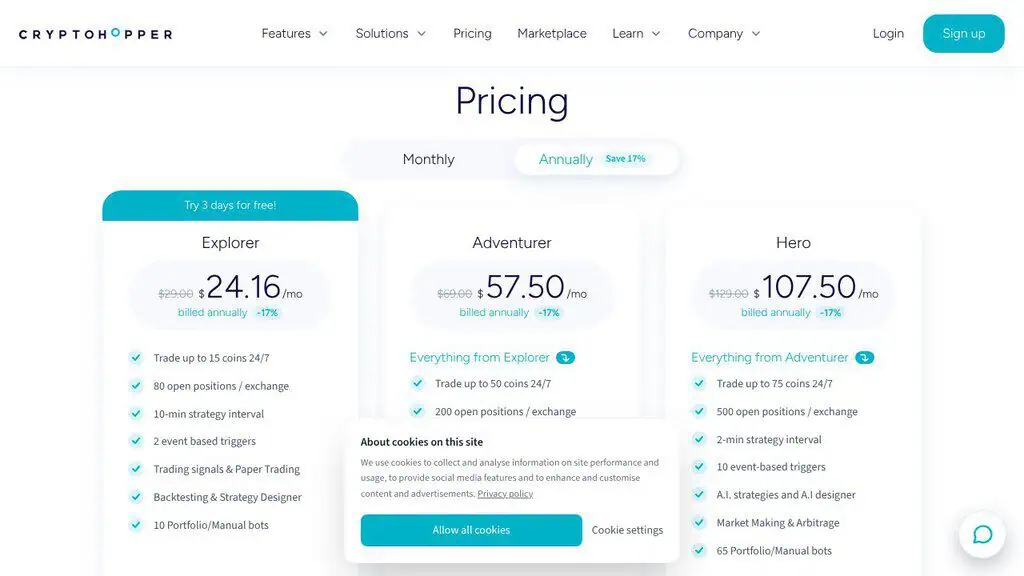
For example, you could build a rule in the strategy designer, run it against history, then paper trade it for a few weeks before it touches money. All of that is on the $29 Explorer plan.
The limit that matters is where the AI sits. AI strategies and the AI designer only arrive on Hero at $129 a month. Explorer caps you at 15 coins and a 10-minute strategy interval, which rules out fast strategies.
- Pricing (checked 30 Oct, excluding VAT): Explorer $29/mo ($24.16 billed yearly), Adventurer $69 ($57.50), Hero $129 ($107.50). Explorer starts with a 3-day free trial.
- Best for: people who want to design and paper trade their own rules.
Bitsgap: grid and DCA bots with the longest backtests
Bitsgap focuses on grid and DCA bots across 17 exchanges, with an AI Assistant on every paid plan and AI Portfolio Mode and “AI improved performance” on Pro. Backtests run 30 days on Basic, 180 on Advanced and 365 on Pro, so a longer test history costs more.
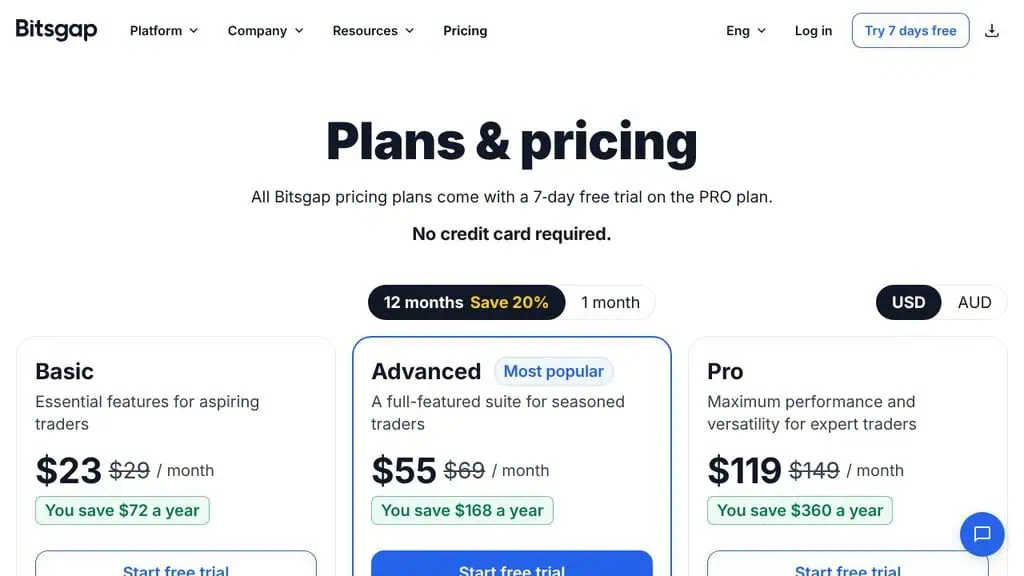
In practice, the free plan is the useful part for a beginner. It gives you 20 active demo bots and manual trading, and the plan list shows live grid and DCA bots starting at Basic.
The catch is cost against account size. Pro at $149 monthly only makes sense on a large balance, as the fee table below shows.
- Pricing (checked 30 Oct): Free $0. Basic $29/mo ($23 billed yearly), Advanced $69 ($55), Pro $149 ($119). A 7-day Pro trial needs no credit card.
- Best for: grid and DCA traders who want to backtest before they commit.
Pionex: an exchange with the bots built in
Pionex works differently from the other three. It is an exchange with an automated trading bot, in grid, futures grid and copy form, built into the trading screen, so there is no API key and no subscription. It charges 0.05% maker and taker on its fee page.

A realistic use is one of the many crypto traders who is new to bots and wants to start a spot grid bot from the same screen they deposit on, with no key-management step.
That convenience is also the risk. Your funds sit with Pionex, not in an exchange account you already trust, so you are trusting a single company with custody. Pionex says it holds a reserve ratio above 100% and shows it with a Merkle-tree audit, which is a claim I could read but not verify.
- Pricing (checked 30 Oct): no subscription; 0.05% per trade.
- Best for: beginners who want the lowest-friction start and accept exchange custody.
Which AI trading bots work best for stocks?
Stock automation is thinner and more regulated than crypto, and none of these is a one-click AI stock trading bot. Each is a trading platform with automation attached. They come at it differently: Trade Ideas is a scanner with an AI signal engine, TrendSpider is a charting platform with no-code bots, and Composer is a brokerage where the strategy is the product. All three look built for US markets.
Trade Ideas: Holly AI signals and auto trading for day traders
Trade Ideas is a real-time stock scanner built on real-time market data. The Premium plan adds Holly AI buy and sell signals with a stop on every trade, OddsMaker backtesting and auto trading. Both plans include an AI Assistant that turns a plain-English description into a scan.

A realistic use: you paper trade a scan on Standard first, then decide whether Holly’s signals and OddsMaker backtests justify the extra $127 a month that Premium costs.
The honest limit is price. Auto trading and Holly sit on Premium at $254 a month, which only works for an account where that fee is a rounding error.
- Pricing (checked 30 Oct): Standard $127/mo ($89 billed yearly, $1,068 a year). Premium $254/mo ($178 billed yearly, $2,136 a year). A Halloween discount code was advertised on the page.
- Best for: active day traders with a large account.
TrendSpider: no-code bots on top of automated charting
TrendSpider is a charting platform whose bots are built without code in its Strategy Tester. Its Sidekick AI acts as an assistant, and every plan includes 25 free Sidekick messages a month. The number of live bots depends on the plan: 5 on Standard, 10 on Premium, 50 on Enhanced and 100 on Advanced.
A realistic use is a swing trader who already reads charts in TrendSpider and wants the same signals to place the trades.
Its pricing is the hardest of the nine to pin down. On 30 October the page showed a Halloween sale with different figures by plan and billing term, so I’m not quoting a monthly price. What was stable: a 14-day trial for $19, whichever plan you pick.
- Pricing (checked 30 Oct): 14-day trial for $19; plan prices vary by term and were on promotion.
- Best for: technical-analysis traders who want charting and bots in one tool.
Composer: no-code strategies inside a regulated brokerage
Composer lets you build and backtest strategies in a no-code editor, then trade them through its own broker. Its Trade with AI feature helps you find and evaluate strategy ideas. Composer Securities LLC is an SEC-registered broker-dealer and FINRA and SIPC member, with accounts carried by Alpaca Securities and Apex Clearing.
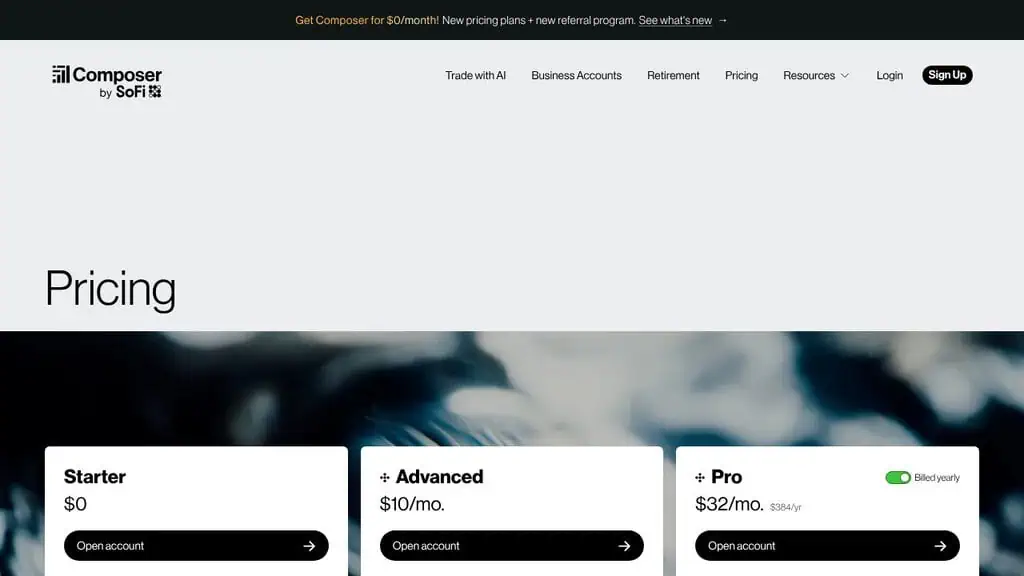
For example, you can build a rules-based portfolio for simple portfolio management, backtest it without limit on the free Starter plan, and automate your first strategy for $0 a month.
The limits are size and scope. Starter strategies cap at 200 nodes and one automated strategy. Composer also states that SIPC “does not protect against market losses.” Regulatory fees on sales still apply.
- Pricing (checked 30 Oct): Starter $0. Advanced $10/mo for up to 5 automated strategies. Pro $32/mo billed yearly ($384) for up to 500 strategies and API access.
- Best for: investors who want rules-based automation inside a regulated broker.
Are there free AI trading bots, and what do you give up?
Yes. Freqtrade and Hummingbot are free and open source, and Pionex, Composer’s Starter plan and Bitsgap’s free plan cost nothing to start. What you give up is convenience, support or live-trading capacity, and in the open-source case, time. A free bot with no installation help can cost more in hours than a paid plan costs in dollars.
| Free option | What you get | What you give up |
|---|---|---|
| Freqtrade | Full open-source crypto bot with backtesting and machine-learning tuning | You need Python skills and your own server |
| Hummingbot | Open-source framework with 318 exchange connectors | Developer-grade setup, no support desk |
| Pionex | Built-in bots with no subscription | Funds held on the exchange; 0.05% per trade |
| Composer Starter | One automated strategy and unlimited backtests | Strategy size capped at 200 nodes |
| Bitsgap Free | 20 demo bots and manual trading | Live grid and DCA bots need a paid plan |
Freqtrade: free, open source and aimed at developers
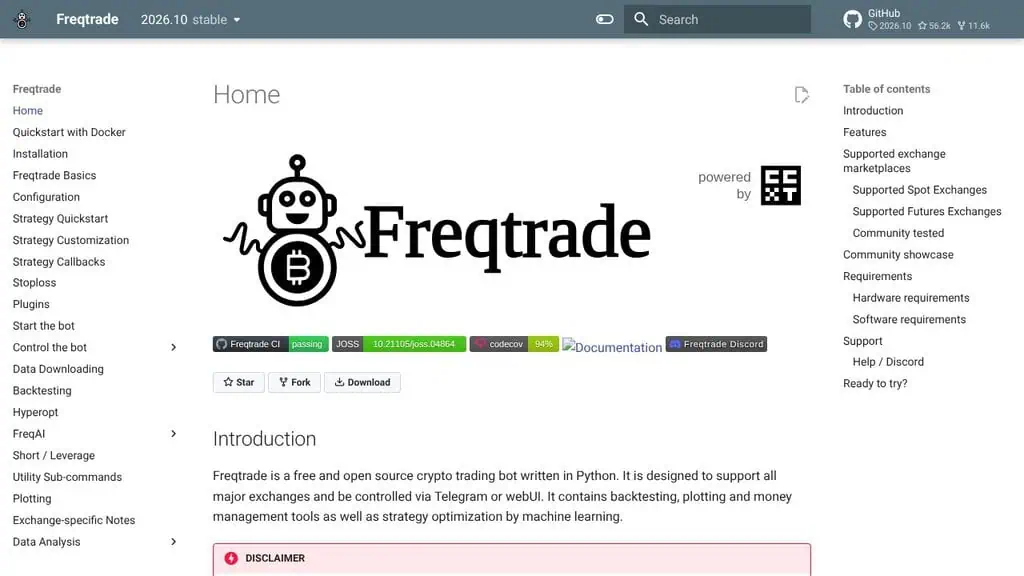
Freqtrade is a free, open-source crypto trading bot written in Python. You control it through Telegram or a web interface, and it includes backtesting, plotting, money-management tools and strategy optimisation by machine learning. Its own documentation calls the software educational, tells you to use it at your own risk, and strongly recommends Python knowledge. It also says to start in dry-run mode, so that no real money is involved.
- Pricing (checked 30 Oct): free. You pay for your own server and exchange fees.
- Best for: developers who want full control of their strategy and data.
Hummingbot: an open-source framework with an AI harness
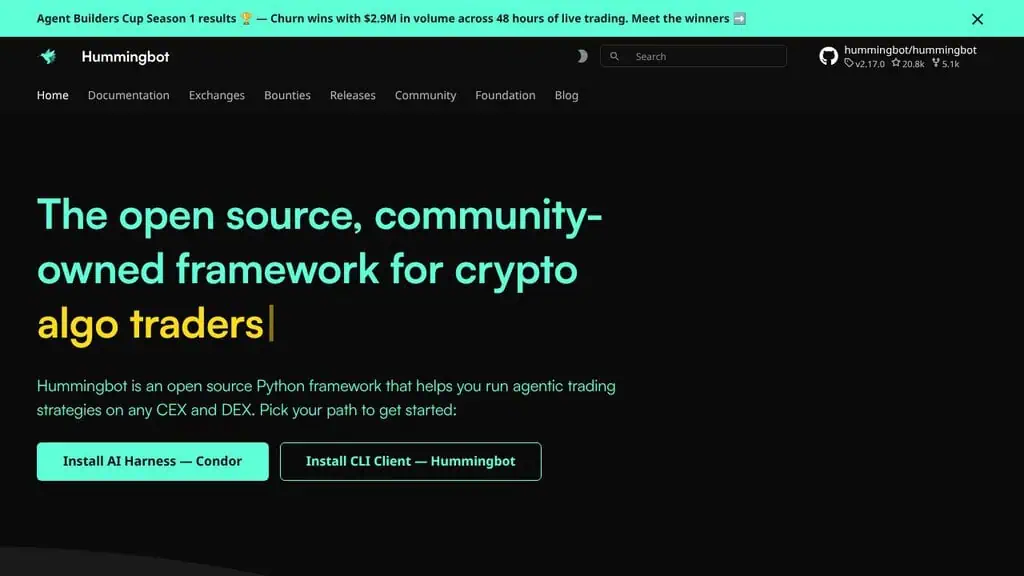
Hummingbot describes itself as an open-source Python framework for running agentic, AI-driven trading strategies on centralised and decentralised exchanges, under the Apache 2.0 licence. The site lists 318 connectors, and its Condor AI harness is the part aimed at building agent-driven strategies. It states no price.
- Pricing (checked 30 Oct): free and open source.
- Best for: developers building their own agent-driven or market-making strategies.
Are AI trading bots profitable, and do they guarantee returns?
No bot can guarantee returns. The US Commodity Futures Trading Commission put it bluntly in a customer advisory titled “AI Won’t Turn Trading Bots into Money Machines”: AI can’t predict the future or sudden market changes. Whether a bot is profitable depends on the strategy, the fees and the market, and none of those are in the vendor’s control.
The CFTC advisory describes a bot-trading pool that guaranteed at least a 10 percent monthly return, which is more than 200 percent a year. Compounding makes that claim absurd on its face.
| Claimed monthly return | Compounded over 12 months |
|---|---|
| 5% | +80% |
| 10% | +214% |
| 20% | +792% |
I know this pitch from the receiving end. As a teenager I lost roughly $300 of savings on paid-to-click sites and PayPal “money generators” that promised guaranteed returns. The pitch hasn’t changed since. Only the label has, from “auto-clicker” to “AI.”
The second thing the vendors don’t put up front is the subscription itself. A fee that looks small becomes a hurdle the bot has to clear before it earns anything. This table shows the monthly price of a plan as a share of the account it runs on, using the monthly-billed prices I checked.
| Plan | Monthly price | Share of a $1,000 account | Share of a $5,000 account |
|---|---|---|---|
| Composer Advanced | $10 | 1.0% | 0.20% |
| 3Commas Starter | $20 | 2.0% | 0.40% |
| Cryptohopper Explorer | $29 | 2.9% | 0.58% |
| 3Commas Pro | $50 | 5.0% | 1.00% |
| Bitsgap Advanced | $69 | 6.9% | 1.38% |
| Trade Ideas Standard | $127 | 12.7% | 2.54% |
| Cryptohopper Hero | $129 | 12.9% | 2.58% |
| Bitsgap Pro | $149 | 14.9% | 2.98% |
| Trade Ideas Premium | $254 | 25.4% | 5.08% |
Put plainly, a $129 plan on a $1,000 account has to earn nearly 13% a month before it breaks even. I run the same audit on my own software stack. I once found two email tools in it, one I’d forgotten I was paying for, and a bot subscription is that mistake with a margin call attached.
What are the risks and security concerns of using an AI trading bot?
The biggest risks are an exposed API key, a strategy that fails when the market changes, fees that eat a thin edge, and custody of your funds. Most bots trade through an API key you generate on your exchange. If that key can withdraw money and leaks, the bot’s strategy no longer matters.
- Key exposure. Create trade-only keys with withdrawals disabled, and restrict them to the vendor’s IP addresses if your exchange allows it. The 3Commas leak is the reason this is not paranoia. For how attackers now use AI to harvest credentials, see how hackers use AI.
- Custody risk. On Pionex or Composer your money sits with the platform, so you are trusting its solvency and its licensing. A bot that connects by API key leaves funds in your own exchange account instead.
- Regime failure. A grid bot profits in a sideways market and loses in a trend. A strategy tuned to last year’s market can fail under changing market conditions, which is exactly what a backtest cannot tell you.
- No risk management by default. Risk management is mostly your job: position size, stop levels and a hard limit on what the account can lose in a month.
- Fee drag. Fees matter most on grid bots, which take many small profits. As a hypothetical, if a grid cycle nets 0.5% and each round trip costs 0.10% in fees (0.05% each way, Pionex’s rate), fees take 20% of every cycle’s profit.
- Impersonation and fraud. The SEC, FINRA and NASAA joined up in January 2024 on an investor alert on AI and investment fraud. It warns about platforms that claim an AI system “can’t lose” and urges you to check registration.
Before you connect anything, run the longer vendor checklist in how to evaluate an AI trading tool. It covers the regulator register, the revenue model and withdrawal tests in detail.
How can a beginner set up and test a trading bot before using real money?
AI trading bots for beginners should follow three stages: backtest the strategy on history, run it in paper or demo mode against live prices, then move to live trading with a small amount you can afford to lose. Most of the bots above have a backtest, a demo or paper mode built in, so a beginner never needs to start with real money.
This is the ladder I’d follow, in order:
- Pick the market first. Crypto and stocks need different bots, so decide which one you are automating before you compare plans.
- Open a demo, not an account with funds. 3Commas includes a demo account on every plan, Bitsgap’s free plan runs 20 demo bots, and Cryptohopper’s Explorer plan includes paper trading. Trade Ideas Standard includes paper trading too.
- Backtest, then distrust the result. On Composer you can backtest trading strategies without limit on the free plan, and Bitsgap’s Pro backtests run up to 365 days. A backtest shows what would have happened in a market that has already gone.
- Write down the vendor’s promise. Note the claimed return, drawdown and trade count, so the trial can contradict them.
- Dry-run before live. Freqtrade tells you to start in dry-run mode, and the rule applies to every bot on this list.
- Go live small, with trade-only keys. Disable withdrawals on the key, start with an amount you can lose, and test a withdrawal early.
- Review monthly against doing nothing. If a bot cannot outperform simply holding the asset after fees and subscription, it isn’t earning its cost.
How do I choose a bot for my market, experience and budget?
Choose by market first, then by your trading experience and how much setup you accept, then by what the subscription costs against your account size. Among bots for beginners, a free tier is the sensible start for a small crypto balance. A coder belongs on Freqtrade or Hummingbot. Nobody with a few hundred dollars should be on a $149 plan.
| If you are… | Look at | Why |
|---|---|---|
| A beginner in crypto with a small balance | Pionex or Bitsgap Free | No subscription or demo-only, so nothing to recover before you start |
| Running crypto bots across several exchanges | 3Commas or Bitsgap | Multi-exchange bot types, demo accounts, API-key trading |
| Wanting to design your own crypto rules | Cryptohopper | Strategy designer and paper trading on the entry plan |
| An active US stock trader with a large account | Trade Ideas Premium | Holly AI signals, backtesting and auto trading in one plan |
| A chart-based technical trader | TrendSpider | Charting and no-code bots in the same tool |
| A long-term investor who wants rules, not signals | Composer | Regulated broker, free to start, strategies you can backtest |
| A developer | Freqtrade or Hummingbot | Free, open source, full control |
Can I build my own AI trading bot with ChatGPT or Claude?
You can use ChatGPT, Claude or other AI models to write strategy code, but the model does not give you an edge, only a faster first draft. The risky part is the same as with any bot: a strategy that has never been tested against real fills and fees.
A sensible route is to let an assistant write a strategy file for Freqtrade or Hummingbot, then backtest and dry-run it like any other. Both projects exist for this purpose and are free. Commercial tools are heading the same way: 3Commas’ AI Assistant turns a plain-English idea into bot rules, and Cryptohopper’s MCP connects your own AI assistant to live market data. To see how that kind of connection works, read our report on the best MCP servers.
Two rules apply. Never paste an exchange key into a chat window, and never run model-written code on a funded account before it has survived a dry run. An AI assistant will write a convincing strategy whether or not it has an edge, and the code looks equally confident either way.
Is AI trading legal, and what about tax?
Using a trading bot is legal for retail traders in many countries, but the rules depend on where you live and which platform you use. The bot itself is rarely regulated. The exchange or broker holding your money usually is, and tax usually applies to bot trades as it does to manual ones.
I’m not a lawyer or a tax adviser, so treat this as a prompt to check, not an answer:
- Platform licensing. Look up the exchange or broker on your own regulator’s register, typed in yourself.
- Availability. Products like these often restrict some countries or features, so read the terms before you register.
- Tax records. A bot can make hundreds of trades a month. Pick one that exports a trade history, and ask an accountant how your country treats them.
Before you fund a trading bot
The best AI trading bot is the one whose cost you can see, whose keys you can lock down and whose strategy you’ve watched fail in a demo. To automate your trading safely, pick one of the nine, open its demo or free tier, and run it for a month without funding anything. If it can’t beat doing nothing on paper, it won’t do it with your money.
Here is the whole decision, whichever of the best AI trading bots you pick, in one line: compare price against account size, keep withdrawals off the key, and distrust every claimed return you can’t trace to a dated live record.
If you want the same scrutiny applied to the rest of your software, I publish tested AI tool reviews and a growing set of best AI tools lists. You can get new ones by email. The vendors are named, the prices are dated and the affiliate policy is in our affiliate disclosure.
Nothing here is financial advice. Trading can lose you all of the money you put in. If you’re unsure whether a product suits you, speak to a regulated adviser in your own country first.
Related Posts

The 30 best AI SEO tools in 2026, tested with real money: what each costs, which ones track AI visibility and AI Mode, a...
30 AI writing tools tested across free, freemium and paid tiers, every link checked, plus which AI beats ChatGPT for wri...

I tested 60 free and freemium AI image generators and ranked them by real traffic and hands-on quality. Free tiers, limi...

Which AI Chrome extension should you install? 132 ranked on real Web Store install, rating and review data, with a pick ...

What Firefox AI actually does, how to enable or disable it, and every one of the 95 AI Firefox add-ons ranked on real da...

30 social media scheduling tools tested for small business: real pricing, every tool link checked September 2026, and th...