


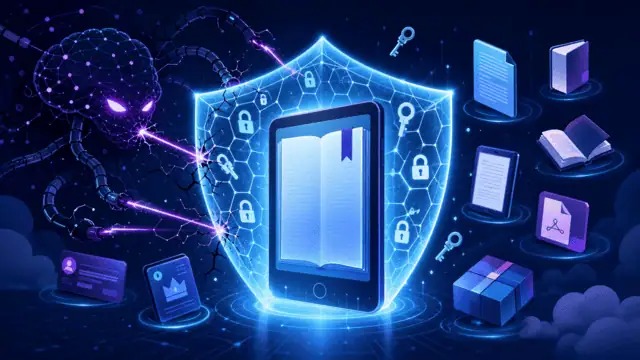
AI changed the economics of content theft. A single unprotected PDF is no longer just a copy. It is raw material that can be summarized, translated, converted to audio, and rebuilt into competing products in minutes. Passwords, download links, and name-stamped watermarks do not stop any of that. Real DRM will not stop everything either, but it closes the easy paths and gives publishers enforceable control over legitimate access. In September 2025, Anthropic agreed to pay $1.5 billion to settle a copyright class action covering roughly 500,000 books, about $3,000 per book. The judge ruled training on books was fair use if the books were legally acquired. Downloading them from pirate libraries was not. The liability was the pirated copy.
Before I ever built a website worth protecting, I was on the other side of this economy. As a teenager I scaled to a four-figure monthly income as a super affiliate on file-hosting sites: FileServe, Filesonic, Hotfile, MegaUpload. Then the DMCA crackdowns arrived, those companies shut down, and roughly $2,000 of monthly income vanished in a matter of days. I have watched the piracy economy from inside it and from the receiving end since. What is different now is not that people copy files. It is what a copied file can become.
One leaked file is now a supply chain
Previously, a pirated ebook was worth roughly one lost sale to whoever downloaded it. Damage scaled linearly. The pirated product was identical to the real one.
Now a single unauthorized user with common AI tools can:
- Extract clean text from a PDF that looks protected but is not.
- Summarize an entire book or a $2,000 industry report into a page.
- Translate premium content into a dozen languages at commercial-adjacent quality (see human translation vs AI translation).
- Convert written material into synthetic audio or video.
- Generate blog posts, study guides, newsletters, or a whole course from the source.
- Upload the document into a private AI knowledge base.
- Search and interrogate an entire collection of stolen documents at once.
That last one deserves attention. A pile of 500 pirated technical books used to be a pile of files nobody had time to read. Fed into a retrieval system, it becomes an expert chatbot that answers questions using your material without ever reproducing a single page verbatim.
The derivative problem. A specialist industry report becomes 30 blog posts. A textbook becomes a question bank. A paid training manual becomes an AI tutor. A collection of ebooks becomes the reference library behind a commercial assistant. The original may never appear publicly, word for word, anywhere. Its commercial value still gets extracted and resold. Traditional anti-piracy thinking looks for copies. This kind of theft has no copy to find.
The $1.5 billion lesson from Bartz v. Anthropic
In June 2025, Judge William Alsup of the Northern District of California split the question in two on summary judgment. Training AI on books was fair use where those books were legally acquired. Downloading them from the pirate libraries LibGen and PiLiMi was not. He certified a class only for the piracy, not for the training.
According to the Authors Guild’s summary of the settlement, about 500,000 titles met the class definition out of roughly 7 million copies Anthropic had downloaded. Rightsholders can expect at least $3,000 per title before fees, split between author and publisher under a default 50/50 arrangement for trade titles. Self-published authors and those whose rights reverted keep the full amount. Reuters reported the settlement received judicial approval in July 2026. Largest copyright settlement in United States history.
Strip out the legal detail: the pirated copies were the liability. Legitimate acquisition was defensible. Unauthorized acquisition cost $1.5 billion. That reframes DRM from a defensive cost into something closer to inventory control. Every uncontrolled copy of your content is a copy that can enter a training set, a competitor’s product, or someone’s private knowledge base with no record of how it got there and no license attached to it.
Sobering detail in the eligibility rules: to qualify, a book needed an ISBN or ASIN and a timely US Copyright Office registration. Authors whose publishers never registered the copyright were excluded from a settlement their book was otherwise part of. Control and paperwork both mattered.
The damage runs wider than a lost sale
Not every pirated copy is a lost sale. Plenty of people who download unauthorized content were never going to buy it. That does not make the damage imaginary. It makes it harder to count.
The real losses show up where publishers do not attribute them:
- Direct revenue. Straightforward, usually the smallest part.
- Subscription and membership renewals. If the archive is freely circulating, renewal logic weakens for everyone in the group.
- Institutional and enterprise license value. A 50-concurrent-reader license is worth less if it functions as unlimited access.
- Territorial and format licensing. Uncontrolled distribution undercuts the exclusivity those deals are priced on.
- Enforcement cost. Takedowns, monitoring, legal time.
- Investment confidence. The quiet one. Publishers stop commissioning specialist work when the return cannot be defended.
For independent authors and mid-list writers, a modest drop in paid readership decides whether the next book happens. For a professional publisher, leakage in one flagship title can damage an entire product line, because the leaked title is often the one that sells the subscription.
Why the common protections fail
Password-protected PDFs, unlisted download URLs, buyer details printed on a page, and static watermarks all fail against a motivated user, and all of them fail completely against AI-assisted extraction.
Passwords travel with the file. Whoever shares the PDF shares the password in the same message. Speed bump, not control.
Download links get forwarded. An unlisted URL is security by obscurity. One post in a group chat ends it.
PDF permission flags are advisory. The “no copying” and “no printing” settings are instructions that compliant readers choose to honor. Plenty of tools ignore them entirely. This is the single most common misunderstanding I see: publishers believe those checkboxes are enforcement when the file itself is still fully readable.
Once an ordinary PDF or EPUB lands on someone’s device, the publisher has essentially no remaining control over it.
Social DRM (stamping a buyer’s name into the document) has genuine deterrent value for low-risk consumer content. Be clear about what it does not do: it does not prevent copying, printing, screen capture, text extraction, format conversion, or continued access after a license expires. It identifies a probable source after a leak. In the AI era that timing gap matters more than it used to. By the time you discover a watermarked file circulating, the contents may already have been extracted, translated, restructured, and loaded into three separate systems. You have a name. You do not have containment.
Static watermarks discourage screenshots and casual redistribution. They do not survive cropping, editing, reformatting, or text extraction, and text extraction is the step that matters for AI reuse. The watermark sits in the visual layer. The text layer walks out untouched.
Dynamic watermarks are meaningfully stronger: user-specific information that changes per session, so screen capture is traceable and psychologically less attractive. Even then, a watermark is one layer inside a system, not the system.
What real DRM should control
Effective DRM is not a padlock icon or a password prompt. It is a set of technical controls that determine who can open a document, on which devices, for how long, and what they can do with it once it is open.
Depending on your publishing model, a serious system covers:
- Encryption of the document itself, not just the delivery link. The file stays protected wherever it ends up.
- User or device binding so credentials cannot be shared without limit.
- Controls on printing, copying, editing, and text extraction, enforced by the viewer rather than requested politely.
- Expiring access for rentals, subscriptions, course enrollments, and temporary licenses.
- Limits on authorized devices or concurrent users, matching what the license actually sold.
- Dynamic watermarks tied to a specific user and session.
- Remote revocation when a license ends, a subscription lapses, or misuse is detected.
- Governed offline access so readers are not punished by a weak connection but licenses still apply.
- Access logs and admin controls for compliance, auditing, and license reporting.
No single item on that list is protection by itself. The value is combining encryption, identity, licensing, and usage rules into something that stays manageable for a legitimate reader.
Crawler controls solve a different problem
Publishers now have real tools for controlling automated access to web content, and 2025 was the year they got teeth. On July 1, 2025, Cloudflare began blocking AI crawlers by default for new domains, and launched Pay Per Crawl.
Under Article 53(1)(c) of the EU AI Act, in force since August 2, 2025, providers of general-purpose AI models must have a policy to identify and respect rights reservations made under Article 4(3) of the DSM Directive. Article 53(1)(d) requires publishing a sufficiently detailed summary of training content using the AI Office’s template. The accompanying Code of Practice explicitly recognizes robots.txt as a valid way to reserve rights.
Here is the gap nobody talks about. Article 4(3) of the DSM Directive requires the opt-out to be expressed by machine-readable means. A downloaded PDF has no robots.txt.
Once your report is sitting in someone’s Downloads folder, there is no crawler to block, no directive to publish, and no hostname to attach a rights reservation to. Crawler controls govern automated access to content you host. They do nothing about a file after an authorized human has downloaded it and uploaded it somewhere else. Contract terms have the same limitation. A license clause prohibiting AI training creates a legal restriction. It does not technically prevent anyone from dragging your PDF into a chat window.
A complete strategy needs four layers, not one:
- Website and crawler controls to govern automated discovery, indexing, and training access.
- Contracts and license terms defining permitted and prohibited uses, including AI reuse.
- DRM and access controls restricting what authorized users can do with delivered files.
- Monitoring and enforcement to detect leaks and act on them.
DRM is the only layer that keeps working after the download.
Control is what makes content licensable
There is a commercial argument for DRM that gets overlooked because everyone frames protection as defense. Control is also what lets you sell the same content twice.
The AI licensing market made this concrete. Taylor & Francis was reported to expect around $75 million from AI licensing deals in a single year, with an initial Microsoft agreement worth about $10 million. Wiley disclosed expectations of around $44 million from its AI partnership.
You can only license what you control. A publisher whose catalog is already circulating freely in pirate libraries is negotiating from a weak position. The buyer can ask a reasonable question: what exactly am I paying for?
The honest half of that story: in several of those deals, authors could not opt out, and many found out from the news rather than their publisher. Author groups objected and they were right to. Control being valuable is precisely why it matters who holds it and what the contract says. DRM strengthens whoever owns the rights. Publishers and authors both should care about how those rights are allocated before the licensing conversation starts.
Proportional control beats maximum control
DRM has a deservedly poor reputation. Early systems created genuine misery: convoluted activation, arbitrary device limits, proprietary software that stopped working, content people paid for becoming unreadable when they changed computers. Security that makes the paid product harder to use than the pirated one does not reduce piracy. It advertises it.
The design principle that fixes this is proportional control. Match the restriction to the risk and the price:
| Content type | Sensible controls | Overkill |
|---|---|---|
| Low-cost consumer ebook | Dynamic watermark, light device limit | Per-session reauthorization |
| Paid course or training material | Expiring access, device binding, copy controls | Permanent offline lockout |
| Corporate or analyst report | Encryption, revocation, logs, no printing | Nothing, honestly |
| Institutional textbook | Concurrency limits, expiry, admin revocation | Per-page authorization |
Before committing to any system, get straight answers on which platforms are genuinely supported, how a license is recovered when a device is lost, how offline access works, whether an administrator can resolve a problem without disabling protection for everyone, and what happens to purchased content if you stop paying the DRM vendor. That last one gets skipped and it should not.
What DRM cannot do
Any vendor promising complete protection is overselling. Treat that claim as a reason to look harder at everything else they say.
DRM cannot stop someone photographing a screen. It cannot stop manual retyping. It cannot stop a determined person filming a monitor. It cannot stop someone with legitimate access from remembering what they read and writing something similar.
What it does is change the economics. It removes the easy methods, prevents unrestricted file sharing, ties access to a license, adds accountability through traceable watermarks, and gives you the ability to revoke.
Against AI-assisted reuse specifically, that matters more than it sounds. The threat model is not one person retyping a book. It is clean, automated text extraction at scale. A system that forces manual photography of 400 pages has not achieved perfect security. It has destroyed the economics of the attack, which is the actual objective. Also worth understanding: a long report does not enter a model as a document. It is broken into tokens and processed in chunks, which is why clean extractable text is so much more valuable to a scraper than a photographed page.
The practical checklist
- Classify your catalog by damage, not by price. Which titles would hurt most if they leaked tomorrow?
- Fix the crawler layer first, because it is free. Set robots.txt directives for AI crawlers, check your CDN’s AI bot settings, confirm gated content is not reachable without authentication. See how AI search engines work for what those crawlers do with what they collect.
- Write the AI clause into your license terms. Address AI training, ingestion into knowledge bases, and derivative generation. It will not prevent anything technically. It is what enforcement rests on.
- Apply document-level DRM to the high-damage tier. Encryption, device binding, expiry, revocation, dynamic watermarks. Match controls to risk.
- Register your copyrights properly and on time. The Anthropic class showed exactly what happens to authors whose registrations were missing or late: exclusion.
- Log and monitor. Access logs make patterns visible. Periodic searches for your title and distinctive phrases catch redistribution.
- Review the reader experience yourself. Buy your own product, on your worst device, and see whether the protection is tolerable. If it annoys you, it will drive customers to the pirated copy.
Steps 2, 3, 5, and 7 cost nothing but attention. Start there before you buy anything.
The exchange that has to keep working
Digital publishing runs on a trade. Readers get convenient access to valuable content. Creators and publishers keep enough control to be paid for producing it. AI does not remove that trade. It puts far more pressure on the boundaries around access, reuse, transformation, and licensing, because the value that can be extracted from one uncontrolled copy is now much larger than the price of that copy.
The single most useful shift in thinking: stop asking “how do I stop people copying this?” and start asking “what can someone do with this file after they legitimately receive it?” That question leads you to controls that still function after download, which is exactly where crawler rules, contracts, and takedown notices all stop working.
If you publish ebooks, reports, training materials, or other PDF-based content and want to control how it is accessed after delivery, Locklizard builds document security tools designed for exactly this kind of controlled distribution.
_Verification note: Bartz v. Anthropic figures come from the Authors Guild’s settlement summary and Reuters, checked 2026-08-25. EU AI Act obligations under Article 53 took effect August 2, 2025. Cloudflare’s default AI crawler blocking began July 1, 2025. Publisher AI licensing figures are as reported in the trade press for 2024. I have not tested any DRM product hands-on for this article; treat the feature discussion as a framework for evaluating vendors rather than a product recommendation._
Liked this guide? Pin ZPlatform as your Preferred Source.
Pinning us tells Google to make our hands-on AI reviews, verified lifetime deals, and founder interviews more likely to appear prominently for you in Top Stories and eligible AI Search experiences (AI Mode, AI Overviews). Set it once, no account needed on our end.
- 500+ AI tools tested with real budgets
- Verified deals - no dead affiliate links
- Editor: Alston Antony, 15+ years in SaaS & SEO
 Opens Google · takes 2 seconds
Related Posts

78% of companies say they use AI. Only 21% redesigned a workflow. Here are the sourced AI adoption statistics and the ho...

A free, cited AI glossary covering 264 artificial intelligence, machine learning, and generative AI terms - plain-Englis...

I pulled 239 threads across 7 subreddits. Marketers use AI daily and hate the products. Here is what the highest-voted t...
The Chrome and Firefox extension I built to save, tag, version, and export AI prompts locally. Free. No account. No clou...

ChatGPT, Gemini, Rufus, Perplexity. Which AI shopping assistant to use for what, plus the fake deals and dynamic pricing...

I ran a 26-feed pipeline for 34 days and logged 2,234 AI stories. Here are the sources worth your time by output, and 3 ...