
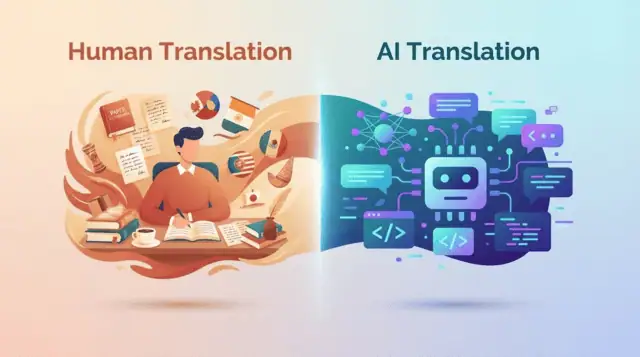
TL;DR: Research consistently finds AI translation is close to human quality for routine, high-resource text and clearly behind it for literary, legal, and low-resource work. One 2024 study rated GPT-4 as comparable to junior translators but behind mid and senior ones. In literary evaluation, annotators preferred human translations 86.7% to 95% of the time. The honest answer to “which is better” is that it depends on the language pair, the domain, and what happens if the translation is wrong.
Every month, people run about 1 trillion words through Google Translate and its related surfaces. More than 1 billion users ask Google for translation help. Those figures come from Google’s own 20th anniversary post published in April 2026. That is a staggering amount of language moving between humans with no human translator anywhere in the loop.
So the question of human translation vs AI translation is not academic anymore. It is a decision millions of people make every day without thinking about it, usually by opening whichever app is on their phone.
I care about this for a personal reason. I grew up in Colombo, I live in Coimbatore, and I run SEOTamil.com and DigitalMarketingTamil.com alongside my English work.
I’ve spent years moving the same ideas between Tamil and English. The gap between “technically correct” and “sounds like a person wrote it” is enormous. That gap is what this article is about.
This isn’t a sales page. I’m not selling translation services and I don’t take money from any tool mentioned here.
What follows is a factual breakdown of what peer-reviewed studies and official documentation actually say. How AI translation works. What human translation involves as a formal process. Where the measurable quality gaps sit, how Google Translate and Apple Translate genuinely differ, and how you can judge quality yourself instead of trusting anyone’s marketing.
What Is AI Translation?
AI translation is the automatic conversion of text or speech from one language to another using machine learning models trained on large volumes of parallel text. Modern systems are either neural machine translation models built specifically for translation, or general-purpose large language models prompted to translate. Both learn statistical patterns from data rather than applying grammar rules written by humans.
The technology moved through three clear generations, and Google’s own history illustrates them well.
Statistical machine translation (roughly 2006 to 2016). Early Google Translate worked by calculating which word and phrase pairings were most probable, based on enormous bilingual corpora. It produced translations that were often understandable and almost always clunky, because the system was assembling probable fragments rather than understanding a sentence.
Neural machine translation (2016 onward). Google shifted Translate to neural networks in 2016. The system could now encode a whole sentence as a numerical representation, then generate the target sentence from that. This is where the famous jump in fluency happened. NMT is why machine output stopped sounding like a telegram.
Large language models (roughly 2023 onward). Google now uses its Gemini models inside Translate, and general models like GPT-4o and Claude are widely used for translation too. The practical difference is context: an LLM can consider a whole document, follow an instruction like “keep this formal,” and handle idioms it was never explicitly trained to translate. If you want the underlying vocabulary, our AI glossary defines terms like tokens, inference, and training data, and the guide to tokens in AI explains why long documents behave differently from short sentences.
How AI translation actually works, in one paragraph
The model converts your source text into tokens. It maps those tokens into a numerical space where similar meanings sit near each other, then predicts the most probable sequence of tokens in the target language.
It’s prediction, not comprehension. That single fact explains almost every failure mode below. The system has no idea what your contract obliges you to do, whether your character is being sarcastic, or whether a mistranslated dosage would hurt someone.
The scale AI translation now operates at
The numbers are worth sitting with. Google Translate supports almost 250 languages and more than 60,000 potential language pairs, which Google says covers 95% of the world’s population. In June 2024, Google added 110 languages in a single release using its PaLM 2 model, reaching an additional 614 million speakers, or roughly 8% of the world.

No human translation industry could ever deliver that coverage. That is the real achievement of AI translation, and any honest comparison has to start by acknowledging it.
What Human Translation Actually Involves
Human translation is a defined professional process, not a bilingual person retyping a document. ISO 17100 is the international standard for translation services. It requires a qualified translator plus mandatory revision by a second qualified linguist, with documented competence requirements for everyone involved.
That second-linguist requirement is the part most people miss. When a professional agency quotes you a price, you are not paying for one person’s time. You are paying for translation, independent revision, and a chain of accountability if something goes wrong.
Professional human translation typically covers several things a model does not do on its own:
- Terminology management. Maintaining a glossary so that your product name, legal term, or clinical phrase renders identically across every document, every time.
- Transcreation. Rewriting rather than translating when a literal rendering would fail. A slogan that rhymes in English rarely rhymes in Tamil, so someone has to invent a new one that carries the same feeling.
- Cultural and legal adaptation. Adjusting examples, honorifics, date formats, currencies, and claims that are legal in one market and not in another.
- Accountability. A named professional or agency carries responsibility, and often insurance, for the accuracy of what they deliver.
The peer-reviewed literature reaches the same conclusion about what humans uniquely contribute. A contrastive study of AI and human translation on legal texts put it plainly. AI translation is faster and cheaper. Human translation “offers a deeper understanding of the cultural context and nuances of the translated text,” which makes it the better choice where accuracy and cultural sensitivity matter most.
Human Translation vs AI Translation: The Core Differences
| Factor | AI translation | Human translation |
|---|---|---|
| Speed | Near instant, thousands of words per minute | Roughly 2,000 to 3,000 words per day per translator |
| Cost | Free to fractions of a cent per word | Typically priced per word, plus revision |
| Language coverage | Up to ~250 languages in one tool | Limited by who you can find for that pair |
| Consistency | Very high within a run, can drift between runs | High when terminology is managed |
| Context handling | Improving with LLMs, still weakest across long documents | Native, including unwritten context |
| Cultural adaptation | Literal by default | Core part of the job |
| Accountability | None. Terms of service disclaim accuracy | A named professional or ISO-certified provider |
| Confidentiality | Depends entirely on the tool’s data policy | Contractual, usually with an NDA |
| Best at | Volume, gist, speed, first drafts | Nuance, persuasion, risk, voice |
Two rows deserve emphasis because they are where most real-world problems come from.
Accountability is a genuine structural difference, not a talking point. If a machine translation is wrong, the loss is yours. Consumer translation tools disclaim accuracy in their terms. A professional provider is contractually on the hook.
Confidentiality matters more than most people check. Pasting an unsigned contract, patient record, or unreleased product spec into a free consumer tool means accepting that tool’s data handling policy. Read it before you paste, especially in regulated industries.
How Accurate Is AI Translation Compared to Human Translation?
Across published evaluations, AI translation now approaches human quality on short, routine sentences in well-resourced language pairs, and falls measurably behind human translators on longer documents, specialised domains, and low-resource languages. The gap narrows every year but has not closed, and how you measure it changes the answer.
Almost every article on this topic gets that point wrong. So it’s worth understanding the measurement problem before you look at the results.
Why the measurement method changes the verdict
In 2018, researchers Samuel Läubli, Rico Sennrich, and Martin Volk published a paper with a deliberately pointed title: Has Machine Translation Achieved Human Parity? A Case for Document-level Evaluation. Earlier work had claimed neural machine translation reached parity with professional human translation on Chinese to English news.
Their finding was that the parity claim was an artefact of the test design. When human raters judged isolated sentences, machine and human output looked comparable. When those same raters judged whole documents, they showed a clear preference for the human translation on both adequacy and fluency.
The reason is simple once you see it. Errors that are invisible at sentence level become decisive across a document. A pronoun that refers to the wrong person. A term translated three different ways. A formal register that slips into casual halfway down the page.
Test a sentence at a time and you’ll conclude AI has won. Test a document and you won’t.
What the numbers say by translator seniority
The most directly relevant study for anyone hiring is a 2024 evaluation titled GPT-4 vs. Human Translators, by Jianhao Yan and colleagues. They compared GPT-4 against human translators at different experience levels, across multiple language pairs and domains, using structured error annotation.
Their headline findings:
- GPT-4 performed comparably to junior translators in total number of errors made.
- GPT-4 lagged behind medium and senior translators.
- Performance degraded steadily moving from resource-rich to resource-poor language directions.
- GPT-4 characteristically produced over-literal translations, while human translators sometimes over-interpreted background information.
That last pair of observations is the most useful thing in the paper. The two systems fail differently. AI errs toward literalism, humans err toward embellishment. Knowing which failure mode you are looking at tells you what to check.
The metrics you will see quoted, and what they mean
If you read further into this topic, you will run into four acronyms. Here is the plain-English version.
BLEU compares machine output against a reference translation by counting overlapping word sequences. It’s fast, cheap, and crude. High BLEU doesn’t mean good translation, and a perfectly good translation that phrases things differently from the reference scores badly.
COMET and XCOMET are neural metrics trained on human quality judgments. They correlate with human opinion far better than BLEU and are the current standard for automatic evaluation.
MQM (Multidimensional Quality Metrics) is a human framework where annotators mark actual error spans and assign categories and severity. It’s the gold standard for professional evaluation, though as you will see in the next section, it has limits.
BWS (Best-Worst Scaling) asks annotators to pick the best and worst of several candidate translations rather than scoring each one. It turns out to be unusually good at separating human translation from very good machine translation.
Assessment of Human Translation vs AI Translation in a Literary Work
Literary translation is the hardest test for AI, and it is the one area where recent research is unambiguous. In a 2024 study, both student annotators and professional translators preferred human literary translations over the best available LLM outputs, with preference rates reaching 86.7% for English to German and 95.0% for German to Chinese.
That study came from Ran Zhang, Wei Zhao, and Steffen Eger. They built LITEVAL-CORPUS, a dataset of over 2,000 paragraphs and 13,000 sentences from classic and contemporary literary works. It covers four language pairs: English to German, German to English, English to Chinese, and German to Chinese.
They tested human translations against GPT-4o, Google Translate, DeepL, and others. Slator’s write-up of the study summarised the researchers’ conclusion directly: in the era of large language models, literary translation remains “an exclusive domain of human translators.”
The ranking, and the gap
Annotators rated human output above every machine system tested. GPT-4o placed second and, in the researchers’ words, came “closely approaching human literary translation.” Google Translate and DeepL followed.
So the gap is real, but it’s no longer enormous, and it is closing fastest at the top of the model range. Anyone claiming machines produce laughable literary translations is describing 2018, not 2026.
Why literature breaks machine translation
The failure mode the researchers identified is precise: LLMs “tend to produce more literal and less diverse translations.” Literary translation is the one domain where literal accuracy is frequently the wrong goal.
Think about what a literary translator actually decides. Does a character’s dialect become another dialect, flattened standard speech, or invented idiolect? Is the pun sacrificed for meaning, or meaning for the pun?
Does a deliberately awkward sentence stay awkward, because the author made it awkward on purpose? Does the rhythm of a paragraph matter more than its literal content?
Every one of those is an interpretive judgment about intent. A model predicting probable next tokens defaults to the safest, most common phrasing. That’s the opposite of what literary style requires.
The evaluation problem nobody had solved
The same study found something uncomfortable for the whole field: MQM was inadequate for literary translation. The framework struggled to separate human translations from high-quality LLM output, because it cannot account for intentional stylistic choices. A translator who deliberately breaks a rule gets marked down as if they made a mistake.
The researchers also found that when LLMs were used as evaluators, they preferred more literal translations over human ones and showed a bias toward their own outputs. That is worth remembering any time you see a benchmark where an AI judges AI translation quality.
BWS proved best at distinguishing high-quality human work from machine output, though it does not produce the detailed error breakdown MQM gives you.
Where AI Translation Is Genuinely Good Enough
Being honest about the research cuts both ways. There are large categories of work where using a human translator would be a waste of money, and pretending otherwise is just as misleading as overselling AI.
Understanding content in another language. Reading a foreign news article, a review, a forum thread, or a supplier email. You need the gist, the stakes are low, and an awkward phrase costs you nothing.
Travel and live conversation. Menus, signs, directions, and short exchanges. Google reports that more than a third of its Live translate sessions last longer than five minutes, which suggests people are holding real conversations, not just looking up single words.
High-volume user-generated content. Product reviews, support tickets, community posts. The volume makes human translation economically impossible and the quality bar is comprehension, not polish.
Internal operational documents. Meeting notes, internal updates, routine correspondence between offices. Nobody’s brand or legal position rests on the phrasing.
First drafts for a human to edit. This is the highest-value use in professional settings, and it has its own name and standard, covered further down.
The common thread is that AI translation is well suited wherever the cost of an error is low and the cost of not translating at all is high. Most of the trillion words a month fall squarely in that category.
Where AI Translation Carries Real Risk
The clearest evidence on risk comes from healthcare. A 2019 study in JAMA Internal Medicine assessed Google Translate on emergency department discharge instructions. It found 92% of Spanish and 81% of Chinese translations were accurate. A minority of the inaccurate ones carried potential for clinically significant harm.
Read those numbers carefully, because they are a good lesson in how to interpret accuracy claims. The study by Elaine Khoong and colleagues shows performance that sounds excellent in the abstract. A 92% accuracy rate would be a great score on almost any test.
But discharge instructions aren’t a test. The 8% that failed included instructions where the error could have led a patient to take the wrong dose or miss a warning sign. Averages hide the cases that matter, and in high-stakes domains the tail is the whole story.
The same logic applies elsewhere:
- Legal and contractual text. A single mistranslated modal verb changes an obligation into a possibility. The legal-domain study cited earlier found human translation superior precisely where accuracy and cultural context intersect, which describes most contracts.
- Regulated content. Medical device instructions, pharmaceutical labelling, financial disclosures, and safety documentation usually carry legal requirements about translation quality and traceability that a consumer tool cannot satisfy.
- Marketing and brand voice. Not dangerous, but commercially costly. Literal translation of persuasive copy is the fastest way to sound foreign to your own customers.
- Anything involving a person’s rights. Immigration paperwork, court documents, consent forms. The asymmetry between cost of review and cost of error is extreme.
A reasonable rule: if being wrong could cost someone money, health, legal standing, or safety, a qualified human needs to sign off, even if a machine produced the first draft.
Is Google Translate the Best Translator?
Google Translate is the most broadly capable general translator by coverage and availability, supporting almost 250 languages and more than 60,000 language pairs. It isn’t automatically the most accurate for any given pair or domain. In published literary evaluation it ranked behind GPT-4o, and specialised or LLM-based tools often beat it on specific pairs.
The word “best” hides three separate questions, and they have different answers.
Best coverage? Yes, comfortably. Nothing else comes close to 250 languages, and Google’s expansion into low-resource and indigenous languages, including its 1,000 Languages Initiative, has no real competitor.
Best accuracy on a given pair? Not necessarily. Quality varies enormously by language pair. English to Spanish, the most common pair on the platform, is trained on far more data than English to Tamil, and the output quality reflects that. The GPT-4 study’s finding about performance degrading from resource-rich to resource-poor directions applies to every system, Google included.
Best for your specific document? Almost certainly not knowable in advance. Which is why the practical answer is to test. There’s a method for that further down.
What Google Translate is genuinely best at

Availability and integration are the real advantages, and they matter more day to day than benchmark scores. Translate works offline once you download a language pack. It appears inside Search, Lens, and Circle to Search. It handles camera translation of menus and signs, and it now supports live conversational translation through Gemini audio-to-audio models.
Most people need one thing: understanding something right now, on the device in their hand. For that job, the combination is hard to beat, whatever a benchmark says.
Google Translate vs Apple Translate: How They Actually Differ
If you use an iPhone, this is the practical comparison, and the honest answer is that they are built for different jobs. Here is what each company officially documents, checked on August 1, 2026.
| Google Translate | Apple Translate | |
|---|---|---|
| Languages in the main app | Almost 250 | 21 language variants |
| Language pairs | 60,000+ | Far fewer, all pairs among its 21 |
| Platforms | Web, Android, iOS, Chrome, Search, Lens | iPhone, iPad, Mac, Apple Watch, Vision Pro |
| Offline mode | Yes, downloadable language packs | Yes, downloadable languages |
| Camera translation | Yes, via Lens | Yes, via Camera app |
| Live conversation | Yes, including headphone-based live translate | Yes, including Live Translation with AirPods |
| System integration | Deep inside Google’s own apps | System-wide across iOS, plus Messages, Safari, Siri |
| Processing | Primarily cloud, offline packs available | On-device for many Apple Intelligence features |
According to Apple’s official iOS 26 feature availability page, the Translate app supports Arabic, Dutch, English (UK and US), French, German, Hindi, Indonesian, Italian, Japanese, Korean, Mandarin Chinese (mainland and Taiwan), Polish, Portuguese (Brazil), Russian, Spanish (Spain), Thai, Turkish, Ukrainian, and Vietnamese. Safari web page translation covers 14 languages. Live Translation with AirPods is narrower still, supporting English (US and UK), French, German, Portuguese (Brazil), and Spanish (Spain).

One data point worth reading carefully: the Translate app’s App Store listing showed a 2.3-star average from about 9,800 ratings when I checked on August 1, 2026. Do not read that as a verdict on translation accuracy. App Store ratings for bundled system apps skew heavily negative, and reviews there mostly complain about missing languages rather than mistranslations. It is still a fair signal that users want wider coverage.
So which is better, Google Translate or Apple Translate?
For coverage, Google wins and it is not close. If your language isn’t among Apple’s 21, the comparison ends there.
For integration on Apple hardware, Apple has the advantage. System-wide translation means you can translate text in almost any app without copying it out, and Live Translation inside Messages and on AirPods is genuinely well built for conversation.
For privacy, Apple’s approach favours on-device processing for many Apple Intelligence features, which means less text leaves your phone. If you are translating anything sensitive, that architectural difference is worth more than a couple of points of accuracy.
For raw translation quality, there is no reliable independent benchmark comparing them head to head across many pairs, and anyone telling you one is definitively more accurate is guessing. Both use modern neural systems. On common pairs like English to Spanish, differences are small and inconsistent. On rarer pairs, Google’s larger training footprint generally shows.
The useful answer is unglamorous: if you own an iPhone, keep both. Use Apple Translate for quick system-wide and conversational work, and Google Translate when you need a language Apple does not support, camera translation of dense text, or a second opinion.
Is There a Better Translation Than Google Translate?
Yes, for specific situations, though “better” depends on the pair and the task. Three categories consistently compete with or beat it.
DeepL built its reputation on European language pairs and is widely preferred by professional translators for German, French, and other Western European languages, though it supports far fewer languages overall. It appeared alongside Google Translate in the literary evaluation cited earlier, both ranking below GPT-4o.
General-purpose LLMs like GPT-4o and Claude now outperform dedicated translation engines on tasks requiring context, tone control, or instruction following. Their advantage is that you can tell them what you want: keep the formal register, preserve the bullet structure, use this glossary, explain the ambiguity rather than guessing. Dedicated engines give you one output with no dialogue. If you are working with AI writing tools already, the same tooling landscape increasingly handles translation as a side capability.
Domain-trained systems used inside professional workflows are trained or fine-tuned on one client’s terminology and previous approved translations, combined with translation memory. For repeat, high-volume technical content, these beat any general tool because they know your terms.
And of course a qualified human translator remains better than all of them for the categories in the risk section. That isn’t a slogan. It’s what the studies keep finding.
How to Assess Translation Quality Yourself
You don’t need a research budget to evaluate translation quality. Here is a practical method that uses the same logic professional evaluators use, adapted for someone with limited time.
1. Test on your actual content, not sample sentences. This is the most important step, and it follows directly from the Läubli finding. Take a real document of at least a few paragraphs. Sentence-level testing systematically flatters machines.
2. Run the same text through two or three systems. Google Translate, one LLM, and one alternative like DeepL if it covers your pair. You are looking for disagreement, because disagreement marks the passages where meaning is genuinely uncertain.
3. Do not rely on round-trip translation. Translating back into the source language and checking whether it matches is the most common amateur method and it is unreliable. Errors can cancel out, and fluent-but-wrong output often back-translates perfectly. Use it to spot obvious disasters, never as proof of correctness.
4. Get one bilingual reader and ask specific questions. A vague “does this look okay” gets a vague answer. Ask instead: is any factual claim different from the source? Is the register right for the audience? Would a native speaker say it this way? Is any term inconsistent? These map roughly to the MQM categories of accuracy, style, fluency, and terminology.
5. Build a small terminology list before you translate anything at scale. Ten to thirty terms that must always render the same way: product names, legal phrases, job titles, units. Most consistency failures in machine output trace back to a term that had no fixed decision behind it.
6. Read the output aloud, or have someone read it to you. Awkward rhythm, wrong register, and unnatural word order are far more obvious in speech than on screen. This is the cheapest quality check there is.
Applied to a real document, this takes about an hour and tells you more than any benchmark table.
The Hybrid Model: Machine Translation Post-Editing
The professional industry largely settled this debate years ago, and the settlement has a name. Machine translation post-editing (MTPE) is the workflow where a machine produces the first draft and a qualified human translator edits it to a defined quality level.
It is formalised in ISO 18587:2017, the international standard covering requirements for full human post-editing of machine translation output and the competences post-editors need. Its existence tells you something. The industry stopped treating machine translation as a threat and started treating it as an input with a documented quality process attached.
Post-editing normally comes in two levels. Light post-editing fixes errors that affect meaning and leaves awkward-but-clear phrasing alone, which suits internal or short-lifespan content. Full post-editing produces output indistinguishable from human translation, which suits anything published or legally significant.
The standard is being updated. A EUATC session held with ISO TC 37/SC 5 in April 2026 confirmed the direction. The revised ISO 18587 is due at the end of 2026, and it will no longer be limited to full post-editing. It will recognise hybrid work, where a translator alternates between human translation, translation memory matches, and AI output inside a single task.
ISO 17100 is scheduled for revision in 2029, shifting from role-based definitions toward competence-based ones.
That direction of travel is the clearest signal available about where this is heading. The formal standards are being rewritten around the assumption that human and machine work happen in the same task, not in competition.
Will AI Replace Human Translators?
Based on current evidence, AI is replacing certain translation tasks rather than translators as a category. Volume work with low error costs has already largely moved to machines. Work where accuracy, style, accountability, or cultural judgment matter is shifting toward post-editing and review rather than disappearing.
Two things are true at once and most coverage picks only one.
The first truth: demand for translation has grown enormously, because machine translation made translating things that were never worth translating suddenly viable. Nobody was paying a human to translate a product review or a support ticket in 2010. Now billions of them get translated.
The second truth: the tasks that remain human-only are getting harder, not easier, and they pay differently. Post-editing is a different skill from translation, priced differently, and not every translator enjoys it. The researchers behind the literary study issued a direct warning. Overestimating LLM quality could lead companies to misjudge capabilities, displacing translators, cutting salaries, and lowering the quality of translated works. That warning sits in a peer-reviewed paper, not an industry press release.
My own read, for what it is worth: the same thing is happening here that happened in every field AI has touched, including mine. The floor rose and the ceiling did not move.
Anyone can now produce adequate translation instantly. Producing translation a native speaker can’t distinguish from original writing is as hard as it ever was. The people who can do that haven’t been replaced by anything.
Key Papers If You Want the Primary Sources
If you searched for machine translation vs human translation as a PDF, you were probably looking for the underlying research rather than another blog post. These are the most useful open-access papers referenced above.
- Has Machine Translation Achieved Human Parity? A Case for Document-level Evaluation (Läubli, Sennrich, Volk, 2018). The paper that showed sentence-level testing overstates machine quality. Free PDF on the ACL Anthology.
- GPT-4 vs. Human Translators (Yan et al., 2024). Structured error comparison against junior, medium, and senior translators. Free PDF on arXiv.
- How Good Are LLMs for Literary Translation, Really? (Zhang, Zhao, Eger, 2024). The LITEVAL-CORPUS literary study, later presented at NAACL 2025. Free PDF on arXiv.
- Assessing the Use of Google Translate for Spanish and Chinese Translations of Emergency Department Discharge Instructions (Khoong et al., 2019). The healthcare accuracy and harm study.
- Artificial intelligence and human translation: A contrastive study based on legal texts (2024). Open access on PubMed Central.
Reading the primary sources takes an afternoon and will make you better at this than reading fifty opinion pieces.
Conclusion: The Question Is Not Which One Wins
The evidence does not support “AI translation is nearly as good as humans now,” and it does not support “machines still produce garbage.” Both are marketing, from opposite directions.
What the research supports is narrower and more useful. AI translation matches junior human work on routine text in well-resourced languages. It degrades predictably as you move toward longer documents, rarer languages, and interpretive work.
In literary translation, annotators preferred human output up to 95% of the time. In healthcare, an error rate that looks fine in a summary contained errors capable of causing harm. In legal text, human translation stays ahead where accuracy and cultural context intersect.
The one insight I would leave you with is this: the useful question is never “which is better.” It is what happens if this translation is wrong. Answer that first, and the choice makes itself. Nobody needs a certified translator for a restaurant menu, and nobody should trust a free app with a clinical discharge summary.
Here’s a concrete next step. Take one document that actually matters to you and run the six-step assessment above. An hour of real testing on your own content beats every comparison table on the internet, including the ones in this article.
Frequently Asked Questions
What is AI translation?
AI translation is automatic translation performed by machine learning models trained on large volumes of parallel text, rather than by rules written by humans. It covers both neural machine translation systems built specifically for translation and general large language models prompted to translate. The system predicts probable output rather than understanding meaning.
Is Google Translate better than Apple Translate?
Google Translate supports almost 250 languages against Apple’s 21, so it wins decisively on coverage. Apple Translate has better system-wide integration on iPhone and does more processing on-device, which favours privacy. There is no reliable independent benchmark showing one is consistently more accurate on shared language pairs.
Which is more accurate, human translation or AI translation?
Human translation remains more accurate for literary, legal, medical, and low-resource work, according to published evaluations. AI translation is comparable to junior-level human work on routine text in well-resourced language pairs. Accuracy gaps widen with document length, domain specialisation, and language rarity.
Can Google Translate replace a human translator?
For understanding content, internal communication, and low-stakes text, it effectively already has. For anything with legal, medical, financial, or reputational consequences, it cannot, because it offers no accountability and no guarantee of accuracy. The professional standard is post-editing, where a human edits machine output.
Is Google Translate the best translator?
It is the most broadly capable by coverage and availability, supporting almost 250 languages and over 60,000 pairs. It is not always the most accurate: DeepL is often preferred for European pairs, and GPT-4o ranked above it in a 2024 literary translation evaluation. The best tool depends on your specific language pair and content type.
What is machine translation post-editing?
Post-editing is the workflow where machine translation produces the first draft and a qualified human translator revises it. It is defined by ISO 18587:2017, which sets requirements for full human post-editing and post-editor competences. Light post-editing fixes meaning errors only, while full post-editing produces output equivalent to human translation.
How do I test translation quality without speaking the language?
Run your real document through two or three systems and compare where they disagree, since disagreement marks genuinely ambiguous passages. Then have one bilingual reader answer specific questions about accuracy, register, and terminology consistency. Avoid relying on round-trip translation, because errors can cancel out and produce a misleading match.
-
Sources and dates: all product facts were verified against official Google and Apple documentation on August 1, 2026. Research findings are cited to their original papers, which are linked and openly accessible. This article is educational and has no commercial relationship with any tool mentioned.