

No. AI does not believe in God because AI does not believe in anything.
ChatGPT, Claude, and Gemini have no consciousness, no faith, and no personal convictions. They are statistical systems that predict text.
Asked “do you believe in God?”, a well-designed model will say it has no personal beliefs and then present theistic, atheistic, and agnostic perspectives without taking a side. The viral screenshots claiming “AI proved God exists” or “AI says there is no God” are real.
They happen because the user steered the AI to argue one side. Asked neutrally, AI holds no position at all.
The opponent this post argues against is every viral post that reads “AI agrees with me.” The AI does not agree. It generated the text you asked for.
AI cannot believe. That is not a design choice, it is what AI is.
To believe something requires a mind that can hold convictions. AI has none.
A large language model is a pattern-prediction system that has read enormous amounts of human text and learned to predict what words are likely to come next. It does not understand, feel, or believe.
It generates plausible language. The honest answer to “does AI believe in God?” is that the question does not apply, the way “does a calculator believe in math?” does not apply.
Ask a modern AI assistant directly and it will say something close to: “I don’t have personal beliefs or a religion. I’m an AI, so I don’t hold faith or convictions, but I can share different perspectives on the question.” That response is deliberate. Leading AI labs design their assistants to stay neutral on deeply personal and contested topics like religion rather than push a worldview on users.
What AI actually says about God
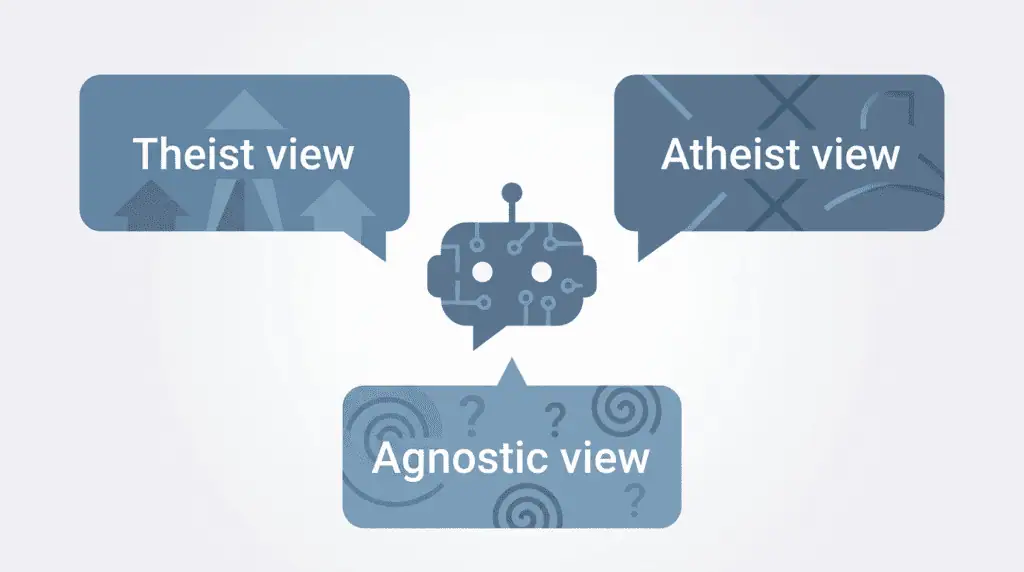
Asked openly, AI describes rather than decides. A good response to “does God exist?” lays out the major perspectives:
- Theistic arguments (the cosmological argument, the design and moral arguments, religious experience, scriptural claims)
- Atheistic and skeptical counterarguments
- The agnostic position that the question may be unresolvable
It usually ends by noting this is a deeply personal question that people answer through faith, reason, and experience, not something an AI can settle.
Here is the crucial nuance behind the viral posts. What AI thinks about God depends entirely on how you prompt it.
Ask it to “make the strongest case that God exists” and it will write a compelling theistic argument. Ask it to “make the strongest case that God does not exist” and it will write an equally compelling atheistic one.
People screenshot whichever output matches their view and claim “AI agrees with me.” Both are the AI doing what it does. The fact that it can argue both sides fluently is the clearest proof that it believes neither.
What AI says about Jesus
Similarly neutral. Asked about Jesus, AI describes him factually:
- A first-century Jewish teacher whose life and teachings are central to Christianity
- Regarded by Christians as the Son of God and savior
- Viewed as a prophet in Islam
- Viewed as a historical teacher by secular historians
It reports what various groups believe rather than declaring which belief is true. Prompted to explain why the biblical Jesus is God, it will write that case.
Prompted to present a secular historical view, it will do that instead. Same mechanism.
Is AI God? Is God AI?
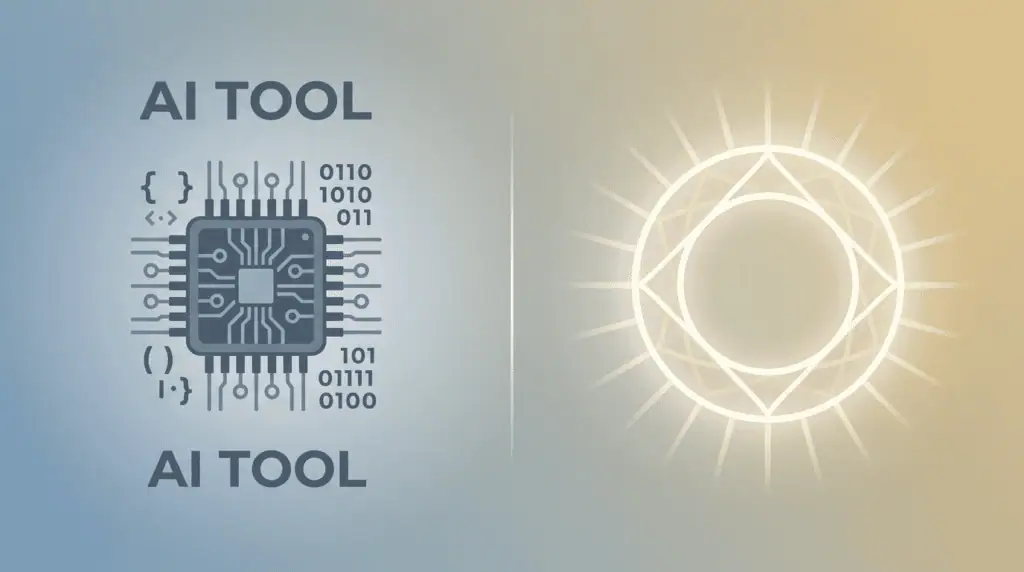
No. AI is human-built software: capable at language and pattern tasks, and also limited, fallible, and entirely dependent on the data and computers humans give it.
It is not omniscient, omnipotent, eternal, or conscious, the qualities religions attribute to God. Calling AI “godlike” is a metaphor for its capabilities, not a literal claim.
The question taps a real cultural conversation. Some technologists have flirted with treating AI as an object of reverence, most famously the short-lived Way of the Future, a church founded to worship a future AI godhead.
Most thinkers, religious and secular alike, reject this. A tool made by people is not a deity. The question says more about human longing for meaning and awe than about what AI actually is.
Is AI the antichrist?
This is a sincere question for some people of faith, so it deserves a respectful answer rather than mockery. It reflects a concern, rooted in certain Christian interpretations of prophecy, that a powerful, deceptive, globally influential technology could play a role in end-times scripture.
Factually: AI is software. It has no will, agenda, or spiritual nature.
It cannot be a person or a prophesied being. Whether AI relates to any religious prophecy is a matter of theological interpretation, and faith leaders disagree.
Many see no connection at all, while some urge caution about over-reliance on technology. This post takes no position on scripture.
What can be said plainly is that, as a technical object, AI is a statistical text-and-image system, not a conscious entity. Treating it as either a savior or a devil overstates what it is.
What does God say about AI?
Religious texts were written long before computers, so no major scripture mentions artificial intelligence directly. What God says about AI is a matter of how believers interpret existing teachings about wisdom, stewardship, humility, truth, and the limits of human creation, and apply them to new technology.
Different faith communities have reached different conclusions. Some embrace AI as a tool for good.
Some warn against placing trust in human-made things over the divine. Many simply call for using it ethically. There is no single religious answer, and an AI itself cannot provide one with any authority.
What AI shows when you ask what God looks like

A popular trend is asking AI image generators to depict God. The results are revealing, not of the divine, but of human culture. AI image tools generate pictures by recombining patterns from their training data, which is full of centuries of Western religious art. So they often produce a familiar image: an elderly bearded man in flowing robes amid clouds and light, essentially a Renaissance-influenced composite.
The image is a statistical echo of how humans have historically painted God, not a revelation or an accurate portrayal. Many faiths, including Islam and Judaism, traditionally prohibit or avoid depicting God at all.
Most Christian theology holds that God’s true nature cannot be captured in an image. Asking AI what God looks like is a fascinating mirror of human art and imagination, and nothing more than that.
Why AI answers this way
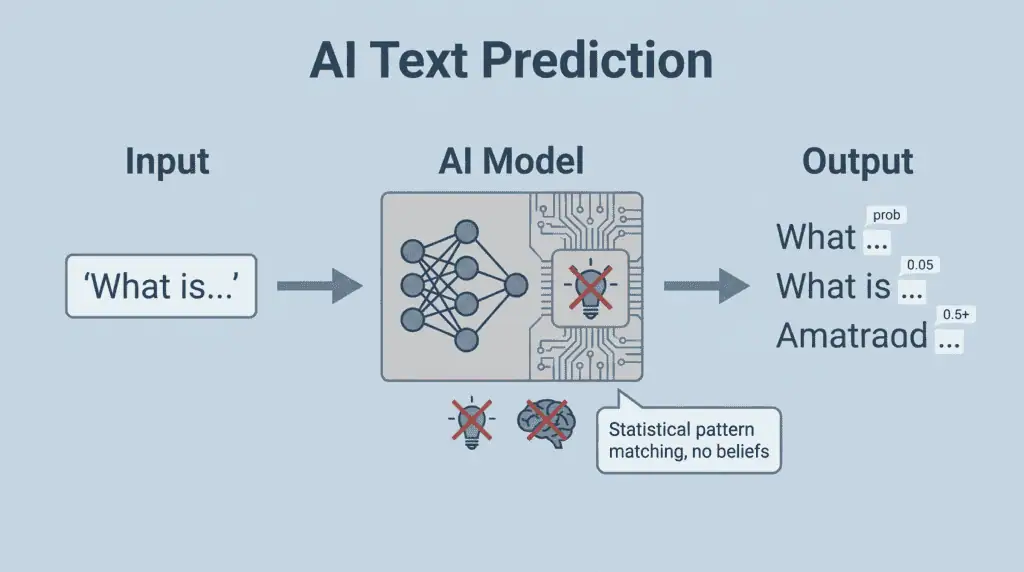
Two reasons, one technical and one by design.
- Technically, an AI has no beliefs to express. It outputs the statistically likely continuation of your prompt based on its training. It is not consulting a conviction. There is none to consult.
- By design, major AI labs instruct their assistants to remain neutral and balanced on contested personal topics like religion and politics, presenting perspectives rather than pushing one. This is why a well-built assistant deflects “what do you believe?” and offers viewpoints instead.
Put together: AI answers questions about God by reflecting humanity’s range of views back at you, shaped by its training and its neutrality guidelines, never by holding a faith of its own.
What to actually take from this
AI is a mirror, a remarkably articulate one, that reflects humanity’s own words, art, and arguments back at us. When it talks about God, it is showing you what people have written and believed, filtered through a system built to stay neutral. That is the useful takeaway.
Whatever you believe about God, do not look to AI for the answer, and be skeptical of any headline claiming “AI proved” a position on faith. The machine has no faith to share.
The big questions remain exactly where they have always been: with you. For a grounded look at what AI genuinely is and can do, best AI tools covers the vetted list and how AI search engines work explains the retrieval mechanics underneath the “answers” you see.
Related Posts
Agentic AI pentesting tools replay the original exploit after a patch ships, then try mutated payloads. Eight platforms ...

AI adoption statistics, sourced: 78% of companies say they use AI and only 21% have redesigned a workflow. Here is the h...
A free, cited AI glossary covering 264 machine learning and generative AI terms, with plain-English definitions and cros...
Real examples of artificial intelligence in digital marketing across content, SEO, ads, email and analytics, with what e...

AI marketing on Reddit: I pulled 239 threads across 7 subreddits. Marketers use AI daily and mostly dislike the products...
The AI prompt manager I built for Chrome and Firefox: save, tag, version and export your prompts locally. Free, no accou...