

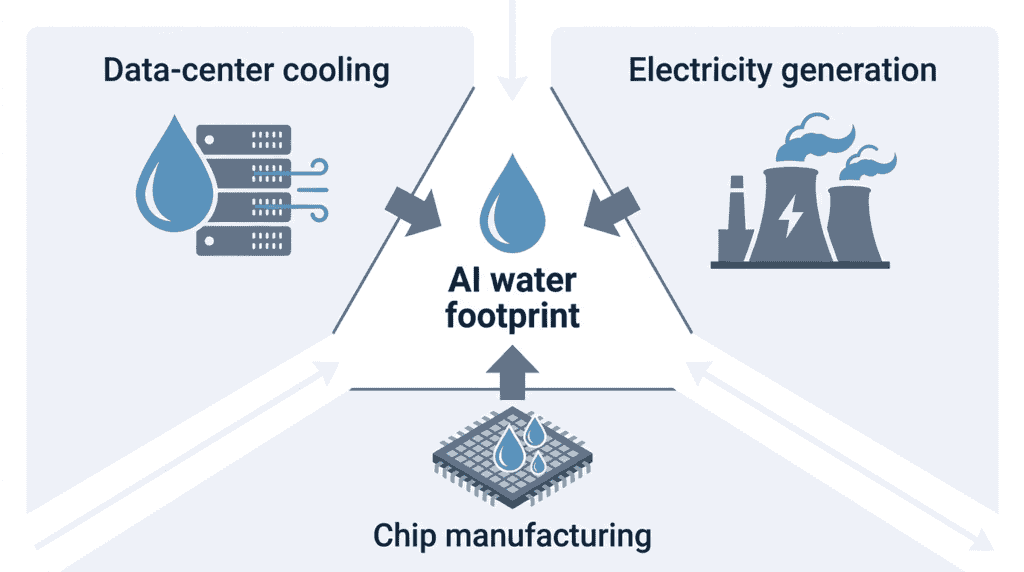
AI uses water two ways: cooling the data centers that run it, and generating the electricity those data centers consume. Per prompt is small and hotly debated: a 2023 UC Riverside study estimated ~500 ml per 10-50 ChatGPT queries; Sam Altman later claimed ~0.000085 gallons (about 1/15 of a teaspoon) per query.
Both figures exist because “AI water use” counts different things. Per data center is large: up to 5 million gallons per day for a big facility.
Per year by 2030: the World Resources Institute projects AI infrastructure will consume 1.1 to 1.7 trillion gallons of freshwater annually. Per query panic is misleading.
Concentrated data-center water use in drought-prone regions is a genuine problem. Both things are true.
The opponent this post argues against is every viral post that claims your single ChatGPT message drains a reservoir. It does not. What matters is the aggregate, and the aggregate is climbing fast in specific places.
Why AI needs water
Three reasons:
Cooling the data center. Servers running AI generate enormous heat, and heat has to go somewhere. Many data centers use evaporative cooling, which is energy-efficient but consumes freshwater. This is the direct, on-site water use.
Generating electricity. AI data centers draw huge amounts of power, and most electricity generation (especially thermoelectric plants) uses water for cooling too. This off-site water is often the larger share, and it is why AI’s energy and water footprints are tied together.
Manufacturing the chips. Producing AI chips requires ultra-pure water, roughly 2,200 gallons per chip according to OECD figures. Upstream water cost most discussions ignore.
How much water per prompt
The most-asked and most-misreported number. Honest range:
- A widely-cited 2023 UC Riverside study estimated a short ChatGPT conversation of 10 to 50 questions consumes roughly 500 ml of water, about one 16-ounce bottle, when you include cooling and the regional power mix. Varies a lot by data-center location and season.
- In 2025, OpenAI CEO Sam Altman claimed each ChatGPT query uses only about 0.000085 gallons (~0.32 ml, one-fifteenth of a teaspoon). Far smaller.
- Independent analysts argue many viral figures are inflated by 50 to 250 times, and that direct data-center water per prompt can be as low as ~0.5 ml.
Somewhere between a fraction of a teaspoon and a sip. The per-prompt amount is genuinely small. The concern is billions of prompts concentrated in specific places.
Per data center per day
At the facility level, the numbers get large.
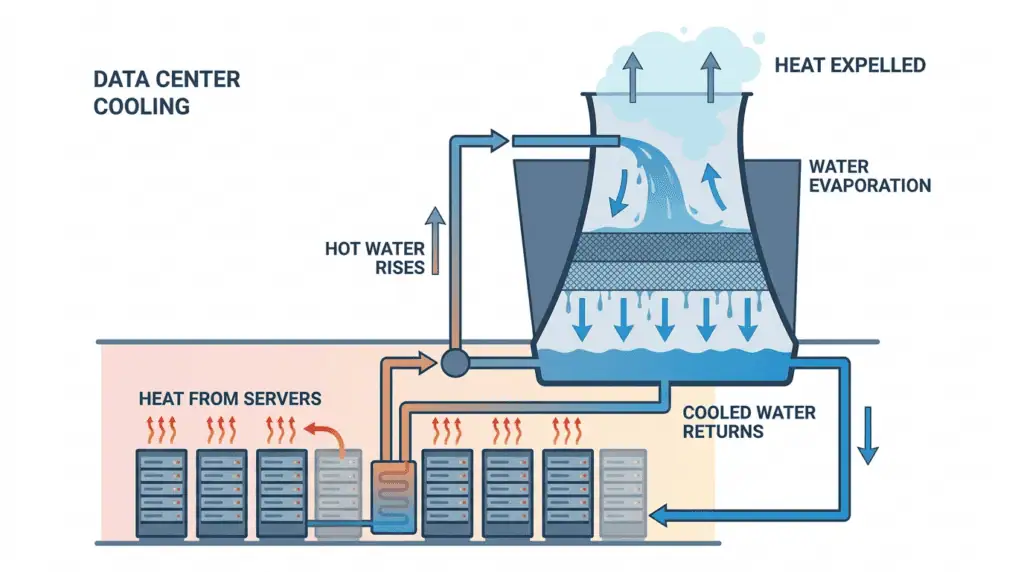
According to the Environmental and Energy Study Institute, large data centers can consume up to 5 million gallons of water per day, equivalent to the daily use of a town of 10,000 to 50,000 people. AI data-center water usage matters because these facilities run continuously and cluster together, so a single region can host many of them.
This is where “AI uses a lot of water” becomes true. It is not the per-query cost. It is the round-the-clock, at-scale cooling of massive server farms, especially when several data centers share one local water supply.
Per year and projected to 2030
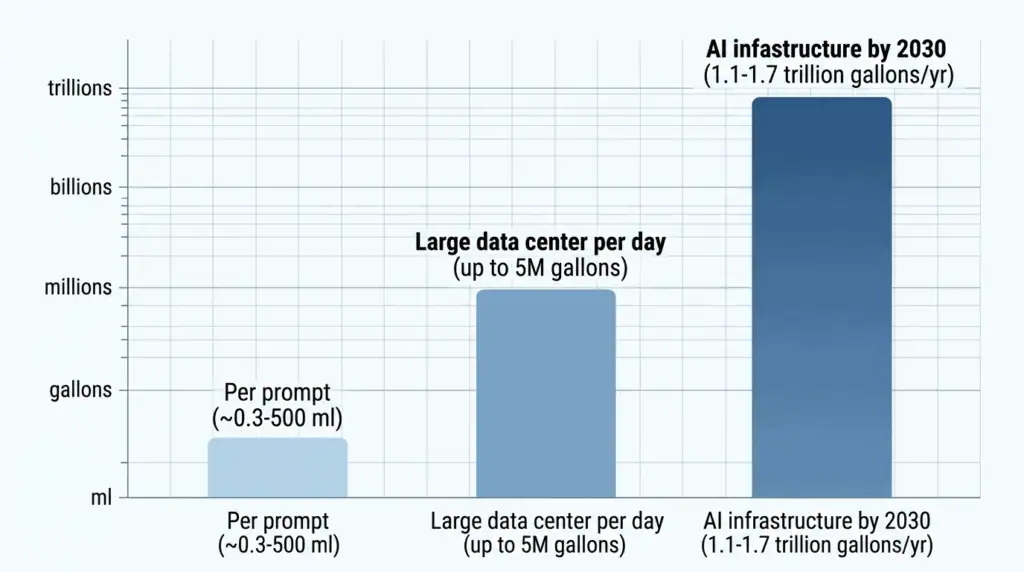
Per year, projected: the World Resources Institute estimates AI infrastructure could consume 1.1 to 1.7 trillion gallons of freshwater annually by 2030. Comparable to the yearly household water use of entire countries.
State-level example: data centers in Texas alone were projected to use around 49 billion gallons of water in 2025, with totals rising further into 2026.
Training: one-time model training is thirsty too. Training GPT-3 was estimated at ~700,000 litres of freshwater.
Which AI uses the least water
No AI company publishes per-query water data, so direct comparisons are estimates. What we do know is that water use per query depends on model size (smaller models use less compute) and data center location (a cool-climate facility near hydropower uses far less water than a hot-desert one running on coal) more than the model brand.
| AI Model / Provider | Estimated water per query | Data center WUE | Notes |
|---|---|---|---|
| ChatGPT (OpenAI / Azure) | ~0.32 ml (Altman, 2023) to 10-50 ml (UC Riverside) | Microsoft: ~1.8 L/kWh (2022) | Wide range reflects on-site vs off-site accounting |
| Google Gemini | Not disclosed; Google ops total: 5.6B gallons (2023) | Google: ~1.1 L/kWh (global avg) | Newer TPU v5 data centers significantly more water-efficient |
| Microsoft Copilot (GPT-4) | Shares Azure infrastructure with ChatGPT | Microsoft: targeting 0 water use by 2030 | Same physical servers as ChatGPT enterprise |
| Claude (Anthropic / AWS) | Not disclosed; runs on AWS | AWS: ~0.25 L/kWh (improving) | AWS has among the lowest WUE of major cloud providers |
| Meta AI (Llama) | Not disclosed | Meta: ~1.26 L/kWh | Data centers heavily solar-powered, reducing indirect water |
| Smaller models (GPT-4o mini, Claude Haiku, Gemini Flash) | Significantly less than full-size | Same data centers | 10-30x less compute per query, proportionally less water |
| Self-hosted open source (Llama 3, Mistral) | Depends on your hardware and power source | User-controlled | Laptop plus solar panel = near-zero water footprint |
In rough order of impact on water use per query:
- Model size. A 70B parameter model uses roughly 10-20x more compute than a 7B model.
- Data center location. Arizona data centers in 40°C heat rely heavily on evaporative cooling. Oregon or Finland data centers use almost none in winter.
- Cooling technology. Older air plus evaporative towers use more water than closed-loop liquid cooling or immersion cooling.
- Energy source. Hydroelectric power has near-zero operational water use. Coal power plants consume water in steam generation.
- Query complexity. A one-word autocomplete uses far less compute than generating a 2,000-word essay or analysing an image.
Lighter models on efficient cloud infrastructure running simple queries use the least. Heavy generation tasks (long outputs, image and video generation) on large models in hot-climate data centers use the most.
No single brand wins. The data center and query type matter more than the logo.
What changed across 2024, 2025, and 2026
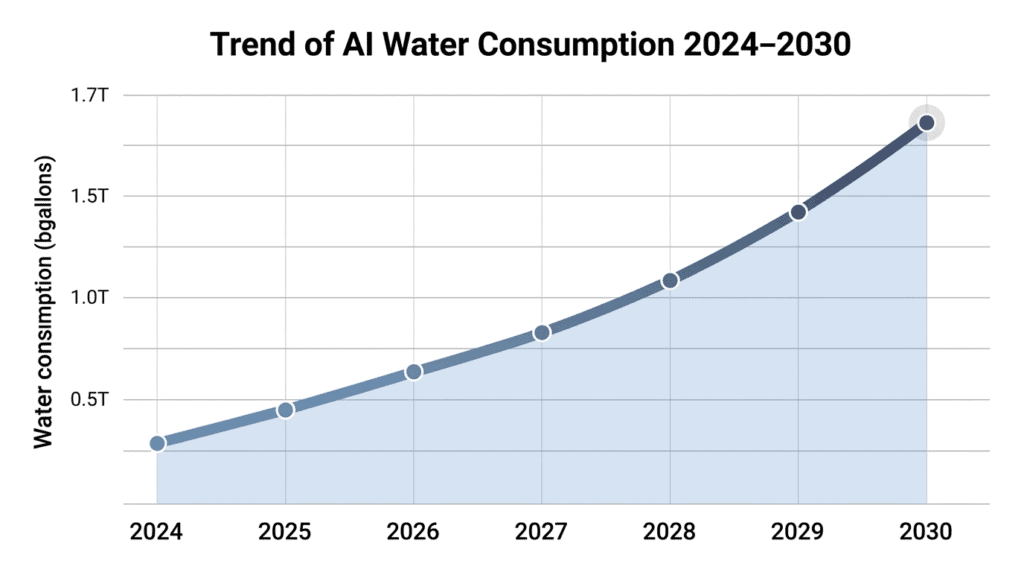
Exact global totals are hard to pin down because tech companies rarely disclose facility-level water data. The trend across years is clear and steep.
- 2024. AI’s water footprint drew major scrutiny as Google’s and Microsoft’s environmental reports showed sharp rises in water consumption tied to AI workloads. Microsoft reported its global water use jumped about 34% and Google about 20% in the year generative AI took off, into the billions of gallons each.
- 2025. Data-center water use accelerated. Texas data centers alone were projected near 49 billion gallons. The per-query debate went mainstream after Sam Altman published his teaspoon figure.
- 2026. Trajectory continues upward as AI build-out expands. The WRI trillion-gallon 2030 projection is on that curve.
Because disclosure is inconsistent, year-by-year global totals are estimates. Treat any precise “AI used X gallons in 2025” claim with healthy skepticism.
Is the concern overblown or real
Both the panic and the dismissal get it wrong.
The case that it is overblown. Per prompt, AI’s water use is tiny, often a fraction of a teaspoon. Many viral statistics conflate direct and indirect water, use worst-case data centers, or inflate figures by 50-250 times.
Growing the food for a single hamburger uses thousands of litres. One AI query is trivial. By that math, “AI is draining the planet’s water” is misleading.
The case that it is real. Aggregate and local impact matter. A data center using 5 million gallons a day in a drought-stricken region is a genuine problem for that community, even if each query is negligible. Concentration, not the per-prompt average, is the issue, and AI’s total footprint is climbing fast.
Does AI waste water? Not meaningfully on a per-prompt basis. At scale and in the wrong places, its water use is a legitimate environmental concern worth tracking. Without the doom or the denial.
What is being done
The picture is not one-directional. Industry and researchers are responding.
- Better cooling. Shifting to closed-loop, air, and liquid cooling that recycles water instead of evaporating it.
- Smarter siting and scheduling. Running water-heavy workloads in cooler climates or at cooler times. The same UC Riverside team showed timing and location can cut water use significantly.
- AI saving water too. AI-powered leak detection has saved billions of gallons. One system reportedly saved 3 billion gallons over a few years in New Jersey. Another caught a single leak saving 350,000 gallons per day.
- Transparency pressure. Growing demand for tech companies to disclose real facility-level water data.
Per prompt, guilt is misplaced. The useful response is pressure for transparency and efficient cooling where data centers are built.
For the broader context, AI adoption statistics covers the growth curve driving all this. For the tools shaping it, best AI tools covers the vetted list.
Related Posts

Agentic AI pentesting tools replay the original exploit after a patch ships, then try mutated payloads. Eight platforms ...

AI adoption statistics, sourced: 78% of companies say they use AI and only 21% have redesigned a workflow. Here is the h...

A free, cited AI glossary covering 264 machine learning and generative AI terms, with plain-English definitions and cros...

Real examples of artificial intelligence in digital marketing across content, SEO, ads, email and analytics, with what e...

AI marketing on Reddit: I pulled 239 threads across 7 subreddits. Marketers use AI daily and mostly dislike the products...

The AI prompt manager I built for Chrome and Firefox: save, tag, version and export your prompts locally. Free, no accou...