

Becoming an AI engineer takes about 6-12 months if you are already a software engineer, or 18-24 months from scratch, depending on how deep your projects go. The seven steps: get solid Python, learn the math (linear algebra, calculus, statistics, probability), study machine learning fundamentals through deep learning, build 3-5 real end-to-end projects, get one recognized certification (Microsoft AI-102 is the most cited), land an internship or transfer from a related role, and keep shipping.
Median US salary for related roles is $140,910 (BLS, May 2024). Specialized AI engineers commonly clear $120K-$200K+ in the US.
Employment for computer and information research scientists is projected to grow 20% from 2024 to 2034 (BLS), far above the 3% average across all jobs. The opponent this post argues against is every bootcamp that says you can get there in six weeks.
You cannot. You can get there methodically.
What an AI engineer actually is
An AI engineer designs, builds, and deploys AI systems: machine learning models, LLM-powered features, computer vision pipelines, recommendation systems, agentic workflows. Distinct from data scientist (heavier on analysis and experimentation) and ML researcher (heavier on new methods). AI engineer sits at the applied end: making models work in production and stay working.
Day-to-day is a mix of coding (mostly Python, sometimes Go or Rust for infra), data work (cleaning, labelling, evaluation), model work (training, fine-tuning, prompt engineering), and system work (APIs, monitoring, cost). The role that dominated 2020-2022 was more classical ML. The role that dominates 2026 is more LLM-integration heavy: RAG, agents, evaluation, and cost optimization on top of hosted APIs.
Skills that actually matter
Technical.
- Python. Non-negotiable. Standard library plus NumPy, pandas, PyTorch or TensorFlow.
- Math. Linear algebra (matrix operations, eigenvectors), calculus (gradients), probability and statistics. Deep enough to read a paper without terror.
- Machine learning fundamentals. Supervised and unsupervised learning, regression, classification, clustering, evaluation metrics, cross-validation, overfitting.
- Deep learning. Neural networks, backpropagation, CNNs for vision, transformers for language. Enough to fine-tune, not necessarily invent.
- LLM stack. Prompt engineering, RAG, function calling, evaluation, cost and latency tradeoffs. This is where 2026 hiring focuses.
- MLOps. Docker, Git, one cloud (AWS, GCP, or Azure), one experiment-tracking tool (MLflow, Weights and Biases), one deployment framework.
- SQL and data engineering basics. Because production AI is 80% data plumbing.
Soft.
- Communication. Explaining a model to a non-technical stakeholder is half the job.
- Product thinking. Which problem is worth solving with AI, and which is not.
- Debugging discipline. AI systems fail in weird ways that require patient investigation.
- Continuous learning. The field moves. Six-month-old techniques stop being the state of the art.
The 7-step roadmap
- Learn Python end-to-end. Not just syntax. Data structures, OOP, async, testing. If you cannot write clean idiomatic Python, everything downstream is harder.
- Cover the math. Andrew Ng’s Coursera Machine Learning Specialization plus the 3Blue1Brown Essence of Linear Algebra YouTube series. Both free. Time investment 3-4 weeks part time.
- Study machine learning fundamentals. Andrew Ng’s ML specialization again, plus one of the classic textbooks (Hands-On Machine Learning with Scikit-Learn, Keras, and TensorFlow by Aurelien Geron is the standard).
- Get into deep learning. Fast.ai’s Practical Deep Learning course is the fastest applied path. Andrew Ng’s Deep Learning specialization is the more theoretical one. Pick one and finish it.
- Learn the modern LLM stack. Prompt engineering, RAG, function calling, evaluation, and cost. Build a small RAG system on top of a hosted API. Deploy it. This one project teaches more than three courses combined.
- Build 3-5 real end-to-end projects. Not tutorials. Real problems with real data. Each project should have: problem statement, dataset, approach, evaluation, deployed demo. Publish them on GitHub with clean READMEs.
- Get one recognized certification. Microsoft AI-102 (Designing and Implementing an Azure AI Solution) is the most cited on job listings. AWS Certified Machine Learning Specialty and Google Cloud Professional Machine Learning Engineer are the equivalent alternatives. Pick the one that matches the cloud your target employers use.
Then apply for internships and entry-level roles. The order matters: you cannot skip projects and hope certifications get you hired. Certifications validate skills. Projects prove them.
Do you need a degree?
No specific AI degree is required. A CS or math degree helps and is common, but a strong portfolio plus certifications can get you hired without one.
Google, IBM, Microsoft, and Anthropic have all publicly relaxed degree requirements for engineering roles. Small startups relaxed them long before.
That said, an advanced degree helps for research roles specifically and for FAANG interviews that still weight prestige. If you are already through undergrad in a different field, the practical move is projects plus certifications, not a second degree.
Best courses and certifications
Free foundations.
- Andrew Ng’s Machine Learning Specialization on Coursera (free to audit).
- Fast.ai Practical Deep Learning (free).
- 3Blue1Brown Neural Networks series on YouTube (free).
- DeepLearning.AI ChatGPT Prompt Engineering for Developers (free).
Paid depth.
- Andrew Ng’s Deep Learning Specialization on Coursera.
- fast.ai Deep Learning course extensions.
- Hugging Face NLP Course.
Certifications that get named on job listings.
- Microsoft AI-102 (Designing and Implementing an Azure AI Solution). Most-cited AI cert on 2026 job postings.
- AWS Certified Machine Learning Specialty.
- Google Cloud Professional Machine Learning Engineer.
- IBM AI Engineering Professional Certificate (broader but shallower).
Salary in 2026
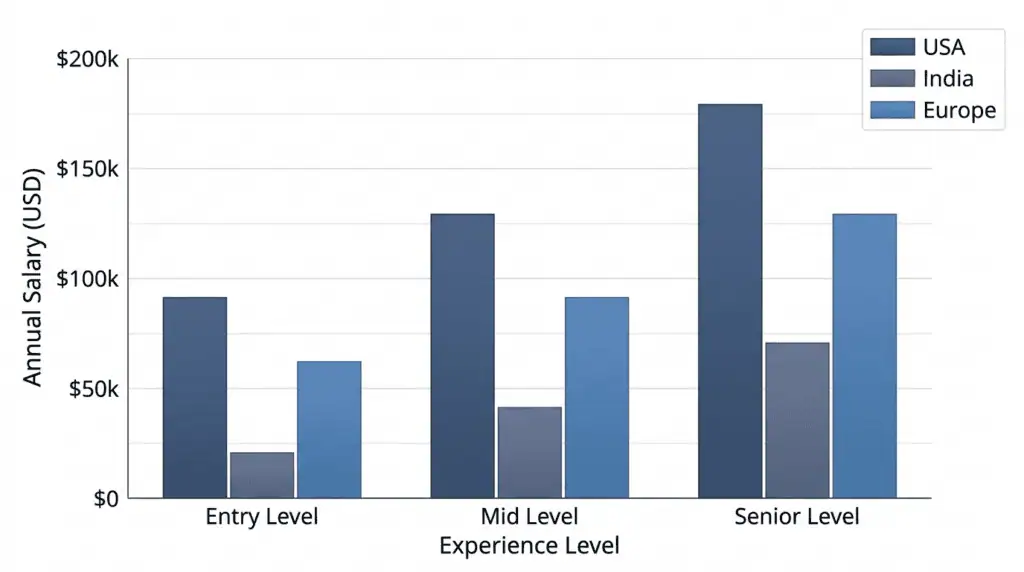
The U.S. Bureau of Labor Statistics reports a median annual wage of $140,910 (May 2024) for computer and information research scientists, the closest official category. Specialised AI engineer roles tracked by Glassdoor, Levels.fyi, and Indeed typically run higher.
| Region | Typical AI engineer salary (2026) | Roughly per month |
|---|---|---|
| USA | $120,000-$200,000+ base (senior / FAANG well beyond) | ~$10K-$16K+ |
| India | ₹8-25 LPA (entry ₹8-12, mid ₹12-18, senior ₹20+) | ~₹65K-₹2L |
| Europe (avg) | €55,000-€110,000 | ~€4.5K-€9K |
USA: entry-level roles often start around $100K-$130K, mid-level $140K-$180K, senior or specialized LLM engineers frequently exceed $200K base before equity. India: freshers commonly see ₹8-12 LPA, rising sharply with experience and skills. Per month, that means roughly $10K-$16K in the US and ₹65K-₹2L in India at typical levels.
Career outlook
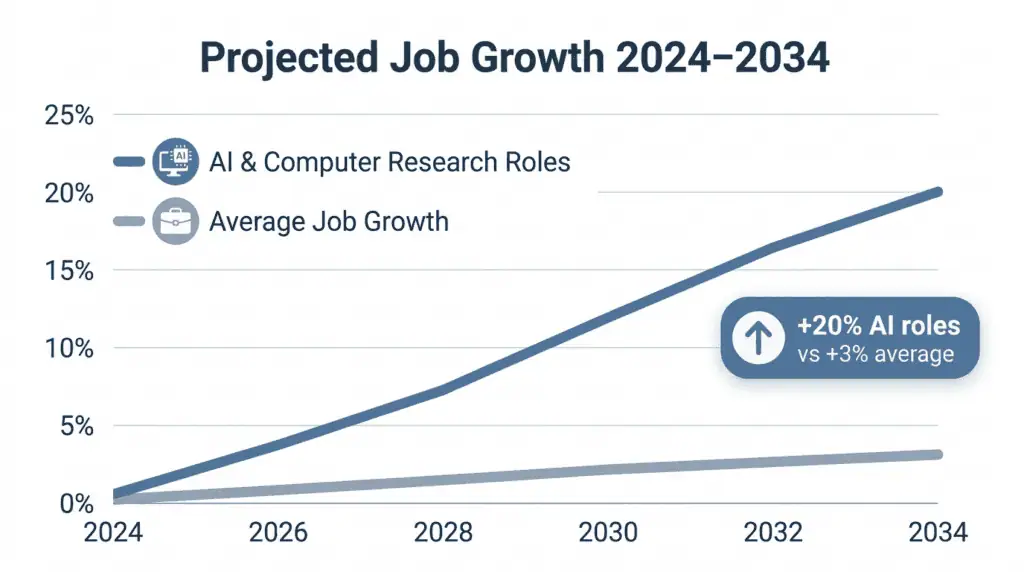
BLS projects employment for computer and information research scientists to grow 20% from 2024 to 2034, far above the 3% average for all jobs. Demand for applied AI skills is outpacing supply.
AI engineer jobs span big tech, startups, finance, healthcare, and increasingly every industry adding AI to its products. The role itself ranks among the jobs most resilient to AI.
Is it a good career choice? On the data, yes. High pay, strong growth, broad demand. The honest caveat is that the field moves fast and the bar is rising. Continuous learning is part of the job, not a phase.
How to get internships and entry-level roles
Internship is the fastest on-ramp. Four practical moves:
Build a project portfolio first. Internship applications with real GitHub projects stand out immediately. Three finished projects beat ten started ones.
Apply broadly. AI engineer intern, ML intern, data science intern, and junior software roles that touch AI all build relevant experience. Do not wait for a role titled exactly “AI engineer intern.”
Contribute to open source. A few merged pull requests on an AI library signal real ability. LangChain, Hugging Face libraries, PyTorch, and the smaller LLM tooling projects all accept beginner contributions.
Network and share your work. Post projects on LinkedIn and GitHub. Many internships come through visibility, not applications alone.
If a formal internship is hard to get, freelance AI projects or an internal transfer from a software role accomplish the same thing: provable, real-world experience.
Resume that gets you interviews
Your AI engineer resume should prove you ship, not just study. Lead with projects and impact:
- Put projects near the top, each with the problem, the tools (Python, PyTorch, an LLM API), and a measurable result.
- Quantify outcomes: “cut inference cost 40%,” “improved model accuracy from 82% to 91%.”
- List the real stack: languages, frameworks, cloud, MLOps tools.
- Include certifications (like AI-102) and link your GitHub.
- Skip the fluff. No generic “hardworking team player.” Show the work.
Interview questions that actually come up
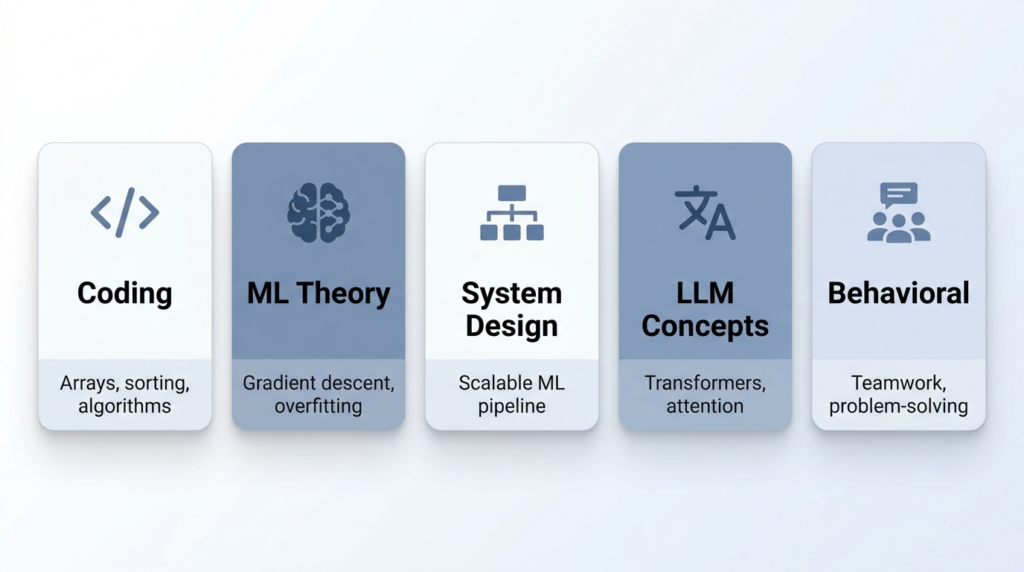
Expect a mix of coding, ML theory, system design, and behavioural. The common ones:
- Explain the bias-variance trade-off and how you handle overfitting.
- How does a transformer architecture work, and why did it change NLP?
- Walk through how you would deploy and monitor a model in production.
- How would you reduce the cost or latency of an LLM-powered feature?
- Explain the difference between fine-tuning, RAG, and prompting.
- Describe an AI project you built end to end, what broke, and how you fixed it.
- A coding problem (often Python plus data manipulation or a basic algorithm).
Prepare by being able to explain your own projects in depth. That is where most candidates win or lose.
Why AI writing code does not make this obsolete
AI writes a lot of boilerplate. Someone has to design, integrate, evaluate, and deploy AI systems, and judge whether the output is correct.
That someone is the AI engineer. AI tools make skilled engineers more valuable, not obsolete, which is why fears that AI will replace software engineers are overblown. The specific skills that survive are exactly the ones this roadmap builds: system design, evaluation, cost thinking, and the ability to ship something that works.
For the mechanics behind what you will be engineering, how AI search engines work covers the retrieval loop, how AI creates images and videos covers the diffusion side, and what are tokens in AI covers the vocabulary underneath the modern LLM stack.
The path is open. It is not fast. Six months if you already code, 18-24 if you do not. Real projects, real math, one certification, one internship. Everything after that compounds.
Related Posts
Agentic AI pentesting tools replay the original exploit after a patch ships, then try mutated payloads. Eight platforms ...

AI adoption statistics, sourced: 78% of companies say they use AI and only 21% have redesigned a workflow. Here is the h...

A free, cited AI glossary covering 264 machine learning and generative AI terms, with plain-English definitions and cros...

Real examples of artificial intelligence in digital marketing across content, SEO, ads, email and analytics, with what e...

AI marketing on Reddit: I pulled 239 threads across 7 subreddits. Marketers use AI daily and mostly dislike the products...
The AI prompt manager I built for Chrome and Firefox: save, tag, version and export your prompts locally. Free, no accou...