

The jobs most resistant to AI automation share four traits: hands-on physical work in unpredictable environments, deep human connection and emotional intelligence, complex creative and strategic judgement, and high-stakes accountability. Anthropic studied millions of real Claude conversations to measure which occupations actually overlap with what AI is used for.
Their finding: 30% of workers have effectively zero AI coverage. The specific occupations at the low-exposure end (cooks, motorcycle mechanics, lifeguards, bartenders, dishwashers, dressing-room attendants) share the same pattern: hands-on, physical, in-person.
The opponent this post argues against is every “AI is coming for every job” panic and every “AI will never replace anyone” dismissal. Neither is true. The honest picture is uneven and the data is available.
The four traits that make a job hard to automate
Hands-on physical work in unpredictable environments. AI cannot lay tile in a curved bathroom, unclog a specific drain that behaves in a specific way, or diagnose why a specific engine is knocking. Robotics is improving, but the combination of dexterity, judgement, and environment adaptation that a plumber or an electrician deploys is not close to full automation on any realistic 2030 timeline.
Deep human connection and emotional intelligence. Therapists, hospice nurses, and early-childhood educators do work where the human relationship is the product, not a wrapper on the product. Efficiency gains from AI here shrink the administrative overhead, not the core work.
Complex creative and strategic judgement. Not “create a poster.” That AI does. “Decide the campaign strategy for a Series B launch given competitive positioning and audience research.” That requires context, taste, accountability, and the ability to defend a call to a board.
High-stakes accountability and trust. Doctors, surgeons, judges, senior military officers. The role exists to be answerable.
Delegating the answer to a model does not remove the accountability, it changes who or what is answerable. Society is not yet willing to let it be a model.
The Anthropic data
Most “safe jobs” lists are opinion. Anthropic’s is data. The company studied millions of real Claude conversations to measure which occupations actually overlap with what AI is used for, published as its labor-market research.
Headline finding: at the low-exposure end, 30% of workers have effectively zero AI coverage. Their tasks appear too rarely in real AI usage to be automated by today’s models. Anthropic frames this as exposure, not predicted layoffs, and reports no systematic increase in unemployment for highly exposed workers since late 2022.
Specific zero-exposure occupations Anthropic names:
- Cooks and food-preparation workers
- Motorcycle and vehicle mechanics
- Lifeguards and safety attendants
- Bartenders and food-service staff
- Dishwashers and manual kitchen roles
- Dressing-room and personal-service attendants
Hands-on, physical, in-person. The pattern is unmistakable.
The flip side from the same research: jobs heavy on computers and data (programmers, customer service reps, data-entry workers, financial analysts) show the highest AI exposure. Anthropic also flags a warning sign, citing Brynjolfsson et al.: a 6-16% fall in employment among workers aged 22-25 in exposed occupations, driven mainly by slower hiring rather than layoffs. The entry rungs of screen-based careers are getting harder to climb, even where the overall field is not collapsing.
30+ jobs that are safe from AI
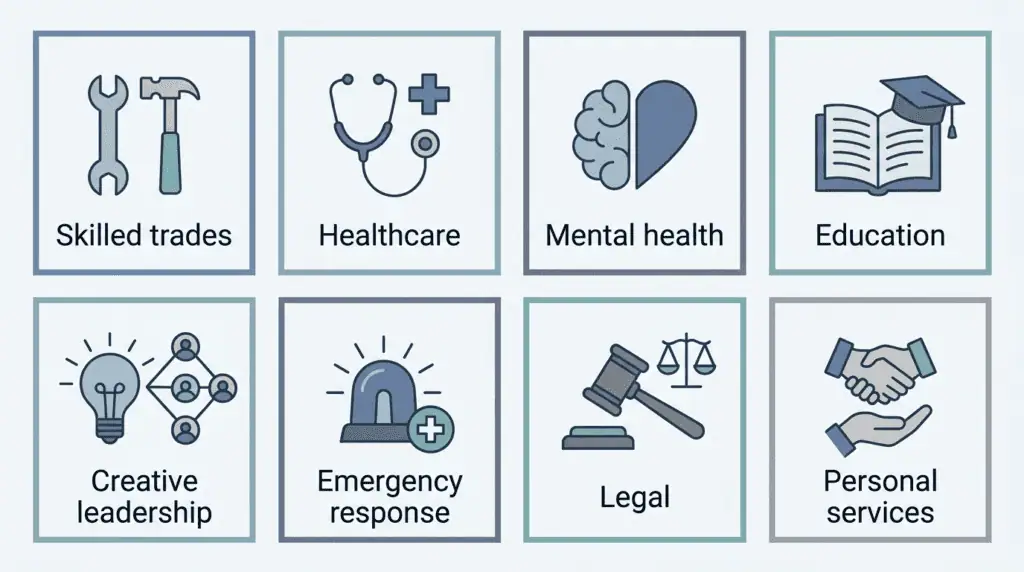
Skilled trades (high-paying, often no degree)
Electrician, plumber, HVAC technician, elevator mechanic, welder, roofer, machinist, industrial mechanic, carpenter, auto mechanic. Six-figure earning potential for the best of these in the US market. Apprenticeship training instead of a four-year degree.
Healthcare and caregiving
Surgeon, ER nurse, ICU nurse, EMT and paramedic, physical therapist, occupational therapist, dental hygienist, home-health aide, personal-care aide, hospice worker.
Mental health and social services
Clinical psychologist, licensed clinical social worker, marriage and family therapist, addiction counsellor, school counsellor, community-organiser, case manager (with human client contact), crisis-line responder (human hand-off role).
Education
K-12 classroom teacher, special-education teacher, early-childhood educator, university professor (research-heavy), music and arts teacher. Tutoring at the basic level is exposed; classroom teaching with behaviour management is not.
Creative leadership and strategy
Art director, senior editor, creative strategist, brand strategist, product designer at senior level, film director, showrunner. Junior copywriting and stock-photo creation are exposed. The senior direction that shapes the work is not.
Crisis, safety, and emergency response
Firefighter, police officer (patrol, detective), paramedic, search-and-rescue, wildland firefighter, disaster-response coordinator, security manager for high-value sites.
Legal, finance, and high-stakes advisory
Trial lawyer, criminal defence attorney, judge, senior M&A analyst, wealth-management advisor for HNW clients, forensic accountant, risk officer. Document review, paralegal work, and junior analysis are exposed. Courtroom advocacy and high-consequence advice are not.
Management and leadership
CEO / COO, hospital administrator, school principal, plant manager, senior product manager, hotel general manager. Executive decision-making involving culture, politics, relationships, and accountability. AI advises. Humans decide and are held responsible.
Personal and in-person services
Hairstylist, massage therapist, personal trainer, chef, sommelier, event planner, wedding coordinator, tour guide, dog trainer, home organiser.
Automation risk by industry, 2030
Combining data from McKinsey, Oxford Economics, and the World Economic Forum’s 2025 Future of Jobs report.
| Industry | Automation risk (2030) | Safest roles | Most at-risk roles |
|---|---|---|---|
| Manufacturing | High (60-70%) | Quality engineers, maintenance techs, plant managers | Assembly line workers, QC inspectors, warehouse pickers |
| Finance and banking | High (55-65%) | Financial advisors, M&A analysts, risk officers | Tellers, data entry, loan processors, basic analysts |
| Retail | High (50-60%) | Store managers, buyers, visual merchandisers | Cashiers, stock clerks, customer service reps |
| Transportation and logistics | High (45-65%) | Fleet managers, logistics coordinators | Long-haul truckers, delivery drivers, dispatchers |
| Legal | Medium (30-50%) | Trial lawyers, judges, criminal defence attorneys | Paralegals, document reviewers, contract drafters |
| Healthcare | Low-Medium (15-35%) | Surgeons, nurses, therapists, EMTs | Radiologists (image reading), medical coders, schedulers |
| Education | Low-Medium (20-30%) | Teachers, school counsellors, special education | Basic-subject tutors, standardised test proctors |
| Creative and media | Medium (25-45%) | Art directors, senior editors, creative strategists | Stock photo creators, junior copywriters, data journalists |
| Construction and trades | Low (10-20%) | Electricians, plumbers, HVAC techs, structural engineers | Some surveying, basic drafting roles |
| Social services | Very Low (5-15%) | Social workers, counsellors, community organisers | Administrative and case-management support roles |
| Hospitality and food | High (45-55%) | Chefs, hotel GMs, sommeliers, event planners | Fast food prep, basic food service, hotel front desk |
| Technology | Mixed (20-50%) | AI engineers, systems architects, cybersecurity specialists | Junior developers, QA testers, basic IT support |
The most future-proof categories across every major research report from 2023-2025:
- Skilled physical trades. Physical unpredictability makes full automation economically unviable for 10+ years.
- Mental health and counselling. Human connection is the product.
- Complex legal advocacy. Courtroom work, criminal defence, high-stakes negotiation.
- Emergency and crisis response. Chaotic real-world environments where split-second physical judgement is irreplaceable.
- Senior leadership and strategy. Executive decision-making involving culture, politics, and accountability.
Jobs AI will replace, partially or substantially, by 2030
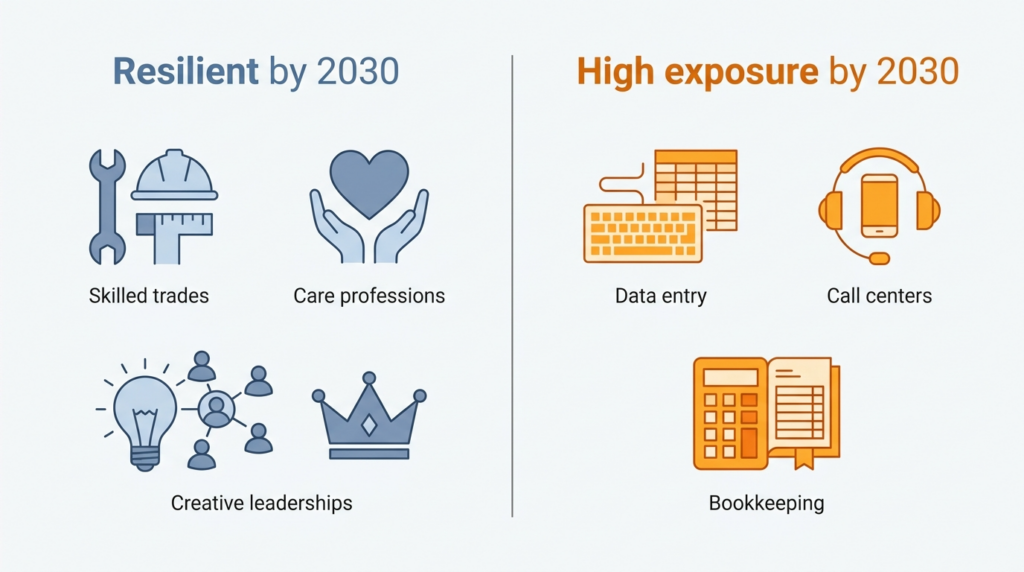
The pattern is the mirror image of the safe list. Routine, screen-based, data-heavy work with low physical or emotional demands.
- Data entry and basic administrative roles.
- Routine customer service and call-center work (AI chat and voice agents are already here).
- Basic bookkeeping and routine financial analysis.
- Entry-level content writing and translation.
- Telemarketing and routine sales outreach.
- Junior programming and QA tasks. Senior engineering judgement remains in demand; see will AI replace software engineers.
- Paralegal document review and basic research.
“Exposed” rarely means “eliminated overnight.” More often the job is reshaped, fewer people do more with AI, and the routine bottom rung shrinks. That is exactly why future-proofing matters even in fields that survive.
Entry-level and high-paying AI-proof jobs
High pay without a degree. Skilled trades are the standout. Electricians, plumbers, HVAC technicians, and elevator mechanics can earn six figures with apprenticeship training instead of a four-year degree, and they sit squarely in the safest category. Personal-service and specialised repair roles pay well and resist automation.
Entry-level roles that hold up. Hands-on and care-based entry jobs (nursing assistant, trades apprentice, early-childhood aide, EMT) are more durable than entry-level screen jobs. If you are early in your career and want resilience, an apprenticeship or a care pathway is a safer bet right now than a routine desk role, especially given the slowdown in entry-level hiring for the most AI-exposed fields.
How to future-proof your career
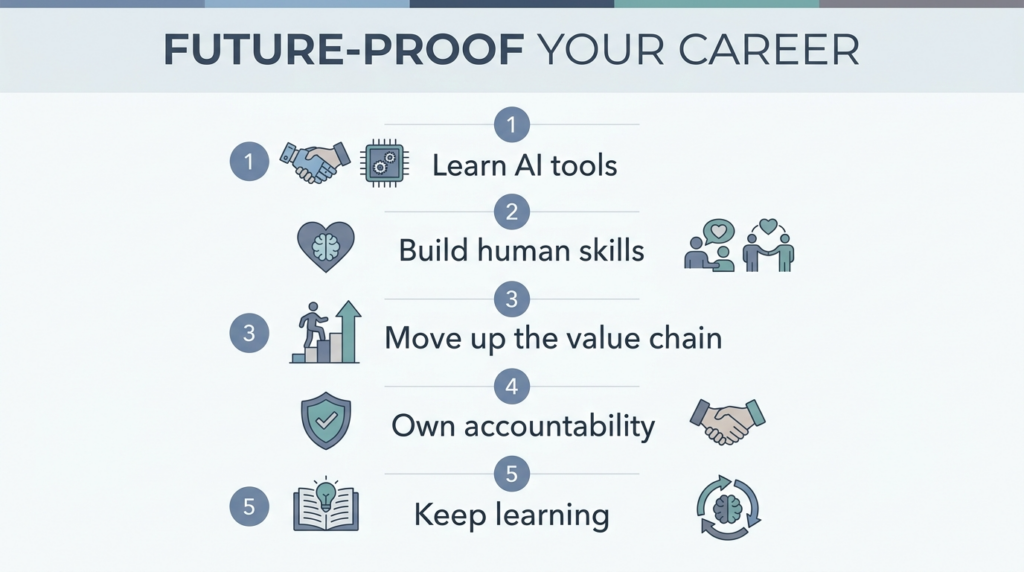
Even if your job is on the safe list, the smart strategy is not to hide from AI. It is to become the person who uses it best.
- Learn to use AI tools in your field. The real near-term risk is not “AI takes your job.” It is “a person using AI takes your job.” Get fluent with the tools relevant to your work.
- Double down on the human traits. Emotional intelligence, communication, leadership, hands-on skill, judgement. Exactly what AI lacks. Invest there.
- Move up the value chain. Let AI handle the routine layer of your job and shift your time toward strategy, relationships, and complex problems.
- Build a track record of accountability. Become the person trusted to own outcomes. That responsibility is hard to automate.
- Stay adaptable. WEF projects around 39% of core skills changing by 2030. The durable meta-skill is learning itself.
Will AI create new jobs
Yes, and this is the part doom headlines skip. The same WEF Future of Jobs report projecting 92 million displaced roles projects 170 million new ones by 2030. Net positive.
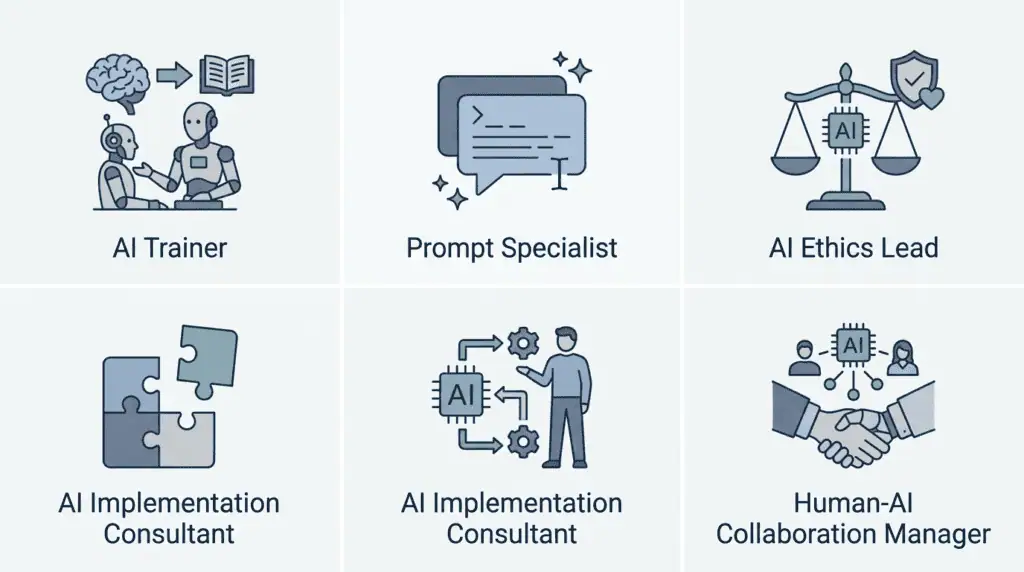
Entirely new categories are already emerging: AI trainers and data annotators, prompt and AI-workflow specialists, AI ethics and governance roles, AI implementation consultants, human-AI collaboration managers. Many overlap with how to become an AI engineer.
History rhymes. Automation has repeatedly destroyed specific tasks while creating new kinds of work.
The pain is that the destruction and the creation do not happen to the same people in the same year. That is the transition problem, and it is real. It is not the same as “no work exists.”
For the broader adoption context, AI adoption statistics covers the receipts. For what specifically hollows out inside software work, will AI replace software engineers covers that in detail.
Related Posts
Agentic AI pentesting tools replay the original exploit after a patch ships, then try mutated payloads. Eight platforms ...

AI adoption statistics, sourced: 78% of companies say they use AI and only 21% have redesigned a workflow. Here is the h...

A free, cited AI glossary covering 264 machine learning and generative AI terms, with plain-English definitions and cros...
Real examples of artificial intelligence in digital marketing across content, SEO, ads, email and analytics, with what e...
AI marketing on Reddit: I pulled 239 threads across 7 subreddits. Marketers use AI daily and mostly dislike the products...
The AI prompt manager I built for Chrome and Firefox: save, tag, version and export your prompts locally. Free, no accou...