

No, AI will not replace doctors or nurses, but it is already transforming both jobs, and the doctors and nurses who use AI well will out-compete those who do not. The evidence: AI today mostly handles administrative work and assists with diagnostics rather than practicing medicine.
About 40% of US physician practices already use some AI (mostly for paperwork), and the FDA has cleared 692 AI medical devices, with 531 in radiology. Medicine runs on human judgment, physical exams, accountability, and trust.
AI cannot own any of that. Free “AI doctor” tools exist and can be useful for information, but they are not a substitute for a real medical professional, and treating them as one is dangerous.
The likely future: doctors who use AI will replace doctors who do not. Not “AI replaces doctors.”
Will AI replace doctors
No. The consensus across medical bodies and researchers is that AI will augment doctors, not replace them. A recent peer-reviewed analysis literally framed the path as “augmentation, not replacement.”
According to the American Medical Association, about 40% of US physician practices now use some form of AI, but mostly for back-end administrative work like documentation and billing, not clinical decisions. Physicians themselves are cautiously optimistic: in one survey, 57% expect AI to become routine in diagnostics within five years, yet only a small minority believe today’s AI can make meaningful clinical suggestions on its own. AI is becoming a powerful assistant in the exam room and the back office, not a substitute for the person making the call.
AI in medicine is not one thing. Each AI system is a narrow tool trained for a specific job.
Some studies suggest AI could match physicians on isolated diagnostic tests, but matching a test question does not mean AI can replace physicians in real clinical practice, where context, ethics, and accountability decide care. AI doctors, in the sense of autonomous AI practicing medicine, do not exist and are not on the near horizon. What exists are AI tools that read scans, draft notes, flag risks, and surface information for a human doctor to act on.
Will AI replace nurses
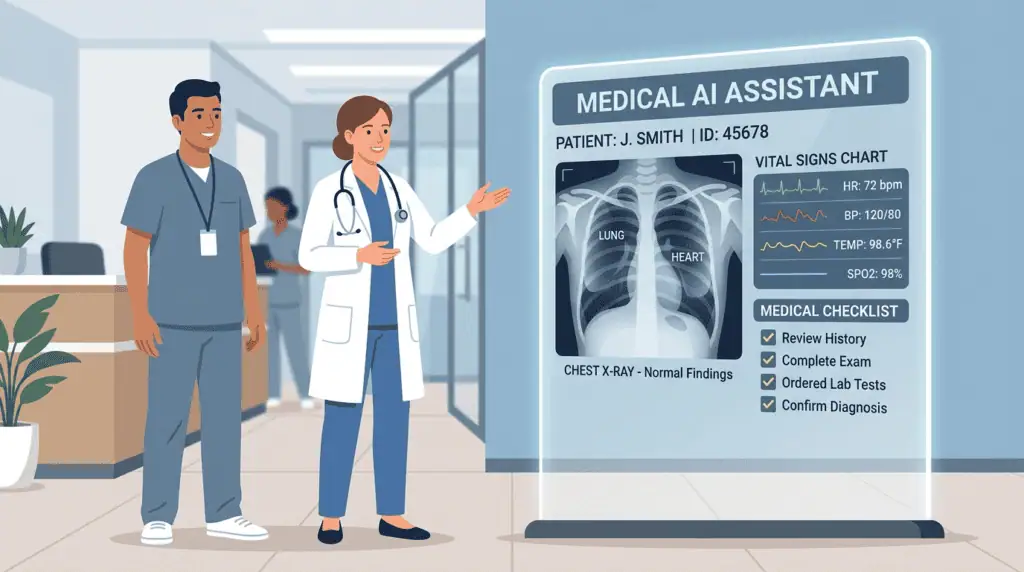
No, and arguably even less than doctors. The core of nursing (hands-on care, monitoring, emotional support, and human judgment at the bedside) is among the hardest work to automate.
What is emerging is “AI nurse” tools: virtual agents that handle routine, repetitive tasks like appointment reminders, basic triage calls, medication check-ins, and answering common questions. Especially valuable given chronic nursing shortages.
An AI nurse is a support layer, not a replacement nurse. AI nurses can take administrative and routine-communication load off human staff so nurses spend more time on actual patient care.
The risk for nurses is not unemployment. It is workplaces that adopt AI poorly. Used well, AI makes nursing more sustainable, not obsolete.
What AI actually does in medicine today
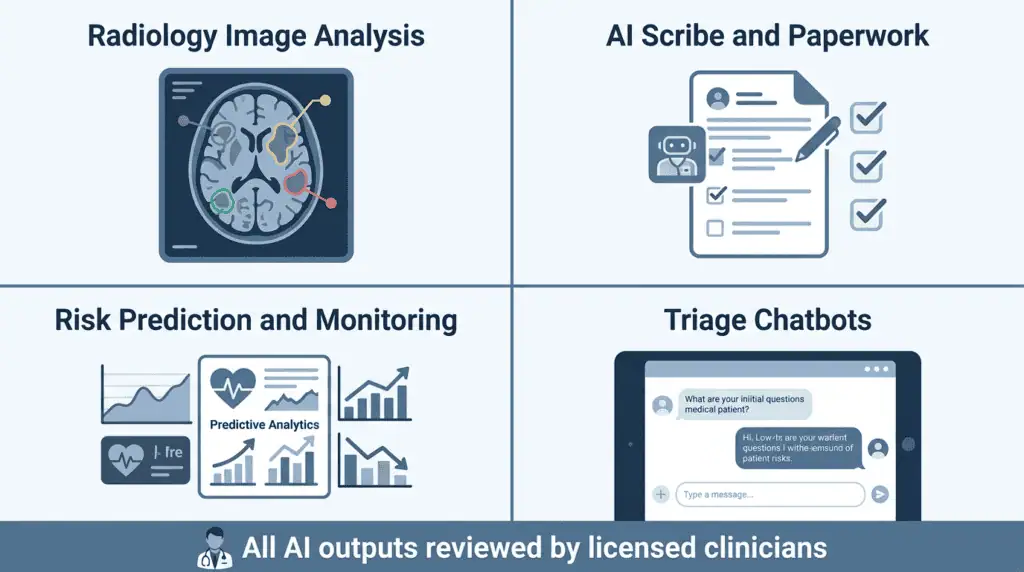
The real story is not replacement. It is specific, growing assistance. Today AI is used for:
- Diagnostics support. AI excels at pattern recognition in medical images. On specific narrow tasks (flagging a suspicious nodule, spotting a fracture) it can match a radiologist. The FDA has cleared 692 AI medical devices, with 531 in radiology, plus dozens in cardiology and neurology. All reviewed by a clinician before action.
- Reducing paperwork. The biggest near-term win. AI scribes and documentation tools cut the administrative burden driving physician burnout. Roughly 46% of doctors see AI’s main value as an administrative and scribe tool.
- Risk prediction and monitoring. AI flags patients at risk of deterioration, sepsis, or readmission for human follow-up.
- Triage and patient communication. Chatbots and symptom checkers route patients and answer routine questions before a human steps in.
The pattern: AI handles narrow, data-heavy tasks; the doctor or nurse owns the diagnosis, the treatment, and the relationship.
Free AI doctor tools and the big caveat
Many people search for “AI doctor free,” “AI doctor online free,” or “ChatGPT doctor.” Direct and responsible answer: yes, free AI tools can give you general health information.
- ChatGPT, Claude, and Gemini can explain symptoms, terms, and conditions in plain language. Useful for understanding, preparing questions for your real doctor, or making sense of a diagnosis.
- AI symptom checkers (Ada and similar apps, plus Google’s health search features) offer free informational guidance.
The non-negotiable caveat. These are not a doctor, not a diagnosis, and not a substitute for professional medical care. AI tools can be confidently wrong, miss serious conditions, and do not know your full history or examine you.
Use them for general information only. For any real symptom, decision, or emergency, see a licensed clinician, and for emergencies call your local emergency number immediately.
Treating a free AI doctor tool as your actual physician is genuinely risky. Nothing an AI says should be taken as medical advice. The right way to use them is as a starting point for understanding, never as the final word on your health.
Why AI will not fully replace doctors and nurses
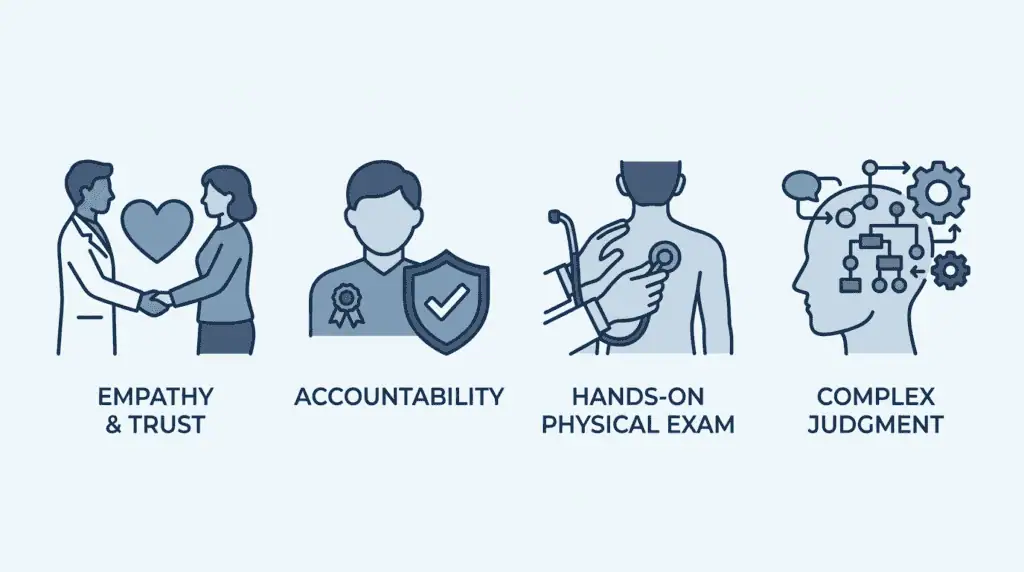
Even as AI gets better, four things keep human clinicians irreplaceable:
- Empathy and trust. Patients want a human who listens, comforts, and earns trust. Central to healing and to following treatment.
- Accountability. Someone licensed must take legal and ethical responsibility for life-and-death decisions. Society does not let software hold that.
- Physical examination and hands-on care. Examining, performing procedures, and bedside care require a physical human presence AI lacks.
- Complex, messy judgement. Real patients have incomplete histories, multiple conditions, and human contexts that require nuanced judgement beyond pattern-matching.
This is why the medical consensus, from the AMA to Harvard Medical School, is that AI is a tool that makes clinicians better, not a replacement for them.
The realistic future
The honest forecast is not “AI replaces doctors.” It is that AI becomes a standard, powerful tool, and the clinicians who master it pull ahead. The widely repeated line in medicine captures it: AI will not replace doctors, but doctors who use AI will replace those who do not.
Expect AI to keep:
- Eliminating paperwork through AI scribes and documentation automation.
- Sharpening diagnostics in radiology, pathology, cardiology, and neurology.
- Extending care via remote monitoring and triage.
The human doctor and nurse stay firmly at the center of medicine.
For patients, the practical advice is simple: use free AI tools to understand your health, never to replace your doctor. For clinicians, the move is to embrace AI as the tool that frees you to do the human parts of care better.
The future of medicine is not doctors versus AI. It is doctors and nurses with AI.
For the broader picture on which professions hold up, what jobs are safe from AI covers the data. For the parallel argument about software work, will AI replace software engineers covers the same question in code. For the tools clinicians actually pilot, best AI tools covers the vetted picks.
Related Posts
Agentic AI pentesting tools replay the original exploit after a patch ships, then try mutated payloads. Eight platforms ...

AI adoption statistics, sourced: 78% of companies say they use AI and only 21% have redesigned a workflow. Here is the h...
A free, cited AI glossary covering 264 machine learning and generative AI terms, with plain-English definitions and cros...
Real examples of artificial intelligence in digital marketing across content, SEO, ads, email and analytics, with what e...
AI marketing on Reddit: I pulled 239 threads across 7 subreddits. Marketers use AI daily and mostly dislike the products...
The AI prompt manager I built for Chrome and Firefox: save, tag, version and export your prompts locally. Free, no accou...