



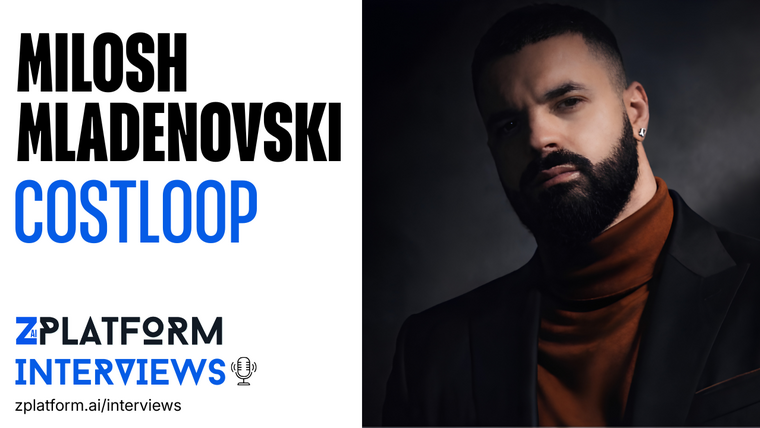
TL;DR: CostLoop founder Milosh Mladenovski explains why his subscription tracker deliberately refuses bank connections, how a two-person bootstrapped team in Oslo competes against funded enterprise platforms, and why he corrects his own marketing claims mid-interview. The product tracks $430,000+ in software spend across 8,200+ subscription records, with a free tier for 5 subscriptions and Pro at $9 per month.
Most founder interviews are an exercise in careful inflation. You ask about traction, you get a number stripped of context. You ask about compliance, you get a list of acronyms.
This one went differently, and that is why it is worth reading. Three separate times, Milosh Mladenovski walked back a claim that would have made CostLoop look better. He rejected the framing that his product is certified against eight privacy regulations. He refused to give me a customer segment breakdown because his dataset is not yet reliable enough to support one. He labelled his own 18% savings statistic a reference point rather than a guarantee.
That is unusual, and it made the rest of the answers more credible, not less.
CostLoop launched in May 2026 out of Oslo, built by two founders with no outside funding. It sits in a specific gap: too small for Cledara or Zluri, too serious for a spreadsheet. The product’s most interesting decision is what it refuses to do, which is connect to your bank. In this interview, Milosh explains that tradeoff, the economics of bootstrapping from one of the most expensive cities in Europe, and which marketing channels actually moved the needle for a two-person team.
Founder Story & Origin
Can you introduce yourselves and give us a brief overview of CostLoop, when it was founded, the team behind it, and the fact that you’re building out of Oslo?
CostLoop is a subscription tracking and SaaS spend management platform for freelancers, agencies, startups, and small to medium-sized businesses.
We started the company in Oslo in 2025 and launched it in May 2026. I am Milosh Mladenovski, the founder, and I lead the product, user experience, and technical direction. Aleksandar Antevski is the co-founder and focuses primarily on business operations and growth.
We built CostLoop because smaller businesses often have the same software-spending problems as larger companies, but they do not have procurement teams, finance departments, or budgets for complex enterprise platforms.
CostLoop gives them one place to see what software they are paying for, how much it costs, when it renews, who owns it, and where it can be cancelled. Users can add subscriptions manually, import them from a CSV or bank statement, or use the Chrome extension to surface subscriptions from Gmail or Outlook.
We are building from Oslo, but the product is intended for a global audience.
You’ve said CostLoop came from a problem you experienced yourselves. Can you share that “aha” moment and the specific bill that pushed you to start building?
There was not one cinematic moment involving a single enormous invoice. It was more frustrating than that, because it was the accumulation of smaller charges.
I sat down to review our statements and found three services that had continued billing even though they had not been actively used for months. None of the individual charges looked catastrophic, which was exactly why they had remained unnoticed.
Once we cancelled them and calculated the annual cost, the waste became obvious. The money was part of the problem, but what frustrated me more was that it was completely preventable.
We had invoices in different inboxes, annual and monthly billing cycles, different currencies, and no single place showing the complete picture. We were managing parts of it through memory and spreadsheets, which worked until the number of tools increased.
That was the real “aha” moment. The problem was not forgetting one subscription. The problem was not having a system that made forgetting impossible.
What made you decide to turn a personal frustration into an actual SaaS product rather than just fixing it with a spreadsheet or a one-off script?
A spreadsheet can solve the inventory problem temporarily, but it does not solve the ongoing management problem.
It can list a subscription, cost, and renewal date. It does not automatically remind the responsible person, calculate costs across different billing cycles, highlight missing ownership, store cancellation links, or warn you that multiple tools may be solving the same problem.
A script would have created a similar limitation. It might have solved our specific setup, but it would not have created something understandable and maintainable for a freelancer, agency owner, or operations manager who is not technical.
The more we looked at the market, the clearer the gap became. At one end, people were using spreadsheets, Notion, or calendar reminders. At the other end, there were enterprise platforms with procurement workflows, corporate cards, SSO discovery, sales calls, and enterprise pricing.
There was very little in the middle for someone who simply needed clear visibility and reliable reminders without handing over their banking credentials.
That gap looked much larger than our personal problem.
Recognise the pattern? If you have never audited your own stack, run the numbers first. Our free SaaS vs lifetime deal calculator shows what a recurring tool actually costs you over 24 months, which is usually the moment people start cancelling.
Building a Bootstrapped SaaS
Why did you choose to bootstrap instead of raising funding, and how has that shaped the product?
CostLoop did not need millions of dollars to prove whether the core problem was real.
Raising funding too early can create pressure to increase headcount, expand the scope, and chase growth before the product has earned it. We wanted the freedom to build around real user problems rather than an investor narrative.
Bootstrapping forced us to be disciplined. Every service we pay for, every feature we build, and every marketing experiment has to justify its cost.
It has also influenced the product itself. CostLoop is deliberately simple because we cannot afford to build features that look impressive in a pitch deck but are rarely used by customers.
The downside is speed. A funded competitor can hire separate teams for development, marketing, sales, support, security, and partnerships. We cannot pretend that two people can match that output.
The advantage is focus. We can change direction quickly, speak directly with users, and say no to features that would move CostLoop away from the problem it was created to solve.
What does the team look like today, and how are you splitting time between building, marketing, and support?
We are a two-founder team.
I lead product development, UX/UI, technical decisions, website strategy, and much of the content. My professional background is in enterprise UX/UI design, so I spend a lot of time making complicated workflows understandable and reducing unnecessary steps.
Aleksandar focuses more heavily on operations, commercial activities, partnerships, and helping us evaluate where the business should spend its limited time and resources.
In reality, the responsibilities still overlap. When you are bootstrapped, nobody gets to say, “That is not my department.” We both test the product, answer users, review analytics, evaluate marketing channels, and discuss roadmap priorities.
The hardest part is not doing the work. It is deciding which work deserves attention. There is always another feature, article, marketplace, integration, directory, partnership, or support improvement available.
Our job is to identify the small number of things that can materially improve the product or distribution and ignore most of the rest.
What have been the biggest tradeoffs of bootstrapping compared to a funded competitor?
The largest tradeoff is that we cannot build several major product areas simultaneously.
Enterprise competitors can develop SSO discovery, procurement, corporate card infrastructure, contract negotiation, employee lifecycle management, mobile applications, and dozens of integrations at the same time. We have to choose a much narrower problem.
We have therefore said no, at least for now, to becoming a complete expense management platform, accounting platform, virtual card provider, or enterprise IT management suite.
We have also moved slower on integrations, mobile applications, large-scale outbound sales, and formal partnership programs.
Another tradeoff is that founders become the bottleneck. Marketing work can delay product work, and a technical issue can pause content or outreach.
But limitations can be healthy. They force us to ask whether a requested feature strengthens the main product or merely makes the feature list longer. CostLoop should not become a smaller, weaker copy of an enterprise platform. It needs to be excellent at the narrower job it was designed to perform.
Building from Oslo, do you see advantages or challenges compared to founders in SF, London, or Berlin?
Oslo has influenced how we think about privacy, product quality, and sustainability.
European users are generally more cautious about how products collect and process data. Building here made us question whether broad access to someone’s bank account or full email content was truly necessary. That led us towards data minimisation from the beginning.
The timezone is also useful. We can communicate with Europe during the normal working day and still overlap with North America later in the afternoon.
The challenge is that Oslo has a smaller software founder ecosystem than San Francisco, London, or Berlin. There are fewer specialised SaaS events, investors, journalists, partnership opportunities, and potential early adopters within immediate reach.
Norway is also an expensive place to build a company. Bootstrapping from Oslo means watching infrastructure, software, legal, and operational costs closely.
However, being outside the largest startup centres can also protect you from copying whatever is fashionable. It makes us focus more on whether users genuinely need something rather than whether other founders are talking about it.
The Product
Walk us through what CostLoop actually does, from signup to a clean view of every subscription.
The process begins by creating an account. No credit card is required for the Free plan.
The first job is building an accurate subscription inventory. Users can add tools manually, import an existing spreadsheet or bank statement CSV, or use the Chrome extension to scan billing-related metadata from Gmail or Outlook.
Every potential subscription is reviewed and confirmed by the user. CostLoop does not silently decide that every recurring-looking transaction or email is definitely a subscription.
Once confirmed, the subscription record can include the cost, currency, billing cycle, renewal date, owner, number of seats, category, invoice or contract link, cancellation URL, and internal notes.
CostLoop then normalises monthly and annual costs so users can see their total software spending in one dashboard, even when some tools are billed monthly and others annually.
Renewal reminders notify the user before the next charge. The Health Score and savings tools help identify missing ownership, unused seats, duplicated categories, and subscriptions that require attention.
The goal is to move the user from scattered information to one maintained source of truth.
You offer an inbox scanner and manual entry, deliberately avoiding bank integrations. Why that specific approach?
No single discovery method is complete.
Manual entry gives the user maximum control and works for any vendor in any country. The downside is that people often forget subscriptions they are already paying for.
The inbox scanner helps fill that gap. Almost every software company sends a receipt, renewal notice, invoice, or price-change notification. That makes an inbox a valuable record of subscriptions without requiring access to a bank account.
Bank statement CSV import covers another part of the problem. It can identify recurring charges that may use unexpected vendor names or may not have sent an easily detectable email.
We deliberately chose file-based bank statement import rather than a persistent live connection. The user exports the statement, decides what to upload, reviews the result, and remains in control.
This approach is less automatic than a permanent banking connection, but it reduces privacy concerns, removes dependence on regional open-banking providers, and allows CostLoop to work with banks and card providers worldwide.
Tell us about the Bank Statement CSV import and the Health Score. What problems were you solving with each?
The Bank Statement CSV importer solves the cold-start problem.
Asking a user to manually enter 20 or 30 subscriptions is a terrible onboarding experience. Many people will add the first three, become distracted, and never complete the inventory. Importing a bank or card statement lets CostLoop surface likely recurring charges so the user can review them much faster.
It also catches vendors that may have been forgotten completely or that bill under a parent company name.
The Health Score solves a different problem. Having a complete list is useful, but a list does not tell you what deserves attention.
The Health Score provides a 0-100 view of the condition of the subscription portfolio. It considers signals such as missing owners, unused seats, duplicate categories, overdue or upcoming renewals, and incomplete records.
The score itself is not the final goal. Its value is that it converts an unstructured list into an actionable review. Users can see why the score is low, fix specific issues, and watch it improve.
How does the Chrome extension work under the hood, and what was the response after launching it?
The extension connects through Google or Microsoft OAuth. Users do not give CostLoop their email passwords.
It works with limited, read-only access and examines billing-related metadata such as the sender, subject line, and date. It does not need to read message bodies or attachments to surface likely billing and renewal emails.
The scanner reviews the previous 12 months, looks for patterns associated with invoices, receipts, renewals, subscriptions, and recurring charges, and presents possible matches to the user. Nothing is added to the CostLoop dashboard until the user reviews and confirms it.
The launch reinforced that discovery is one of the hardest parts of subscription management. People often know they need better tracking but do not know what their complete list actually contains.
It also showed us that permission explanations matter enormously. Users do not simply ask whether a scanner works. They ask exactly what it can read, what is stored, and what happens after the scan. That trust question has influenced both the product and our communication around it.
Privacy-First Positioning
“No bank connection, no password sharing, no financial data access” is a strong stance. Is that a product decision or a values decision?
It is both.
As a values decision, we do not believe a subscription tracker should automatically receive the broadest possible access simply because that access is technically available.
As a product decision, reduced access removes several sources of friction and risk. We do not need to maintain live banking connections, support different open-banking systems in every market, or ask users to trust us with credentials that are not necessary for the service.
The tradeoff is that CostLoop is not completely passive. Users must import a file, scan their inbox, or add information manually, and they must confirm what is saved.
We consider that a reasonable tradeoff. Full automation is not automatically better when it requires permanent access to highly sensitive information.
When explaining the difference from tools such as Ramp or Cledara, we are also clear that they solve broader problems. They may provide cards, procurement, expense controls, or payment infrastructure. CostLoop is for users who want subscription visibility and renewal control without replacing how their business pays for software, at a considerably lower cost.
You list compliance with GDPR, UK GDPR, FADP, PIPL, APPI, PIPA, PDPA, and DPDP. What did that take operationally as a small team?
I would be careful with the wording here. We do not claim that CostLoop has received eight separate government certifications.
What we have done is design our product, policies, and operational safeguards around the major privacy principles represented in those regulations.
The practical work includes data minimisation, explicit consent, clear purposes for processing, user data export and deletion, documented subprocessors, a Data Processing Agreement, EU-based data hosting, encryption in transit and at rest, restricted access, and transparent privacy and cookie documentation.
For the inbox integration, we intentionally limited access to metadata needed for detecting likely subscriptions and avoid storing email bodies or attachments.
The difficult part for a small company is not writing a privacy policy. Anyone can generate legal-looking text. The difficult part is making sure the product architecture and everyday operations behave consistently with what that policy promises.
We still review this as the product evolves. Compliance is not a document you publish once and forget.
Is privacy-first positioning a lasting moat, or something bigger tools will eventually adopt?
Privacy alone is not a permanent moat. A larger company can rewrite a policy, add consent controls, or release a lighter integration.
The stronger advantage comes from architecture and incentives.
If a product’s discovery, card, procurement, and analytics systems depend on broad financial or identity access, changing that model is more difficult than adding a privacy-focused paragraph to the website.
CostLoop has been designed around user confirmation, limited data access, portability, and no persistent bank connection. That affects how features are built from the beginning.
The other part of the moat is trust. Trust develops through consistent behaviour, clear explanations, and not quietly expanding permissions over time.
Bigger tools may absolutely improve their privacy practices, and I hope they do. Our responsibility is not to assume they will remain weak. It is to keep proving that a useful subscription management product does not need to become invasive.
Market, Competition & Positioning
Your positioning is sharp: “too small for Cledara or Zluri, too serious for spreadsheets.” How did you land on that wedge?
We arrived at it by looking honestly at who was being poorly served.
A business with three subscriptions probably does not need CostLoop. A simple spreadsheet may be enough.
A company with hundreds or thousands of employees may need automated SSO discovery, employee lifecycle management, procurement workflows, corporate cards, and dedicated SaaS operations. An enterprise platform makes sense there.
The underserved group sits between those extremes. It includes freelancers with a serious software stack, agencies, startups, and small businesses paying for 10, 20, or 50 tools without a dedicated procurement team.
They have outgrown a spreadsheet, but they do not want an enterprise sales process, a long implementation, or pricing that costs more than the subscriptions they are trying to manage.
That wedge shapes our pricing, onboarding, and roadmap. We optimise for fast setup, understandable workflows, and practical renewal control.
It also helps us say no. We are not trying to rebuild every feature offered by Cledara, Zluri, Zylo, or Vendr.
Where do you clearly win against spreadsheets and enterprise tools, and where do you honestly still lose?
Against spreadsheets and Notion, we win on automation and structure.
CostLoop automatically normalises monthly and annual spending, sends renewal reminders, provides a renewal calendar, assigns owners, stores cancellation links, identifies possible duplicates and unused seats, and calculates portfolio health. A spreadsheet can imitate parts of this, but somebody has to build and maintain the system manually.
Against enterprise tools, we win on simplicity, speed, pricing, and privacy. There is no implementation project, procurement call, SSO requirement, card migration, or bank connection.
Where do we lose? We do not currently offer the depth of enterprise SaaS discovery, identity management, employee onboarding and offboarding, vendor negotiation, corporate card controls, or complex procurement approval that larger platforms offer.
Our discovery also depends more heavily on user review. We consider that good for accuracy and privacy, but it is less automatic than a deeply integrated enterprise system.
We should not pretend CostLoop is the best product for every company. It is intended to be the right product for a specific type of company.
Your 2026 SaaS Waste Report cites 18% average savings after a first audit. What’s the story behind that number?
The report was created because we kept finding that small businesses understood they probably had waste, but lacked useful benchmarks.
It combines external research from established SaaS management sources with patterns observed through subscription audits and user-reported waste categories. It looks at problems such as zombie subscriptions, excessive seat counts, duplicate tools, forgotten annual renewals, and the rapid growth of AI software spending.
It is important to describe the methodology accurately. This is a synthesis report and benchmark, not a controlled scientific survey of every CostLoop customer. The 18% figure is an average reference point, not a guaranteed outcome.
From a marketing perspective, the report gives us something more useful than another promotional page. It creates data and frameworks that founders, operations teams, journalists, and other publications can reference.
Users & Traction
Can you share how CostLoop is doing today? What’s the split across freelancers, agencies, startups, and SMBs?
The current aggregate product figures show more than $430,000 in software spend tracked and more than 8,200 subscription records managed through CostLoop.
Those figures should not be confused with CostLoop revenue, annual recurring revenue, or the number of paying businesses. They represent activity and subscription data managed through the platform.
Our strongest user groups are freelancers, agencies, startups, and small to medium businesses. The common pattern is not a specific industry. It is that one person or a very small operations team has become responsible for software spending without having a dedicated procurement system.
We do not currently publish precise percentages for each segment because our dataset is still developing and user-type classification is not consistent enough for us to present a split confidently.
I would rather say that honestly than publish percentages that look precise but are not reliable.
What matters strategically is that the original target group is showing up: people with enough subscriptions for the problem to hurt, but not enough organisational complexity to justify an enterprise platform.
Could you share specific customer stories where CostLoop found meaningful savings?
One example is a freelance designer who had subscriptions spread across both personal and business cards. After creating a complete inventory, she found two tools that were no longer being used and cancelled them. She also set reminders for her annual plans and used the advance notice before one renewal to review the plan instead of letting it charge automatically.
Another example is a 12-person marketing agency managing more than 30 software products across several cards. Their audit identified subscriptions with no clear internal owner. Four tools were cancelled and two were moved to lower plans. More importantly, the agency introduced named ownership and a recurring review process, which reduced the chance of the same problem returning six months later.
A third case involved an operations manager who discovered that the company’s estimated monthly software spending was significantly below the actual amount. Importing and reviewing statement data surfaced several subscriptions that were not recorded in any internal system. Some were cancelled, while others were reassigned to active owners.
The recurring lesson is that savings usually come from visibility first, not from complicated optimisation.
Marketing & Growth Lessons
What marketing channels have actually worked, and which underperformed?
SEO has been one of the most strategically useful channels because the problem has many specific search intents. People search for how to track software renewals, find hidden subscriptions, replace a subscription spreadsheet, compare Cledara alternatives, or control SaaS costs for a small team.
The Chrome Web Store is also useful because it places CostLoop close to the moment when somebody is actively looking for an inbox-based solution. It functions as both a distribution channel and a trust signal.
Founder interviews, product listings, and relevant partnerships help with credibility and search visibility, although they do not always produce immediate conversions.
Broad social media promotion has been less predictable. A post may receive impressions or likes without bringing qualified users. Generic startup communities and directories also tend to underperform unless the audience is already experiencing the exact problem CostLoop solves.
Our lesson has been that distribution channels with strong intent usually outperform channels with broad attention. Ten visitors actively searching for a renewal tracker can be more valuable than thousands of passive social views.
You have a lot of “vs. Cledara / Zluri / Notion” pages. What have you learned about ranking against much bigger competitors?
It is very intentional, but the goal should not be to publish hundreds of thin comparison pages.
Comparison searches happen near a decision. Someone searching “Cledara alternative for a small team” or “subscription tracker versus spreadsheet” already understands the category and is evaluating an approach.
The opportunity for a smaller company is specificity. We are unlikely to outrank a major competitor for a broad term simply by repeating the same generic product language. We can compete by answering narrower questions more directly and honestly.
That means explaining where CostLoop wins, where the competitor wins, which type of company should choose each one, and where the products are not genuinely comparable.
We have also learned that publishing the page is only the beginning. Search performance depends on internal linking, technical SEO, authority, updates, and whether the page actually satisfies the question.
A comparison page that reads like dishonest advertising may attract a click, but it will not build trust or survive long-term search quality changes.
What’s the most counterintuitive marketing lesson you’ve learned?
People rarely wake up wanting “SaaS management software.”
They notice a $400 renewal they forgot about. They realise the company pays for both Slack and Teams. They discover three unused AI subscriptions. An accountant asks for a list of recurring software costs and nobody has one.
The marketing works better when we begin with that concrete moment rather than with the product category.
Another counterintuitive lesson is that being global does not require pretending to be American or hiding that we are based in Oslo. The location can support the story when it is connected to product quality, privacy, and a practical European approach to data.
What does not work is talking endlessly about being a founder, being bootstrapped, or building in public without connecting it to a customer problem. Other founders may enjoy that content, but they are not automatically buyers.
The product story has to remain about the money and operational friction the user can avoid.
Pricing, Business Model & Roadmap
Walk us through the pricing model and how you decided what to charge for.
The Free plan allows users to begin tracking up to five subscriptions without a credit card. We wanted it to be genuinely useful rather than a dashboard that becomes unusable after a few minutes.
The Pro plan costs $9 per month and is designed for an individual user who needs to manage an unlimited number of subscriptions and use the deeper auditing, automation, import, reminder, Health Score, and savings capabilities.
The Business plan costs $39 per month and is aimed at teams that need shared workspaces, administrative views, subscription request and approval workflows, and integrations such as the REST API and webhooks.
Our pricing principle is that basic visibility should be accessible, while we charge for scale, deeper automation, collaboration, and integration.
We also wanted the price to be easy to understand. A subscription management tool for a small business should not require a sales call or a custom quote.
At $9 per month, catching one unnecessary annual renewal can pay for CostLoop for several years. That is the economic comparison we want users to make.
Paying monthly for tools you barely open? That is exactly the subscription bloat problem. Browse the AI lifetime deals directory for one-time-payment alternatives worth checking before your next renewal.
Your June 2026 update mentions a public REST API and webhooks. Does this hint at a bigger platform play?
The API and webhooks are primarily aimed at operations teams, finance teams, developers, agencies, and businesses that already have reporting or workflow systems.
The REST API allows them to pull subscription records, spending totals, and other CostLoop data into tools such as Power BI or an internal dashboard.
Webhooks work in the opposite direction. They can notify another system when a subscription is created, updated, deleted, approved, or declined. That could trigger a Slack notification, create a task, or update an internal financial workflow.
It does create opportunities for accountants, consultants, resellers, and integration partners, but I would not describe CostLoop as making a broad platform pivot.
The immediate purpose is practical interoperability. Customers should not have to manually copy data out of CostLoop just because another system needs it.
Over time, we can learn which integrations are genuinely valuable and build the platform in that direction without losing focus.
What’s on the roadmap for the next 6 to 12 months, and what does long-term success look like?
The roadmap is focused on making discovery, auditing, and renewal decisions faster.
That includes improving inbox-based detection, making price-change detection more useful, strengthening bank statement and CSV imports, expanding team workflows, and improving the recommendations behind the Health Score and savings panel.
We are also interested in Slack notifications, calendar integration, and connectors for tools such as Zapier or Make. These make CostLoop fit into the workflows people already use rather than forcing them to check another dashboard constantly.
The API and webhook layer will continue to mature based on how operations teams and partners use it.
Long term, success does not mean turning CostLoop into accounting software, corporate banking, expense management, and enterprise procurement at the same time.
We want to remain focused on the recurring software lifecycle: discovering what is being paid for, understanding its cost, assigning responsibility, reviewing it before renewal, and removing waste.
The company can grow significantly within that scope. Staying focused and bootstrapped does not mean staying small. It means expanding because users need the next capability, not because a pitch deck needs a larger market category.
About Milosh Mladenovski
Milosh Mladenovski is the founder of CostLoop, an enterprise UX/UI designer, and a digital product specialist based in Oslo, Norway. He leads CostLoop’s product direction, user experience, and technical development.
Alongside building CostLoop, he works as an enterprise UX/UI designer on complex digital products and public services in Norway. His experience includes contributing to digital systems within the Norwegian defence sector, as well as designing applications that support the building permit process for municipalities across Norway.
His work focuses on simplifying complex regulations and workflows, improving usability, and creating reliable digital services for organisations with demanding operational, security, and accessibility requirements. He can be found on LinkedIn, alongside co-founder Aleksandar Antevski.
The Bottom Line
The most useful thing in this interview is not the product. It is the number of times Milosh declined to make CostLoop look bigger than it is.
He rejected the idea that listing eight privacy regulations means eight certifications. He refused to publish a customer segment breakdown because the underlying data is not yet reliable. He described his own headline savings statistic as a reference point rather than a promise, and he named the specific things enterprise competitors do better. Any of those would have been easy to fudge, and none of them were.
That matters more than usual in this category, because subscription management is a trust purchase. You are handing a tool visibility into what your business pays for. A founder who overstates his compliance posture in an interview is not someone I would trust with inbox access, however limited that access technically is.
The strategic bet is also clear and defensible: refuse bank connections, accept that discovery will be slower and more manual, and win the users who were never going to hand over banking credentials to a two-person startup. That tradeoff is real and stated plainly rather than hidden behind automation language.
If you are paying for 10 to 50 tools with no single source of truth, the free tier costs nothing and five subscriptions is enough to see whether the workflow fits. If you are managing three subscriptions, Milosh will tell you himself that a spreadsheet is fine.
Want more of these? Read more founder interviews where builders explain the decisions behind their products, or request an interview if you are building something worth talking about.
Liked this interview? Pin ZPlatform as your Preferred Source.
Pinning us tells Google to make our hands-on AI reviews, verified lifetime deals, and founder interviews more likely to appear prominently for you in Top Stories and eligible AI Search experiences (AI Mode, AI Overviews). Set it once, no account needed on our end.
- 500+ AI tools tested with real budgets
- Verified deals - no dead affiliate links
- Editor: Alston Antony, 15+ years in SaaS & SEO
 Opens Google · takes 2 seconds
More Founder Interviews

DeltaReview founder Rida Rahim on why her AI code reviewer has no login, why she refuses GitHub integration, and the weak output she flagged herself.
ConvertMyStore founder Thiago Nobre on outgrowing a $29 Shopify scan, refusing magic scores and guarantees, and what he will not let AI decide.
XRP Healthcare founder Kain Roomes on $1.2M in prescription savings, 77,000 users across 217 countries, and the exit deal that quietly did not close.