

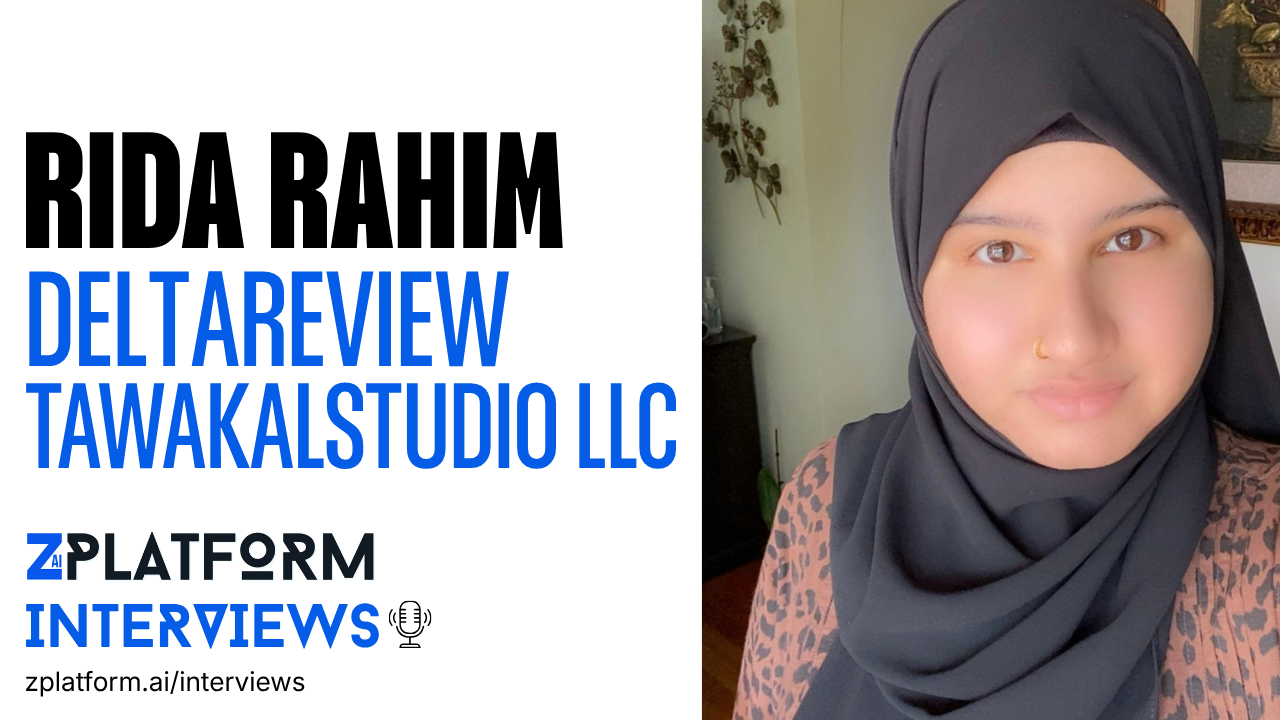

DeltaReview founder Rida Rahim, a third-year computer science student at NYIT, explains why her AI code diff analyzer has no login and no persistent storage, why she is cautious about the GitHub and IDE integrations every rival is racing to ship, and why she wants to stay a solo founder. She also states plainly that she has no meaningful usage data yet, points at a placeholder-sounding suggestion in her own sample output, and says she has no burnout systems in place.
Most founder interviews arrive with a traction number attached. This one does not, and the founder says so in the first sentence of her answer to the question about it.
“Honestly, I don’t have meaningful usage data yet,” Rida Rahim says of DeltaReview. “Right now traction looks like me cold-outreaching developers directly, asking them to try it and give me real feedback, rather than any kind of organic user base yet.”
That is an unusual thing to lead with, and it sets the tone for the rest of the conversation. Asked for the most surprising piece of user feedback, she says she has not received enough feedback for anything to qualify as surprising.
Asked what systems keep her from burning out across coursework, a services company, and a product, she says she does not have any and is still figuring that out. Asked where the product is weakest, she does not give a diplomatic answer about roadmap priorities; she points at a specific string in her own sample output, “review and refactor if needed,” and calls it placeholder-feeling.
What she does have is a set of product decisions that run directly against where the rest of the AI code review market is heading, and clear reasoning for each one.
DeltaReview is a diff analyzer. You paste a before version and an after version of a file, pick from 23 languages, and get back four scored risk categories, located findings, refactoring suggestions, and a commit message.
There is no account. There is no GitHub connection.
History exists only for the length of your session, and if you want to keep an analysis you export it as JSON or Markdown before you close the tab. Much of what the industry treats as table stakes, the PR bot, the CI check, the IDE plugin, the persistent dashboard, she has deliberately not built, and in the roadmap answer at the end of this interview she explains why she may never build it.
Rahim is also running TawakalStudio LLC, a web design and branding studio serving local businesses on Long Island, at the same time, while going into her third year of a computer science degree. She calls herself a “messy founder.” Here is the conversation.
From an internship application to two companies
Can you start by introducing yourself, your background, where you are studying computer science, and how you would describe yourself as a builder today?
My name is Rida and I’m a Computer Science student at NYIT, going into my third year this fall. My path into CS wasn’t the traditional “always wanted to code” story.
I actually found my way into software engineering through an internship application that required me to build a website, and that was the moment it clicked. Since then I’ve been self-directed about it: I founded TawakalStudio, a web design, development and digital branding studio where I build sites for local businesses on Long Island, and I built DeltaReview, an AI-powered code diff analyzer that supports 23+ programming languages.
As a builder, I’d call myself a “messy founder.” I think that’s the honest version of building. I don’t wait until I feel fully ready or until something’s polished.
I ship things, hit real problems, debug late into the night, and learn in public instead of pretending it’s clean from day one. That’s genuinely how I’ve grown the fastest.
As the first founder in your family and a young woman in tech, what initially drew you to entrepreneurship, and what was the moment you decided to actually start building products?
Being the first person in my family to go down this path meant I didn’t have a blueprint to follow. There was no one to ask “how do I start a company” or “is this normal to feel lost right now.” I had to figure that out myself, which made my early path pretty experimental. For a while, that looked like mass-applying to jobs without much direction, because I didn’t have a clear model of what building a career in tech was even supposed to look like.
The shift happened when I applied to an internship that required me to actually build something as part of the process. That was the first time I sat down and built something real from scratch, and something clicked.
I realized I loved the feeling of creating. There’s something different about seeing something you built with your own two hands go from nothing to something that actually works, something someone else can actually use. That feeling is what pulled me toward entrepreneurship rather than just continuing to look for another internship or job.
As a young woman in tech, especially without anyone in my family or immediate circle who’d done this before, there were definitely moments where I felt like I had to prove I belonged in the room, or that my ideas were worth building. And if I’m being honest, in the short time since I started, there were multiple points where I wanted to give up on both TawakalStudio and DeltaReview and just go back to the traditional path, find a job, find an internship, because it genuinely felt delusional to keep going.
But every time I got close to that decision, I realized what I was actually choosing: if you’re hired as a developer or engineer at someone else’s company, you’re technically helping build their vision, their name. And that didn’t sit right with me.
I wanted my work to have my name attached to it. So instead of quitting, I kept building, and I kept putting myself out there.
That’s what led to TawakalStudio first, and then DeltaReview once I realized I wanted to build actual products, not just client websites.
Looking back, what were the earliest signs that you would end up creating both a developer tool and a services company in parallel?
Honestly, looking back, there wasn’t one clear sign pointing to “you’ll end up building both a services company and a developer tool.” A lot of what I’ve built has come from trying things and following what felt right at each step, not from a master plan. I’m young, and I know that gives me the freedom to experiment with direction instead of committing to one lane too early.
TawakalStudio came first. I registered it because I wanted to help local businesses on Long Island build their web presence and brand.
I realized what I actually cared about wasn’t just “building websites,” it was helping someone build something that represented them. That intention is what shaped the service side from the start.
A little while later, I built a project for a Codex Challenge on Handshake called ReviewAI, an AI-powered code reviewer that analyzed snippets in real time, flagging bugs, security vulnerabilities, and performance issues, scoring overall code health, and suggesting one-click fixes with streaming output in a Monaco editor. It made the Showcase.
That project became the direct foundation for DeltaReview. Building ReviewAI, I noticed there wasn’t a dev tool that consistently supported 23+ programming languages, compared “before” and “after” code versions, and returned structured feedback across bugs, security risk, performance, and complexity.
Something that turned a raw diff into a prioritized list of what actually needs attention before deployment, instead of just a wall of changed lines. That’s when it clicked for me: I wanted to build something for devs, by a dev.
So if there was an early sign, it’s this. Every project I built, whether aimed at a business or a developer, kept circling back to the same instinct: figure out what’s actually needed, and build the real thing, not just a version of it.
Why the Product Refuses to Ask You to Log In
What inspired DeltaReview specifically? Was there a personal frustration with the code review process that pushed you to build it?
DeltaReview came directly out of building ReviewAI, but the real personal frustration was friction. Every code review or analysis tool I tried required some kind of login, GitHub integration, workspace setup, this and that and the third, before you could even get to the part where it actually looks at your code. And a lot of the time, I just wanted to paste a diff and get an answer, not set up a whole pipeline for a quick check.
That frustration is what shaped DeltaReview’s core design: it’s frictionless. There’s no login, no GitHub connection required.
You just paste or type a diff and immediately get structured analysis on logic issues, potential bugs, and code improvements. That makes it genuinely useful for fast iteration workflows, where setting up full tooling just to check one change would be way too heavy for what you actually need at the moment.
On top of that, I noticed there wasn’t a tool that consistently supported 23+ programming languages, compared “before” and “after” versions of code, and returned structured feedback across bugs, security risk, performance, and complexity. Something that turns a raw diff into a prioritized list of what actually needs attention, instead of a wall of changed lines you have to interpret yourself.
History works the same way, session-based, so it’s there as long as you’re active, and you can export it as JSON or Markdown before you leave. Once you leave, it’s gone.
That was intentional too. No accounts means no persistent storage tied to you, which keeps it lightweight and frictionless by design, not just by accident.
How did you arrive at the angle of AI feedback on code diffs before formal review, as opposed to a full code reviewer or a pair programming tool?
ReviewAI was closer to a full code reviewer. It analyzed a snippet in real time and flagged bugs, security issues, and performance problems on its own.
But building it taught me something: reviewing a snippet in isolation isn’t really how risk shows up in real development. Risk shows up in change, what got added, removed, or modified, not in a static block of code sitting on its own.
A pair programming tool is a different problem entirely. It’s about real-time collaboration and assistance while you’re actively writing code. That’s a much heavier, more integrated product, and it solves “help me write this” rather than “tell me if what I just wrote is safe to ship.”
What I kept coming back to was the moment right before formal review. You’ve made changes, you’re about to open a PR or push to review, and that’s the point where you want a fast, honest gut-check: did this diff introduce a bug, a security risk, a performance regression, before a human reviewer even sees it. That’s a narrower, more specific moment than “review my whole codebase” or “help me write code in real time,” and narrower, to me, meant I could actually go deep and be genuinely useful there, instead of being a shallow version of a dozen other tools that already do full review or pair programming.
So the diff-feedback angle wasn’t a downgrade from a full reviewer. It was a deliberate focus on the specific moment where I felt the most friction myself: right before you commit to formal review, when you want to know what actually needs attention, without needing an account, a pipeline, or another person in the room yet.
Inside the Diff Workspace
Can you walk us through the journey from idea to first working version, how long it took, what you built it with, and the biggest technical hurdles you hit early on?
The first working version came together within a few days. I had something functional fast.
From there, it took a few weeks of prompt testing to get it reliable, and a full redesign, before it became the version it is today, moving from a plain interface to a real brand and UI/UX: dark navy, a proper logo, a workspace that actually feels like it belongs in a dev environment. The old version worked. This one looks like it means it.
The biggest technical hurdle by far was prompt reliability. The model would silently drop fields, findings, commit messages, suggestions, just gone, with no error thrown. That’s a dangerous kind of bug because nothing crashes, it just quietly returns incomplete data, and if you’re not checking closely, you’d never know.
I fixed it with a two-layer approach: an explicit JSON contract built directly into the prompt, so the model has a strict structure to follow, plus a Zod schema with hard fallback defaults on the backend, so even if a field comes back missing or malformed, the app doesn’t fail quietly. It catches it and handles it properly instead of just passing broken data through.
Now the tool consistently returns bug and security risk scores, specific findings with exact locations, refactoring suggestions, and commit messages you can actually use, all built with Next.js, TypeScript, the Groq API, and Vercel serverless functions.
Could you walk us through how DeltaReview actually works, from a developer pasting in a diff to the AI returning actionable feedback?
A developer starts in the Code Workspace. There’s no login, just two side-by-side panels: “Before Code” and “After Code.” You select the language from a dropdown covering 23 options plus an Other option, then paste or type your original code on the left and your modified version on the right. From there, you hit “Analyze Diff,” and DeltaReview sends that before/after comparison to the Groq API for structured analysis.
What comes back is the Analysis Dashboard. Not a wall of changed lines, but four scored categories at the top: Bug Risk, Security Risk, Performance, and Complexity, each rated by severity. Below that is a plain-language Change Summary, then Key Findings, each one tagged by severity and category, showing exactly which part of the code is impacted and a suggested fix, so you know precisely what to act on and where.
Past that, it generates Suggested Commit Messages you can copy directly, and Refactoring Suggestions for anything worth improving beyond the immediate fix. And if you want to keep the analysis, you can export the whole thing as JSON or Markdown before you leave. Since there’s no account system, nothing persists past your session unless you export it.
So the full loop is: paste or type before/after code, pick your language, hit analyze, and in seconds you get a prioritized, structured breakdown of what actually needs your attention before you ship, instead of manually combing through a diff line by line.
You support 23+ programming languages. How do you ensure consistent quality and depth of feedback across such a wide range?
The consistency doesn’t come from treating each language differently under the hood. It comes from standardizing the output structure, regardless of what language goes in. I built an explicit JSON contract into the prompt itself, so no matter if the input is Python, Rust, or a Dockerfile, the model is constrained to return the same structure: bug risk, security risk, performance, complexity, findings with locations, refactoring suggestions, and commit messages.
On top of that, I added a Zod schema with fallback defaults on the backend, so even if the model handles a less common language slightly differently, or a field comes back incomplete, the schema catches it and fills in safely instead of returning broken or inconsistent output to the user. That was actually the same fix that solved my early reliability bug, where fields were getting silently dropped, so depth and consistency across languages ended up being solved by the same underlying fix as reliability in general.
The tradeoff I’m honest about is that depth naturally varies a bit by language. Something like JavaScript or Python, which the underlying model has seen a lot more of, is going to get richer, more specific findings than a less common language. But the structure and quality bar, meaning you always get scored categories, located findings, and actionable suggestions, stays consistent no matter what language you paste in.
What is your current tech stack, and were there interesting tradeoffs between cost, speed, and review quality?
The current stack is Next.js and TypeScript on the frontend, the Groq API for the model layer, and Vercel serverless functions for the backend, all deployed on Vercel.
The tradeoffs so far have mostly been around cost versus scale, not cost versus quality. I chose Vercel because it’s free at this stage and handles serverless functions well, and Groq specifically because it’s fast and free to use right now, which matters a lot for a tool where the whole value proposition is speed.
Nobody wants to paste in a diff and wait a long time for feedback. Groq’s inference speed lines up directly with the frictionless, fast-iteration experience I wanted DeltaReview to have.
Right now, free-tier hosting and a free API are the right call because I don’t have a large user base yet, so there’s no reason to pay for infrastructure I don’t need. But I’m treating that as a starting point, not a permanent decision. Once I see real usage and a larger user pool, the next step is looking into a dedicated domain and likely scaling up the hosting and API tier to match actual demand, rather than over-investing in infrastructure before I know it’s needed.
So the tradeoff, if I had to name one, was speed and cost now versus scalability later. I optimized for getting something fast, frictionless, and real into people’s hands first, and I’ll invest further once usage actually justifies it.
New to some of this? Inference speed, JSON contracts and schema validation get used as shorthand in almost every AI product pitch without being defined. Our AI glossary covers 264 terms with citations.
What it catches, and what still reads like a placeholder
What kinds of issues does DeltaReview catch best today, and where does it still have room to improve?
Today, DeltaReview catches security risks and clear logic bugs the best. Things like SQL injection, where it correctly flags the vulnerability, identifies the impacted function, and gives a real suggested commit message. That category feels the most reliable right now because those patterns are relatively well-defined and consistent across languages.
Where it still has room to improve is depth on the more nuanced suggestions. Refactoring advice and some of the secondary findings can come back a little generic right now.
Looking at my own sample output, I actually noticed “review and refactor if needed” showing up as a suggested fix in more than one finding, which is exactly the kind of placeholder-feeling response I want to tighten up. It’s not wrong, but it’s not specific enough to be genuinely useful yet, and that’s the bar I’m holding myself to.
Honestly, the only real way I’m going to close that gap is through actual user testing and feedback. I can guess at what “more useful” looks like, and I can improve the prompt engineering on my end, but I can’t fully predict what a developer actually needs to see in that moment without watching real people use it and hearing what falls flat for them. I wish I could read every user’s mind, but since I can’t, feedback is the only honest path to making the depth match the reliability I’ve already gotten on the security and bug side.
How is DeltaReview different from just asking ChatGPT or Claude to review your code?
If you ask ChatGPT or Claude to “review my code,” you’re doing a lot of invisible work yourself. You have to think of the right prompt, decide what you actually want it to check for, format the before/after clearly enough for it to understand, and then read through a free-form response and figure out what’s actually important versus conversational filler. Every time, you’re re-deciding all of that, and the output structure can vary depending on how you phrased the prompt that day.
DeltaReview removes all of that thinking. There’s no prompt to write.
You just paste or type your before and after code, and you get the same consistent structure every single time: bug risk, security risk, performance, complexity, specific findings with locations, refactoring suggestions, and a ready-to-use commit message. You’re not prompting a general-purpose assistant and hoping it checks the right things. The tool is already built to check the right things, every time, in the same format.
So the value I’m adding isn’t the underlying model. Claude and ChatGPT are obviously powerful on their own.
What I’m adding is the layer on top: a fixed contract for what gets checked, a consistent structure for how it’s returned, and zero setup cost to get there. You don’t need to know what to ask for.
You just paste or type your code, look at the result, and move on with your day. The thinking’s already been done for you, baked into the product itself.
What has been the most surprising piece of user feedback you have received so far, and how did it change the product?
Honestly, I haven’t gotten a large volume of feedback yet, so I can’t point to one dramatic “surprising” moment. But the feedback I have gotten has been genuinely useful. A couple of people told me it looked promising and worked well with their language of choice, which was reassuring given how much I focused on keeping quality consistent across 23+ languages.
One person did flag a slight issue, and I fixed it immediately, which actually tied back into the prompt reliability work I’d already been doing. It reinforced something I already believed: the two-layer approach of an explicit JSON contract plus Zod schema fallbacks isn’t a one-time fix, it’s something I need to keep tightening as real users hit edge cases I didn’t think to test myself.
If anything, the most honest takeaway isn’t a specific surprising piece of feedback. It’s that even a small amount of real user feedback surfaces things I genuinely couldn’t have caught testing it myself. That’s exactly why I think broader user testing, even from just a handful of people, is going to matter more for improving DeltaReview than any amount of me guessing what might be wrong with it.
Beta, no usage data, and cold outreach
Who is the ideal DeltaReview user today, and where are you seeing the most traction?
Honestly, I don’t have meaningful usage data yet. DeltaReview is still in beta, and right now traction looks like me cold-outreaching developers directly, asking them to try it and give me real feedback, rather than any kind of organic user base yet.
But in terms of who it’s actually for, I built it to be open, not restricted to one type of developer. It works for a newer developer just starting to understand what makes code risky, a student who wants fast feedback without setting up a whole review pipeline, an engineer checking a diff before a PR, or even a senior engineer who just wants a fast sanity check before shipping.
The frictionless, no-login design was intentional for exactly that reason. I didn’t want to gate it behind a persona or a workflow assumption. It’s there, it’s free to use, and if it helps you, use it, regardless of where you are in your career.
So right now my focus isn’t narrowing to one ideal user segment. It’s getting it in front of as many actual developers as possible through direct outreach, seeing who gets the most value out of it, and letting that real feedback tell me where the traction actually ends up forming, instead of guessing upfront and building for an assumption.
How are you currently approaching outreach and getting early users as a solo student founder without a big network or budget?
Right now, my approach is mostly LinkedIn and direct cold outreach. Reaching out to developers individually, sharing what I’ve built, and asking them to try it and give me honest feedback.
As a solo student founder without a big network or budget, that direct, one-on-one approach is really the most realistic lever I have right now. I don’t have paid channels or an existing audience to lean on, so it’s been about consistently putting myself and the product in front of real people rather than waiting for organic discovery.
Going into fall 2026, I’m also part of NYIT’s NESTS program, where DeltaReview is approved as my project. I’m hoping that gives me more structured access to networking, mentorship, and potentially other early users I wouldn’t reach through cold outreach alone. It’s a resource I haven’t fully been able to tap into yet since the semester hasn’t started, but it’s a big part of how I’m thinking about scaling traction beyond just me individually reaching out to people.
So right now it’s founder-led, manual, and direct, and I see NESTS as the next stage of that, not a replacement for it. I don’t think outreach stops just because a program starts. I’m expecting it to add more surface area on top of what I’m already doing.
Lessons from building without a blueprint
What are the biggest lessons you have learned from launching an early-stage software product without a traditional roadmap or mentor blueprint?
One of the biggest lessons has been realizing that the worst-case scenario I imagine in my head almost never matches the actual worst case in reality. When you don’t have a mentor or a traditional roadmap, every decision feels higher-stakes than it probably is.
Should I reach out to this person, should I pitch this idea, should I put this out publicly. But I’ve learned that if you ask and the answer is no, you’re not losing anything, you just stay exactly where you already were.
Nobody takes the ground out from under you just because you asked for something. So a lot of the fear around those moments turned out to be bigger in my head than in reality.
The other lesson is around failure itself. I think failure gets built up as this thing you’re supposed to avoid at all costs, but honestly, that’s where I’ve actually learned the most.
What works, what doesn’t, what I assumed would matter that didn’t, and what I overlooked that turned out to matter a lot. Without a blueprint to follow, failure isn’t a detour from the path, it basically is the path. Every version of DeltaReview that exists today, including the parts that work well, came from something earlier not working and me figuring out why.
So if I had to sum up the biggest lesson from building without a traditional roadmap: the risk of trying and failing is almost always smaller than it feels at the moment, and the risk of not trying at all is the only one that guarantees you stay exactly where you started.
What is a mistake you made early on that you would warn other student founders or first-time builders about?
If I had to name one, it’s this: early on, I mistook doubt for a signal that I was on the wrong path. There were multiple points where I genuinely considered giving up on both TawakalStudio and DeltaReview and going back to the traditional route, just finding a job or an internship, because it felt delusional to keep going without a blueprint, without anyone in my circle who’d done this before, and without any guarantee it would work.
To be clear, I don’t think building someone else’s vision is a lesser path. Everyone has different dreams, and there’s real value and skill in helping build something bigger than yourself as part of a team.
For me personally, though, I wanted my work to have my name attached to it. I wanted to build something from the ground up and be able to point to it and say, that’s my hard work, that’s mine. That’s just what mattered to me specifically, not a judgment on any other path.
The mistake wasn’t feeling doubt. I think every founder hits that phase, especially without a mentor or roadmap to reassure them it’s normal.
The mistake was almost treating that doubt as proof I should stop, instead of recognizing it as just part of building something with no precedent to lean on. What actually got me through it wasn’t the doubt disappearing, it was reconnecting with that reason I wanted to build in the first place. That’s what kept me going instead of the doubt itself resolving.
So the warning I’d give other student founders or first-time builders is this: doubt is going to show up, especially in the early, unclear stretches with no map. Don’t mistake it for a verdict on whether you should keep going.
It’s not a signal to stop. It’s just the actual texture of building something without a blueprint, and it doesn’t mean you’re wrong, it just means you’re doing something hard without anyone telling you it’s normal to feel that way.
How do you decide what to build next versus what to ignore, especially when user feedback pulls in different directions?
Right now, my honest answer is that I’m deliberately narrowing, not expanding. My main focus is grinding on TawakalStudio and DeltaReview and actually scaling them, rather than adding more to the plate.
I’ve noticed the more you’re juggling at once, the harder everything gets. Attention gets split, and nothing compounds properly. So right now, when feedback or ideas pull in different directions, my filter is: does this actually move TawakalStudio or DeltaReview forward, or is it a new direction entirely?
My thinking is that once you actually have a base, whether that’s a user base or a client base, that’s when you can start compounding and layering more on top, because you have real signal and real momentum to build from. Trying to build that breadth before you have any base just means spreading thin without anything solid underneath it yet.
That said, I still build smaller projects on the side. I don’t think every single thing I make has to become a startup or a business.
Some things are just for learning, for fun, or for exploring an idea without the pressure of it needing to scale. But when it comes to what I’m actually prioritizing and putting real weight behind right now, it’s TawakalStudio and DeltaReview specifically. Everything else stays lower-stakes and optional until those two have a real base to build from.
Coursework, two businesses, and no boundaries yet
How do you realistically balance computer science coursework, running TawakalStudio LLC, and building DeltaReview? What does a typical week look like?
Realistically, the honest answer is that these three don’t stay in separate lanes. They bleed into each other constantly, even though day to day it feels like they’re pulling in completely different directions.
DeltaReview asks me to think like a product founder: distribution, feedback loops, retention, figuring out if there’s even a real market for what I built. TawakalStudio asks me to think like a service provider instead.
It’s not about retention or product-market fit, it’s about trust, communication, and delivering work a real client is willing to stake their business on. And school asks me to think like a student: consistency, depth, long-term discipline, showing up for material whether or not it feels immediately relevant to what I’m building.
What actually makes the balance work isn’t strict time-blocking so much as noticing that skills transfer across all three instead of staying siloed. Cold outreach for DeltaReview made me sharper at pitching TawakalStudio to potential clients.
Managing client expectations at TawakalStudio taught me how to think about onboarding users for DeltaReview. Studying algorithms in school reminds me why clean architecture actually matters in my own products, not just as an abstract concept for a grade.
So a typical week isn’t really three separate buckets of time. It’s more that I’m constantly moving between three different mindsets: founder, service provider, and student, and treating each one as making me better at the other two instead of competing with them for my attention.
The hard part isn’t the hours, honestly. It’s learning to move between all three without losing momentum, since none of them ever fully stop needing something from me.
What systems, routines, or boundaries have helped you avoid burnout while juggling all of this?
If I’m being honest, I don’t have strong systems or boundaries in place right now. I’m still very much in the phase of figuring that out rather than having it solved.
But there’s one thing that’s come close to serving that role without me planning it that way: TawakalPlayer. It’s a kiosk-mode Quran audio player I built on a secondhand Samsung Galaxy A10e, locked into Android’s Device Owner and Lock Task Mode so the app can’t be exited, mounted inside a wooden box from Amazon, built with Kotlin, Jetpack Compose, and Media3 ExoPlayer. It’s on my LinkedIn as something I built and talked about, but it was never a live link I shared for people to actually test or judge.
That distinction mattered more than I expected. With TawakalStudio and DeltaReview, and honestly, even most of my other smaller portfolio projects as a CS student and dev, there’s always some version of “what would people think” running in the background.
Would this perform well on LinkedIn, is this good enough to show, does this make me look capable. TawakalPlayer didn’t have that pressure at all.
Android was completely new to me going in, but I wasn’t worried about judgment, I was just genuinely problem-solving. Things like debugging a stale closure bug or a silent network failure entirely through Logcat, with no browser-style dev tools to lean on. It ended up being the most relaxing project I’ve built, purely because there was nothing riding on it except my own curiosity.
So if there’s an actual system in my life right now, it’s less a formal routine and more this: having at least one project running where nobody’s judging the outcome seems to be what keeps the rest from turning into pure grind. I don’t think I’ve built real boundaries yet, but I think I’ve accidentally found what one might look like.
Has being a CS student actively helped DeltaReview, or have school and startup mostly lived in separate worlds?
For most of the time I’ve been building DeltaReview, school and the startup lived in pretty separate worlds. Coursework was coursework, and DeltaReview was something I worked on outside of it, on my own time and my own direction. There wasn’t a lot of direct overlap for a while.
That’s actually changing this fall, though. I’m taking ETCS 350, an NYIT course called NESTS, “Necessary Eleven Steps to Tech Startups,” which teaches startup creation and ends with a pitch event, and DeltaReview has been approved as my actual project for that course. So for the first time, school and the startup are formally intersecting, instead of just running in parallel.
Even before that, there were smaller moments of real overlap. Studying algorithms, for example, reminded me why clean architecture actually matters in my own products.
It’s one thing to learn complexity and structure in an abstract, academic sense, and a completely different thing to feel the cost of bad architecture when you’re the one who has to maintain and scale what you built. That’s the kind of classroom learning that quietly shows up in how I approach my own code, even when it’s not a direct one-to-one “I learned X in class and used it immediately.”
So I’d say it’s less that classroom material has been actively driving DeltaReview’s roadmap, and more that being a CS student has sharpened how I think about the code I write for it. And now, with NESTS, the two are starting to intersect much more directly and formally through the coursework itself.
First Founder in the Family
What has been the hardest part of navigating the tech and startup world as a young woman and the first founder in your family, and what has been more encouraging than you expected?
The hardest part is probably a combination of two things. First, CS is still a male-dominated field, so that’s a layer that exists regardless of anything else.
But beyond that, I think the harder part has been being the only one in my family pursuing entrepreneurship at this scale, and not just one venture, but two at once, one service-based and one product-based. There isn’t anyone I can formally turn to for advice beyond “go get a job.” So a lot of the real questions I’m sitting with, how do I get users, how do I get clients, how do I actually scale this, how do I grow from being seen as just a student into being seen as someone building something real, I’m answering those in real time, without anyone ahead of me to check my thinking against.
The more encouraging part is this: the more I learn, the more I grow, and I’m hoping that eventually puts me in a position to be that person for someone else. I’d genuinely like to be able to show someone in my position that the path isn’t clean or straightforward.
It gets messy. There are moments where you wonder, “am I actually playing founder, or am I doing something real?” And I think that question itself is part of the process, not a sign that something’s wrong. If I can get to a point where I can hand someone else a slightly clearer version of that path than the one I had, that would mean everything I’m figuring out right now actually mattered beyond just me.
What advice would you give other young women or first-generation founders who feel like they do not have a blueprint to follow?
If you don’t have a blueprint, my honest advice is: the doubt you feel isn’t a sign you’re on the wrong path, it’s just what building without a map actually feels like. I’ve hit multiple points where I wanted to quit and go back to something more traditional, because without anyone ahead of me to check my thinking against, everything can feel higher-stakes than it probably is.
What helped was realizing the worst case almost never matches the version I imagined. If you ask for something and the answer is no, you’re not losing anything, you just stay exactly where you already were. Nobody takes the ground out from under you just because you asked.
I’d also say: let failure teach you instead of avoiding it at all costs. Without a blueprint, failure isn’t a detour from the path, it basically is the path. Every part of what I’ve built that actually works came from something earlier not working, and me figuring out why.
And genuinely, if it works out, great. If it doesn’t, it’s not like there’s no other choice.
There’s still a 9 to 5, and I truly believe that everything you build along the way makes you a stronger candidate for that path too. The skills you pick up trying to get users, manage clients, solve problems with no one to ask, that doesn’t disappear if the startup doesn’t work out. It makes you more capable, not less, wherever you end up.
I think it’s okay to sit with the question “am I actually doing something real, or am I just playing the part?” too. That question doesn’t mean something’s wrong with you. It means you’re being honest with yourself, which is exactly what you need to keep building without pretending you have it all figured out.
Mostly, I’d want other young women and first-generation founders to know: the path won’t be clean or straightforward, and that’s not a sign you’re doing it wrong. It’s just what it looks like when there’s no one ahead of you to hand you the map. You’re the one drawing it as you go, and that’s genuinely enough.
Where TawakalStudio Fits
How does TawakalStudio LLC fit into the bigger picture? Is it a parallel business, a funding source for DeltaReview, or a learning ground that feeds into your product work?
TawakalStudio runs parallel to DeltaReview. It’s not a funding source for it, and it’s not purely a learning ground either.
It’s its own thing, with its own purpose: helping local businesses on Long Island build a real web presence and brand. It runs on a different logic entirely: service-based, relationship-driven, built around trust and delivering work a client is willing to stake their business on.
That said, parallel doesn’t mean disconnected. Running TawakalStudio does feed into how I think about DeltaReview, just indirectly rather than financially.
Managing client expectations and communication for TawakalStudio shapes how I think about onboarding and expectations for DeltaReview’s users. Cold outreach for one sharpens how I pitch the other. They’re two separate businesses, but the skills and instincts built running one show up in how I operate the other.
So if I had to place it precisely: TawakalStudio isn’t subsidizing DeltaReview, and it isn’t just practice for it either. It’s a real, standalone business I’m building at the same time, and the two happen to make each other sharper simply because I’m the one running both.
AI, engineers, and the integrations she is cautious about
Where do you stand on the AI replacing developers debate, and how does DeltaReview’s design reflect your belief about AI assisting rather than replacing engineers?
I don’t believe AI is replacing engineers. I think it’s raising the bar for what engineers need to bring to the table.
AI still needs a human to prompt it well: someone who knows what to ask, how to structure the problem, and when the output is wrong even if it looks right. That skill didn’t disappear, it evolved.
AI also trains on what already exists. It remixes and pattern-matches, but it doesn’t originate. It’s always catching up to human creativity, never ahead of it.
There’s also a real quality gap that gets ignored in the “AI replaces engineers” narrative. Research backs this up directly.
A Cloud Security Alliance report from mid-2025 found that a majority of AI-generated code contains design flaws or known vulnerabilities, because AI doesn’t understand your specific risk model, internal standards, or threat landscape. It can skip security controls and repeat insecure patterns that look fine until they aren’t. AI can execute, but it can’t fully author with judgment.
DeltaReview’s whole design reflects that belief. It’s not built to write code or replace a developer’s decision-making.
It’s built to sit at the exact moment right before a human makes a judgment call, and hand them structured signals: here’s the bug risk, here’s the security risk, here’s what changed and why it might matter. The engineer still decides what to do with that.
I designed it as an assistant that sharpens a developer’s judgment before they ship, not a tool that ships instead of them. That’s the difference between a tool that needs an engineer and one that pretends it doesn’t.
Editor’s note: the figure checks out. Cloud Security Alliance research finds that 62% of AI-generated code solutions contain design flaws or known security vulnerabilities, even on current frontier models, with 45% to 70% failing security tests depending on the methodology used. Veracode’s separate 2025 GenAI Code Security Report put its own figure at 45% across more than 100 models and 80 coding tasks, with Java the worst performer at over 70%.
What is on the DeltaReview roadmap for the next 6 to 12 months, and what is the long-term vision for both DeltaReview and your founder journey?
Near-term, over the next 6 to 12 months, my focus is less about adding a long list of new features and more about deepening what already exists: tightening depth and specificity in the findings and refactoring suggestions, especially through real user feedback, since that’s the main gap I’ve identified so far. I’d also like to move toward automatic language detection instead of manual selection, to remove one more small piece of friction from the flow.
On infrastructure, once there’s a real, active user base, the next step is moving off free-tier hosting and getting a dedicated domain, so the product can scale properly instead of running on the free resources that make sense at this early stage.
As for deeper integrations like GitHub or GitLab, or IDE plugins, I’m genuinely cautious about that direction, because DeltaReview’s core value right now is being frictionless: no login, no setup, paste and go. Adding pipeline integrations risks recreating the exact overhead I built this to avoid.
If I ever go there, it would have to be an optional layer on top, not a requirement. The core paste-and-analyze experience needs to stay intact no matter what gets added around it.
Long-term, the vision for DeltaReview is to become the tool developers reach for by default in that moment right before formal review, regardless of experience level or team size, because it removes friction rather than adding it.
As for my own founder journey, as far as I can go building this alone, I want to. That’s not a knock on team-based building.
Plenty of great companies are built that way, and there’s real value in it. But personally, I don’t want a blame game.
If something slips up, I want it to be a hundred percent on me, because it’s my name and my values on the line either way. With a team, if something goes wrong, someone can leave, get let go, or stay, but I’m still the one whose name takes the hit.
And realistically, some people won’t want to admit fault if it puts their job at risk, so blame gets passed around instead of actually fixed. I’d rather own every mistake directly and fix it myself than have accountability get diffused across other people.
So the long-term vision, for both DeltaReview and TawakalStudio, is really an extension of what I’ve already been building: reaching a real base of clients and users that lets me compound from there, staying solo as long as I can, because I want my name fully attached to both the wins and the mistakes.
Working the other side of this problem? The integration layer Rahim is choosing to avoid is exactly where the rest of the market is moving. Our ranking of the best MCP servers tracks how AI agents are actually being wired into repositories, CI and editors today, and our list of AI tools every developer should use covers the rest of the stack.
About Rida Rahim
Rida Rahim is the founder of DeltaReview, an AI-powered code diff analyzer supporting 23+ programming languages, and the CEO of TawakalStudio LLC, a web design, development and digital branding studio serving local businesses on Long Island, New York. She is a computer science student at the New York Institute of Technology, entering her third year in the 2026 fall semester.
DeltaReview grew out of ReviewAI, a real-time AI code reviewer she built for a Codex Challenge on Handshake that was selected for the Showcase. The current product is built on Next.js, TypeScript, the Groq API and Vercel serverless functions. As of this interview in August 2026 it is in beta, free to use, and running on free-tier hosting without a dedicated domain, which Rahim describes as a stage-appropriate decision rather than a permanent one.
She is enrolled in ETCS 350, NYIT’s NESTS course (“Necessary Eleven Steps to Tech Startups”), for the fall 2026 semester, with DeltaReview approved as her course project. Her other work includes TawakalPlayer, a kiosk-mode Quran audio player built in Kotlin, Jetpack Compose and Media3 ExoPlayer, running on a secondhand Samsung Galaxy A10e locked into Android Device Owner and Lock Task Mode.
The Bottom Line
The most interesting thing about DeltaReview is not the product. It is the set of things Rahim has decided not to build, and the fact that she can articulate why for each one.
No login. No GitHub integration.
No persistent storage. No IDE plugin.
No team plan. No co-founder. Every one of those is a default that competing tools treat as obligatory, and she has a specific argument against each: the login is the friction she built the tool to escape, the pipeline integration recreates the setup cost she was trying to remove, the persistence follows from the missing account, and the co-founder diffuses an accountability she wants concentrated on her own name.
That is a coherent position, and it is also an expensive one, in a way worth naming.
A tool with no accounts has no retention loop, no email list, and no easy way to see which of the 23 languages people actually paste in. When Rahim says she has no meaningful usage data, that is not only because she is early.
It is partly a structural consequence of the design she chose. She has built a product that is hard to learn from, and then correctly identified that the way to improve it is real user feedback, which is the one input the architecture makes hardest to collect at scale.
Cold outreach on LinkedIn is not a stopgap here. Without a change to the design, it is close to the only channel the product supports.
The same tension runs through the roadmap. She wants to close the gap on generic refactoring suggestions through user feedback, and she wants to keep the surface that makes users invisible to her.
Those two goals pull against each other, and the resolution is probably the optional layer she already sketched for integrations: an account for people who want history, staying entirely out of the way for people who do not. The argument she makes for keeping integrations optional applies just as well to storage.
What makes her worth watching anyway is the self-audit. A founder who volunteers, unprompted in an interview, that her own product returns “review and refactor if needed” as a suggested fix is applying a standard most early-stage founders reserve for competitors.
The security and logic bug findings are the part she claims work, and those are the checkable ones. Paste a diff with an injection flaw in it and you can test her claim in about thirty seconds, which is more than most AI code review marketing lets you do.
So the thing to watch over the next twelve months is whether the specificity improves. She has named the gap, named the bar, and named the only method she thinks will close it.
If DeltaReview comes back with findings that cite the actual variable, the actual line and the actual fix instead of a hedge, the narrow bet on the pre-review moment holds. If the suggestions are still generic, the friction advantage will not be enough, because what developers ultimately judge a review tool on is not how fast the answer arrived but whether it told them something they did not already know.
Want more of these? Read more founder interviews where builders explain the decisions behind their products, or request an interview if you are building something worth talking about.
More Founder Interviews
ConvertMyStore founder Thiago Nobre on outgrowing a $29 Shopify scan, refusing magic scores and guarantees, and what he will not let AI decide.

XRP Healthcare founder Kain Roomes on $1.2M in prescription savings, 77,000 users across 217 countries, and the exit deal that quietly did not close.

CostLoop founder Milosh Mladenovski on bootstrapping from Oslo, why he refuses bank connections, and the numbers he will not publish about his own...