



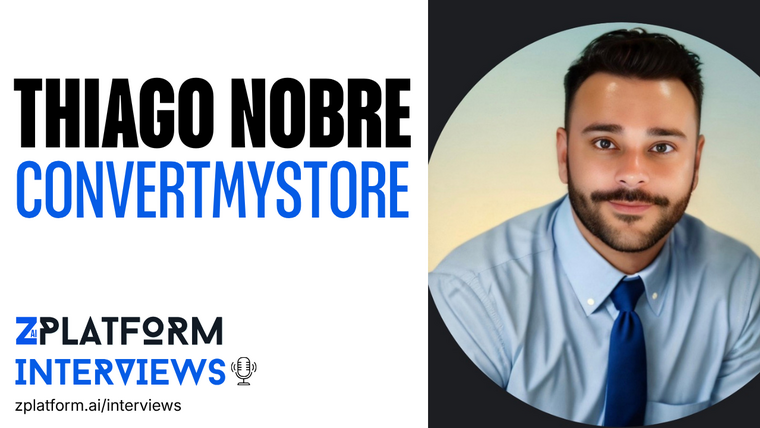
ConvertMyStore founder and CEO Thiago Nobre explains why he gave up a working US$29 to US$149 entry diagnostic to rebuild the company around what he calls a decision layer, now sold across ecommerce, DTC, social commerce and digitally enabled retail, why AI in his framework never gets decision rights, and why he refuses to publish a most common revenue leak, a diagnostic-to-engagement conversion rate, or a traction number until the sample justifies it. He also gives a dated, falsifiable prediction about agentic commerce in 2031 and names the condition that would prove him wrong.
Five separate times in this interview, Thiago Nobre declined to give me the better story.
Asked for the moment the thesis crystallised, he says there was no dramatic client conversation and that he does not want to invent one. Asked which of his seven revenue leak categories is the real culprit most often, he refuses on the grounds that naming one is exactly the shortcut his taxonomy exists to prevent.
Asked whether he has lost a deal over refusing to guarantee rankings, he says he cannot point to one and will not manufacture it. Asked for the conversion rate from entry diagnostic to full engagement, and then for traction numbers, he declines both until the volume makes the figure useful rather than decorative.
That is a lot of unanswered questions for a founder interview, and it is the most informative thing in the piece. A company whose entire pitch is “we separate what we observed from what we inferred” either applies that standard to its own marketing or it does not.
ConvertMyStore started as something much smaller and much easier to explain: a Shopify-focused Revenue Leak Scan sold asynchronously at US$29, US$79 and US$149. It now positions as an AI Commerce Intelligence and Implementation company, with an entry assessment listed on the site from US$1,000, a four-stage Diagnose to Prioritize to Implement to Optimize framework, a seven-category Revenue Leak Taxonomy, and a Partner Network that executes delivery outside the company’s own payroll.
One clarification worth making up front, because it is the exact problem Nobre describes later in this interview when he talks about entity ambiguity: Shopify was where the original diagnostic started, not where the company sits now. ConvertMyStore today sells across ecommerce, DTC, social commerce and digitally enabled retail, and describes its current focus as spanning revenue intelligence, AI discovery and GEO, and governed implementation. Shopify remains one important commerce ecosystem among several rather than the company’s positioning or its service boundary.
The argument underneath the repositioning is worth taking seriously even if you never buy anything. Execution got cheap.
Analysis got abundant. The number of defensible things a commerce team could do next exploded, and nothing in the stack owns the question of which one to do first. Nobre’s bet is that the scarce capability is no longer generating options but sequencing them, and that the sequencing has to stay human because nobody has worked out how to make a probabilistic model accountable for being confidently wrong.
He is operating from Brazil, under Thiago Nobre Franqueira LTDA, selling into the United States, United Kingdom, Canada and Australia. Here is the conversation.
The Founder Journey
Introduce yourself in your own words: your background before ConvertMyStore, and what you were doing right before you started it.
I spent more than two decades in commercial roles around technology, telecom and B2B solutions. The recurring part of the job was never just explaining technology; it was helping a buyer decide why a solution mattered, what should be prioritized, and what had to change after the purchase.
Immediately before ConvertMyStore, I was working around B2B technology sales and partnerships while also building and testing digital AI ventures, including StackPilot AI. That combination made me increasingly interested in the gap between having more technology and making better decisions with it.
What in your career made this specific problem, the gap between commerce data and commerce decisions, the one you wanted to build a company around?
Across my career, I kept seeing the same pattern: companies could buy more software, collect more data and add more dashboards, yet still struggle to decide what deserved attention first. The bottleneck was often not access to information but the translation of information into a sequenced decision.
Commerce makes that problem especially visible because acquisition, product data, conversion, operations and retention all interact. I wanted to build around that decision gap rather than around another isolated tool.
ConvertMyStore appears under a couple of entities in public materials. Can you clarify the structure for readers, and where you are personally based and operating from?
The current structure is simpler than some older public references suggest. ConvertMyStore is a commercial brand operated by Thiago Nobre Franqueira LTDA, a Brazilian company; Wellness Brands is the registered trade name of that legal entity, but it is not the customer-facing identity of ConvertMyStore.
Nobre Ventures was an earlier venture identity I used while I was based in Portugal, and references linking it to ConvertMyStore are now outdated; it is not the current operating entity behind the company. I am currently based in Brazil, and ConvertMyStore is built to serve digital commerce businesses internationally.
Your LinkedIn also mentions building StackPilot AI. How do those fit together, and how do you divide your attention?
StackPilot AI is a separate project I built around AI software discovery and comparison. It is not a product line, parent company or shared commercial offering with ConvertMyStore, and I have deliberately kept the brands and infrastructure separate.
ConvertMyStore is my current operating priority because it is closer to a service-led problem with a clearer path to revenue and client outcomes. StackPilot remains a separate project rather than something I try to bundle into the ConvertMyStore story.
The Repositioning
Walk us through the original proposition. What was the narrow ecommerce diagnostic you started with, and what did the deliverable actually look like?
The first public proposition was deliberately narrow: a Shopify-focused Revenue Leak Scan designed as a low-friction, asynchronous diagnostic. It was offered in entry tiers at US$29, US$79 and US$149, with deliverables ranging from a directional review and prioritized risks to a deeper action plan and annotated store review.
The offer did exactly what an early validation product should do: it forced us to codify the diagnostic logic, build the operational workflow and test how buyers reacted to a concrete problem rather than a broad consulting promise. It was never intended to be the final shape of the company, and we are not treating a small early sample as a benchmark.
What was working about it, and what was not? Was it a demand problem, a pricing problem, or a “this does not change anything for the client” problem?
What worked was the clarity of the problem: merchants immediately understand the idea that revenue can leak between traffic and purchase, and the narrow offer forced us to codify how we inspect a buying journey. What became clear very quickly was that the valuable part was not the report itself; it was the decision logic behind it.
A business does not ultimately need one more diagnosis, it needs to know which finding deserves attention, what should happen next and who will execute it. That insight is what moved ConvertMyStore from a diagnostic product toward an intelligence-and-implementation model.
When did you realise the real problem was not a shortage of dashboards or AI tools but not knowing what to fix, prioritize, or build next?
There was not one dramatic client conversation that created the idea, and I do not want to invent one. It crystallized while building the diagnostic, studying the market and looking at how many specialized tools a commerce team can already buy.
The more tools you add, the more obvious the coordination problem becomes: one system flags conversion, another flags feeds, another generates content, another reports attribution, but none owns the question of what should happen next. That was the moment I started thinking of ConvertMyStore as a decision layer rather than a diagnostic product.
Repositioning from “diagnostic” to “AI Commerce Intelligence and Implementation” is a big leap in scope and in what you are asking a buyer to believe. What did that cost you?
The repositioning cost us simplicity in the short term. A Shopify diagnostic is easy to explain in one line; AI Commerce Intelligence and Implementation asks us to prove a broader operating model and a bigger point of view.
We chose to make that change before scale made the old positioning expensive to unwind. The real investment has been building the methodology, production workflows, governance model and Partner Network required to support the broader promise. In other words, we decided to build the operating model before trying to manufacture the appearance of scale.
Looking back, was the diagnostic a wrong start or a necessary one? What did you only learn by shipping the narrow version first?
I see the narrow diagnostic as a necessary start, not a mistake. It forced us to turn vague ideas about conversion into a repeatable inspection process and exposed the limits of stopping at diagnosis.
It also taught me a broader operating rule: do not productize or automate a new offer just because you can; prove demand manually first. The diagnostic still has a role as an entry point, but it no longer defines the company.
How do you now explain the company to a skeptical operator in two sentences, without leaning on the category name?
We help digital commerce teams find where growth is being constrained, decide what deserves attention first, and turn that decision into implemented work. We combine structured evidence, AI-assisted analysis, expert judgment and governed execution instead of handing over another dashboard or a generic list of recommendations.
The decision layer thesis
Make the core argument for us: why do digital commerce businesses increasingly need a decision layer between data and execution?
Execution has become cheaper and faster while the number of possible actions has exploded. Commerce teams now operate across more channels, more data sources, more automation and AI-generated customer journeys, including search experiences where the buyer may never start on the brand’s website.
That creates a paradox: teams can do more things, but the cost of choosing the wrong thing has also increased because everything is interconnected. In that environment, prioritization becomes an operating capability rather than a quarterly planning exercise.
Ecommerce teams already have analytics, session recording, CRO tools, feed tools, and now a dozen AI copilots. Be specific about what still fails.
Most tools are excellent at answering a narrow question, and that is also their limitation. Analytics can show a drop, session recordings can show behavior, feed tools can flag data quality, and copilots can generate recommendations, but none of those outputs automatically understands margin, team capacity, strategic timing and dependencies across the whole business.
The gap appears when five tools produce ten valid actions and the team still cannot agree on the first two. That is where decision quality, not data volume, becomes the constraint.
Your framework ranks priorities against business impact, evidence strength, implementation effort, urgency, and strategic relevance. Which of those five do clients most often get wrong on their own?
The failure mode I designed the framework around is evidence strength. Teams can easily confuse a plausible explanation with a sufficiently supported one, especially when a dashboard or AI system presents it confidently.
Implementation effort is the other discipline I think operators routinely underestimate: a theoretically high-impact idea can still be the wrong next move if it consumes scarce engineering or operational capacity. The point of the framework is to force impact, evidence, effort, urgency and strategic relevance into the same decision instead of letting the loudest metric win.
Your Revenue Leak Taxonomy defines seven categories of leakage. Which category is most commonly the real culprit and most commonly misdiagnosed?
I deliberately resist naming a universal “most common” category because that is exactly the shortcut the taxonomy is designed to prevent. The visible symptom is often not the origin of the leak: what looks like a conversion problem can begin in acquisition quality, product and offer clarity, discovery, checkout or operational decision-making.
Once we have a defensible sample, I want to publish the distribution rather than turn intuition into a statistic. The disruptive idea here is that “conversion rate” is often the end of the story operationally, but it should be the beginning of the diagnosis.
Prioritization implies saying no. What is an example of a finding that was real, technically valid, and that you still told a client not to work on?
A technically valid finding is not automatically a priority. A store can have a measurable page-speed issue, for example, while a broken payment path or severe traffic-intent mismatch is destroying far more value.
Fixing speed first would still produce an improvement, but it could be the wrong use of the next unit of engineering capacity. Prioritization is the discipline of protecting a business from valid but mistimed work, and that is often harder than finding the problem in the first place.
How do you know the decision layer worked? What do you measure to prove the sequencing itself created value, separate from the individual fixes?
We measure the decision layer by what it changes operationally, not by whether the framework looks sophisticated. The key signals are time-to-decision, the size and age of the unresolved backlog, implementation cycle time, acceptance against written criteria, and the business outcome attached to each implemented change.
The sequencing is creating value when low-priority work stops consuming scarce capacity and high-confidence actions reach implementation faster. Over time, that operating evidence should become more valuable than any proprietary score.
Automation plus human judgment
Draw the line concretely. What does AI do in your workflow, and what does a specialist do that AI does not touch?
AI does the high-volume mechanical work: collecting and normalizing evidence, comparing patterns, structuring first-pass findings, generating drafts and performing repeatable QA checks. A specialist interprets business context, challenges the model’s assumptions, judges evidence quality, weighs trade-offs, decides priority and approves what is safe to recommend or release.
Partners or specialists can then execute approved work, while ConvertMyStore retains scope, quality and acceptance governance. The principle is simple: automation prepares, experts decide, specialists implement, and governance closes the loop.
You state that AI makes no autonomous decisions in your framework. What made you that firm about it?
It was an architectural choice, not a reaction to one incident. Generative models are probabilistic, can be confidently wrong and do not carry commercial accountability for the consequences of a decision.
I am comfortable letting AI do more and more of the analytical work; I am not comfortable quietly transferring authority over pricing, customer experience, spend or release decisions to a model. Our view is that AI should make analysis abundant while decision rights remain explicit.
Where has AI-generated analysis been confidently wrong in your work, and what does your review process catch that a fully automated product would ship?
The failure mode I pay the most attention to is causal overreach: incomplete evidence gets converted into a confident explanation. A model can see weak conversion and a slow page and jump to “speed is the cause,” even when traffic quality, offer fit or checkout friction could matter more.
It can also treat absence of evidence as evidence of absence or rely on technically accessible but outdated information. Our review layer exists to challenge causality, downgrade confidence and ask what evidence is missing before a plausible narrative is allowed to become a business decision.
As models improve, does the human layer shrink? What part of expert judgment stays human, and what are you already comfortable handing over?
The human layer should shrink dramatically around mechanical work, but not around accountability. Collection, normalization, first-pass pattern detection, drafting and deterministic QA are exactly the kinds of work I want models and agents to absorb.
What remains scarce is context, trade-off judgment, exception handling and ownership of consequences. My view is that AI will make expert judgment more valuable, not less, because analysis and execution will become abundant.
New to the terminology? Terms like inference and agentic workflow get used constantly in commerce AI pitches without ever being defined. Our AI glossary covers 264 of them with citations.
Every finding is “documented, dated and traceable to observable evidence.” Why the emphasis on traceability, and how much extra work does that discipline cost per engagement?
Traceability is what turns advice into an auditable operating record. If every finding is dated and tied to observable evidence, we can see what was known at the time, what changed, why a decision was made and whether the recommendation still holds.
That discipline does add overhead, which is why we are automating evidence capture wherever the rules are deterministic. I would rather spend compute on documentation and give the expert more time for judgment than save a few minutes and lose the ability to explain a decision later.
No magic scores, no guarantees
You deliberately avoid automated “magic scores” and guaranteed outcomes. That is a harder sell than a competitor promising a number or a ranking. Why hold the line?
Because false precision is still false, even when it is easier to sell. A single number can look objective while hiding assumptions, weights, stale data and uncertainty, and a guaranteed ranking or revenue outcome claims control over systems we do not control.
I would rather make a narrower promise about the quality of the process: documented evidence, explicit confidence, defined scope and accountable implementation. That may be a harder sale, but it is a healthier basis for a long-term service.
What is wrong with scores specifically? What do they hide, and what bad client behavior do they create?
Scores compress complexity into a number and then invite people to optimize the number. They can hide whether a problem is high-impact or merely easy to measure, whether the underlying evidence is current, and whether two very different businesses arrived at the same score for completely different reasons.
The bad behavior is treating movement in the score as the objective instead of improvement in the business. A score can be useful when its construction is explicit and bounded; what I object to is a proprietary magic number presented as truth.
Have you lost deals over refusing to guarantee rankings, citations, or revenue?
I cannot point to a closed deal we lost specifically over that stance, and I will not invent one for a better story. But the commercial line is already set: if a buyer requires a guarantee over an external platform’s ranking, an AI system’s citation behavior or a revenue number we do not control, we are comfortable walking away.
That is not caution for its own sake; it is part of the product philosophy. I would rather build a smaller base of buyers who value evidence and accountability than create demand with promises that become liabilities later.
How do you give a buyer confidence to sign without a guarantee? What replaces the promise in your sales conversation?
Confidence has to come from process rather than prediction. We define the scope, show what evidence will be used, make acceptance criteria explicit, document what changes, and separate what we observe from what we infer.
For implementation work, the buyer should be able to see what was approved, who executed it and how completion was verified. The replacement for a guarantee is transparency plus accountability.
AI search, GEO and generative discovery
Explain in plain terms how AI answer engines and generative discovery are changing ecommerce visibility. What is materially different from classic SEO?
Classic SEO largely optimizes the conditions for a page to be crawled, indexed and ranked in a list of links. Generative discovery adds another layer: an answer engine may retrieve information from multiple sources, synthesize it, omit the brand entirely or describe it inaccurately without ever showing a conventional results page.
For ecommerce, that means product facts, entity clarity, retrievable buying information and external corroboration matter alongside technical SEO and content quality. GEO is not a replacement for SEO; it extends the problem from “can you rank?” to “can a system retrieve, understand and represent you accurately?”
If the retrieval side of that is new to you, our guide to how AI search engines work covers the mechanics Nobre is describing here.
You define AI Search Visibility as whether a brand is mentioned at all, and how accurately. How do you handle the fact that AI answers are non-deterministic and vary by user, session, and model?
We treat AI visibility as observation, not as a universal ranking score. For an approved set of prompts, we record the provider, date and context, whether the brand appeared, how it was described, which sources were cited or relied on when visible, and whether important facts were accurate.
Because answers are non-deterministic, a single response is not treated as truth; the value comes from repeated observations and changes over time. The output is a dated baseline with known limitations, not a claim that we have reverse-engineered the model.
What is the most common way brands are currently misrepresented or invisible inside AI answers, and how much of the fix is technical versus editorial?
One recurring risk is entity ambiguity: the brand has changed, but search engines and AI systems are still seeing older descriptions, third-party references or inconsistent facts. ConvertMyStore itself has been a useful example.
After our positioning evolved beyond a Shopify-focused diagnostic, older Shopify-centric descriptions and previews continued to surface in search and AI interfaces for a period. The fix is rarely only technical or only editorial; it can require crawlability, canonical facts, structured data, updated owned content and stronger external corroboration. That experience made the idea of “accurate representation” very concrete for me.
Most GEO advice on the internet right now is guesswork. What is genuinely knowable today, and what are people asserting with far more confidence than the evidence supports?
What is genuinely knowable is what a specific system returned for a specific query at a specific time, what sources were visible, whether the brand’s facts are accessible and consistent, and whether technical barriers are preventing retrieval. We can also observe changes across repeated tests.
What I think is overstated is the idea that anyone knows a universal GEO score, the exact weighting of a proprietary model, or a guaranteed recipe for being cited. People are often turning a small set of observations into deterministic laws about systems that are changing underneath them.
Where does social commerce fit into discovery? Is TikTok Shop a channel, a search engine, or something else in your model?
I see TikTok Shop as a discovery environment, distribution channel and transaction surface at the same time. It is not a search engine in the classical web sense, but search, recommendations, creator content, affiliate distribution and checkout are compressed into one experience.
That matters because the path from discovery to purchase is no longer a neat funnel that starts with Google and ends on a store website. Social commerce is part of the broader fragmentation of discovery.
What should an ecommerce leader do about AI discovery in the next 90 days, and what should they explicitly not bother with yet?
In the next 90 days, an ecommerce leader should establish a baseline: define the questions buyers are likely to ask, test how the brand and products are represented, fix obvious crawlability and entity inconsistencies, make product and buying facts retrievable, and improve the quality of evidence on owned and credible external sources. Then repeat the observations rather than judging success from one screenshot.
I would explicitly avoid mass-producing AI content, buying low-quality citations, chasing a mysterious “GEO score,” or rebuilding the entire stack around a single answer engine. The first job is to make the brand clear, accessible and evidence-backed.
Business model, delivery and competition
How do engagements actually run, from entry diagnostic to assessment to strategy to implementation?
The engagement path is modular rather than a mandatory funnel. Entry diagnostics are asynchronous and typically delivered in 24 to 72 hours; a broader AI Commerce Opportunity Assessment is usually scoped around two to three weeks; strategy work is typically two to four weeks; and implementation sprints vary by workstream, commonly from roughly one to six weeks.
The operating model is intentionally service-led, tech-enabled and partner-scaled: automation prepares the evidence, experts interpret and prioritize it, approved specialists execute defined workstreams, and ConvertMyStore governs scope, QA and acceptance. Much of that collaboration is designed to work asynchronously in writing, which lets us bring the right specialist into the work without turning every engagement into a meeting-heavy consulting process.
Your entry diagnostics are described as “a way in, not the main scope.” What is the conversion pattern from diagnostic to full engagement, and where do prospects drop off?
The entry diagnostic is intentionally a lower-friction way to experience the thinking, not a disguised requirement to buy a larger project. The commercial hypothesis is that the best expansion trigger is not a sales script; it is evidence that a higher-value problem exists and that the client is ready to act on it.
We are instrumenting the funnel to learn which entry points create qualified demand and where expansion actually happens. I am deliberately not publishing a conversion percentage until the volume is large enough to make the number useful rather than decorative.
You implement through your own team or approved delivery partners. How do you keep quality consistent when execution sits partly outside your walls?
The Partner Network is already part of the operating model, not a future slide in a deck. We have specialist partners who can originate opportunities, contribute expert review or execute defined delivery workstreams, while ConvertMyStore retains the methodology, scope governance, QA, acceptance criteria and release authority.
The point is not to build a traditional agency payroll; it is to expand specialist capacity without diluting accountability. A partner gets a structured commercial and delivery framework, and the client still experiences one governed operating model. My shorthand is: partners can own the opportunity, but ConvertMyStore governs the experience.
Who is your real competition, agencies, consultancies, in-house teams, or SaaS tools, and where does each of them beat you?
All four are competitors in different moments, and I think pretending otherwise would make the positioning weaker. Agencies can beat us on specialist depth and execution scale; large consultancies can beat us on enterprise procurement and transformation capacity; in-house teams will always understand their own politics and customers better; and SaaS wins on speed and unit cost for a narrow repeatable task.
The white space I see is the layer between them: cross-functional decision intelligence connected directly to governed implementation. The next commerce bottleneck will not be access to AI or another tool, it will be deciding which AI-generated action deserves authority.
State your USP in one sentence, then tell us the moat.
The USP in one sentence is: ConvertMyStore turns fragmented commerce signals into prioritized, evidence-backed decisions and governed implementation. The moat is not one algorithm, because algorithms get copied and foundation models improve.
It is the combination of proprietary frameworks, judgment, traceability, partner-scaled delivery governance and the feedback loop that forms when recommendations are actually implemented and measured. Intelligence generation will become cheaper every year; disciplined decision-making and accountable execution are much harder to commoditize.
Who is the ideal client, and who is a bad fit? Be honest about the second one.
The ideal client is an established ecommerce, DTC, social commerce or digitally enabled retail business that already has traffic, data and multiple possible initiatives, but lacks a clear sequence for what to do next. They need enough operational maturity to implement decisions and enough openness to challenge assumptions.
A bad fit is a very early store with no meaningful demand signal, a buyer looking for guaranteed revenue or AI rankings, or a team that wants a report but has no intention or capacity to act on it. We are building for operators who have complexity; if the problem can be solved by buying one more dashboard, we probably should not be in the engagement.
Any traction, scale, or team details you can share?
ConvertMyStore is in the commercial validation and early-scale stage, but the operating foundation is already in place. We have built the core methodologies, production workflows, governance infrastructure and a Partner Network with specialist partners so delivery capacity can expand without requiring a large fixed team.
The model is deliberately service-led, tech-enabled and partner-scaled, with international commercial focus across the United States, United Kingdom, Canada and Australia. I am not interested in publishing vanity traction numbers before the sample is meaningful; the milestone that matters now is turning this infrastructure into a repeatable body of evidence-backed engagements and measurable implementation outcomes.
Forward View and Lessons
What will AI-driven commerce operations actually look like in three to five years? Give us a falsifiable prediction rather than a safe one.
My falsifiable prediction is that within five years the major commerce platforms will expose first-party agent action layers that can create or change products, promotions, content and operational workflows under policy controls, and teams will increasingly manage those policies rather than initiate every action manually. Routine commerce operations will move from “open a dashboard and do a task” to “set constraints, review exceptions and audit what agents did.” The ecommerce stack spent the last decade producing more dashboards; the next decade will be about deciding what deserves to happen. If most established digital commerce teams are still manually moving information between dashboards for the majority of daily operational work in 2031, that prediction will have been wrong.
Which parts of commerce operations do you expect to be fully agentic, and which will stubbornly stay human-owned?
I expect data hygiene, catalog enrichment, tagging, routine reporting, anomaly detection, content variants, first-line support triage and many repeatable workflow steps to become highly agentic. Human ownership will persist around economic policy, brand and offer strategy, capital allocation, high-risk exceptions, major partner decisions and final accountability for changes that can materially affect customers or revenue.
The dividing line will move, but it will be based less on whether an agent can perform the task and more on the cost of being wrong. We are not trying to automate judgment; we are trying to make judgment faster, better evidenced and easier to execute.
The plumbing behind that shift is already being standardised. Our roundup of the best MCP servers tracks how agents are actually being wired into commerce and operational systems today.
What is the hardest lesson you have learned building this, and what would you do differently if you started again today?
The hardest lesson has been that building something and proving that people will pay for it are completely different activities. I have a natural tendency to see a system, improve it and add capability; that becomes dangerous when distribution and demand are not being validated at the same pace.
If I started again today, I would sell the manual version earlier, put buyer evidence ahead of product depth, and refuse to automate a workflow until repeated demand justified it. That lesson became a rule inside ConvertMyStore: technology should scale validated value, not substitute for validation.
What is on the roadmap for the next 6 to 12 months?
The next six to twelve months are about proving and compounding the operating model, not multiplying SKUs. The priorities are deeper implementation evidence, AI discovery and visibility monitoring, selective AI automation and agent work for commerce operations, and continued expansion of the Partner Network for specialist delivery.
Commercially, the focus is international, with the United States, United Kingdom, Canada and Australia as priority markets. We will productize where repeated demand creates leverage, but the company will remain service-led at the core because judgment and implementation are where the highest-value problems live.
What advice would you give a founder positioning a company in a category that does not have a settled definition yet?
Start with the problem and the operating behavior, not with the category label. Publish a precise definition, say what the category does not mean, and make the workflow concrete enough that a skeptical buyer can judge it without agreeing with your terminology.
Then let evidence, use cases and outcomes sharpen the definition over time. In an unsettled category, the founder has a rare advantage: you are not only competing inside a market, you can help define the language the market will later use to understand itself.
Quickfire
One belief about AI in ecommerce that you hold and most of your industry would argue with.
AI will make expert judgment more valuable, not less. Analysis and execution will become abundant; the scarce capability will be deciding which action deserves authority, budget and accountability.
Anything we did not ask that you want readers to know.
AI commerce is not about adding an AI feature to a store. It is about redesigning how evidence becomes a decision, how that decision becomes execution, and how the result becomes intelligence for the next decision, a continuous operating loop rather than another isolated tool.
Where should readers go to reach you or start with ConvertMyStore, and what is the most useful thing someone could do for you right now?
Readers can reach me through convertmystore.com or start with the AI Commerce Opportunity Assessment on the site. The most useful thing someone could do right now is introduce us to an established digital commerce operator with a real prioritization or implementation challenge, or to a specialist who sees a strong fit with the Partner Network. The next phase of ConvertMyStore is about putting the operating model against more real business constraints and turning that evidence into repeatable advantage.
About Thiago Nobre
Thiago Nobre is the founder and CEO of ConvertMyStore, an AI Commerce Intelligence and Implementation company serving ecommerce, DTC, social commerce and digitally enabled retail businesses. He spent more than two decades in commercial roles across technology, telecom and B2B solutions before starting the company, and he is based in Brazil.
ConvertMyStore is operated by Thiago Nobre Franqueira LTDA, a Brazilian legal entity, and sells internationally with the United States, United Kingdom, Canada and Australia as priority markets. It launched as a Shopify-focused Revenue Leak Scan at US$29 to US$149.
That narrow entry offer was a starting point rather than the current service boundary: the company now sells across ecommerce, DTC, social commerce and digitally enabled retail, and describes its focus as spanning revenue intelligence, AI discovery and GEO, and governed implementation. The current model is organized around a four-stage Diagnose, Prioritize, Implement and Optimize framework, a seven-category Revenue Leak Taxonomy, and a Partner Network of specialist delivery partners.
Its entry AI Commerce Opportunity Assessment is listed on the site from US$1,000 (checked 18 August 2026). Nobre also separately builds StackPilot AI, an AI software discovery and comparison project he keeps deliberately unconnected from ConvertMyStore.
The Bottom Line
Take the refusals seriously, because they are the product.
Nobre would not name a most common revenue leak category, would not produce the client conversation that supposedly triggered the pivot, would not invent a lost deal, would not publish a diagnostic-to-engagement conversion rate, and would not give a traction number. Every one of those was an easy win in an interview, and he passed on all five for the same stated reason: the sample is not big enough to make the number mean anything yet.
A company selling “we separate what we observed from what we inferred” that then inflates its own figures in press would be worth ignoring. This one does not, at least here.
The strategic argument is genuinely contrarian in a market currently selling autonomy. Nearly every AI commerce pitch right now is some version of “the system will decide for you.” Nobre’s position is that analysis is about to be free and therefore worthless as a differentiator, and that the scarce, defensible thing is deciding which of ten valid actions gets budget and engineering capacity first. That is why he will not let a model hold decision rights, and why he is building governance, traceability and acceptance criteria instead of a score.
The obvious risk is that a decision layer is much harder to buy than a diagnostic. He said so himself: a Shopify scan sells in one line, and AI Commerce Intelligence and Implementation requires a buyer to believe in an operating model.
He gave up a working, cheap, self-explanatory offer for a US$1,000 entry point and a category name that does not exist yet. Whether that was conviction or a demand problem in the making is exactly the question his own missing conversion numbers would answer.
So the thing to watch is the distribution he says he wants to publish. If ConvertMyStore comes back in twelve months with the real spread across those seven leak categories, a conversion rate from entry diagnostic to engagement, and implementation outcomes tied to dated findings, the evidence-first positioning holds and the refusals in this interview look like discipline. If those numbers never arrive, the refusals were just a nicer way of not having them.
Want more of these? Read more founder interviews where builders explain the decisions behind their products, or request an interview if you are building something worth talking about.
More Founder Interviews

DeltaReview founder Rida Rahim on why her AI code reviewer has no login, why she refuses GitHub integration, and the weak output she flagged herself.

XRP Healthcare founder Kain Roomes on $1.2M in prescription savings, 77,000 users across 217 countries, and the exit deal that quietly did not close.

CostLoop founder Milosh Mladenovski on bootstrapping from Oslo, why he refuses bank connections, and the numbers he will not publish about his own...