

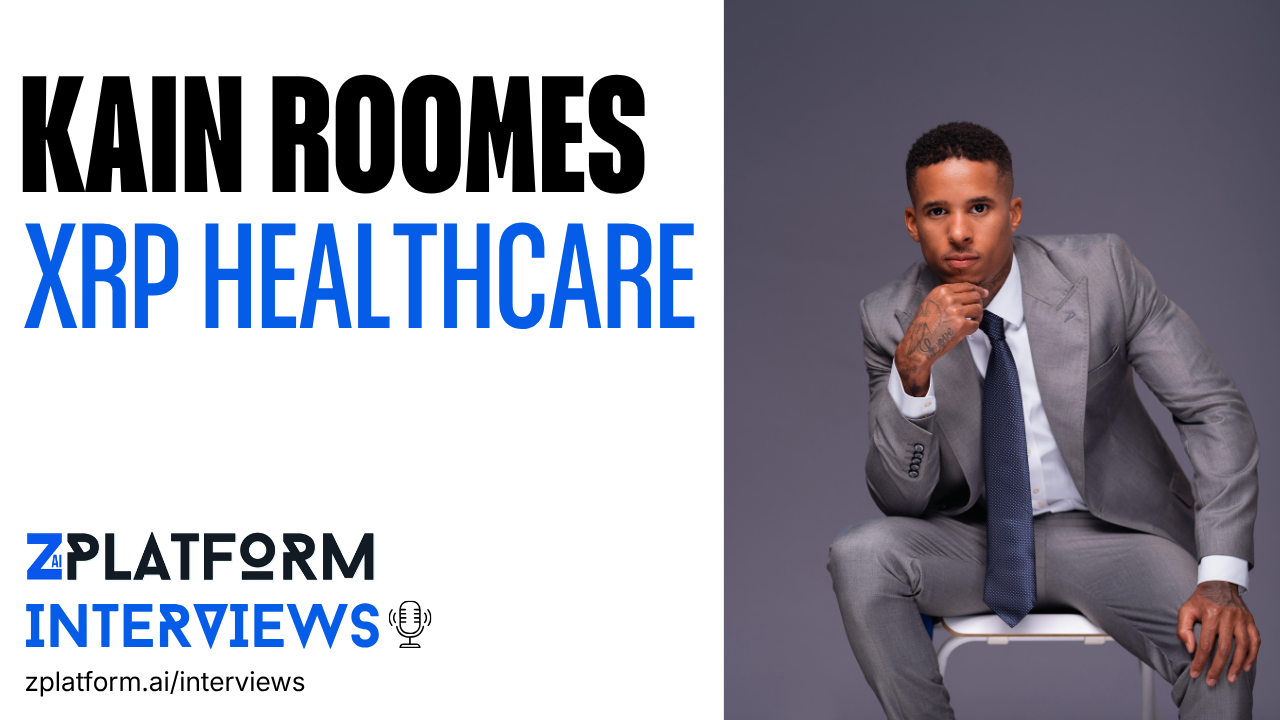
XRP Healthcare founder and CEO Kain Roomes explains how the XRPH AI app has delivered $1.2 million in prescription savings to 77,000+ cumulative users across 217 countries while still being pre-revenue by design, why the company bought a pharmacy chain in Africa, and how a $2.5M raise splits across six areas. He also confirms the AAJ Capital 3 listing transaction did not complete, and draws a hard line between the one monetisation path with a modelled forecast behind it and the two that are still target scenarios.
“Crypto plus healthcare plus AI” is the kind of phrase that makes you close the tab. Three of the most over-promised categories in tech, stacked. Roomes knows it, and says so in this interview before I could.
What makes the conversation worth reading is where he stops selling. Asked about the TSX-V listing path through AAJ Capital 3, he does not spin it: the transaction did not complete and both sides walked away.
Asked which of three monetisation paths becomes the biggest revenue engine, he separates the one with an actual modelled forecast, subscriptions at $10 a month, from enterprise partnerships and AI licensing, which he calls target scenarios rather than signed contracts. He even corrects the premise of my first question, which had him in debt in 2018 when he was simply broke with a Rolex in a safe.
The numbers he does claim are specific enough to check: $1.2 million in prescription savings, 77,000+ cumulative users across 217 countries and territories, up to 80% off at more than 68,000 US pharmacies through a partnership with United Networks of America, and a token that hit a $194 million peak valuation within three months of launch before the market took it back.
Roomes founded XRP Healthcare in 2022 with his father Laban as co-founder, after losing most of a crypto fortune in that year’s crash. In this interview he walks through the XRPH AI app and wallet, the Proof Of Health™ rewards framework, the first African pharmacy acquisition, the compliance posture across three very different regulatory environments, and what long-term success looks like to someone who has now made and lost and remade the same money twice.
The Founder Journey
Take us back to the moment before 2018, how deep in debt were you, and what was going through your mind when you decided to sell your Rolex Submariner as your last resort?
I wasn’t in debt at this time. I was broke, with no income, just the Rolex Submariner sitting in my safe.
It was actually after losing most of the money I’d made in the 2022 crash that the debt really piled up, to the point I owed my girlfriend at the time, who I was living with, over £15,000, plus around £20,000 to the mortgage company, with my property close to being repossessed. Deciding to sell the Rolex was an easy call.
I wasn’t even wearing it, it was just sitting in the safe. I knew I wanted to get rich, and that watch was the tool that would get me there.
Why crypto, and why that specific moment in 2018? What did you see that made you willing to put your last money into it?
I was on holiday in Jamaica with my family and saw my dad by the pool one day reading a book about Bitcoin. I was excited and curious, and about a week later, once I was back in England, I fully locked in on crypto, day and night, sometimes sleepless nights, and from there the rest is history.
What was it like going from that debt to becoming a millionaire, and then losing it all? What did each of those extremes actually teach you?
I’m someone who said my affirmations every day, to the point I actually believed I was a millionaire before I became one. I fooled myself into believing I already had millions, so when it materialised, it wasn’t a surprise, it was as if it had always been there and reality just caught up.
Then when I lost most of it, I needed that lesson, honestly. It woke me up, made me more alert, stopped me taking things for granted.
I got greedy and comfortable, and comfort isn’t good. We constantly need to stay alert, and I lost focus.
I believe nothing happens by chance, obstacles are there to teach and develop us. I was meant to lose that money so my character could become stronger and wiser.
I’m glad it happened sooner rather than later, we all need these moments to shake us up and sharpen us. It also taught me I need to secure profits sooner and not be greedy.
A lot of founders would have quit after losing a fortune. What made you keep going, and how did that experience shape the founder you are today?
I’m a born winner, I’ll always find a way to win, maybe not straight away, but eventually. I’ve been like that since I was a child.
I’d already tasted what it’s like to materialise millions, so I knew I could do it again. And I did. Since starting XRP Healthcare in 2022, I’ve made more than double what I lost in that crash.
The Origin of XRP Healthcare
How did you go from crypto trader to founding XRP Healthcare in 2022, why healthcare, and why on XRP Ledger specifically?
I just wanted to change my situation, really. I needed money, needed a new direction.
It was my dad who recommended I start a crypto project, and from there it was in motion. Even though I’d said I’d never want a crypto project, given the crazy stick and abuse founders get, this time felt different, and it worked.
Your father Laban is your co-founder. What’s it like building a company with your dad, and how do you split responsibilities day-to-day?
It’s beautiful, really. We have a natural connection and we both aim for perfection.
We sharpen each other’s iron and always want the best out of a situation, even if we disagree at times, we always land on the best conclusion. It’s an honour to be working with my dad, I’m truly blessed.
The XRPH token reached a peak valuation of $194 million within its first three months. How did you handle that speed of validation, and what did the market volatility that followed teach you?
It was encouraging to see, it showed there was big interest in the project. But I didn’t get excited, I just continued with what needed to get done in the moment, because I’ve seen many projects hit high valuations and come down hard when the bear market arrives.
The XRPH AI App & Platform
Could you walk us through what the XRPH AI App actually is today, the core user experience from download to daily use?
Someone downloads the app and lands in what’s essentially an AI-powered healthcare engagement platform. Day to day, that means an AI Health Advisor for guidance, daily health check-ins, CalmXRPH for stress and breathing support, a Prescription Savings Card, and Proof Of Health™, where genuine healthy engagement earns XRPHAI rewards. The wallet then sits alongside it as the infrastructure layer, so the whole thing works as one connected ecosystem rather than a set of separate tools.
Can you tell us more about the AI Health Advisor, what problems it solves for users, and how it’s different from generic AI health chatbots?
Most AI health chatbots are built as a bolt-on to something else. Ours was purpose-built for this specific job, not adapted from a general-purpose model.
It’s there to give people personalised guidance, multilingual support, and a genuine sense of navigation through their own health journey, rather than a generic Q&A box. The difference is it’s tied into the wider ecosystem, so the guidance connects to real actions, like prescription savings or Proof Of Health™ rewards, not just information sitting on its own.
How does the prescription savings feature work in practice, up to 80% off across 68,000 US pharmacies? Who are the pharmacy partners and how did you build that network?
This runs through our partnership with United Networks of America, UNA, a US healthcare network solutions provider that already serves over 120 million members through more than 240,000 participating healthcare providers. Through that, our Prescription Savings Card gives users up to 80% off eligible medications at more than 68,000 pharmacies, including Walgreens, CVS, Walmart, Kroger, and thousands of independents. We didn’t have to build that pharmacy network from scratch, we built the right partnership instead, and integrated it properly into the app rather than leaving it as a separate coupon.
Proof of Health™ rewards is a really interesting concept. Can you explain how it works, what actions users take, what they earn, and how it ties back to the XRPH token?
The idea is simple, we reward people for genuine engagement with their own health, not vanity metrics like step counts. That could be using the Prescription Savings Card, completing a health check, or engaging with the AI Health Advisor.
Eligible actions earn XRPHAI rewards, which can then move through to the XRPH Wallet. It’s the first framework of its kind, as far as we’re aware, that ties verified AI-driven healthcare engagement directly to a blockchain reward.
Where do features like CalmXRPH and Doctor Finder fit into the bigger picture, and which features are driving the strongest engagement so far?
CalmXRPH is actually our highest engagement feature right now, it speaks to how much people want simple, accessible support for stress and wellbeing, not just medical information. Doctor Finder fits in as part of the wider navigation piece, helping people actually act on the guidance they get from the AI Health Advisor, rather than leaving them stuck after a conversation.
How do the XRPH Wallet and XRPH AI App work together, and how important is the crypto/token layer to the end-user experience vs. purely being an economic layer?
They’re two distinct products that function as one ecosystem. The App is the healthcare engagement layer, where people actually interact with their health.
The Wallet is the infrastructure layer, non-custodial, built on the XRP Ledger, handling self-custody and settlement. Healthcare information stays off-chain, intentionally separated from blockchain transactions, so the token layer adds real value through rewards without ever compromising the privacy of someone’s health data.
Traction & Numbers
You’ve delivered $1.2M in prescription savings across 77,000+ combined cumulative users, all pre-revenue. What do those numbers actually tell you about product-market fit right now?
To me, it says people are actually using this for something real, not just downloading it and forgetting about it. $1.2 million in genuine prescription savings is money back in people’s pockets, that’s proof the product does what it says. We’re pre-revenue by design at this stage, the priority has been proving real usage and real value first, monetisation is the next chapter, not the first one.
Are the 77,000+ users concentrated in a specific geography or demographic, and how do you plan to bridge from cumulative users to 1M+ monthly active users?
We’ve reached users across 217 countries and territories since launch, so it’s genuinely global, though the US is our top market given the Prescription Savings Card. Getting from where we are to 1M+ monthly active users comes down to a few things working together, direct acquisition through creators and paid channels, deepening healthcare partnerships that bring users in at scale, new exchange listings that reach existing token communities, and continuing to lead on the AI product itself so people stay, not just download and leave.
Africa Expansion & M&A Strategy
You’ve just completed your first retail and wholesale pharmacy chain acquisition in Africa. What’s the strategic thesis behind Africa specifically, and how does it connect back to the AI app?
Africa carries a disproportionate share of the world’s disease burden relative to the number of health workers available, so the need is real, and I think the continent has been treated as an afterthought by health tech built elsewhere for too long. Our thesis is simple, build something that actually meets people where they are, not a stripped-down version of a product designed for someone else’s market.
That’s why XRPH AI became Africa’s first HIPAA-grade health app, not because anyone told us to, but because African users deserve the same data protection standard as anyone else, not a watered-down one. The app itself, the AI Health Advisor, the prescription savings, Proof Of Health™, all of it is built to work the same way for someone in Kampala as it does for someone in Dubai or New York.
XRP Healthcare M&A Holding Inc. suggests M&A is a core part of the strategy. What’s the acquisition playbook, what kinds of targets, what integration model, and how do you fund it?
The playbook is about acquiring real, functioning healthcare infrastructure and technology partnerships that extend what the app can offer, rather than trying to build every single piece from zero. Alongside that we’ve got Letters of Intent with Isansys Lifecare, an NHS collaborator in AI-enabled remote patient monitoring, and Spiritus Medical, giving us access to their NASA-designed VITALITY ventilator technology. Funding runs through the current $2.5M raise and ongoing revenue as the platform scales.
The $2.5M raise & path to enterprise value
You’re currently raising $2.5M in growth capital. How is that broken down across product, distribution, M&A, and marketing?
It splits across six areas: 26% into global user growth, mainly marketing and acquisition, 24% into digital asset and exchange expansion, getting XRPHAI onto higher-tier exchanges, 20% into strategic healthcare partnerships, deepening what we’ve already got with UNA, Isansys, and Spiritus, plus new ones, 12% into institutional readiness, audit, compliance, governance, 10% into working capital and reserve, and 8% into AI product leadership.
Your monetisation paths are freemium + premium subscriptions, enterprise healthcare partnerships, and AI licensing. Which one do you believe becomes the biggest revenue engine long-term, and why?
Subscription is the clearest path right now, it’s the one with an actual modelled forecast behind it, priced at $10 a month, projecting toward $12M in annual recurring revenue by 2030 as we scale toward a million users. Enterprise partnerships and AI licensing represent bigger long-term upside on paper, but I want to be straight, those are target scenarios based on the size of the opportunity, not signed contracts today. Subscription is the one I’d point to as the near-term engine, the others are where I believe this goes over time.
You’ve mentioned public markets and strategic acquisition as potential exits. How are you thinking about the TSX-V listing path via AAJ Capital 3, and what does that unlock for shareholders?
The transaction with AAJ Capital didn’t complete, as they weren’t the right fit for us in the end, and we mutually agreed to part ways. We’re currently raising a further $2.5 million to fund three main things: growing our user base, expanding where our token is traded by getting listed on more exchanges, and strengthening our AI capabilities, with the option of doing an RTO and becoming a publicly listed company.
AI, trust & regulation in healthcare
Healthcare AI faces serious trust, safety, and regulatory challenges. How are you approaching clinical safety, data privacy, and compliance across the US, Africa, and other jurisdictions?
We’ve built with HIPAA-grade security standards in mind for protecting sensitive health information, encrypted communications, secure authentication, role-based access, privacy-by-design from the ground up rather than bolted on afterward. On the token side specifically, we’ve taken formal legal opinion, including from GS Legal in Singapore, on how XRPHAI is classified under securities and payment services law. Compliance isn’t a single jurisdiction problem for us, it’s something we’re building to be modular enough to meet different standards as we expand.
What’s your position on where AI should and shouldn’t be in the patient journey, assisting the user, augmenting a doctor, or something more autonomous?
For me, AI’s role is to assist and guide, not replace clinical judgement. It’s there to help someone understand their own health better, point them toward the right next step, whether that’s a pharmacy saving or finding a doctor, not to make an autonomous medical decision on someone’s behalf. That’s also why we keep healthcare information intentionally separated from the blockchain layer, the technology should support trust, not complicate it.
New to the terminology? Terms like non-custodial wallet and inference come up constantly in AI health products without ever being defined. Our AI glossary covers 264 of them with citations.
Competition, Market & Positioning
Companies like GoodRx (savings), Ada/Babylon (AI symptom checkers), and various Web3 health projects touch parts of what you do. Where do you clearly win, and where are you still building the moat?
Most of those companies do one piece of what we do well, savings, or AI triage, or a token layer, but not all three connected together. Our moat is that combination, a proprietary AI platform that was purpose-built rather than adapted, Proof Of Health™ as the first framework rewarding verified AI-driven engagement specifically, and a wallet that gives those rewards real, usable value. Where we’re still building is scale, turning that combination into the kind of user numbers and enterprise partnerships that make the moat undeniable rather than just structurally true.
What’s your response to skeptics who see “crypto + healthcare + AI” and immediately worry it’s a mashup rather than a focused product?
I understand the instinct, that combination can sound like buzzword bingo if you haven’t looked closely. My response is always to point to what’s actually real, a genuine partnership with UNA reaching 68,000+ pharmacies, a Letter of Intent with an NHS collaborator in Isansys, real users saving real money on prescriptions.
The crypto and AI pieces aren’t there for the sake of being trendy, they’re the mechanism that makes the healthcare engagement and rewards model actually work. Once people see the real partnerships and real numbers behind it, that scepticism tends to soften.
Roadmap & Vision
What’s on the XRP Healthcare roadmap for the next 12 to 24 months, covering MAU milestones, enterprise deals, AI licensing customers and further African expansion, and what does long-term success look like for you personally, after everything you’ve been through to get here?
Over the next 12 to 24 months, it’s about pushing hard toward that 1,000,000+ monthly active user mark, and building toward our first real enterprise and AI licensing customers rather than just the target scenarios we’ve modelled. Africa is a huge, genuinely underserved market, industry analysts project the African healthcare market will reach $259 billion by 2030, so the need and the opportunity are both real.
XRPH AI is a global platform though, and the roadmap is about continuing to grow across all our markets, not just one. Personally, long-term success isn’t really about a number for me anymore. After selling that Rolex with nothing left, then losing it all again in 2022, and then building it all back up once more, what matters most now is that this company is still standing, still growing, still genuinely helping people, that’s the win that actually means something.
About Kain Roomes
Kain Roomes is the founder and CEO of XRP Healthcare, an AI healthcare platform built on the XRP Ledger, which he started in 2022 alongside his father Laban Edward Roomes as co-founder and COO. He entered crypto in 2018 after selling his Rolex Submariner to fund his first positions, built and then lost most of a fortune in the 2022 crash, and says he has since made back more than double what he lost.
The company now operates the XRPH AI app and the non-custodial XRPH Wallet, holds a prescription savings partnership with United Networks of America covering more than 68,000 US pharmacies, has completed its first retail and wholesale pharmacy chain acquisition in Africa, and carries Letters of Intent with Isansys Lifecare and Spiritus Medical. He can be found on LinkedIn.
The Bottom Line
The most useful answers in this interview are the ones that cost Roomes something.
He could have left the AAJ Capital 3 question alone and let the TSX-V listing path stand as a live plan, since that is how it had been reported. Instead he says plainly that the transaction did not complete and the two sides parted ways.
He could have put enterprise healthcare partnerships and AI licensing forward as revenue engines, because both sound larger than a $10 subscription. Instead he flags them as target scenarios based on opportunity size, not signed contracts, and points at the subscription line as the only one with a real forecast behind it. In a category where projections routinely get presented as pipeline, that distinction is worth more than the projections.
The rest of it is a bet on sequencing. Prove real usage first, at $1.2 million of prescription savings and 77,000+ cumulative users, then monetise.
Buy working healthcare infrastructure in Africa rather than build it. Keep health data off-chain so the token layer never becomes the privacy problem. Every part of that is defensible, and none of it is proven yet, because the company is still pre-revenue by its own description and the 1M+ monthly active user target is roughly an order of magnitude away from where cumulative users sit today.
So the number to watch is not the token price or the raise. It is whether subscription revenue actually arrives at something close to $10 a month per user, because that is the only monetisation claim in this interview with a model attached, and everything else in the plan is funded by it.
Want more of these? Read more founder interviews where builders explain the decisions behind their products, or request an interview if you are building something worth talking about.
More Founder Interviews
DeltaReview founder Rida Rahim on why her AI code reviewer has no login, why she refuses GitHub integration, and the weak output she flagged herself.
ConvertMyStore founder Thiago Nobre on outgrowing a $29 Shopify scan, refusing magic scores and guarantees, and what he will not let AI decide.
CostLoop founder Milosh Mladenovski on bootstrapping from Oslo, why he refuses bank connections, and the numbers he will not publish about his own...