
MQTT Broker Lifetime Deal
MQTT Broker by Bevywise is on AppSumo from $53.10 one-time (two tiers at $53.10 and $106.20), covered by AppSumo's standard 60-day money-back guarantee.
- Type Lifetime
- Verdict Skip
- Status Active
- Updated Jul 4, 2026
- Confidence Low
- Score 3/10
Verdict: Skip
The one-time price is attractive, but reported message-reliability and rules-engine instability, a limited API, no confirmed free tier or documented clustering, and just one verified rating make free tiers from EMQX and HiveMQ the safer choice.
MQTT Broker deal: quick verdict
Skip 3/10- Verdict
- Skip (3/10)
- Price
- From $53.1
- Free option
- Yes, free tier available
- Best for
- Solo developers and small teams running private, self-hosted IoT setups on one server
- Skip if
- Production teams that need guaranteed uptime should choose HiveMQ, which advertises a 99.99% SLA and built-in clustering that MQTT Broker does not document.
- Bottom line
- The one-time price is attractive, but reported message-reliability and rules-engine instability, a limited API, no confirmed free tier or documented clustering, and just one verified rating make free tiers from EMQX and HiveMQ the safer choice.
Last verified Jul 4, 2026 by Alston Antony.
On this page7 sections
What is MQTT Broker?
MQTT Broker by Bevywise is a self-hosted MQTT server for routing real-time device messages across IoT deployments. MQTT Broker by Bevywise is on AppSumo from $53.10 one-time (two tiers at $53.10 and $106.20), covered by AppSumo's standard 60-day money-back guarantee.
The MQTT Broker lifetime deal by Bevywise is on AppSumo from $53.10 one-time, with a second tier at $106.20, replacing the recurring cost of a managed cloud broker for small, self-hosted IoT setups. That price is genuinely low for a perpetual license, but the value case is thinner than it looks. By the second sentence, the caveats matter: the AppSumo listing carries only one verified rating, and independent AWS Marketplace feedback flags limited features, complicated configuration, and an 'unreliable message issue' that turns into a performance problem. Message reliability is the one thing an MQTT broker cannot get wrong. Competitors set a high bar here. EMQX offers a free serverless tier with 1,000 connections and HiveMQ offers a free 100-device tier, both letting you test before spending anything, and both ship high-availability clustering with uptime SLAs that Bevywise does not clearly document. If you run a private single-server deployment and want to avoid a subscription, this deal can fit. If you need production reliability, transparent scaling, or a free trial run, EMQX and HiveMQ are safer and better documented choices.
Pros & Cons
Pros
- A one-time price from $53.10 replaces recurring monthly broker fees, which is a real saving for hobby and small private deployments that run on a single server.
- Self-hosting keeps device data fully on your own infrastructure, on-premises or on AWS, Azure, and Google Cloud, which suits teams with data-control or compliance requirements.
- Core building blocks are present: a web monitoring dashboard, database integration with MySQL, PostgreSQL, and SQL Server, plus a REST API and a rules engine.
- Bevywise has operated since 2010 and lists on AWS Marketplace, G2, and Capterra, so the vendor is established rather than an untested newcomer.
Cons
- An AWS Marketplace reviewer reports an unreliable message issue that surfaces as a performance problem, a serious flag for production IoT where delivery must be dependable.
- The rules engine and REST API are described as insufficient and unstable in Capterra feedback on Bevywise's related product, limiting extensibility and complex routing.
- Only one verified AppSumo rating exists, so there is almost no independent evidence of real-world reliability compared with hundreds of reviews for EMQX and HiveMQ.
- There is no confirmed free tier and no clearly documented high-availability clustering, while pricing beyond the deal tiers stays opaque about connection and device limits.
What It Does
- Routes real-time MQTT messages between IoT devices
- Runs on-premises or on AWS, Azure, Google Cloud
- Ships a web dashboard for monitoring device activity
- Stores data in MySQL, PostgreSQL, or SQL Server
- Exposes a REST API for external integration
- Applies a rules engine for message routing
Who It's For
- Solo developers and small teams running private, self-hosted IoT setups on one server
- Hobbyists and prototypers who want a one-time cost instead of a monthly cloud broker bill
- Engineers who need on-premises data control and cannot use a public managed cloud broker
Pricing Comparison
| Plan | Price | Type |
|---|---|---|
| MQTT Broker (AppSumo Tier 1) | $53.10 one-time | ⭐ Best Value |
| MQTT Broker (AppSumo Tier 2) | $106.20 one-time | Lifetime Deal |
| EMQX Serverless (Free) | $0 (1,000 connections) | Free Tier |
| HiveMQ Cloud (Free) | $0 (100 devices) | Free Tier |
| EMQX Dedicated Flex | From $234/month | Subscription |
| HiveMQ Standard | ~$0.34/hour (~$249/month) | Subscription |
| AWS IoT Core | Usage-based, from $0.042/device/year | Subscription |
Feature Comparison
| Feature | MQTT Broker | EMQX | HiveMQ |
|---|---|---|---|
| Self-hosted one-time license | ✅ | ❌ | ❌ |
| On-premises deployment | ✅ | ✅ | ✅ |
| Web monitoring dashboard | ✅ | ✅ | ✅ |
| REST API | ✅ (limited) | ✅ | ✅ |
| Database integration | ✅ | ✅ | ✅ |
| Built-in HA / active-active clustering | ❌ | ✅ | ✅ |
| Serverless pay-per-use pricing | ❌ | ✅ | ✅ |
| Free tier for testing | ❌ | ✅ (1,000 conn.) | ✅ (100 devices) |
| Enterprise SLA with uptime guarantee | ❌ | ✅ | ✅ (99.99%) |
| Stream processing / advanced analytics | ❌ | ✅ | ✅ |
| Large public user base and ratings | ❌ | ✅ | ✅ |
Limitations
- An AWS Marketplace reviewer states the product 'has limited features and configuration is little complicated,' pointing to a smaller feature set and a steeper setup path than HiveMQ or EMQX.
- Reliability is a concern: an AWS Marketplace reviewer flags an 'unreliable message issue' that becomes a performance problem, and message delivery stability is critical for production IoT systems.
- Feedback on Bevywise's related MQTTRoute product on Capterra says 'rule functions are insufficient and rules are not stable,' suggesting the rules engine may fail or misbehave during execution.
- Capterra feedback on the sibling product notes 'api's are insufficient, api's should be developed for more functions,' which limits how far you can extend the broker with custom integrations.
- Only one verified rating exists on the AppSumo listing (5.0 from a single buyer), so there is almost no independent signal on real-world reliability compared with hundreds of competitor reviews.
- Neither the Bevywise site nor its marketing emphasizes high-availability or active-active clustering, so single-broker deployments carry a single point of failure that HiveMQ and EMQX address directly.
- Pricing beyond the AppSumo deal is opaque: Bevywise publishes no clear tiered pricing, and the $53.10 and $106.20 tiers do not spell out connection, device, or feature limits, per the deal and vendor pages.
- Configuration complexity is a repeated theme across AWS Marketplace feedback, meaning longer deployment time and a likely need for hands-on expertise before the broker is production-ready.
What's Missing vs Competitors
- EMQX and HiveMQ both offer free tiers (1,000 connections and 100 devices respectively) for testing; MQTT Broker has no confirmed free tier for evaluation before you commit.
- HiveMQ and EMQX ship built-in high-availability clustering with uptime SLAs (HiveMQ advertises 99.99%); MQTT Broker does not prominently document active-active clustering.
- EMQX and HiveMQ Cloud provide serverless, pay-per-use billing with no infrastructure management; MQTT Broker is self-hosted and leaves operations entirely to you.
- EMQX includes data processing and stream analytics in its base plan and AWS IoT Core integrates deeply with Lambda, DynamoDB, and Kinesis; MQTT Broker's integration surface is narrower.
Who Should Skip This Deal
- Production teams that need guaranteed uptime should choose HiveMQ, which advertises a 99.99% SLA and built-in clustering that MQTT Broker does not document.
- Anyone wanting to test before paying should start with the EMQX free serverless tier (1,000 connections) or HiveMQ's free 100-device tier instead of buying blind.
- Teams that want zero infrastructure management should pick EMQX or HiveMQ Cloud, whose serverless models remove the operational burden that self-hosting MQTT Broker creates.
- Builders on AWS who need deep ecosystem hooks (Lambda, DynamoDB, Device Shadow) are better served by AWS IoT Core than by this standalone broker.
Frequently Asked Questions
- For a small, self-hosted IoT project on a single server, the AppSumo price from $53.10 one-time is cheap compared with a monthly managed broker, so it can be worth it if your needs are modest. For anything approaching production scale, the value is questionable. Independent AWS Marketplace feedback reports limited features, complicated configuration, and an unreliable message issue, and the AppSumo listing has only one verified rating. Message reliability is the core job of a broker, so those flags carry weight. EMQX and HiveMQ both offer free tiers you can test at no cost and add high-availability clustering, which makes them lower-risk choices for most buyers who care about uptime.
- The deal is sold through AppSumo, which applies its standard 60-day money-back guarantee to most listings, meaning you can request a full refund within 60 days of purchase if the broker does not fit your setup. You should confirm the exact terms on the live deal page at checkout, since specific conditions can vary by product and can change over time. The 60-day window is a meaningful safety net here, because the tool has very few public reviews and reported reliability concerns. Use the window to actually load-test message delivery and the rules engine before you commit, rather than assuming the marketing claims hold under real traffic.
- MQTT Broker's main edge is a one-time self-hosted license, while EMQX and HiveMQ run on subscription or usage-based pricing. That is where its advantage largely ends. EMQX offers a free serverless tier with 1,000 connections and HiveMQ offers a free 100-device tier, so both let you test before paying, which MQTT Broker does not. Both competitors ship built-in high-availability clustering with uptime SLAs, HiveMQ advertising 99.99%, plus stream processing and analytics that MQTT Broker does not clearly document. EMQX and HiveMQ also carry hundreds of public reviews, versus a single verified AppSumo rating here. For private, cost-sensitive, single-server use, MQTT Broker can work; for production reliability and transparent scaling, the competitors are stronger.
- The most serious limitation is reliability: an AWS Marketplace reviewer describes an unreliable message issue that becomes a performance problem, which is critical for IoT. Capterra feedback on Bevywise's related product calls the rules engine insufficient and unstable and the APIs too limited for building custom functions. Configuration is described as complicated, meaning longer setup and a need for hands-on expertise. There is no prominently documented high-availability clustering, so a single broker is a single point of failure. Pricing beyond the two AppSumo tiers is opaque about connection and device limits, and with only one verified AppSumo rating, there is very little independent evidence of how the product behaves under real production load.
- Skip this deal if you run production workloads that need guaranteed uptime; HiveMQ advertises a 99.99% SLA and built-in clustering that Bevywise does not document. Skip it if you want to test before paying, because EMQX offers a free serverless tier with 1,000 connections and HiveMQ offers a free 100-device tier, while MQTT Broker has no confirmed free trial. Skip it if you want zero infrastructure management, since EMQX and HiveMQ Cloud handle operations for you while this broker is fully self-hosted. And if you build on AWS and need deep integration with Lambda, DynamoDB, or Device Shadow, AWS IoT Core is a better fit than a standalone broker with a narrow integration surface.
Is MQTT Broker by Bevywise worth the money?
What is the refund policy for MQTT Broker?
How does MQTT Broker compare to EMQX and HiveMQ?
What are the main limitations of MQTT Broker?
Who should NOT buy MQTT Broker?
Sources
MQTT Broker pricing at a glance
- Free tier
- Yes
- Deal price
- From $53.1
MQTT Broker deal terms
- Refund window
- 60-day money-back guarantee
MQTT Broker vendor check
- Domain Rating
- 45/100 Backlink authority
- In business since
- 2016
- Security
- No known flags Google Safe Browsing
Domain Rating by Ahrefs. Objective third-party data, not our opinion.
How MQTT Broker's price compares
MQTT Broker is the 7th-cheapest of 17AI Automationlifetime deals we've reviewed. At $53 it is below the $59 median for AI Automation lifetime deals we've reviewed.
- MarkupGo$25
- SlideFill$29
- LeadToSheet$39
- Airwork AI$49
- AdaCertify$49
Related tools & guides
Alternatives to MQTT Broker
Other active deals in AI Automation

Reoon Yellow Pages Scraper is a desktop app that extracts business emails, phone numbers, and social handles f...
DijiBot is a content scraping and automation tool that extracts, manages, and republishes posts from WordPress...

Group Collector is a Chrome extension that automates Facebook group member approvals, answer collection, and w...
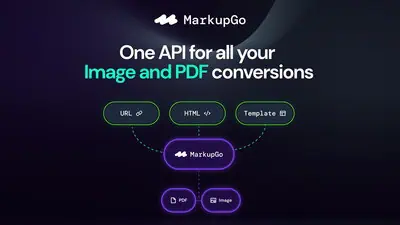
MarkupGo is an API platform that converts URLs, HTML, CSS, and JavaScript templates into PDFs and images for d...
Comments
Loading comments...