


AI-Text-Humanizer.com Review Summary
| Field | Detail |
|---|---|
| Tool | AI-Text-Humanizer.com |
| Category | One-button AI text humanizer and rewriter, with an optional API |
| Best use case | Cleaning AI vocabulary out of AI-assisted drafts before your own editing pass |
| Price | Free tier: yes, 500 words total and 200 words per process, no card or login. PRO Monthly $19.99/month for 50,000 words, 2,000 per process, words do not roll over. PRO Prepaid $69.99 one-time for 150,000 words valid up to 24 months. Volume discounts from 20% at five packs to 50% at forty. Checked 31 July 2026. |
| Verdict | Buy the $69.99 prepaid pack if your content work arrives in bursts, skip the monthly |
Quick Answer: What Is AI-Text-Humanizer.com?
AI-Text-Humanizer.com is a one-button rewriting tool that strips the vocabulary and sentence patterns AI detectors look for, priced free for 500 words, $19.99 per month for 50,000 words, or $69.99 prepaid for 150,000 words valid two years. It suits writers cleaning AI-assisted drafts before an editing pass. The output is readable but flat, with no tone control. Verdict: buy the prepaid pack if your content work arrives in bursts.
How Does AI-Text-Humanizer.com Work for Detector Evasion?
The tool works by rewriting your text to remove the lexical and structural fingerprints detectors score against, rather than by injecting errors or hidden characters.
- Input. You paste text into a single box, capped at 200 words per process on free and 2,000 on either PRO plan.
- Rewrite. One pass replaces AI-associated vocabulary and flattens the evenly balanced sentence rhythm models produce. There is no tone selector and no style sample to steer it.
- Output. The result comes back longer than the input, in plain declarative prose that preserves meaning while losing voice.
- API, on PRO only. You send your account login and text as POST variables, with CURL and Python examples in the docs. Rate limit is 60 calls per minute with a requested one-second pause between calls.
- No batching. Two hundred articles means two hundred calls and your own queue logic.
Privacy is a genuine strength here: a German company, no retention of your input, and no training on your text.
Who Is AI-Text-Humanizer.com Best For (and Not For)?
AI-Text-Humanizer.com is best for:
- Writers producing AI-assisted content in bursts. The prepaid pack spreads 150,000 words across two years, which fits irregular workloads better than a monthly reset.
- Content teams wanting a pipeline step. The API turns the tool from a browser tab into an automated cleanup stage at 50,000 words a month for $19.99.
- Anyone whose drafts read like a model wrote them. It removes the cliches in one click, faster than prompting your way out of them.
- Editors who scan before and after. Meaning survives the pass intact, so it is safe as a pre-edit cleanup.
- Buyers who care where their text goes. German company, no input retention, no training on your content.
AI-Text-Humanizer.com is not for:
- Writers with a strong personal voice. The rewrite flattens personality out of the prose, and getting it back costs you an editing pass.
- Anyone needing tone control. There is no register, style or audience setting of any kind.
- Students submitting graded coursework. No vendor can guarantee a detector outcome, and the site’s student-facing marketing oversells this.
- High-volume publishers. No batching plus a 60 calls per minute ceiling means you build the queue yourself.
- Casual users expecting a real free tier. The advertised 500 free words did not survive one 132-word job anonymously.
What Are the Limitations of AI-Text-Humanizer.com?
- It flattens your voice. Output reads like a careful non-native speaker explaining something clearly. Meaning survives, personality does not, so this can never be the last step before publishing.
- The free tier is smaller than advertised. The pricing page lists 500 free words, but without an account the tool returned “Out of free daily words” after a single 132-word job.
- No tone or style control. One button, one register. If the output does not suit your publication, there is no dial to turn.
- Output gets longer, not tighter. Expect to cut length back during editing.
- API authentication is dated. You send your account login in the POST body rather than a revocable token, so rotating credentials means changing your password.
- The refund window is narrow and stated plainly, and volume discount codes require contacting the vendor rather than applying at checkout.
- Detector outcomes are never guaranteed. A pass that clears one scanner today can fail another tomorrow, whatever the marketing implies.
What Are AI-Text-Humanizer.com’s Alternatives?
| Alternative | Price | Pick it instead when |
|---|---|---|
| Textbuddy | Free, no login | You want rewriting plus tone settings and 16 other writing tools, and can live with occasional grammar slips |
| ChatGPT Plus or Claude Pro | $20/month | You already pay for one and are willing to write and maintain your own rewriting prompt with a style sample |
| QuillBot | Free tier, paid plans above it | You want sentence-level paraphrasing modes rather than a single detector-focused pass |
My AI-Text-Humanizer.com Review Conclusion
I tested this on the public free tier on 31 July 2026, with no vendor access and no PRO account. I wrote a 132-word paragraph out of pure ChatGPT cliches and scored it before and after in the same session. It came back at 100% AI on both ZeroGPT and AIscan24. After one pass through the humanizer it read 0% on ZeroGPT and 3% on AIscan24. I deliberately cross-checked on ZeroGPT because it is run by an unrelated company, and that is the number I trust.
What matters more than the score is how it got there. The tool did not wreck my grammar to fool the scanner, which is how a lot of cheaper humanizers earn their numbers. The meaning of the paragraph survived completely. What did not survive was any sense of a person having written it. So I would use this as a cleanup step and never as the final draft, and I would buy the prepaid pack rather than the subscription, because content work does not arrive at a steady 50,000 words a month.
Disclosure: Free-tier tested. I ran every test in this review on the public free tier on July 31, 2026. I do not hold a PRO account, I was not given vendor access, and there is no affiliate link on this page. All prices come from the official AI-Text-Humanizer pricing page.
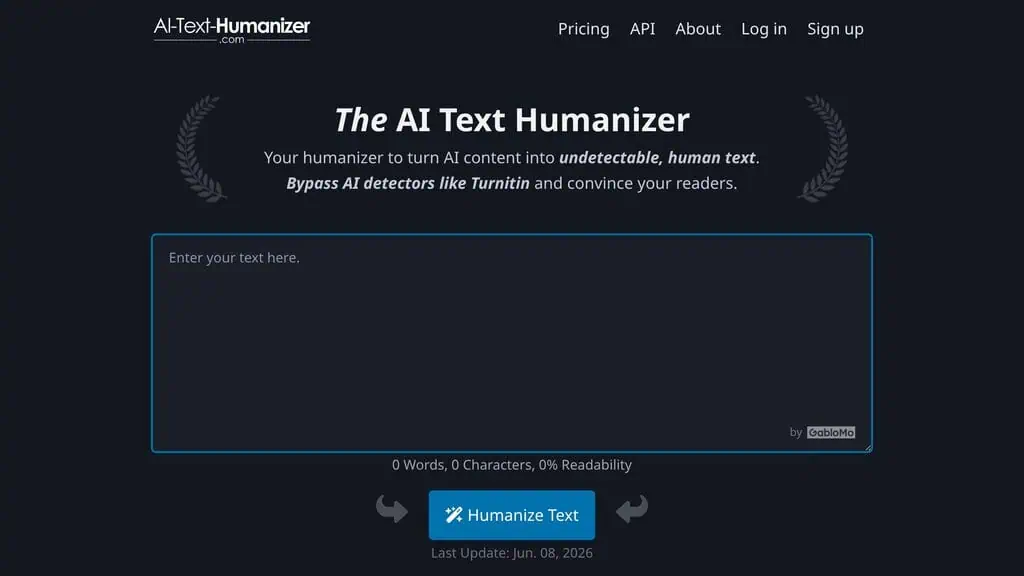
I have a rule with humanizer tools: I don’t trust the before and after screenshots on the sales page. Anyone can pick a paragraph that flatters their own software. So when I opened AI-Text-Humanizer.com, I did the only thing that tells you anything useful. I wrote the worst possible ChatGPT paragraph I could, scored it in two separate detectors, ran it through the tool once, and scored it again.
The result surprised me a little. Not because it bypassed the detectors, most humanizers manage that. It surprised me because the output was actually readable. I have tested rewriters that deliberately break your grammar and drop in typos to fool a scanner, which leaves you with text you cannot publish anywhere. This one does not do that.
For context on where I am coming from: I have reviewed well over 500 SaaS tools, most of them in AI, SEO, and marketing, and I have paid for most of them with my own money. My default setting with any tool that promises to make content “undetectable” is doubt, because that promise is usually the easiest thing in the world to fake in a marketing screenshot.
So this is a full AI-Text-Humanizer.com review with the numbers from my own screen, the exact pricing math, and the two situations where I would tell you to close the tab and walk away.
Key Takeaways
- It works on detectors, and I verified it on one the vendor does not own. My ChatGPT test paragraph went from 100% AI on ZeroGPT to 0% after one pass. On AIscan24 it went from 100% to 3%. I ran both scans myself, in the same session, on the same text.
- The output is plain, not polished. The tool removes the AI vocabulary and the flowery phrasing, and what you get back reads like a careful non-native speaker explaining something clearly. Meaning survives. Personality does not. Budget time for an editing pass.
- Pricing is fair, and the prepaid option is the interesting one. PRO Monthly is $19.99/month for 50,000 words. PRO Prepaid is $69.99 one time for 150,000 words that stay valid for up to 24 months. If your work comes in bursts, prepaid is the better structure.
- The free tier is smaller than it looks. The pricing page lists 500 free words. Without an account I hit “Out of free daily words” after a single 132-word job, so treat the anonymous free tier as a taste test, not a workflow.
- The student marketing is the weakest part of the site. The homepage says teachers will not find out. I would not build a study habit on that sentence, and later in this review I explain exactly why the same company’s own detector proves the point.
A tool that rewrites your draft is worth paying for. A tool you paste your final work into and publish without reading is a liability. Same software, different user. Alston Antony
What Is AI-Text-Humanizer.com?
AI-Text-Humanizer.com is a browser-based paraphrasing tool that rewrites AI-generated text into plainer language so it stops matching the statistical patterns that AI detectors look for. You paste text into one box, press one button, and a rewritten version appears below with word count, character count, and a readability percentage.
There is no dashboard, no project system, and no tone selector. That is the whole product, and I mean that as a compliment. The company behind it is GabloMo.com, a small German operation that also runs the free detector AIscan24 and the free writing toolbox Textbuddy. Keep that family relationship in mind, because it matters when you read detector claims. I come back to it below.
How does the humanizer actually work?
According to the vendor, the tool uses custom prompts to rephrase your content into less common, plain language, then breaks up repetitive patterns in the result. In practice that means two things happen at once. The AI vocabulary gets swapped out, and the sentence rhythm gets rebuilt so it stops being uniform.
That second part is what detectors are usually reacting to. Machine text tends to have a very even texture: similar sentence lengths, similar connective phrases, the same handful of favorite adjectives. If you want the longer explanation of what scanners actually measure, our guide on how AI detectors actually work walks through the statistical side without the marketing spin.
One detail I like: press the button twice on the same input and you get a different result. That is useful when the first rewrite mangles a sentence you care about.
Who is it built for?
The site pitches four groups: students, writers and bloggers, marketing teams, and companies writing customer-facing copy. Based on the output I got, I would rank the fit differently.
It fits best for anyone who drafts with AI and needs the draft to stop sounding like AI before a human reads it. It fits well for non-native English writers who want a clarity pass. It fits worst for anyone writing in a distinctive personal voice, because a distinctive voice is exactly what this kind of rewriting flattens.
Did It Actually Bypass the AI Detectors?
Yes. In my test, one pass took a paragraph from 100% AI to 0% on ZeroGPT and 3% on AIscan24. I used a deliberately terrible 132-word ChatGPT paragraph stuffed with the usual tells: “in today’s rapidly evolving digital landscape,” “leverage cutting-edge,” “unlock their full potential,” “paradigm shift,” “holistic approach.”
Here is the before score. Both detectors agreed the text was machine written, which is exactly what you would expect from a paragraph built out of AI cliches.
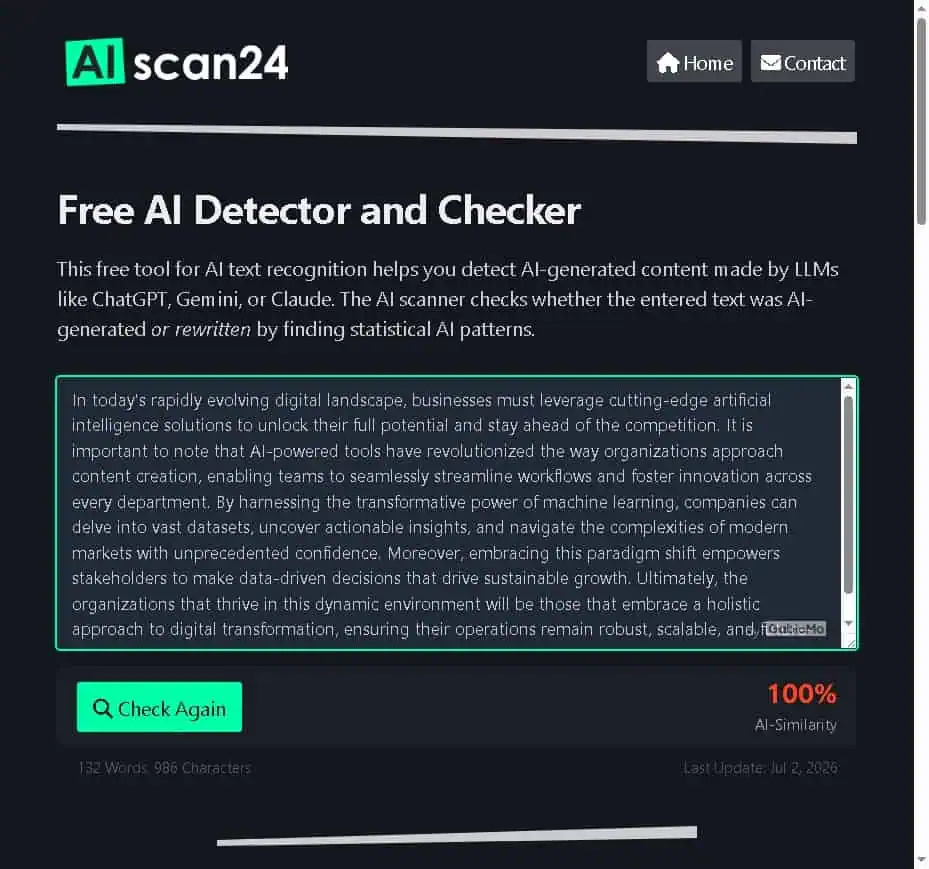
Then I pasted the same paragraph into AI-Text-Humanizer.com, pressed Humanize Text once, and took the output straight into both detectors without touching a word of it.
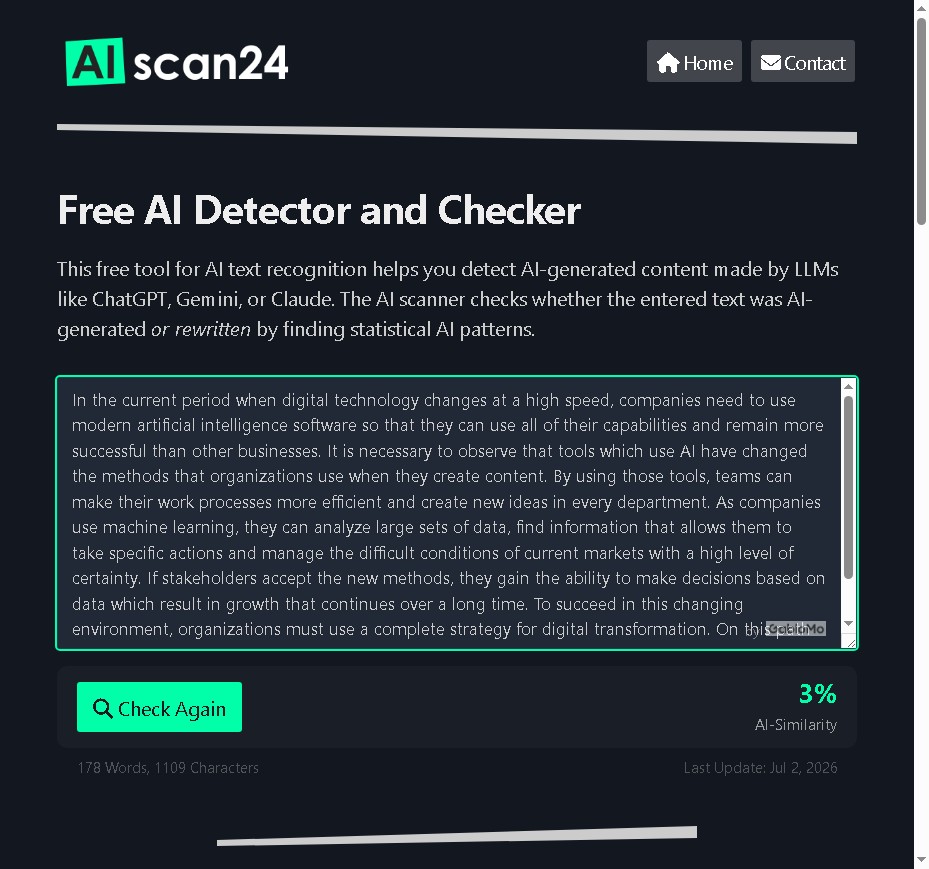
| Detector | Original ChatGPT paragraph | After one humanizer pass |
|---|---|---|
| ZeroGPT | 100% AI, “Your Text is AI/GPT Generated” | 0% AI, “Your Text is Human written” |
| AIscan24 | 100% AI-Similarity | 3% AI-Similarity |
| Word count | 132 words | 178 words |
| Readability (vendor score) | 10%, rated Very Hard | 25%, rated Hard |
Why the ZeroGPT number matters more than the AIscan24 number
AIscan24 is run by the same company as the humanizer. A 3% score on your own sister site is a weak proof point, and I would not publish it on its own. That is why I ran ZeroGPT in the same session. ZeroGPT is unrelated to GabloMo, it flagged my test paragraph at 100%, and after the rewrite it returned 0% with the verdict “Your Text is Human written.”
Two detectors, one of them independent, same direction, one pass. That is a real result.
What this does not prove
It doesn’t prove the tool beats Turnitin. Turnitin sits behind an institutional license, I don’t have access to it, and I’m not going to repeat the vendor’s claim as if I had checked it. The site says it tests Turnitin regularly. Treat that as a vendor statement, not a verified fact.
It also does not prove anything about durability. Detector models get retrained. A rewrite that scores 0% today can score differently in six months, and nobody selling a humanizer can honestly promise otherwise. To their credit, the tool’s own FAQ says exactly that: they cannot guarantee results bypass every scanner every time.
Want the other side of this test? I put the same detector through five samples of my own writing, including two paragraphs I wrote by hand, in my AIscan24 review. One of my human paragraphs scored 80%. That is the number that should worry you more than any humanizer score.
What Does the Humanized Output Actually Read Like?
This is the part most humanizer reviews skip, and it is the part that decides whether the tool is useful to you. A 0% detector score on text you cannot publish is worth nothing.
Here is my input, which is intentionally awful:
“By harnessing the transformative power of machine learning, companies can delve into vast datasets, uncover actionable insights, and navigate the complexities of modern markets with unprecedented confidence.”
And here is what came back:
“As companies use machine learning, they can analyze large sets of data, find information that allows them to take specific actions and manage the difficult conditions of current markets with a high level of certainty.”
Look at what happened. “Harnessing the transformative power” became “use.” “Delve into vast datasets” became “analyze large sets of data.” “Actionable insights” became “information that allows them to take specific actions.” Every AI tell is gone, and the meaning survived intact. No invented facts, no dropped clauses, no deliberate typos.
The honest problem: it flattens your voice
Now read that output again as a writer instead of as a detector. It is correct, clear, and slightly lifeless. The sentences got longer and more explanatory, and the rhythm is even throughout. It reads like a competent second-language speaker being very careful.
If your brand voice is “clear and neutral,” that is fine. If your brand voice has any edge to it, short punchy sentences, opinions, a joke, this rewriting will sand it off. I would never run one of my own published paragraphs through it, because the thing that makes my writing mine is the first thing it removes.
Output gets longer, not shorter
The FAQ warns that results are sometimes shorter because the tool strips AI fluff. In my test the opposite happened: 132 words in, 178 words out, a 35% increase. That makes sense once you see the style, since replacing “actionable insights” with a full explanatory clause costs words.
Practical note: if you are writing to a word ceiling, humanize first and trim after, not the other way around.
The readability score is a nudge, not a verdict
The tool reports a readability percentage next to your word count, and it moved from 10% (Very Hard) to 25% (Hard) on my sample. Useful direction, but don’t read too much into the label. The vendor recommends aiming above 60% for anything you publish, and a single dense paragraph about machine learning is never going to hit that. I treat this number the way I treat a Flesch score: worth a glance, not worth chasing.
How Much Does AI-Text-Humanizer.com Cost?
Three tiers, and all prices below are from the official pricing page as of July 31, 2026. The prepaid option is the one I would actually buy, and I explain why after the table.
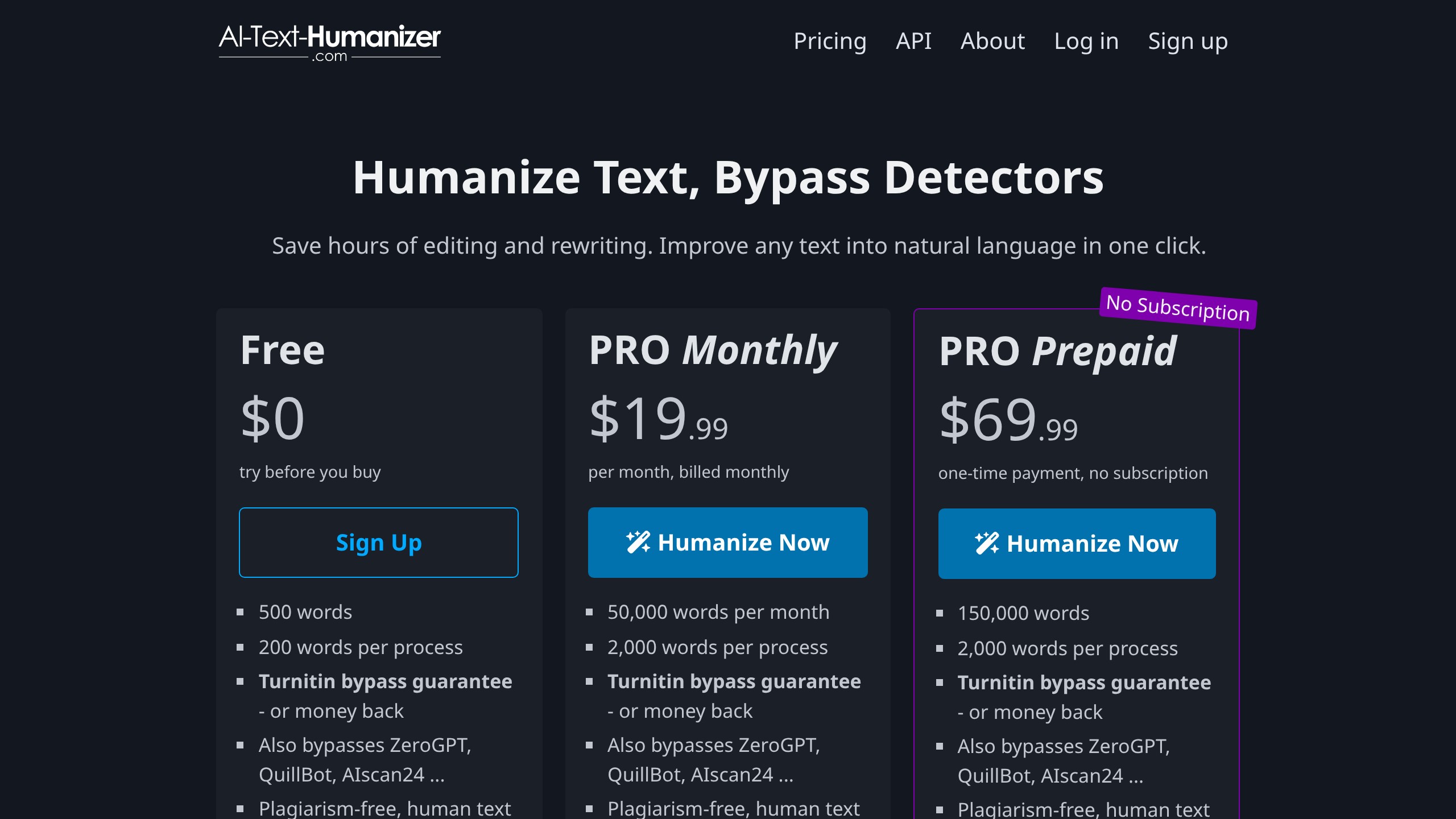
| Plan | Price | Word allowance | Per process | Notes |
|---|---|---|---|---|
| Free | $0 | 500 words | 200 words | No credit card, no login needed to start |
| PRO Monthly | $19.99/month | 50,000 words/month | 2,000 words | API access optional, cancel anytime, words do not roll over |
| PRO Prepaid | $69.99 one time | 150,000 words | 2,000 words | Valid up to 24 months, buy multiple packs, no subscription |
Volume discounts apply if you buy multiple prepaid packs: 20% off at 5 packs, 30% at 10, 40% at 20, and 50% at 40. Those are for agencies buying seats, and the vendor asks you to contact them for the code rather than applying it automatically at checkout, which is friction I would rather not have.
Payment runs through credit card, PayPal, Google Pay, or Apple Pay. The refund policy is narrow and stated plainly: you can get a refund within three days of your first payment if you used fewer than 10,000 words. Read that twice before you buy. Three days is short, and 10,000 words is easy to burn through in an afternoon if you are testing seriously.
The math: monthly or prepaid?
This is where the pricing gets genuinely smart, and where most tools in this category are worse.
PRO Monthly costs $19.99 for 50,000 words, which is $0.40 per 1,000 words, and unused words expire at the end of the month. PRO Prepaid costs $69.99 for 150,000 words, which is $0.47 per 1,000 words, and they stay usable for up to 24 months.
So monthly is cheaper per word, and prepaid is cheaper in reality for most people. Here is why. Content work is lumpy. You do 40,000 words in March when a client project lands, then 2,000 words in April. On monthly, the April subscription is nearly pure waste, and after three quiet months you have paid $60 for almost nothing. On prepaid, you paid $69.99 once and the words sit there waiting.
My rule: if you humanize more than 25,000 words every single month without fail, take the subscription. Everyone else should take prepaid. If you want to run that comparison with your own numbers, our free SaaS vs lifetime deal calculator does the break-even math in about thirty seconds.
What the free tier really gives you
The pricing page says 500 free words. What actually happened in my session is worth knowing before you plan around it.
I ran one 132-word job with no account. When I came back a few minutes later with an 81-word paragraph, the tool told me “Out of free daily words” and asked me to sign up.
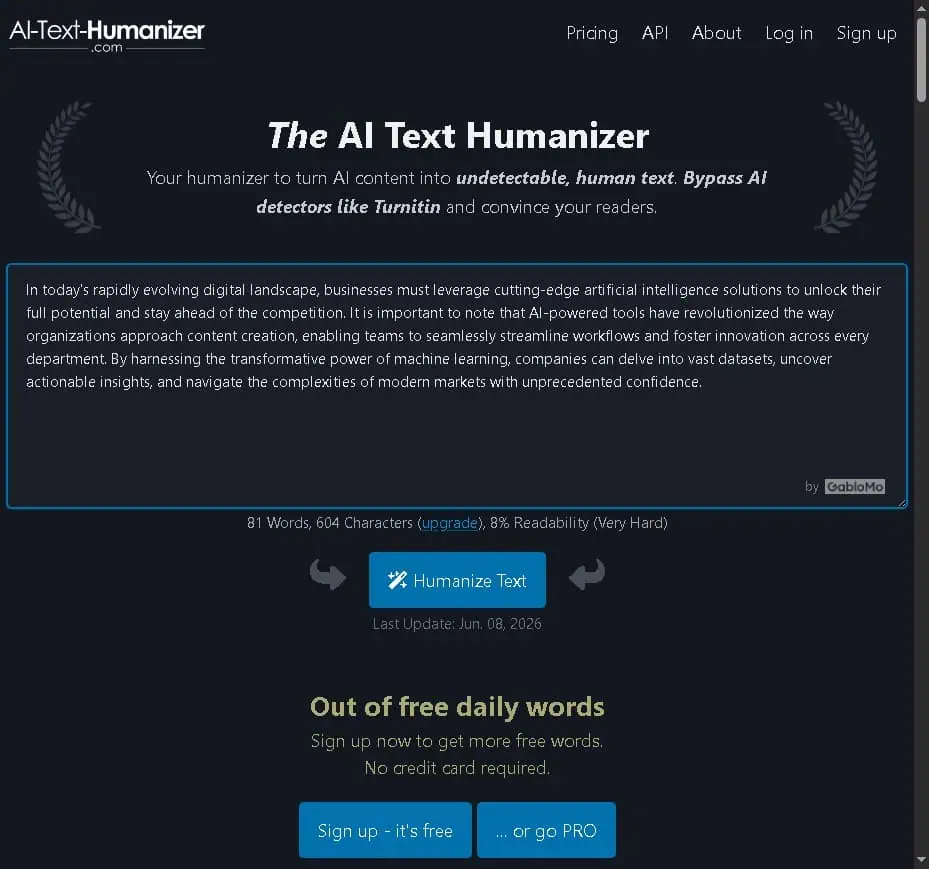
So the anonymous allowance is a daily trickle, and the 500 words appear to sit behind a free account. That’s not a scandal, plenty of tools do this, but “free without login” sets an expectation the daily cap doesn’t meet. I would rather the homepage said “try roughly a paragraph a day free, sign up for 500 words.”
Is the Humanizer API Worth It for Teams?
The API is the strongest argument for the PRO plan if you publish at volume, because it turns the tool from a browser tab into a step in your pipeline. It is bundled with PRO rather than sold separately.
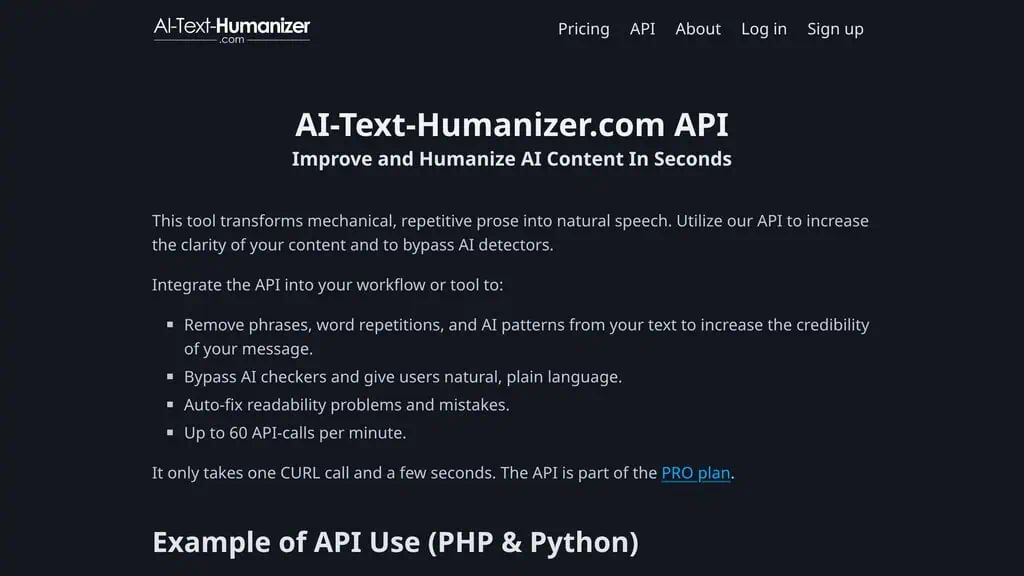
The setup is deliberately basic. You create an account, buy PRO, then send your login details and your text as POST variables. The docs show a CURL example in PHP and the same call in Python, and that is genuinely all there is to it. Rate limit is 60 calls per minute, and the vendor asks you to pause a second between calls.
Two honest notes. First, authenticating with your account login in a POST body is old-school, and I would prefer a revocable API token I can rotate without changing my password. Second, there is no batching, so 200 articles means 200 calls and your own queue logic.
For a small agency running a content pipeline, that is fine, and 50,000 words a month at $19.99 is cheap for an automated cleanup step. For anything larger, ask about the seat discounts before you build.
Where I Would Actually Use This Tool
I want to be specific here, because “humanize your AI content” is a vague promise and the honest use cases are narrower than the homepage suggests.
Cleaning up AI first drafts before a human edit. This is the best fit by a wide margin. You brief ChatGPT or Claude, you get back something structurally fine and stylistically dead, and you want the cliches gone before you start editing. One pass, then you rewrite the intro and add your own examples. This saves real time.
Plain-language rewrites for non-native writers. The output style, simple vocabulary and explicit constructions, is close to ideal for making dense text understandable. I would happily hand this to someone drafting technical support documentation in their second language.
Internal and operational copy. Product descriptions, help center articles, FAQ answers, release notes. Text where clarity matters and personality does not. This is where the flattening effect stops being a problem.
Reducing false positives on your own writing. This is a real and underrated use. Editors and clients now run drafts through detectors, and polished human writing gets flagged constantly. I have the receipts on that in my detector testing. If your own paragraph comes back at 80% AI and a client is nervous, a rewrite pass is a pragmatic fix for a broken measurement.
Where I Would Not Use It
Anything with your name and your voice on it. My own writing goes through my own hands. If I let a rewriter smooth my paragraphs, the site stops sounding like me, and sounding like me is the entire asset. If you want tone control, the same company’s Textbuddy toolbox at least gives you five tone settings, because this tool has none and says so in its FAQ.
Publishing without reading the output. The rewrite occasionally produces a clumsy clause, and nothing in the interface flags where it happened. Read every word before it ships.
Graded academic work, and I’m not going to soften this. The site runs a whole guide page dedicated to getting past Turnitin, and the homepage says students can finish homework in minutes and teachers will not find out.
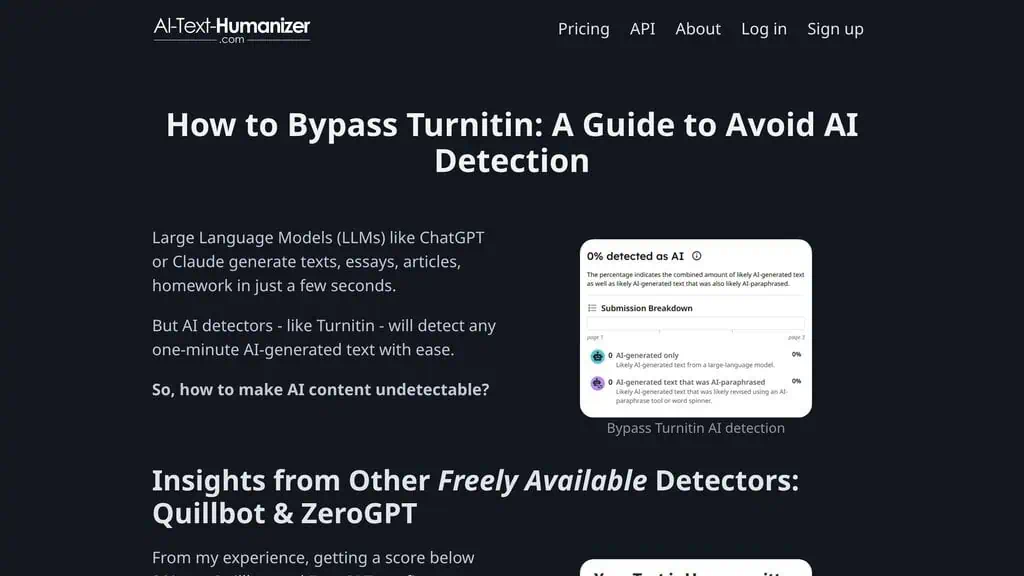
Two problems. It is an academic integrity violation at essentially every institution, with consequences that outlast the assignment. And the promise is not something any vendor can back, because detection is a moving target and the same company’s own FAQ states that clear proof of AI use is not possible, in either direction.
There is a legitimate student use, and it is worth naming: you wrote the essay yourself, a detector flagged it anyway, and you need the prose to stop tripping a broken scanner. That is a defensive edit on your own work. Using the tool to submit machine-written work as your own is a different act, and no amount of clean output changes what it is.
AI-Text-Humanizer.com Alternatives
| Option | What you pay | Best for | Honest tradeoff |
|---|---|---|---|
| AI-Text-Humanizer.com | $19.99/month or $69.99 prepaid | Fast, readable one-button rewrites with an API | No tone control, output is flat |
| Textbuddy | Free, no login | Rewriting plus 16 other writing tools including tone settings | No accounts, no history, occasional grammar slips |
| ChatGPT Plus or Claude Pro | $20/month | Rewriting with detailed style instructions you control | You have to write and maintain the prompt yourself |
| QuillBot | Free tier plus paid plans | Sentence-level paraphrasing with modes | Built for paraphrasing, not detector evasion |
Honest recommendation: before you pay for any humanizer, spend an hour writing a rewriting prompt for a model you already subscribe to. Feed it three paragraphs of your own writing as a style sample and tell it to remove the AI vocabulary while preserving your sentence rhythm. If that gets you 80% of the way, you do not need another subscription. If you are running volume and want it automated, that is when the API justifies itself. Our roundup of the best AI writing tools covers the drafting side of that stack.
Final Verdict: Is It Worth It?
Worth it, with conditions. AI-Text-Humanizer.com does the specific job it claims, and I verified it on a detector the vendor does not own: 100% AI to 0% on ZeroGPT in a single pass, with the meaning of the paragraph intact and no deliberate errors injected to fool the scanner. That last part separates it from a lot of cheaper tools I have tested, which get their scores by wrecking your grammar.
The pricing is honest and the prepaid structure respects how content work actually arrives. The API is basic but real. The privacy position, German company, no input retention, no training on your text, is better than most of this category bothers with.
What holds it back is style, not capability. The output is clear and dull, so this is a cleanup step in your workflow, never the last step. And the student-facing marketing oversells something no vendor can guarantee, which is a shame on a site whose own FAQ is otherwise refreshingly honest about how unreliable detectors are.
One thing I would tell you to do before you buy anything in this category: go score your own handwritten work in a detector first. Take a paragraph you wrote yourself, with no AI involved, and check it. If it comes back flagged, and there’s a good chance it will, you’ll understand this entire market differently, and you’ll stop treating detector percentages as facts about authorship.
Next step: if you want to see how badly detectors misjudge real human writing, read my AIscan24 review where I scored five samples including two I wrote by hand. If you would rather see what the same team gives away free, I tested all 17 tools in the Textbuddy review. And for tools worth paying once instead of monthly, our AI deals directory is where I keep the ones that passed testing.
Frequently Asked Questions
Does AI-Text-Humanizer.com really bypass AI detectors?
In my test it did, on two detectors. A 132-word ChatGPT paragraph went from 100% AI to 0% on ZeroGPT and 3% on AIscan24 after one pass. I could not test Turnitin, which sits behind institutional licensing, so treat the vendor’s Turnitin claim as unverified. No humanizer can promise permanent results, because detector models get retrained.
How much does AI-Text-Humanizer.com cost?
There are three tiers as of July 2026. Free gives you 500 words at 200 words per process. PRO Monthly is $19.99 per month for 50,000 words. PRO Prepaid is $69.99 one time for 150,000 words valid up to 24 months. Prepaid packs get 20% to 50% off in volume, and refunds are limited to three days and under 10,000 words used.
Is the free version actually usable?
Barely, without an account. The pricing page lists 500 free words, but my anonymous session ran out of daily words after a single 132-word job and prompted me to sign up. Use the free tier to check output quality on one paragraph, not to get real work done.
Does the humanizer change the meaning of my text?
Not in my testing. It swapped AI vocabulary for plain equivalents and rebuilt sentence rhythm while keeping the facts and argument intact. It did not invent claims or drop information. What it does change is voice: the output is clearer and noticeably flatter than the input.
Can I set the tone of the output?
No. The tool has no tone control and tries to preserve the tone of your input, which its own FAQ confirms. If you need to switch between casual and formal, the same company’s free Textbuddy tools include five tone settings on their generator and rewriter.
Is my content safe when I paste it in?
The vendor states that inputs are not saved and are never used to train models, that the connection is encrypted, and that the LLM APIs behind the tool are configured not to retain data. The company is German, which puts it under GDPR. That is a stronger privacy position than most humanizers publish, though as with any hosted tool you are trusting a stated policy rather than something you can audit.
Is using a humanizer on schoolwork a good idea?
No, if the goal is to pass off machine-written work as your own. That breaks academic integrity rules at nearly every institution, and no vendor can guarantee detection outcomes. Rewriting your own genuinely written essay because a detector produced a false positive is a different situation, and false positives on human writing are common enough that it happens regularly.
Liked this guide? Pin ZPlatform as your Preferred Source.
Pinning us tells Google to make our hands-on AI reviews, verified lifetime deals, and founder interviews more likely to appear prominently for you in Top Stories and eligible AI Search experiences (AI Mode, AI Overviews). Set it once, no account needed on our end.
- 500+ AI tools tested with real budgets
- Verified deals - no dead affiliate links
- Editor: Alston Antony, 15+ years in SaaS & SEO
 Opens Google · takes 2 seconds
Related Posts

I tested AgainstData on 355 pages of Gmail data. Here’s my honest review: bulk unsubscribe, personal data deletion reque...
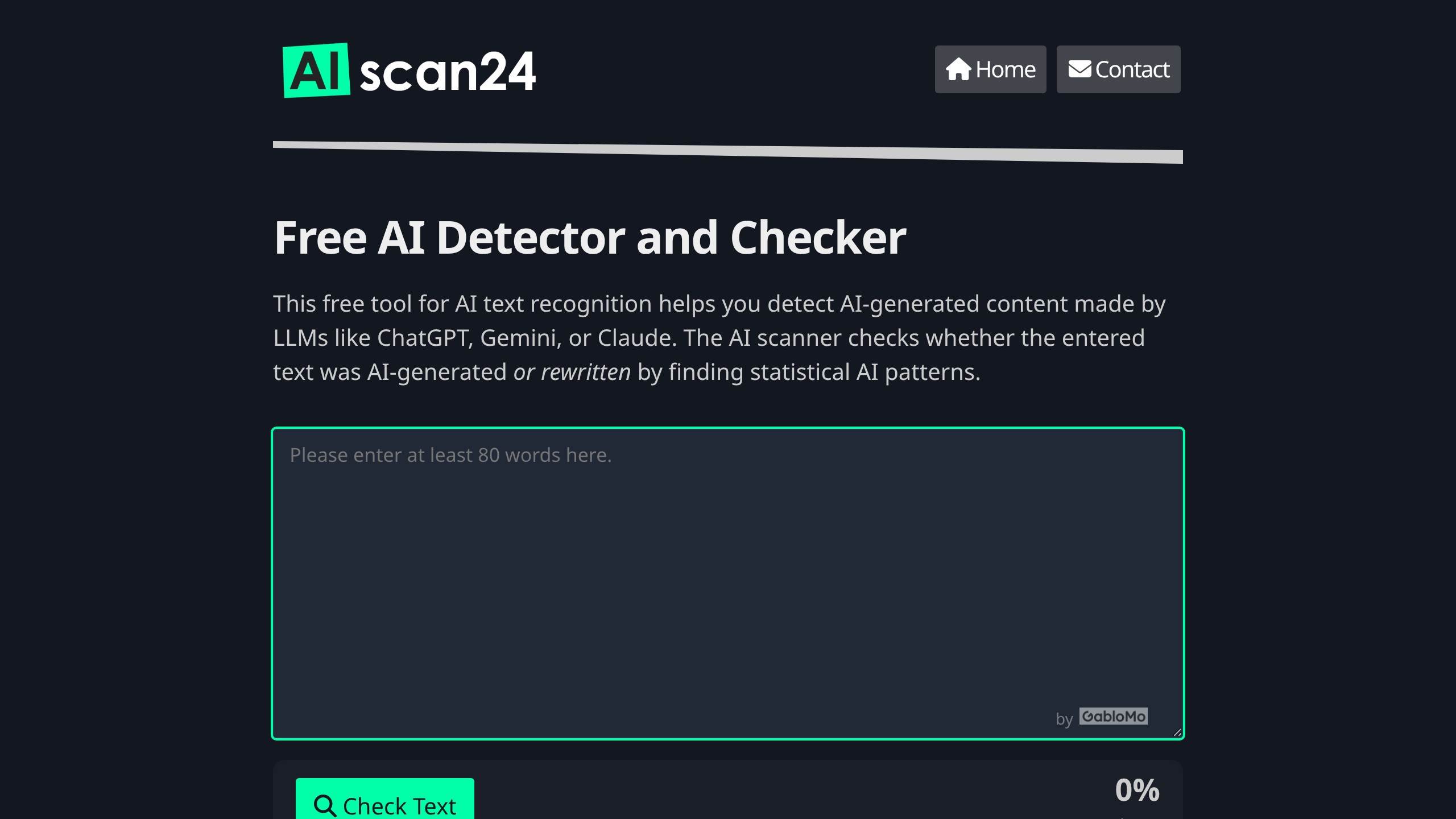
I ran five text samples through AIscan24, including two I wrote by hand. One scored 80% AI. Here is what this free detec...
Starting August 2, 2026, the EU AI Act’s transparency provisions become enforceable. That means if your website uses AI-...

My hands-on Answer Socrates review covering all features, free plan limits, pricing, and how it compares to AlsoAsked. I...

“I’ve spent $4,200 on 118 AppSumo lifetime deals over 5 years. Here’s my honest review: what works, what fails, and whet...
I checked Aura++’s DR 69 backlink claim in Ahrefs (it’s really 71) and broke down every launch tier. Here is whether the...