


TL;DR: Textbuddy is a set of 17 AI writing tools that run in your browser with no account, no credit card, and no visible paid tier. I tested the generator, the humanizer, and the style rater on July 31, 2026. Output quality is good enough for real work, with occasional grammar slips, and the honest catch is that nothing you do is saved.
Disclosure: Free-tier tested. Every test in this review ran on the public tools at textbuddy.com on July 31, 2026, with no account and no payment. There is no affiliate link on this page, and I could not find a live pricing page to verify any paid tier, which I cover in detail below.
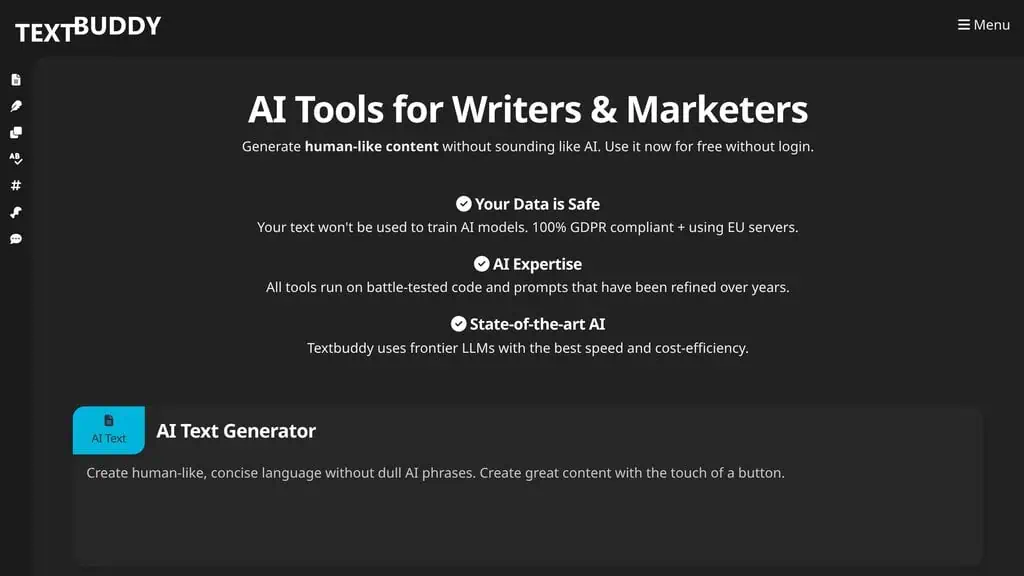
Most “free AI writing tool” sites are a signup form wearing a costume. You get three generations, then an email wall, then a credit counter, then a checkout page. So when I opened Textbuddy and pasted a paragraph straight into a working generator without creating anything, I assumed the wall was two clicks away.
It never appeared. I ran a text generation, two humanizer passes, and a writing style rating across three different tools, and nothing asked me for an email address. Not once. That is unusual enough in 2026 to be worth writing about.
For context, I have tested well over 500 SaaS and AI tools, most of them paid for out of my own pocket, and my instinct with anything free is to look for where the cost is hidden. With Textbuddy the cost is real, but it is not money. This Textbuddy review covers what each tool actually produces, which four I would keep in my bookmarks, the grammar problem I hit twice, and the missing pricing page that you should understand before you build a workflow on it.
Key Takeaways
- 17 tools, zero friction. Generator, blog post writer, rewriter, proofreader, social post writer, hook generator, reply writer, summarizer, idea generator, statistics, translator, clarity checker, style rater, humanizer, code generator, text comparison, and a classic editor. All free, all in the browser, no login.
- Output is genuinely usable, and not perfect. My test answer came back specific and well-structured, then dropped one broken sentence: “OpenAI updates this platform repeatedly than most niche tools.” Good enough to edit, not good enough to publish blind.
- The humanizer works, and it invents things you did not ask for. It rewrote my ChatGPT test paragraph down to 17% AI-similarity on AIscan24, then added a heading called “How AI Helps Businesses” that was nowhere in my input.
- There is no verifiable paid tier right now. Both `/pricing/` and `/premium/` load the homepage. Third-party directories still list old monthly and lifetime prices that I could not confirm anywhere on the official site, so treat Textbuddy as a free tool and nothing more.
- No account means no history. Close the tab and your work is gone. There is no saved project, no team access, no usage dashboard, no version history. For quick jobs that is liberating. For anything you might need again, it is a real limitation.
A free tool you do not have to log into is worth more than a cheap tool you have to manage. Until you need to find last week’s draft. Alston Antony
What Is Textbuddy?
Textbuddy is a collection of single-purpose AI writing tools built by GabloMo.com, a small German company that also runs the humanizer AI-Text-Humanizer.com and the free detector AIscan24. Each tool is its own page with its own input box, and every one of them runs the same core engine underneath with a different task preset.
The positioning is right there in the tagline: generate human-like content without sounding like AI. That is not a small claim, and it explains a design choice you notice immediately. The prompts behind these tools are tuned to avoid the vocabulary that makes machine text obvious.
How does the interface work?
Three dropdowns and a box. You pick a Task from 20 options, a Tone from five, and a target language from a list of 20, then paste your text and press the button. The result appears below with a word count and export buttons for TXT, HTML, and DOC.
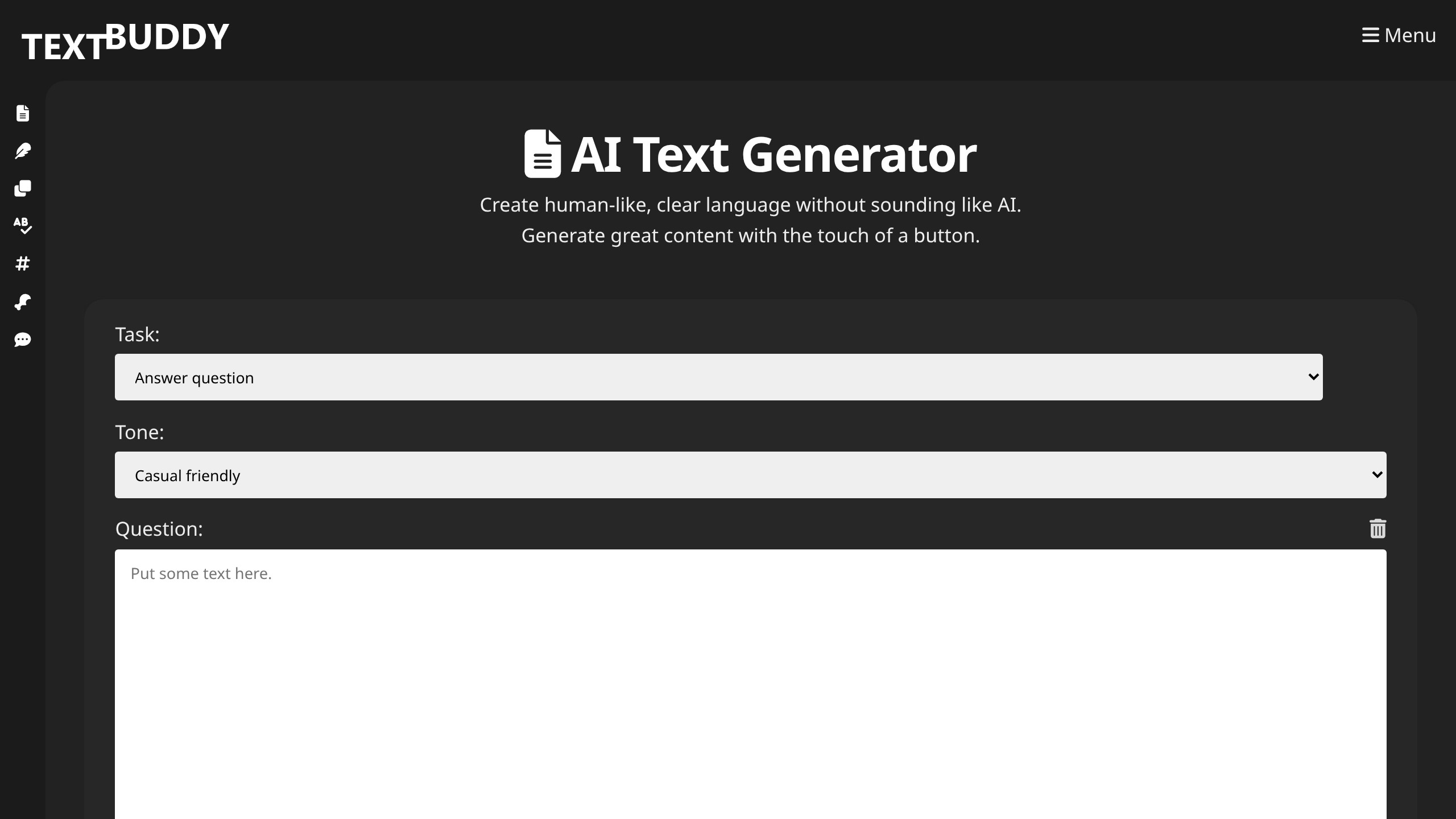
Here is the useful part most people miss: every tool page carries the same full Task dropdown. The AI Text Generator page can proofread. The humanizer page can summarize. The individual pages exist mostly for search and for defaults, which means once you bookmark one, you have all of them.
There is also a web search toggle under the input on the generator, which pulls live results in as context before answering. That is the difference between a generic answer and one that references something that happened this month.
What does it cost?
Nothing that I could find, and I didn’t look casually. I checked `textbuddy.com/pricing/` and `textbuddy.com/premium/`, and both resolve to the homepage rather than a plan table. There is no upgrade button, no credit counter, and no account link in the navigation.
Third-party directories still list an old Textbuddy Premium at $19 per month, $9 per month billed annually, and a $195 lifetime option. I could not verify any of those numbers on the official site, so I am not going to present them as current. As of July 31, 2026, treat Textbuddy as free, with the standard caveat that a free tool with no visible business model can change or disappear. If you want tools with a published price and a refund policy behind them, our AI deals directory is where I track the ones I have paid for and tested.
Which Textbuddy Tools Are Actually Worth Using?
I put the 17 tools into three groups after testing: the ones I would keep, the ones with a real use case, and the ones you can ignore. That ranking is based on output quality against what else you can get free.
| Tool | My verdict | Best use |
|---|---|---|
| AI Text Generator | Keep | One box for 20 tasks, with live web search |
| AI Text Humanizer | Keep | Stripping AI vocabulary out of drafts |
| AI Writing Style Rater | Keep | Second opinion on prose before publishing |
| Text Statistics | Keep | Finding repeated words and repetitive sentence starts |
| AI Proofreader | Situational | Grammar fixes without style rewriting |
| AI Summarizer | Situational | Long documents into bullets |
| AI Translator | Situational | 50+ languages, quick drafts |
| Text Clarity | Situational | Readability plus an AI score in one pass |
| AI Blog Post Generator | Situational | Structure and outline, not final copy |
| AI Hook and Social Post Generators | Situational | Repurposing an article into posts |
| AI Reply Generator | Situational | Turning scribbled notes into clean emails |
| AI Content Ideas | Skip for research | Fine for brainstorming, thin for keyword work |
| AI Code Generator | Skip | Use a real coding assistant |
| Text Comparison | Keep as a utility | Diffing two drafts |
| Classic Editor | Situational | Plain-language editing with synonyms |
AI Text Generator: how good is the output?
Good, with one clear flaw. I asked it a real question a reader might ask, using the Answer task and Casual direct tone: is buying a lifetime deal on an AI writing tool smarter than paying monthly for ChatGPT Plus, answered for a small business owner.
It returned 133 words that got the substance right. It separated the two cases correctly, said lifetime deals suit fixed budgets and niche feature sets while subscriptions suit broad reasoning and frequent model updates, and then closed with genuinely good advice I did not prompt for: check whether the lifetime deal includes future model updates, because many small providers charge extra when they move to newer technology.
That last line is the kind of practical caveat most AI answers skip. Anyone who has bought a lifetime deal on an AI wrapper knows exactly how real that risk is.
Then came the flaw, in the middle of the same answer: “OpenAI updates this platform repeatedly than most niche tools.” That sentence is broken. It reads like a word got swapped during the humanizing step and nothing checked the grammar afterward.
I saw the same class of error twice in three tests, so plan for it. The output is a strong draft and a bad final. Read every sentence.
AI Text Humanizer: what does it do to your text?
It removes AI patterns effectively, then takes a liberty or two. I fed it the worst ChatGPT paragraph I could write, packed with “in today’s rapidly evolving digital landscape,” “leverage cutting-edge,” and “paradigm shift.”
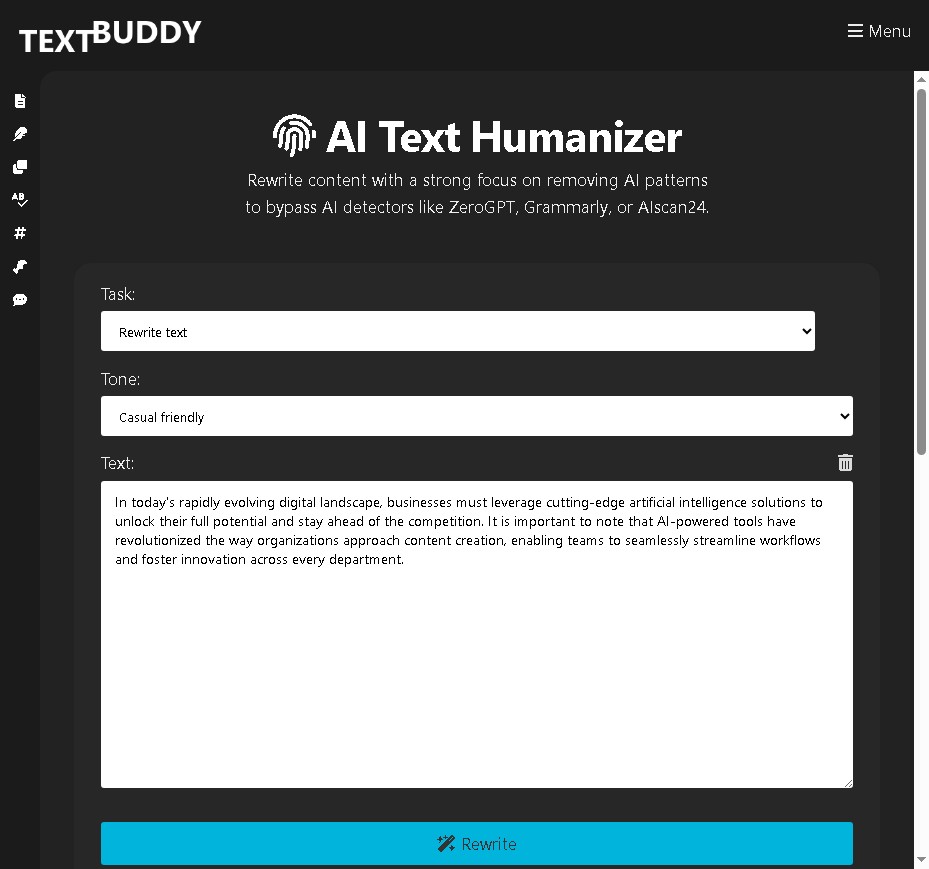
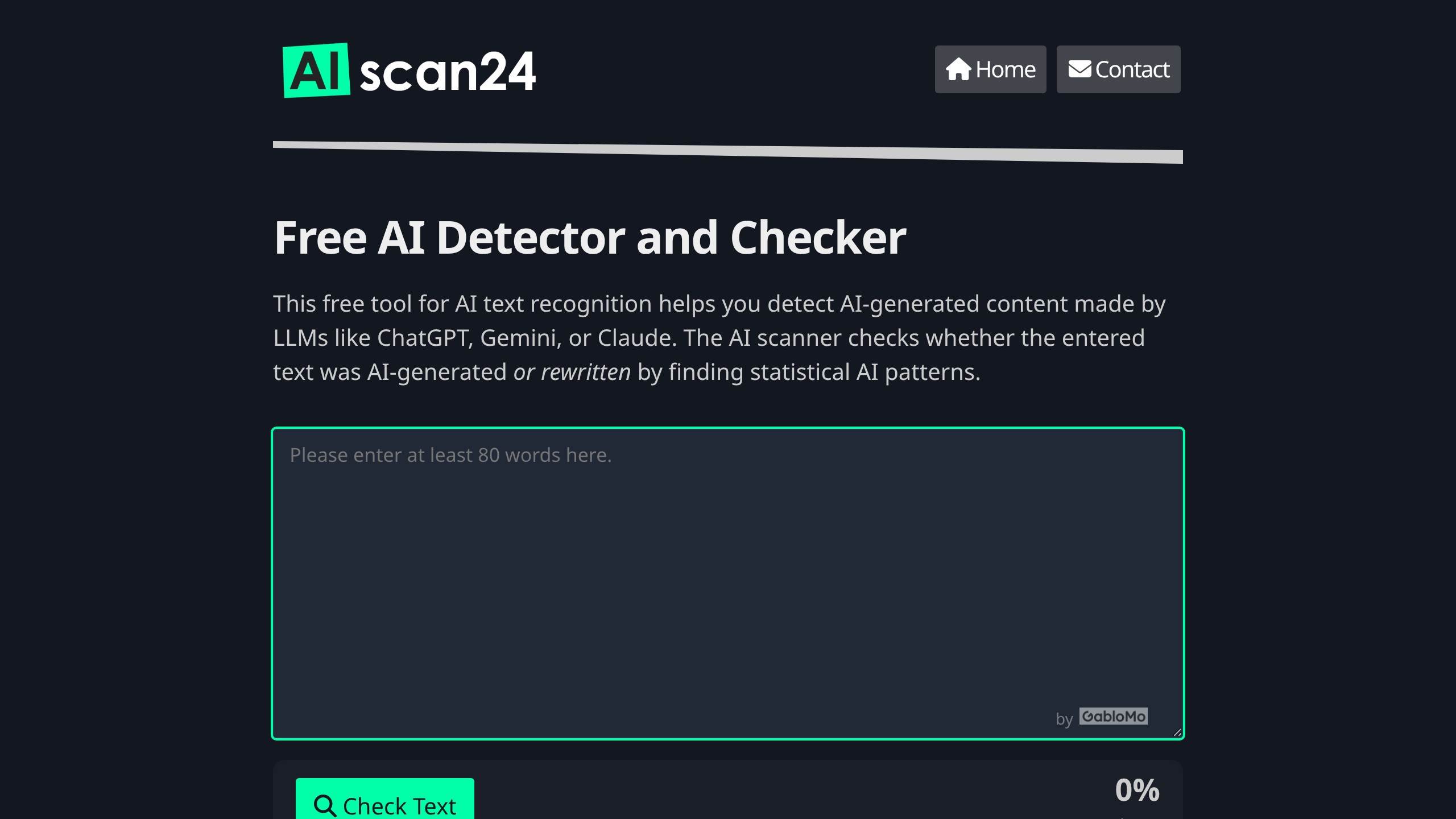
The rewrite came back at 152 words and every cliche was gone. I scanned it in AIscan24, which scored it at 17% AI-similarity, inside the “rather human” band under the detector’s own guidelines. The original scored 100%. So the core job got done.
Two things it did that I did not ask for. It added a heading, “How AI Helps Businesses,” that appeared out of nowhere. And it used the same construction over and over: a spaced hyphen in the middle of a sentence, followed by a capital letter. “Companies today are in a world where technology changes fast - Using new artificial intelligence helps these businesses do their best work.”
That isn’t correct punctuation, and there’s a small irony in a humanizer producing a tic that reads as machine-made. If you use this tool, search your output for ” - ” and fix each one by hand. It takes twenty seconds and it matters.
For comparison, the same company’s paid humanizer scored 3% on the same detector with the same source paragraph and produced cleaner punctuation. I broke that test down in my AI-Text-Humanizer.com review, including scores from an independent detector.
AI Writing Style Rater: the tool I did not expect to like
This one surprised me. I pasted in a paragraph I wrote by hand, from my own published review work, and asked it to rate the writing style.
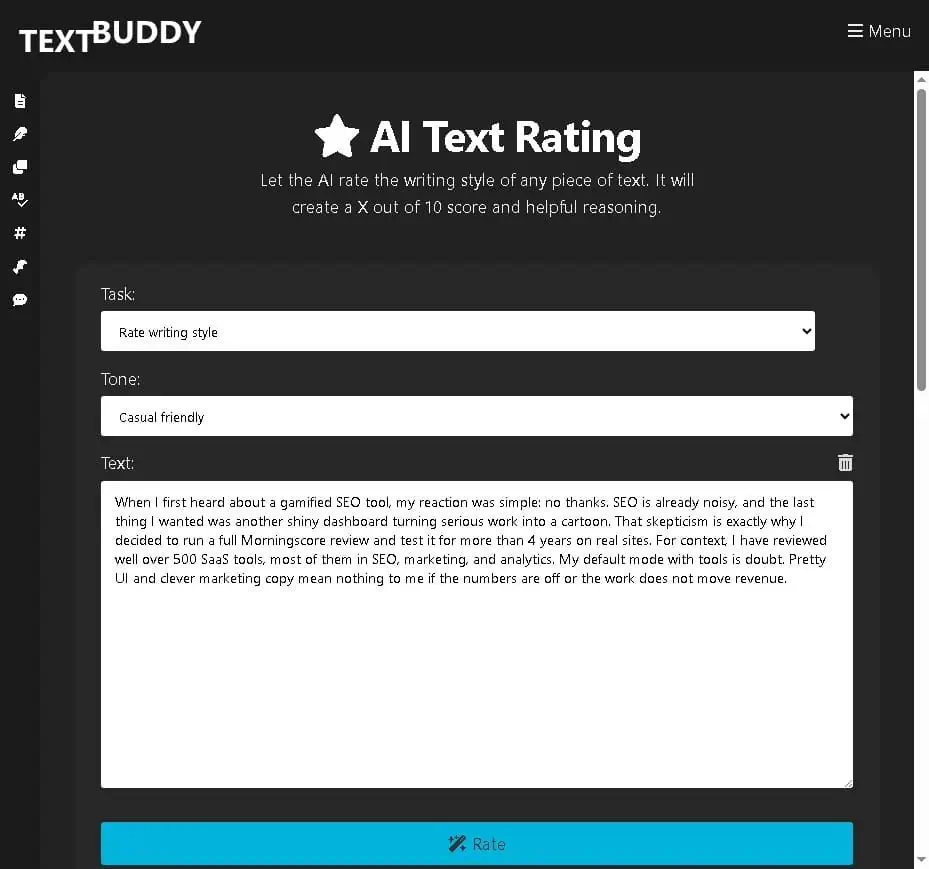
It returned 7 out of 10 with five specific reasons. It identified that I lead with credibility (“they tested over 500 digital products to show they know the field well”), that my sentences are short and quick to read, that opinions sit at the front rather than the end, that the vocabulary avoids formality, and that the logic moves from doubt to testing. Then it summarized the register as “a conversation you might have over coffee.”
That is an accurate read of how I write, produced from six sentences. As a second opinion before publishing, especially if you are trying to check whether a piece sounds like you or like a template, this is more useful than a readability score. It doesn’t tell you what to fix, which is the limitation, but it tells you what’s coming across.
Text Statistics and Text Clarity: the boring tools that catch real problems
Text Statistics counts words, sentences, paragraphs, and pages, then flags word repetitions and repetitive sentence starters. That second feature is the one worth having. Repetitive sentence openings are one of the most reliable signals that a draft was machine-written, and they are almost invisible when you read your own work.
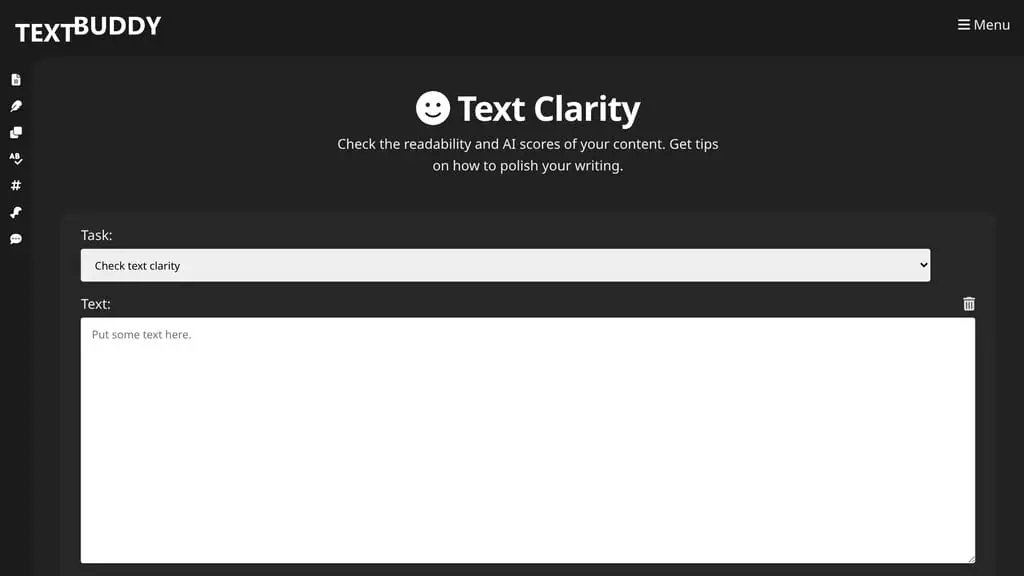
Text Clarity gives you readability plus an AI score in one pass with suggestions for polishing. Treat any AI score, from any tool, as a rough signal rather than a fact. I ran five samples through the sister detector and one of my own handwritten paragraphs came back at 80% AI, which tells you how much weight these percentages deserve. The full test matrix is in my AIscan24 review, and the underlying reasons are in our guide on how AI detectors actually work.
AI Rewriter and AI Proofreader: know the difference
These two get confused constantly, and picking the wrong one wastes your afternoon.
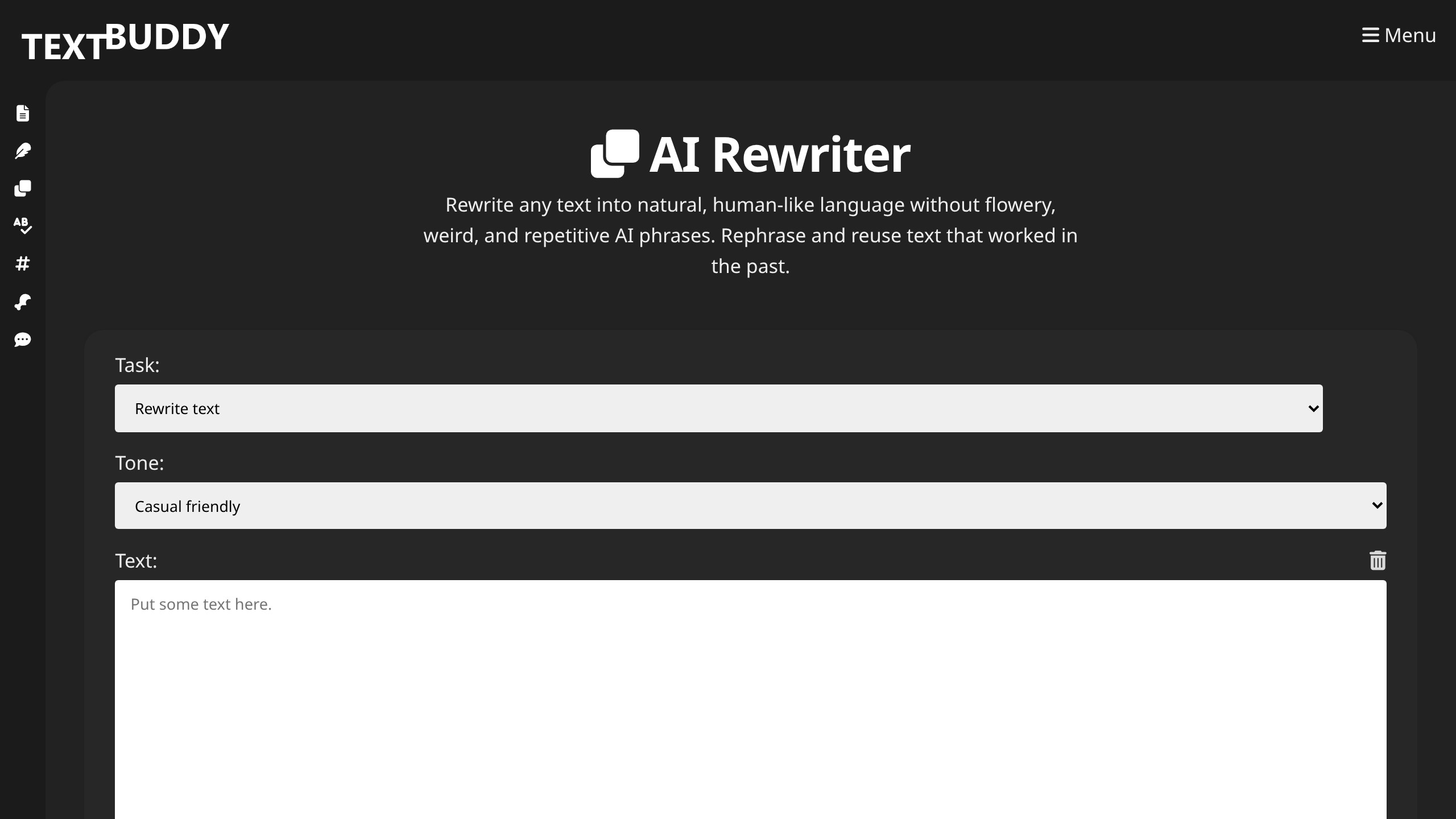
The Rewriter rebuilds your sentences into natural language and removes repetitive phrasing, so your wording changes. The Proofreader fixes grammar, spelling, and punctuation while leaving your writing style alone, according to the tool description.
Practical rule from my testing: use the Proofreader on anything you wrote yourself, because you want your voice untouched. Use the Rewriter on anything a model wrote, because there is no voice worth preserving.
The repurposing set: hooks, social posts, replies, summaries
These four share one pattern. They take content that already exists and change its shape, which is the task where AI is most reliable and least likely to invent facts.
The Hook Generator produces short openers from any context, aimed at social posts and short-form video. The Social Media Post Generator turns an article into a few punchy posts. The Reply Generator takes a scribbled answer and returns a clean, mistake-free version, which is the most underrated tool on the site if you answer a lot of email. The Summarizer condenses long text into bullets or a paragraph.
I would use all four for internal or social work. I would not paste their output straight into a client deliverable without editing, for the same grammar reason above.
The two I would skip
AI Code Generator. It returns concise source code from a description in the language you name. It works, and it is nowhere near a real coding assistant with repository context. If you write code, you already have a better option.
AI Content Ideas for keyword research. It suggests topics for a keyword or context, and the suggestions are reasonable brainstorming prompts. They are not search data. Nothing here tells you volume, difficulty, or intent, so do not confuse a topic list with keyword research. That work needs actual metrics, which is why I still start with our AI tool comparisons and proper SEO data rather than an idea generator.
What Is the Real Catch With No-Account Tools?
Nothing is saved, and that is a bigger deal than it sounds. There is no history, no drafts folder, no project structure, no team seats, no usage dashboard, and no way to retrieve what you generated yesterday.
Everything lives in one browser tab until you export it. The export buttons for TXT, HTML, and DOC exist precisely because of this, and using them is not optional if the output matters.
The tradeoffs shake out like this.
What you gain: no signup friction, no email in another marketing database, no credit anxiety, no subscription to cancel later, and nothing to manage across a team.
What you lose: persistence, collaboration, any audit trail of what was generated when, and any commercial relationship you could rely on. There is no support contract behind a free tool, and no refund to ask for.
For a solo writer running quick jobs, the gain wins easily. For an agency delivering client work, the loss is disqualifying on its own, and you should be looking at tools with accounts, seats, and a paper trail.
How Is My Data Handled?
Better than average, based on what the vendor publishes. Textbuddy states that your text is never used to train AI models, that the service is fully GDPR compliant, and that it runs on EU servers. The company is German, which puts it inside that regulatory framework rather than merely claiming alignment with it.
The tools also state they use leading LLM APIs configured not to retain inputs. That is a stated policy, not something you can independently audit, which is true of every hosted AI tool including the expensive ones. If your text is genuinely confidential, client contracts, unpublished financials, personal medical details, do not paste it into any free browser tool, this one included.
For everyday marketing copy, blog drafts, and email replies, the position here is reasonable and clearer than most free tools bother to state.
Textbuddy vs Just Using ChatGPT
The fair question. If you already pay $20 a month for ChatGPT Plus or Claude Pro, why open Textbuddy at all?
| Factor | Textbuddy | ChatGPT Plus or Claude Pro |
|---|---|---|
| Cost | Free, no account | $20/month |
| Setup per task | Three dropdowns | You write the prompt |
| Consistency | Same tuned prompt every time | Depends on your prompt |
| Output style | Tuned to avoid AI vocabulary | Default style reads as AI unless instructed |
| History and projects | None | Full conversation history |
| Range | 17 fixed writing tasks | Anything, including code and analysis |
The honest answer: Textbuddy wins on speed for narrow, repeatable jobs. Rating a paragraph, generating five hooks, cleaning an email, checking repetitive sentence starters. The prompt is already written and tested, so you skip the part where you explain yourself to a chatbot.
A general model wins on everything that needs context, iteration, or memory of what you asked before. It also wins if you want control over voice, because you can hand it three samples of your own writing and tell it exactly what to preserve.
I use both, for different reasons, on the same day. That’s not a compromise, it’s just what the tools are good at. For the full drafting stack, our roundup of the best AI writing tools covers the paid options worth the money.
Who Should Use Textbuddy?
Use it if: you write regularly, you want specific writing utilities without another subscription, and you are comfortable exporting anything you want to keep. Freelancers, bloggers, solo marketers, and non-native English writers get the most value here.
Use it selectively if: you already pay for a frontier model. Bookmark the Writing Style Rater, Text Statistics, and Reply Generator, and ignore the rest.
Do not build on it if: you need accounts, saved work, team access, an audit trail, or a support contract. A free tool with no visible business model is not a foundation for client delivery.
Final Verdict: Is Textbuddy Worth Your Time?
Yes, and the reason is narrower than the homepage suggests. Textbuddy is not an all-in-one writing platform, and treating it like one will disappoint you. It is a bookmark bar full of well-tuned single-purpose utilities that cost nothing and ask nothing.
What genuinely impressed me: the no-signup model held up under real testing, the Writing Style Rater gave me a more useful read on my own prose than any readability score has, the web search toggle makes the generator current instead of generic, and the whole thing runs on EU servers with a clear no-training policy.
What holds it back: the grammar slips are real and I hit them twice in three tests, the humanizer adds headings you did not ask for and punctuation you will have to clean up, and nothing you produce is saved. There is also no verifiable paid tier, which means no support relationship and no guarantee the tools are here next year.
My honest recommendation is to use it as a utility belt, not a workshop. Draft in the model you already pay for, then bring the paragraph here for a style rating, a repetition check, and a humanizing pass. That combination costs you nothing extra and catches things you would otherwise publish.
One concrete first step: take a paragraph you wrote entirely yourself, run it through the Writing Style Rater, and see whether the five reasons it gives back describe the writer you think you are. It took me one test to learn something about my own openings.
Next step: if you want to see how the paid sibling compares on the same test paragraph, read my AI-Text-Humanizer.com review. If you want to understand why AI scores on your own writing are so unreliable, my AIscan24 review has the five-sample test. And if you would rather pay once than subscribe, browse the verified deals in our AI deals directory or get the weekly roundup by subscribing here.
Frequently Asked Questions
Is Textbuddy really free?
Yes, as of July 31, 2026. All 17 tools run in the browser with no account, no credit card, and no visible upgrade path. Both the pricing and premium URLs redirect to the homepage, and older paid tiers listed on third-party directories could not be verified on the official site.
Do I need an account to use Textbuddy?
No, and there is no account option in the navigation. That also means nothing is saved. Use the TXT, HTML, or DOC export buttons on the results panel before you close the tab, because there is no history to go back to.
How good is the Textbuddy AI Text Generator?
Strong drafts, imperfect sentences. My test answer was specific and well-organized, and it included a caveat about lifetime deals not always covering future model updates that I had not asked for. It also produced one broken sentence in the same output, so read everything before you use it.
Does the Textbuddy humanizer bypass AI detectors?
In my test it lowered the score substantially. A ChatGPT paragraph that scored 100% on AIscan24 came back at 17% after one rewrite, inside that detector’s “rather human” band. It also added an unrequested heading and used spaced hyphens where commas belong, so the output needs cleanup.
Is Textbuddy safe for confidential text?
For everyday marketing and blog content, the stated position is solid: EU servers, GDPR compliance, and no use of your input for model training. For genuinely confidential material such as client contracts or personal data, do not paste it into any free hosted tool, regardless of the policy on the page.
Which Textbuddy tool is the most useful?
For me it is the AI Writing Style Rater, because it gives a specific read on how your prose comes across rather than a generic score. Text Statistics is a close second for catching repeated words and repetitive sentence openings, which are the clearest signals that a draft reads as machine-written.
Liked this guide? Pin ZPlatform as your Preferred Source.
Pinning us tells Google to make our hands-on AI reviews, verified lifetime deals, and founder interviews more likely to appear prominently for you in Top Stories and eligible AI Search experiences (AI Mode, AI Overviews). Set it once, no account needed on our end.
- 500+ AI tools tested with real budgets
- Verified deals - no dead affiliate links
- Editor: Alston Antony, 15+ years in SaaS & SEO
 Opens Google · takes 2 seconds
Related Posts

I tested AgainstData on 355 pages of Gmail data. Here’s my honest review: bulk unsubscribe, personal data deletion reque...
I ran AI-Text-Humanizer.com through ZeroGPT and AIscan24 with real before and after scores. Here is what works, what it ...
I ran five text samples through AIscan24, including two I wrote by hand. One scored 80% AI. Here is what this free detec...
Starting August 2, 2026, the EU AI Act’s transparency provisions become enforceable. That means if your website uses AI-...

My hands-on Answer Socrates review covering all features, free plan limits, pricing, and how it compares to AlsoAsked. I...

“I’ve spent $4,200 on 118 AppSumo lifetime deals over 5 years. Here’s my honest review: what works, what fails, and whet...