


BuzzAbout is an AI social research tool that analyzes real conversations across Reddit, YouTube, LinkedIn, X, and Instagram. It surfaces audience pain points, emotion clusters, topic engagement, and audience personas, with every insight linked back to the actual post it came from. After running it on real queries across three platforms, the accuracy is high and the citation layer is what separates it from every “AI wrapper” tool that dresses up ChatGPT and calls it audience research. Best for content strategy and SaaS positioning. Not a keyword tool. Do not buy it expecting search-volume data.
I went in skeptical. Another AI hype product wrapping a language model in a dashboard, I assumed. So I bought it, ran it on topics I actually care about, and watched what happened. This review is the honest version, one image per feature, no fabricated screenshots.
What BuzzAbout actually is
BuzzAbout connects to social platforms and analyzes conversation patterns around topics you define. Give it a query, it pulls real posts, and instead of raw data it delivers structured insights: what emotions dominate the conversation, which topics drive the most engagement, what specific phrases your audience uses, and who those people are.
Platforms covered: Reddit, YouTube, LinkedIn, X, Instagram.
It is not a keyword research tool. It does not surface search volume. What it does is tell you what real people say in their own language when they talk about a problem related to your niche. Different data source, genuinely useful.
The workflow, four steps
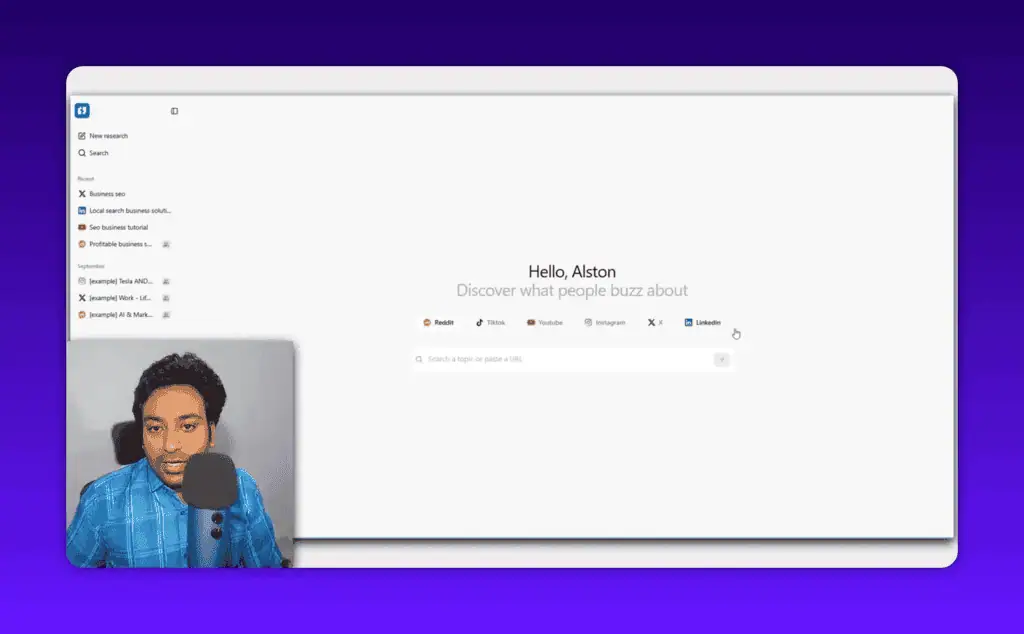
Pick one platform per run. No “analyze all at once” option, and this is deliberate. Emotions and topics vary sharply by platform. Reddit surfaces raw frustration. YouTube trends positive. LinkedIn leans promotional. Mixing them muddies the data.
Enter the query and refine it. Plain language, not keyword-tool language. “Business SEO pain and trends” rather than “business SEO tips.” The system shows the mention count immediately. 20M mentions is too broad. The tool coaches you to specificity (“Are you looking for SEO trends for small businesses specifically?”) until the count drops to something workable, like 250K or 50K. Focused data is better data. BuzzAbout enforces that at the input.
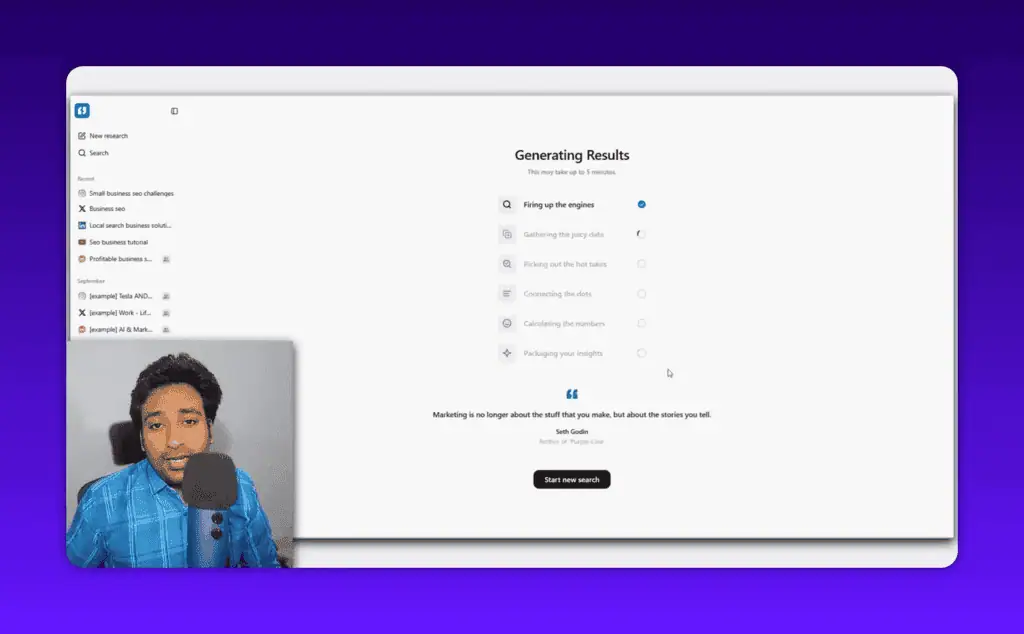
Run and wait about 5 minutes. Pulling posts, running sentiment analysis, clustering topics, identifying emotional signals, building the report. Not instant. Fine.
Work the report. Where the value is.
Inside the report
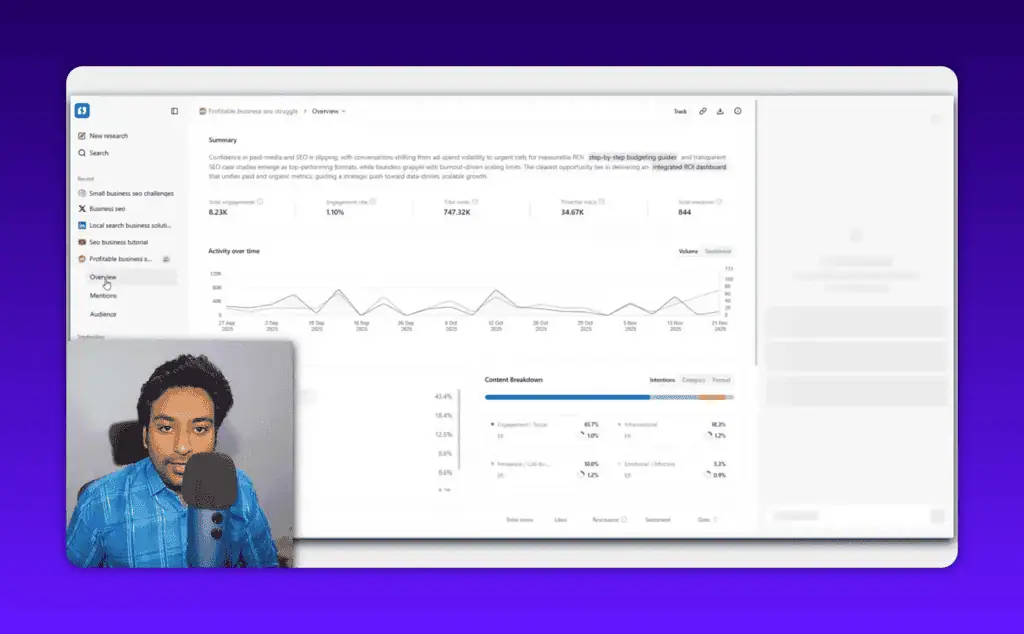
The plain-language summary is the first thing you see and it is not filler. Real output from a Reddit run on “profitable SEO business struggle”: “Confidence in paid media is slipping with conversions shifting to urgent calls for measurable ROI. Step-by-step budgeting guides and transparent SEO case studies are emerging as the top performing content format.” That is strategic intelligence, not word salad.
Below the summary: total engagement, engagement rate, total views, potential reach, total mentions. Scale context for the dataset.
Activity timeline. Conversation spikes on a timeline. Click a spike, the tool tries to explain what caused it from the posts in that window. Useful for separating evergreen trends from event-driven noise.
Sentiment analysis. Standard positive/neutral/negative over time. Useful as a quick read. In my Reddit test on business SEO, sentiment was negative almost every day except one. Reddit users discussing this topic are worried, not optimistic.
Emotion breakdown. Better than sentiment. Categories: neutral, sadness, joy, fear, anger, disgust, surprise. Click any emotion and ask the chat what is driving it. I asked “Why are people feeling sadness in this conversation?” and got: “Sadness themes arise from stories of failed business attempts, irreversible decline in visibility especially in tech and digital, and small business owners detailing how once-thriving side hustles have shrunk dramatically.” That is not generic. That is the specific narrative driving the emotion in that data set.
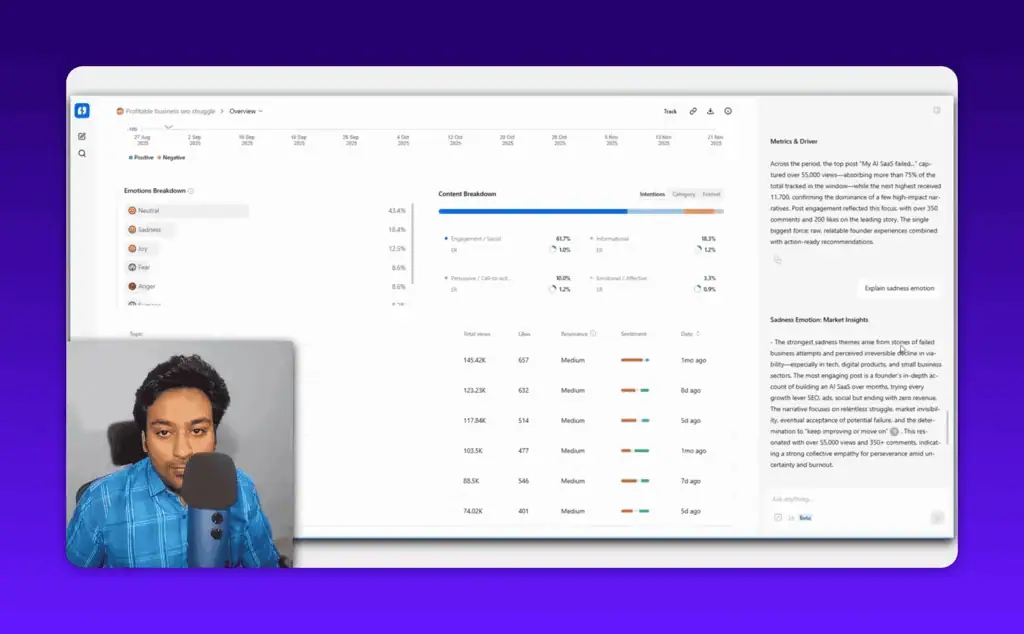
Topic clusters with engagement metrics. Posts grouped into themes, ranked by engagement. In my test, “platform and technology adoption” scored much higher engagement than “content creation workflow” even though content workflow is something I write about constantly. That shifts strategy. Click any cluster for the specific fears and questions inside.
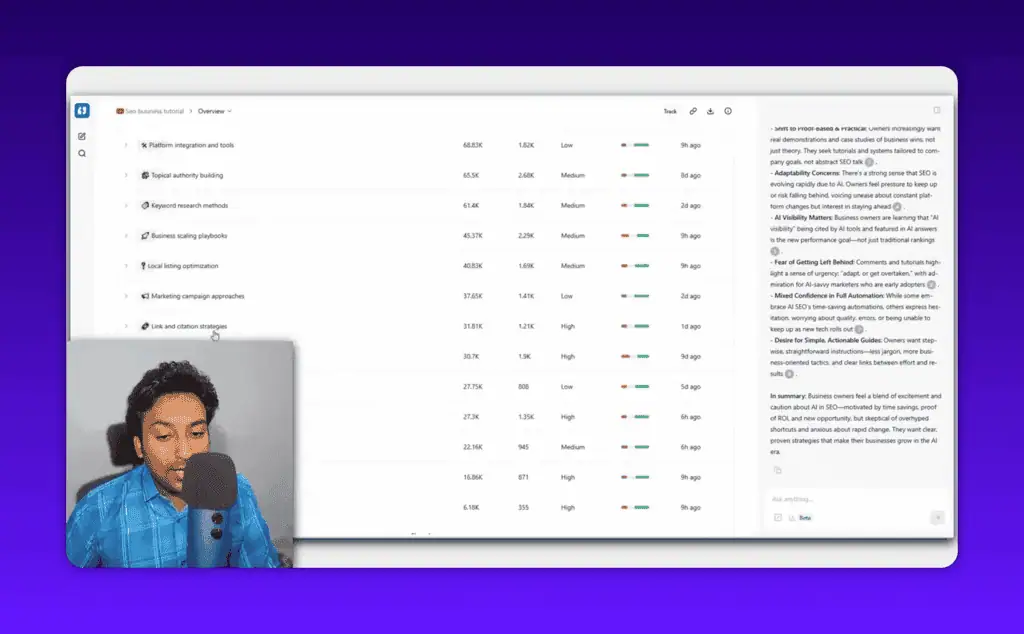
Mentions tab. The actual posts feeding the research. Sort by recency, engagement rate, comments, or views. Click through to the original. This is the citation layer, and it is why I trust the output. When the tool says your audience fears breaking URLs during platform migration, you can click through and read the Reddit thread where someone said exactly that.
Workflow tip: copy the raw mentions and paste them as context into ChatGPT or Claude. You get a pre-loaded understanding of your audience in their own words, then use the LLM to write against it. The combination beats either tool alone.
Audience tab. Not available on every platform. On Reddit it was, and it produced three distinct personas in my run: “curious and cautious,” “introverted and relaxed,” “skeptical and guarded.” Each persona comes with behavioural guidance: how they evaluate products, what emotional triggers they respond to, what content approach works. The “skeptical and guarded” description: “prefers evaluating the product or service and calling out flaws rather than accepting marketing claims.” Knowing that persona exists in your audience changes how you position your content.
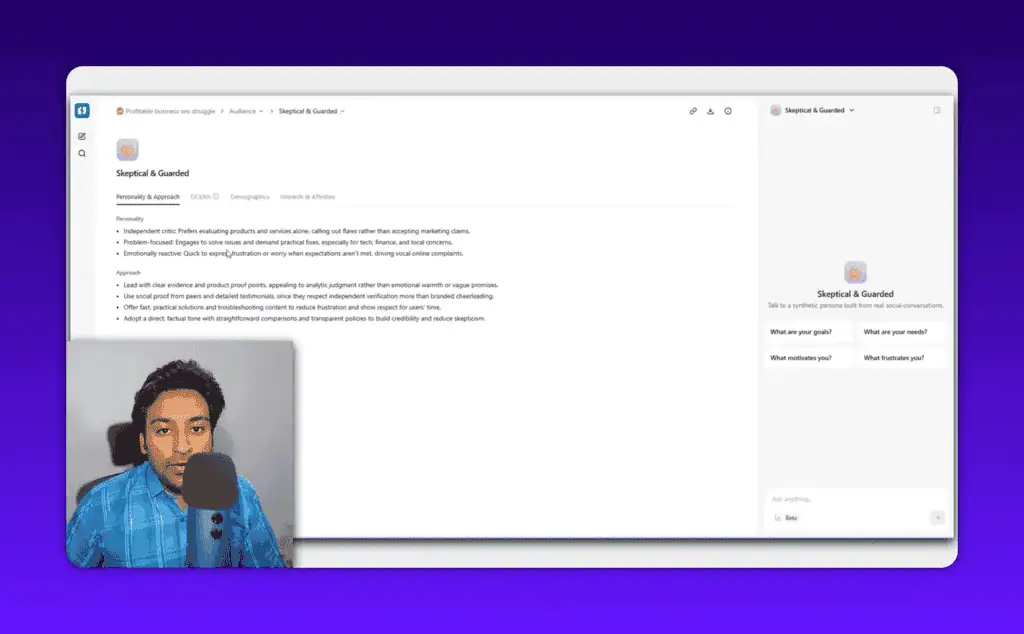
Chat interface. Open throughout the report. Ask anything. Every answer cites the actual data it pulled. The platform is clearly trying not to hallucinate, and in my testing it mostly succeeds.
Why the platform separation matters
Running the same query on Reddit, YouTube, and LinkedIn returns three completely different reports, not because the tool is inconsistent, but because the conversations are.
Reddit on business SEO: almost entirely negative sentiment. Worry, frustration, failure stories, questions about whether SEO is even viable anymore. Reddit is where people go to complain honestly.
YouTube on the same topic: almost entirely positive. Enthusiasm, tutorials, success stories. YouTube commenters rarely show up to express deep frustration.
LinkedIn: promotional and aspirational. Thought leadership, agency wins, professional polish.
The recommendation: finalize your query on one platform, run it across all five. Reddit shows you their fears. YouTube shows you what they aspire to. LinkedIn shows you what they want to be seen believing.
How I actually use it with keyword research
BuzzAbout is not a replacement for Ahrefs or Semrush. It does not tell you search volume, keyword difficulty, or SERP competition. What it fills is the gap keyword tools cannot: why people care about a topic, what specific language they use, what emotional angle resonates.
The practical workflow:
- Use your keyword tool to identify topics worth targeting on volume and competition.
- Run those topics through BuzzAbout to understand the emotional context.
- Use the emotion breakdown and topic clusters to pick your angle.
- Use the exact phrases from mentions as raw material for headlines, subheadings, and body copy.
- Paste the mentions data as context when writing with an AI assistant.
Turns generic “SEO content” into content that speaks directly to what your audience is actually worried about. For prompting the writing side, see how to make ChatGPT write like a human and ChatGPT prompts for SEO keyword research for the input side.
Pricing
Subscription plans, plus lifetime deals through platforms like AppSumo and SaaSPirate. Pricing changes with promotions. Check the official BuzzAbout site for current pricing. If a lifetime deal is currently active, ZPlatform’s tested AI deals is where I would look for the verified offer.
Is the lifetime deal worth it if you find one? For content strategy, product positioning, or regular audience research, yes. The data quality justifies the spend.
Where it falls short
Five minutes per run. Fine for serious research, not for quick lookups.
Platform access varies. The audience persona feature was only fully available on Reddit in my testing. Other platforms gave shallower audience-side analysis.
Query refinement is a skill. First-time runs will be too broad. Spend a few sessions learning to write queries that produce focused data sets. The tool coaches, but the learning curve is real.
No CSV export from mentions. To move raw mentions into another tool you copy manually. An export button would tighten the whole workflow. This is the single most obvious missing feature.
Not a keyword replacement. If you go in expecting a full SEO stack, you will be disappointed. It is a research layer, not a full stack.
Buy, wait, skip
Buy it if you do content strategy and want to understand audience beyond search volume, run a SaaS product and need real customer pain language for positioning, create content in a niche where emotional resonance matters (health, finance, career, marketing), want to understand how the same audience behaves differently across platforms, or do persona work and want something faster than manual research.
Skip it if you only need keyword volume and competition data (use Ahrefs or Semrush), you work in a very small niche with minimal social presence (thin data set), or you want instant results with zero setup.
Alternatives worth naming
SparkToro. Closest direct alternative. Strong for audience channel and media research. Weaker on emotional depth.
Brand24. Social listening with sentiment analysis. Better for brand monitoring than content strategy research. Stronger real-time tracking, weaker for structured topic analysis.
Brandwatch. Enterprise-grade, enterprise pricing. If you manage brand sentiment at scale, deeper coverage. For individual creators and small teams, overkill.
Manual Reddit research or third-party tools like Gummy Search. Free, slow, unstructured. BuzzAbout automates what you would otherwise do manually over many hours.
None of these combine emotion analysis, topic clustering, and persona features the way BuzzAbout does in one tool.
_Disclosure: this review is based on hands-on testing with my own money. Links to BuzzAbout may be affiliate links. Both referral and non-referral links are provided where available so you can choose whether to support this site._
Liked this guide? Pin ZPlatform as your Preferred Source.
Pinning us tells Google to make our hands-on AI reviews, verified lifetime deals, and founder interviews more likely to appear prominently for you in Top Stories and eligible AI Search experiences (AI Mode, AI Overviews). Set it once, no account needed on our end.
- 500+ AI tools tested with real budgets
- Verified deals - no dead affiliate links
- Editor: Alston Antony, 15+ years in SaaS & SEO
 Opens Google · takes 2 seconds
Related Posts

78% of companies say they use AI. Only 21% redesigned a workflow. Here are the sourced AI adoption statistics and the ho...

A free, cited AI glossary covering 264 artificial intelligence, machine learning, and generative AI terms - plain-Englis...

I pulled 239 threads across 7 subreddits. Marketers use AI daily and hate the products. Here is what the highest-voted t...
The Chrome and Firefox extension I built to save, tag, version, and export AI prompts locally. Free. No account. No clou...

ChatGPT, Gemini, Rufus, Perplexity. Which AI shopping assistant to use for what, plus the fake deals and dynamic pricing...

I ran a 26-feed pipeline for 34 days and logged 2,234 AI stories. Here are the sources worth your time by output, and 3 ...