

By Alston Antony, Founder & Researcher, ZPlatform. Data as of 2026-11-17.
The average Series A round size for an AI startup is $58M, but the median, the typical round, is $19M. A few very large rounds pull the average up, so the median is the better guide to a normal Series A funding amount.
- Median Series A: $19M across 36 rounds.
- Average Series A: $58M (computed by ZPlatform from the stage total).
- Average seed round size: $17M, with a median of $8M.
- Series B funding amount: a median of $60M and an average of $92M.
The typical round grows about two to three times with each stage after seed.
| Stage | Median round | Rounds in the data | Total raised | Largest round |
|---|---|---|---|---|
| Pre-seed | $6.4M | 2 | $13M | Evos |
| Seed | $8M | 13 | $223M | Dream Labs |
| Series A | $19M | 36 | $2.1B | Mirendil |
| Series B | $60M | 26 | $2.4B | Bedrock Robotics |
| Series C | $140M | 17 | $4.3B | Instinct |
| Series D and later | $250M | 11 | $8.4B | Crusoe |
Data: ZPlatform AI funding research, as of 17 November 2026. ZPlatform tracks AI product companies and records a round only when a company announcement, press release, SEC filing or reputable report backs it; every example below links that source. The table covers the 105 verified AI rounds that state a stage. 39 rounds announced no stage and a few were labelled growth or debt, so they are left out. OpenAI’s $122B round is labelled growth and is not in any row above.
The median AI round grows two to three times per stage
Read the medians as the size of a typical round, not a target. Each stage from seed onward is about two to three times the one before it (computed from the table):
- Seed to Series A: $8M to $19M, about 2.4 times.
- Series A to Series B: $19M to $60M, about 3.2 times.
- Series B to Series C: $60M to $140M, about 2.3 times.
- Series C to Series D and later: $140M to $250M, about 1.8 times.
Pre-seed and seed sit close together in this data, at $6.4M and $8M. That gap is too small to read much into, because pre-seed rests on only two rounds.
Average versus median round size at each stage
A median is the middle round when every round at a stage is lined up by size. Half raised more and half raised less. One huge round barely moves it.
An average does the opposite. Divide each stage’s total by its round count (computed from the table) and you get:
| Stage | Median | Average | Average vs median |
|---|---|---|---|
| Pre-seed | $6.4M | $6.5M | About the same |
| Seed | $8M | $17M | 2.1 times |
| Series A | $19M | $58M | 3.1 times |
| Series B | $60M | $92M | 1.5 times |
| Series C | $140M | $253M | 1.8 times |
| Series D and later | $250M | $764M | 3.1 times |
Where the average is three times the median, a handful of very large rounds are pulling it up. Series A and Series D and later show this most clearly, and one company explains most of it in each case.
Series A vs Series B funding: how the round size changes
Series B rounds for AI startups are about three times the size of Series A rounds. The median moves from $19M to $60M, and the average from $58M to $92M (computed by ZPlatform).
| Measure | Series A | Series B |
|---|---|---|
| Median round | $19M | $60M |
| Average round | $58M | $92M |
| Rounds in the data | 36 | 26 |
| Total raised | $2.1B | $2.4B |
The average gap is smaller than the median gap because one outlier, Mirendil’s $1B Series A, lifts the Series A average. Without large outliers, a Series A round in this data usually lands between $15M and $60M.
Three outliers that distort the averages
Mirendil: a $1B Series A
Mirendil, filed under AI infrastructure, raised a $1B Series A on 12 November 2026, led by Clearlake Capital and Kleiner Perkins. No valuation is stated. Source: Mirendil.
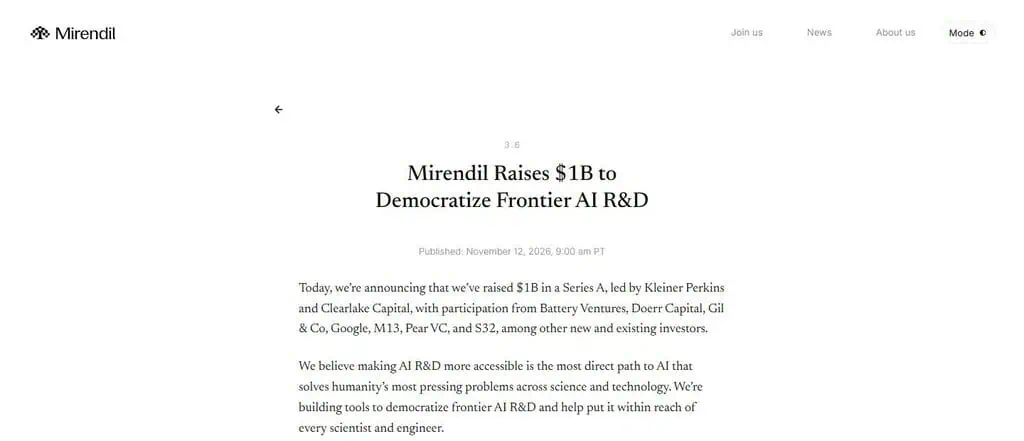
That single round is about 48% of all Series A dollars in the data ($1B of $2.1B, computed). Take it out and the other 35 Series A rounds average roughly $31M, much closer to the $19M median.
Instinct: a $1B Series C
Instinct, which the dataset classes as an AI agent company, raised a $1B Series C at a $10B valuation on 28 September 2026. Lead investors are not recorded in the dataset. Source: Business Wire via FinancialContent.
It is about 23% of Series C dollars and roughly seven times the $140M Series C median.
Crusoe: $3.9B at Series D and later
Crusoe, which calls itself “the AI factory company”, raised $3.9B at a $30.9B valuation on 17 September 2026. Lead investors are not recorded in the dataset. Source: TechCrunch.
That is about 46% of all late-stage dollars in the data, which is why the late-stage average lands at three times its median.
Real rounds at each stage
These examples come from the same ZPlatform research. They show the spread around each median, not a recommended amount.
Pre-seed: both rounds in the data
- Evos, which builds AI operators that do work for logistics, manufacturing, retail and private equity teams: $9M, led by Field Ventures and Uncork Capital, 15 October 2026. Source: Evos.
- Marble, whose homepage title is “AI-Native Restaurant Operating System”: $3.8M raised so far per SEC filing, dated 2 November 2026. Source: SEC Form D.
Seed: average seed round size and real examples from $5.5M to $17M
- Ravical, AI for accounting and other full-service firms going by its homepage title: $17M, led by MMC Ventures, 29 October 2026. Source: Ravical.
- Klarent, autonomous QA for iOS, Android and web apps per its homepage title: $8M, led by Mosaic Ventures, 12 October 2026. Source: Klarent.
- Satlyt, onboard AI and in-orbit computing per its homepage title: $8M, lead not recorded, 13 October 2026. Source: TechCrunch.
- Lette, which runs the resident side of residential property, from first enquiry to renewal: $6.5M, led by Peak and Peak Ventures, 26 October 2026. Source: Lette.
- Asymptote Labs, real-time visibility and control for AI agents per its homepage title: $5.5M, led by Tower Research Ventures, 22 October 2026. Source: Asymptote Labs.
Series A funding amount: most rounds sit between $15M and $60M
- Eka Robotics, which builds a vision, force and action AI model so robots can handle many physical tasks safely: $150M at a stated $1.5B valuation, led by Andreessen Horowitz and F-Prime Capital, 21 October 2026. Source: Eka Robotics.
- General Compute: $100M at a stated $0.8B valuation, led by Abstract Ventures and Blackbird Ventures, 28 October 2026. Source: General Compute.
- Fragment, an AI engine for procurement per its homepage title: $56M, lead not recorded, 28 October 2026. Source: Fragment.
- Trajectory: $45M at a stated $0.3B valuation, led by Sequoia Capital, 2 November 2026. Source: TechCrunch.
- Duvo, an “Enterprise Execution OS” per its homepage title: $32M, led by Balderton Capital, 14 October 2026. Source: Duvo.
- Melius, an AI-native operating system for creatives per its homepage title: $20M, led by CRV, 6 October 2026. Source: TechCrunch.
- Confido Health, AI agents for front, mid and back office work at medical and dental practices: $12.5M, led by Z47, 14 October 2026. Source: Confido Health.

Series B funding amount: $30M to $250M in these examples
- Vinci, physics AI for engineering simulation per its homepage title: $250M at a stated $1.5B valuation, led by Advent International, Temasek and Xora, 6 October 2026. Source: Business Wire via FinancialContent.
- Traversal, AI SRE software that keeps live systems running and helps fix them when they break: $120M at a stated $1B valuation, led by Khosla Ventures, Kleiner Perkins and Redpoint Ventures, 3 November 2026. Source: Traversal.
- Daytona Platforms, secure sandboxes for running AI-generated code: $60M at a stated $1B valuation, led by FirstMark Growth, 23 October 2026. Source: Daytona.
- Stuut, which automates accounts receivable from collections to disputes: $52.5M, led by Insight Partners, 7 October 2026. Source: Stuut.
- Adaptive, AI agents for running a business per its homepage title: $30M, led by Tidemark, 17 September 2026. Source: PR Newswire.
Table D names Bedrock Robotics as the largest Series B. Its $600M round from 26 October 2026 is listed with no stated stage elsewhere in the dataset, so the Series B figure may refer to a different Bedrock round. We have not assumed either way.
Series C: $45M to $875M in these examples
- Positron AI, generative AI acceleration per its homepage title: $875M at a stated $5B valuation, lead not recorded, 10 September 2026. Source: Positron AI.
- Upwind Security, a cloud and AI security platform that ranks risks and detects attacks live: $400M at a stated $3.8B valuation, lead not recorded, 28 October 2026. Source: SiliconANGLE.
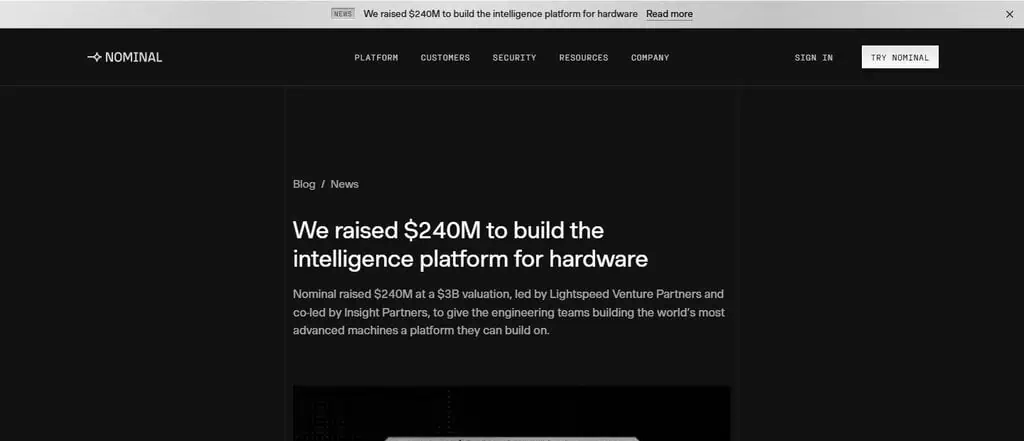
- Nominal, a test-data and analysis platform for hardware engineering teams: $240M at a stated $3B valuation, led by Insight Partners and Lightspeed Venture Partners, 9 November 2026. Source: Nominal.
- SiMa.ai, “Scaling Physical AI” per its homepage title: $150M at a stated $1.5B valuation, led by Amplify Partners and Fidelity Management & Research Company, 28 September 2026. Source: SiMa.ai.
- Metaview, an agentic recruiting platform per its homepage title: $60M, led by Insight Partners, 30 September 2026. Source: Metaview.
- Numa: $45M, led by Blue Cloud Ventures, 16 November 2026. Source: PR Newswire.
Series D and later: $130M to $1.5B in these examples
- Tenstorrent, AI hardware from cards to servers plus open-source software and licensable chip designs: $1.5B at a stated $6.2B valuation, led by Innovation X and Trace Capital, 19 October 2026. Source: Tenstorrent.
- Ramp, finance software combining corporate cards, expenses, bill pay, accounting and banking with AI agents: $750M at a stated $44B valuation, led by GIC, Iconiq Capital and OTPP, 4 June 2026. Source: PR Newswire.
- Legora, agent-based AI that automates complex legal work: $550M at a stated $8.8B valuation, led by Atreides Management, 21 October 2026. Source: Legora.
- Pigment, finance planning software with AI agents for models and forecasts: $250M at a stated $2.3B valuation, lead not recorded, 21 October 2026. Source: PR Newswire.
- Tractian, which monitors industrial equipment so manufacturers can catch failures early: $130M at a stated $1.4B valuation, led by M&G Catalyst Fund and Sapphire Ventures, 22 October 2026. Source: PR Newswire.
What the category does to round size
Stage is not the only thing that sets a round’s size. What the company builds matters as much. Median rounds by category, across all stages and without OpenAI:
| Category | Rounds | Median round |
|---|---|---|
| AI coding | 5 | $200M |
| AI infrastructure | 35 | $125M |
| Other AI (health, finance, legal, security and more) | 66 | $55M |
| AI agents | 32 | $32M |
Infrastructure companies buy chips, servers and data centre capacity, so their rounds start larger. Agent startups in this data skew earlier and smaller. The coding median rests on only five rounds, two of them Cognition’s.
How far to trust each number
Some medians rest on solid counts. Others rest on a handful of rounds.
- Series A (36 rounds) and Series B (26): the most reliable medians here.
- Series C (17), seed (13) and Series D and later (11): usable, but one or two rounds can move them.
- Pre-seed (2): not a real median. It is the midpoint of Evos and Marble, and Marble’s figure is an SEC filing amount, not a closed round.
Three more limits apply to every figure:
- Coverage is dense from September 2026 and thin before. Most rounds are from fall 2026, when large rounds were common. The fall median across all stages is $56M, against $60M for every verified round.
- ZPlatform tracks AI product companies only, and only rounds it could verify against a public source. Small seed rounds are announced less often, so the seed and pre-seed medians may sit higher than the real typical round.
- Unstated stages are excluded. 39 rounds, including several of the biggest of the fall, gave no stage and are not in the stage table.
Where to go from here
- For the 30 largest rounds of the fall, with leads and sources, see the biggest AI funding rounds of fall 2026.
- If you are setting an early valuation, our pre-revenue startup valuation calculator walks through the common methods.
- If you are at seed and need users more than money, see the best places to launch your AI tool.
Nothing here is investment advice. Valuations are as stated by the companies or the reports, and medians, averages and shares are computed by ZPlatform from the dataset.
Data: ZPlatform AI funding research, as of 17 November 2026.
Related Posts

Agentic AI pentesting tools replay the original exploit after a patch ships, then try mutated payloads. Eight platforms ...

AI adoption statistics, sourced: 78% of companies say they use AI and only 21% have redesigned a workflow. Here is the h...

30 AI agent startups raised $2.7B across 32 verified rounds, led by Instinct’s $1B Series C. The median AI agent round w...
Before you buy an AI agent subscription, test whether you can revoke its authority. Five practical tests for stop, queue...

Cognition’s valuation is $48B as of its September 2026 round, up from $26B in May. Factory AI is valued at $5B. Five AI ...

A free, cited AI glossary covering 264 machine learning and generative AI terms, with plain-English definitions and cros...