



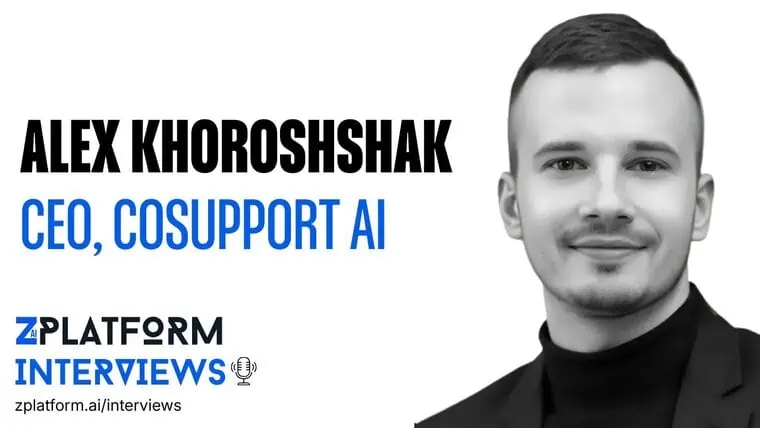
Most AI support tools promise the same thing: deflect more tickets, cut costs, scale without hiring. CoSupport AI promises something harder to fake - answers that are correct, traceable to a source document, and backed by a refund if the AI does not reach a 60% resolution rate within 60 days.
That guarantee rests on a USPTO-approved architecture built to stop the one failure mode that quietly kills AI support deployments: confident, wrong answers. We sat down with CEO Alex Khoroshchak to unpack the technology behind the claim, the real numbers from customer deployments, how the pricing actually works, and why he believes the support inbox is the most underused data source in the company.
Company & background
When did CoSupport AI start, who founded it, and what was the original mission?
In 2020, Daria Leshchenko had spent more than a decade running support operations, and every tool on the market gave her the same result: generic bots, slow replies, no memory of the customer. So she founded CoSupport AI to build the product she couldn’t buy. 3 years of R&D and hundreds of tests later, that product drafts ready-to-send replies for support teams.
The company was formally established in 2023. In 2024, Alex Khoroshchak joined as CEO, leading the platform’s evolution into a fully customizable AI solution for customer service. The company is headquartered in the US and serves BPOs, SaaS companies, ecommerce platforms, fintech firms, and education providers globally. The mission has stayed consistent since day one: build AI that resolves support tickets accurately using a company’s own data, not generic training sets.
What problem in customer support did you originally set out to solve, and how has that vision evolved?
In 2020, the tools that existed were not solving the problem; they were superficial. The vision from day one was to build AI that goes beyond basic automation - something genuinely intelligent, helpful, and human-like. The first product was an AI assistant that generated ready-to-use reply suggestions for support agents. That was the starting point.
In 2023, the team set a bigger mission: build AI solutions that deliver immediate, measurable business results while setting a new standard for customer service. By 2025, under Alex Khoroshchak’s leadership, CoSupport AI had grown from that single support tool into a full platform covering autonomous ticket resolution, agent assistance, multilingual support across 40+ languages, and conversation analytics. The goal has not changed: make AI not just a tool in the support stack, but a trusted partner that handles the work intelligently and turns every customer interaction into actionable insight.
Who is your ideal customer today?
CoSupport AI fits companies with medium to high ticket volume, where a significant share of incoming requests are repetitive and well-documented. Specifically:
- Industries: SaaS, ecommerce, fintech, education, BPO, and contact centers
- Support team size: 5 to 500+ agents
- Ticket volume: 500 to 100,000+ tickets per month
- Tech stack: teams using Zendesk, Freshdesk, Intercom, Zoho, HubSpot, or Salesforce Service Cloud
The fit is strongest when three conditions are present: high repetitive ticket volume, an existing helpdesk with historical ticket data, and a support leader who measures success by resolution quality and cost, not just deflection rate.
Product & capabilities
Walk me through the core products in the suite.
CoSupport AI is a unified platform with four core components:
- AI Agent - fully autonomous. Handles incoming requests end to end across email, chat, helpdesk, and social channels, and resolves up to 90% of routine queries without human involvement. Trained on the company’s own tickets, knowledge base, and internal documentation.
- AI Assistant (Copilot) - agent-facing. Sits inside the helpdesk and drafts suggested replies using full conversation context. Agents review, edit, and send. Built-in translation and ticket summarization cut ticket-handling time by 40 to 60% on non-automated tickets.
- AI Business Intelligence (AI BI) - an internal assistant that answers questions about support operations, products, services, and customers. It connects to customer correspondence, the knowledge base, and internal docs to provide data-driven insights and analysis on request. Used by support, business analysts, product, and marketing, and integrated with Slack and MS Teams.
- AI Translator - handles 40+ languages natively inside the existing workflow. Detects language, translates, and responds in the customer’s language without a separate tool or multilingual agents.
Which channels does the AI support today?
CoSupport AI operates across email, chat, and helpdesk ticketing. On the helpdesk side it integrates with Zendesk, Freshdesk, Freshchat, Zoho Desk, Zoho SalesIQ, Intercom, and Salesforce. For internal workflows it connects to Slack and Microsoft Teams, and ecommerce and billing integrations include Shopify and Stripe. The most commonly deployed combination is email plus chat plus helpdesk, typically Zendesk or Freshdesk. For teams with custom CRMs or legacy systems, a flexible API enables custom integration.
How does the AI handle multilingual conversations, and how many languages are supported?
The AI Translator component supports 40+ languages out of the box. Language detection is automatic: the system identifies the customer’s language from the incoming message, retrieves the relevant answer from the knowledge base (which can be in any language), and generates the response in the customer’s language. A single AI instance handles every locale without separate training per language or separate routing by language. That is especially valuable for BPOs and global ecommerce operations serving multi-regional customers.
What does a typical onboarding and go-live timeline look like?
The standard timeline is 15 days from signed contract to live AI on real tickets:
- Day 1: requirements scoping - use cases, success metrics, data sources, integration touchpoints.
- Days 2 to 4: AI training - the AI learns from the company’s tickets, help center content, web content, and internal docs.
- Days 4 to 14: shadow mode - the AI runs alongside agents without responding to customers while accuracy is tuned, confidence thresholds are calibrated, and escalation logic is tested against real ticket patterns.
- Day 15: go-live - the AI handles real tickets and performance tracking begins immediately.
Client requirements are minimal: access to historical ticket data, helpdesk credentials for the integration, and a knowledge base or documentation source. No engineering involvement is required for standard helpdesk integrations. Custom integrations with proprietary helpdesks or CRMs typically take 30 days.
Technology & differentiation
Your site mentions a USPTO-approved AI architecture. What does the patent cover, and why does it matter?
The patent covers the architecture that controls how AI responses are generated. In practice it enforces three things that separate it from generic LLM deployments:
- Knowledge grounding: the AI generates responses only from a defined, verified set of company data sources - tickets, help center articles, internal documentation, product data. It cannot draw on its general training data or fabricate information outside those boundaries.
- Controlled generation: output logic is deterministic within defined parameters. The system does not produce open-ended responses; it retrieves and synthesizes from approved sources.
- Confidence thresholds with mandatory escalation: when certainty falls below a defined threshold, the system escalates to a human agent with full context rather than producing a low-confidence answer. This is enforced at the architecture level, not through prompt engineering.
Why it matters: hallucination is the primary trust failure in AI support. A customer who gets a confident but incorrect answer about a refund policy, account status, or product spec loses trust faster than they would over a slow reply. The patent addresses that structurally, not through workarounds.
How is CoSupport AI different from solutions built on generic LLMs?
CoSupport AI uses a hybrid architecture that combines proprietary retrieval and generation controls with underlying large language models. The key distinction is in what the model is allowed to access and say. Generic LLM tools generate responses from broad training data; they may be accurate for general questions but frequently hallucinate on company-specific policies, pricing, product details, and account information. With CoSupport AI, responses are generated exclusively from the company’s own verified data. The LLM handles language understanding and generation; the patented retrieval and control layer determines what it can access and when it must stop.
The platform is not fine-tuned on a single model. It uses retrieval-augmented generation (RAG) with a proprietary control layer that enforces knowledge boundaries, which produces more consistent accuracy than fine-tuning generic models, particularly in compliance-sensitive environments.
What are the top USPs you would highlight to a prospect?
- Patented AI architecture: responses from verified data only, no hallucinations, every answer traceable to a source document.
- Performance guarantee: 60% AI resolution within 60 days or a full refund. No other platform in the category ties commercial terms to a measurable outcome benchmark.
- Unified platform: autonomous resolution, agent copilot, multilingual support, and conversation analytics in one place - no per-module billing, no extra vendors, no integration maintenance overhead.
- Fast deployment, no engineering required: standard helpdesk integrations go live in 15 days, with no code and no rip-and-replace of existing infrastructure.
- Outcome-linked pricing: three models all tied to actual AI activity rather than per-agent seats, with resolution-based pricing at $0.19 per resolved ticket.
How do you handle data security, privacy, and compliance?
- ISO 27001 certified
- GDPR and CCPA compliant
- Data anonymization and encryption - AES-256 at rest, TLS in transit
- Role-based access controls and audit logs on all interactions
- Dedicated server options for customers requiring full data isolation
- No data sharing with third parties, and no use of customer data for model training outside the client’s own environment
For regulated industries such as fintech, healthcare, and legal, dedicated infrastructure deployment is offered as a standard option, not an enterprise add-on.
Performance & results
What KPIs do customers typically see improve, and what is realistic in the first 3 to 6 months?
Based on documented customer deployments:
- AI resolution rate: 60 to 90% of repetitive ticket categories automated within 60 to 90 days. The guarantee threshold is 60%; top deployments reach 80 to 90%.
- First response time: from hours to seconds. Average AI response time is 1.5 seconds, and human-queue response times typically fall 40 to 70% as volume is redistributed.
- Cost per ticket: typically drops from $3 to $15 (human-handled, fully loaded) to $0.19 (AI-resolved). Monthly savings range from $5,000 to $515,000 depending on volume and operation size.
- CSAT: maintained or improved in well-configured deployments, with AI-resolved tickets averaging 4.1 to 4.6 out of 5 where measured. The risk to CSAT comes from poor escalation design, not from automation itself.
- Agent handle time: 40 to 60% reduction on tickets handled with AI Assistant in copilot mode.
Can you share a few detailed customer case studies?
SupportYourApp (BPO, USA). A US-based BPO with 1,500+ professionals serving SaaS, ecommerce, and fintech clients globally, founded in 2013. The challenge was managing 7,000+ monthly internal support chats and emails with a growing agent team. CoSupport AI built a custom integration with their in-house helpdesk in 30 days, starting with a pilot team of 22 agents (live since May 2022). By month two, 80% of internal requests were deflected automatically, saving $14,000 monthly, with 40+ languages supported in the same deployment.
‘After launching CoSupport AI, 80% of our incoming requests are handled automatically. We have saved thousands of dollars while keeping support quality high.’ - Axel Barrionuevo, Account Manager, SupportYourApp
ProjectFitter (AI-driven hiring platform). ProjectFitter first tried to build its own AI support model on OpenAI’s API, but integrating it with Freshdesk and Freshchat proved too resource-intensive, and training on historical tickets produced inconsistent responses from outdated information. CoSupport AI integrated with Freshdesk and Freshchat in 15 days. The result: roughly 70% of support tickets resolved autonomously, with the AI handling 75% of incoming chats and 76% of email inquiries, and resolution time cut from hours to minutes - a 93% decrease for chats and 77% for email (August to October 2024).
‘CoSupport AI streamlined our support operations with its advanced customer service AI tools, automating the resolution process for about 70% of support tickets and shortening the resolution time from hours to minutes.’ - Yaroslav Burgman, Project Manager, ProjectFitter
Softorino (software development). Softorino evaluated six AI vendors but found that competing solutions frequently hallucinated, producing outputs they could not trust for support, marketing, or HR. They needed accuracy across three departments - Customer Support (Zendesk), Marketing, and HR. CoSupport AI integrated the AI Assistant with Zendesk and connected CoSupport BI to Slack for marketing and HR, completed in 1.5 months. The result: a 53% drop in full ticket resolution time, a 45% drop in first response time, a 30% increase in resolved tickets, and roughly $2,500 saved monthly.
‘Setup took one API key. In three months, resolution rates grew from 69 to 82 percent. We tested six other tools before. Nothing performed as well as CoSupport AI.’ - Bogdan Dzhel, CEO, Softorino
Market & competition
Who do you consider your main competitors, and where does CoSupport AI win or lose?
The landscape splits into three categories:
- Native helpdesk AI (Zendesk AI, Freshdesk Freddy AI): built into the helpdesk UI with no separate vendor contract for teams already on those platforms. In practice, though, Zendesk Advanced AI is an expensive add-on on top of an already costly subscription. CoSupport AI wins on accuracy - the patented architecture is specifically designed to prevent hallucinations, a documented weakness in generic add-ons - and for teams running multiple helpdesks or wanting to avoid dependence on one platform’s AI roadmap.
- Purpose-built AI support platforms (Ada, Forethought, Decagon, Sierra): these vary in architecture, pricing, and target segment, and several skew mid-market to enterprise with longer implementations and higher entry prices. CoSupport AI wins on pricing structure and a performance guarantee no competitor currently matches.
- General-purpose AI repurposed for support (ChatGPT integrations, custom LLM wrappers): low barrier to entry, but two compounding problems - the engineering effort to integrate and maintain them is substantial, and hallucination rates without a grounded architecture create real accuracy and compliance risk. CoSupport AI wins on accuracy, integration simplicity, and enterprise readiness.
What are the most common reasons prospects choose CoSupport AI over another vendor?
- The performance guarantee is unique: prospects burned by a previous AI deployment respond strongly to a vendor willing to put a refund on the table at 60 days.
- Deployment speed: 15 days to go-live is consistently faster than alternative enterprise platforms.
- Pricing model: resolution-based pricing at $0.19 per ticket is more economical than per-seat models for teams with high automation rates.
- Accuracy through grounded architecture: regulated industries and teams with previous hallucination incidents choose CoSupport AI specifically for patent-backed knowledge boundary enforcement.
- Unified platform: teams managing separate tools for translation, analytics, and automation consolidate and reduce overhead.
Pricing & commercials
Can you explain your pricing models, and which is the most popular?
CoSupport AI offers three pricing models, all tied to actual AI activity rather than agent seat count:
- Response-based: $0.04 per AI response. Best for variable ticket flow, with a predictable per-interaction cost whether or not the ticket is resolved.
- Resolution-based: $0.19 per resolved ticket. Best for teams that want pricing aligned with outcomes - the AI only charges when it successfully closes a ticket without human involvement.
- Server-based (fixed tier): from $99 per month for fixed tiers covering 1,000 to 30,000 tickets. Best for steady-volume operations that prefer predictable billing.
The resolution-based model is the most frequently chosen by new customers because it aligns vendor and customer incentives directly. There are no setup fees, the 30-day free pilot means the first month costs nothing regardless of the model chosen, and there is no long-term contract requirement on entry. Enterprise deployments with dedicated server infrastructure are priced separately based on volume and configuration, and custom pricing is available for BPO partnerships where CoSupport AI is resold as a premium service tier.
Support, roadmap & company direction
What does post-sale support look like?
- A dedicated implementation team for the first 30 days covering setup, training, data preparation, integration, shadow mode, and go-live.
- A customer success manager assigned to each account after go-live, responsible for performance review, optimization recommendations, and scope expansion.
- An SLA of 4 business hours for standard accounts and 1 business hour for enterprise, with a dedicated Slack channel for enterprise and BPO accounts.
- Training resources - documentation, onboarding guides, and knowledge base content at go-live, plus ongoing access to the support team for configuration questions.
What is on the product roadmap for the next 6 to 12 months?
While specific release timelines are not disclosed publicly, the directional priorities include:
- Proactive AI: moving from reactive resolution to proactive engagement - AI that identifies high-risk accounts from support signals and reaches out before a cancellation request arrives.
- Deeper AI BI integration: structured feedback loops from conversation analytics directly into product team workflows, with configurable alerts when signal thresholds are crossed.
- Expanded voice capabilities: building on current voice deployment for BPOs with more sophisticated intent classification and resolution.
- More helpdesk integrations: expanding the native integration library based on customer demand.
- Model accuracy improvements: continuous refinement of confidence calibration to reduce false escalations while maintaining zero-hallucination standards.
Any recent milestones to highlight, and what is the long-term vision?
Recent milestones include the USPTO patent granted for CoSupport AI’s core architecture, ISO 27001 certification enabling deployment in enterprise and regulated environments, live deployments across BPO, SaaS, ecommerce, fintech, and education verticals in multiple countries, recognition on G2, Capterra, and Crozdesk as a top performer in AI customer support, and AWS partner recognition.
As for the long term: CoSupport AI is building toward a world where support is not a cost center but an intelligence layer. The goal is not just to resolve tickets autonomously, but to make every customer interaction a source of structured business intelligence that feeds product, sales, and operations decisions in real time. The support conversation is one of the richest data sources a company has, and most organizations are not using it. CoSupport AI is building the infrastructure to change that.
Liked this interview? Pin ZPlatform as your Preferred Source.
Pinning us tells Google to make our hands-on AI reviews, verified lifetime deals, and founder interviews more likely to appear prominently for you in Top Stories and eligible AI Search experiences (AI Mode, AI Overviews). Set it once, no account needed on our end.
- 500+ AI tools tested with real budgets
- Verified deals - no dead affiliate links
- Editor: Alston Antony, 15+ years in SaaS & SEO
 Opens Google · takes 2 seconds
More Founder Interviews

DeltaReview founder Rida Rahim on why her AI code reviewer has no login, why she refuses GitHub integration, and the weak output she flagged herself.
ConvertMyStore founder Thiago Nobre on outgrowing a $29 Shopify scan, refusing magic scores and guarantees, and what he will not let AI decide.

XRP Healthcare founder Kain Roomes on $1.2M in prescription savings, 77,000 users across 217 countries, and the exit deal that quietly did not close.