Search across 309 pages

Try a tool name, category, or "lifetime deal"

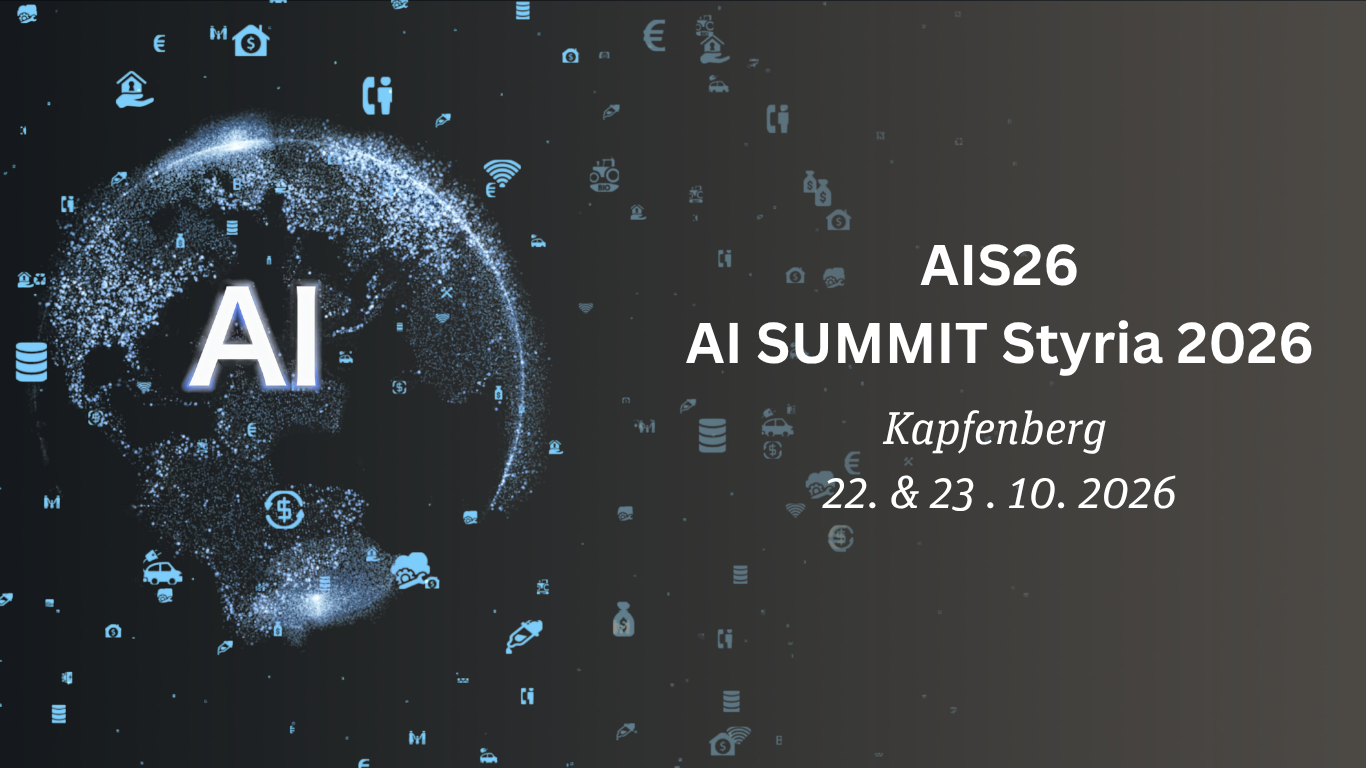
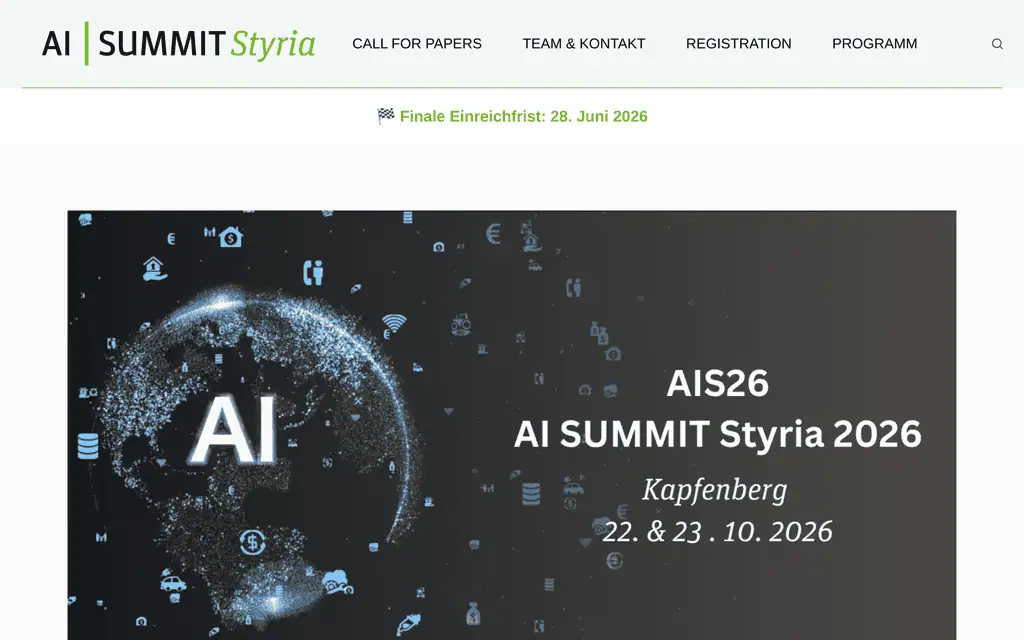
AI Summit Styria 2026: Complete Guide to Tracks, Speakers & Registration (October 22-23, Kapfenberg)

October 22-23, 2026

TL;DR: AI Summit Styria 2026 (AIS26) takes place October 22-23, 2026 at FH JOANNEUM in Kapfenberg, Austria. It is a two-day academic and applied conference covering Generative AI, Software Engineering, IT Security,...

AI Summit Styria 2026

TL;DR: AI Summit Styria 2026 (AIS26) takes place October 22-23, 2026 at FH JOANNEUM in Kapfenberg, Austria. It is a two-day academic and applied conference covering Generative AI, Software Engineering, IT Security, and AI ethics and regulation. Day 1 is free for everyone, Day 2 starts at €65 for students with the early bird rate, and reserved hotel room contingents at Hotel Bühlerstern and Sporthotel Kapfenberg are available with the booking code “AI Summit Kapfenberg”.

Why I’m Covering AI Summit Styria 2026

I track AI events year-round because they often surface tools, research, and real production use cases that never make it to the deal-tracking sites I usually write about. The tools that get demoed on stage in October typically show up in our Black Friday deal coverage three to five weeks later, so events like this are early signal for what to watch when discount season opens.

AI Summit Styria caught my attention because it is one of the few European conferences that gives equal weight to research, applied practice, and student work. It is not a vendor showcase and it is not a hype event. It is a working conference where people who build real AI systems present what is working and what is not.

If you are an early-career researcher, a software engineer integrating AI into production code, an IT security professional dealing with AI-related threats, or a student trying to decide where to focus your studies in 2026, this guide gives you what you need to decide whether the trip to Kapfenberg is worth it.

Let me walk through the program, the speakers, the registration math, the venue logistics, and the accommodation details. I will flag the parts I think matter most and the parts that are easy to miss in the official conference materials.

AI Summit Styria 2026 Event Quick Facts

DetailInformation
Event nameAI Summit Styria 2026 (AIS26)
DatesOctober 22-23, 2026 (Thursday and Friday)
LocationFH JOANNEUM Kapfenberg, Austria
Host institutionFH JOANNEUM University of Applied Sciences, Institut Software Design & Security
Venue addressWerk-VI-Straße 46, 8605 Kapfenberg, Österreich
Submission languageEnglish
Presentation languageGerman or English
Day 1 costFree for all attendees
Day 2 early bird€65 students, €145 non-students (by 30 June 2026)
Day 2 standard€95 students, €195 non-students (after 30 June 2026)
FH JOANNEUM students and staffFree for both days
Paper submission deadline29 May 2026
Author notification30 June 2026
Camera-ready submission11 September 2026
Official websitehttps://ai-summit-styria.fh-joanneum.at/
Hotel booking codeAI Summit Kapfenberg

Key Takeaways

  • AI Summit Styria 2026 runs across four specialized tracks: Foundations & Infrastructure (GenAI, RAG, MLOps and LLMOps), Software Engineering (AI in CI/CD, code generation, automated testing), IT Security (penetration testing, malware detection, threat modeling), and Interdisciplinary (regulation, ethics, GDPR, ROI).
  • Day 1 is free for everyone, which makes the conference unusually accessible for students, early-career researchers, and anyone evaluating whether to commit to the full program.
  • Three confirmed keynote speakers: Patrick Ratheiser (Head of AI at EY Austria), Prof. Dr. Elisabeth André (University of Augsburg), and Dr. Klaus Steinmaurer (Managing Director, RTR).
  • Call for papers closes 29 May 2026 with author notification by 30 June and camera-ready submissions by 11 September. Accepted papers appear in the AIS26 Conference Proceedings.
  • Hotel contingents are reserved at two hotels (Hotel Bühlerstern and Sporthotel Kapfenberg) with the booking code “AI Summit Kapfenberg”. Each property only holds up to 20 single rooms, so book early.

What Is AI Summit Styria 2026?

AI Summit Styria 2026 is a two-day academic and applied conference hosted by FH JOANNEUM in Kapfenberg, Austria. The summit positions itself as a meeting point for early-career researchers, students, experts, and practitioners working on the current technical and ethical challenges of Artificial Intelligence.

The conference is organized around four parallel tracks that cover most of the current AI engineering scope: foundational infrastructure, software engineering integration, IT security, and interdisciplinary topics such as regulation and ethics. Submitted papers go through a peer-review process and accepted contributions are published in the AIS26 Conference Proceedings.

The framing matters. This is not an industry trade show where vendors pitch products. It is closer to a regional academic conference with a clear applied focus, run by a university that has a strong track record in software engineering education. The RADIUS project at FH JOANNEUM, which focuses on generative AI and large language model applications for software engineering and IT security, is one of the institutional drivers behind the event.

Who AI Summit Styria 2026 Is Built For

The organizing committee is explicit about its target audience, but here is how I read it.

Early-career researchers and PhD candidates: This is one of the few conferences in the German-speaking region that actively invites young scientists to present alongside established academics. The poster track is designed to lower the barrier for first-time presenters.

Software engineers and AI integration specialists: The Software Engineering track is heavy on practical AI integration topics. If you are working on AI-assisted code generation, automated test suite generation, or context-aware code suggestions in production systems, this track will be useful.

IT security professionals: The IT Security track covers AI-based malware detection, AI-assisted penetration testing, intrusion detection for IoT and critical infrastructure, and threat modeling for AI systems. Practitioners who deal with adversarial AI scenarios will find peer-reviewed content here.

Legal and compliance professionals working on AI governance: The Interdisciplinary track addresses GDPR, EU AI Act compliance, liability frameworks, and bias mitigation. Several track chairs and editorial board members come from law faculties at Vienna and Graz universities.

Students at FH JOANNEUM and similar institutions: Students from FH JOANNEUM get free admission to both days, and discounted rates apply for students from other institutions. Day 1 is free for everyone, regardless of student status.

If you are looking for a CES-style AI vendor showcase, this is not the right event. If you want to see what European academic and applied AI research is actually producing in 2026, AIS26 is one of the most accessible conferences on the calendar.

Conference Tracks: A Deep Dive Into the AIS26 Program

The AI Summit Styria 2026 tracks split across Foundations & Infrastructure, Software Engineering, IT Security, and Interdisciplinary work. Each of the four parallel tracks runs the full two days with dedicated chairs from FH JOANNEUM and partner universities at TU Graz, Vienna, Klagenfurt, and Webster Vienna. Here is what each AI Summit Styria 2026 track covers and the kinds of submissions the committee is actively requesting.

Track 1: Foundations & Infrastructure

This is the technical foundation track. It covers the underlying systems, architectures, and operational practices that make modern AI work in production.

Core topics in this track include:

  • Retrieval-Augmented Generation (RAG): How to combine retrieval systems with generative models to reduce hallucinations and ground outputs in verified data sources.
  • LLM-based agent architectures: Single-agent and multi-agent system design, including collaboration and self-organization between agents.
  • MLOps and LLMOps for AI systems: Operational practices for deploying and maintaining AI models in production, including monitoring, versioning, and rollback strategies.
  • System and software architectures for AI: Reference architectures for integrating AI capabilities into existing systems.
  • Selection, deployment, and roll-out of LLMs and Generative AI: Vendor evaluation, model selection criteria, and deployment strategies.
  • Handling overconfidence and hallucinations: Techniques for detecting and mitigating model errors in deployed systems.
  • Evaluation metrics and validation rules: How to measure AI system performance beyond traditional accuracy metrics.

Track chairs for Foundations & Infrastructure are:

  • DI Dr. Michael Hammer (FH JOANNEUM)
  • Univ.-Prof. DI Dr. Peter Michael Roth (Webster Vienna Private University)
  • FH-Prof. Mag. Dr. Wilhelm Zugaj (FH JOANNEUM)

Track 2: Software Engineering

The Software Engineering track focuses on how generative AI is changing the software development lifecycle. This is the track that will likely attract the largest applied-engineering audience.

Core topics in this track include:

  • Integrating GenAI into SDLC and CI/CD: How AI tools fit into existing development pipelines, including code review, testing, and deployment automation.
  • AI for requirements engineering and architecture design: Using AI to capture, validate, and refine requirements and architectural decisions.
  • AI-assisted code generation, refactoring, and performance optimization: Practical applications of code-generation models for production codebases.
  • Context-aware code suggestions: How to make AI suggestions relevant to the specific codebase, conventions, and constraints of a project.
  • Automated test case generation and test suite optimization: AI-driven test creation, coverage analysis, and regression testing.
  • AI-assisted formal verification: Using AI to support formal proofs and verification workflows.
  • Automated code reviews and defect prediction: AI-based static analysis and defect detection in code.
  • AI for performance testing and monitoring: Anomaly detection in performance metrics and automated load test generation.
  • Automated code documentation: AI-generated documentation that stays synchronized with code changes.
  • Detecting architectural patterns and automated validation: Using AI to identify and enforce architectural conventions across large codebases.
  • Specializing language models for existing codebases: Fine-tuning and adapting general-purpose code models to project-specific contexts.

Track chairs for Software Engineering are:

  • DI Helmut Lindner (FH JOANNEUM)
  • FH-Prof. DI Dr. Elmar Krainz (FH JOANNEUM)

Track 3: IT Security

The IT Security track addresses both AI-enabled defense strategies and AI-specific security concerns. This is one of the strongest tracks because FH JOANNEUM has a dedicated Institut Software Design & Security.

Core topics in this track include:

  • Automated penetration testing and ethical hacking: AI-assisted vulnerability discovery and exploitation.
  • Intrusion and anomaly detection: Including IoT and critical infrastructure scenarios.
  • AI-based malware and phishing detection: Modern detection systems that adapt to evolving threats.
  • AI for vulnerability detection in code and patch generation: Identifying flaws and suggesting fixes automatically.
  • AI-assisted secure software architecture and threat modeling: Embedding security into design decisions from the start.
  • AI-assisted network protocols and anomaly analysis: Traffic pattern analysis and protocol-level threat detection.
  • Detection of web vulnerabilities: SQL injection, cross-site scripting (XSS), and similar attack vectors.
  • AI-supported attack prevention and privacy: Including privacy-preserving machine learning techniques.
  • Standardized datasets and tools for reproducible research: Benchmarking and reproducibility in AI security research.

Track chairs for IT Security are:

  • FH-Prof. DI Dr. Klaus Gebeshuber (FH JOANNEUM)
  • Univ.-Prof. Dipl.-Ing. Mag. Dr. techn. Edgar Weippl (Vienna University)

Track 4: Interdisciplinary

The Interdisciplinary track covers the legal, ethical, and business dimensions of AI deployment. This track is essential for anyone responsible for AI governance, compliance, or strategic decisions.

Core topics in this track include:

  • Legal frameworks for AI-supported software development: How the EU AI Act and national legislation apply to AI-assisted development practices.
  • Compliance, data protection (GDPR), and liability issues: Practical implementation of GDPR for AI systems and liability frameworks for autonomous AI decisions.
  • Regulatory requirements for critical systems: Sector-specific compliance requirements in healthcare, finance, and critical infrastructure.
  • Bias mitigation and ethical guidelines in development and testing: Practical approaches to identifying and reducing algorithmic bias.
  • Acceptance, trust, and transparency in automated processes: How users and stakeholders accept or reject AI-driven systems.
  • Cost-benefit analyses for deploying Generative AI: When AI integration genuinely pays off and when it does not.
  • Business models and ROI for AI-supported development and security solutions: Quantifying the financial impact of AI tooling.
  • Practical examples of AI integration in companies: Real case studies from companies that have integrated AI into core operations.
  • Lessons learned from pilot projects in software engineering and IT security: What went wrong, what worked, and what surprised the teams running these projects.

Track chairs for Interdisciplinary are:

  • FH-Prof. Mag. a Dr. Sabine Proßnegg (FH JOANNEUM)
  • MMMMag. DDr. Wolfgang Granigg (FH JOANNEUM)

AIS26 Keynote Speakers

The AI Summit Styria 2026 keynote speakers are Patrick Ratheiser (Head of AI, EY Austria), Prof. Dr. Elisabeth André (University of Augsburg), and Dr. Klaus Steinmaurer (Managing Director, RTR). Each represents a different intersection of AI practice, academic research, and regulation, which fits the conference’s positioning as a venue where these three perspectives meet rather than operating in isolation.

Patrick Ratheiser, Head of AI at Ernst & Young Wirtschaftsprüfungsgesellschaft m. b. H.

Patrick Ratheiser leads the AI practice at EY Austria. His keynote will likely cover applied AI in audit, advisory, and large enterprise contexts. EY has been one of the more visible Big Four firms in operationalizing AI for internal workflows and client-facing services. If you are interested in how generative AI is being deployed in regulated industries (finance, audit, compliance), this is the keynote to prioritize.

Prof. Dr. Elisabeth André, Professor of Artificial Intelligence at the University of Augsburg

Prof. André is one of the most cited European researchers in AI, particularly in human-centered AI, multimodal interaction, and affective computing. Her work bridges traditional AI research with practical questions about how humans interact with intelligent systems. Expect a keynote that addresses both technical depth and broader societal questions about AI deployment.

Dr. Klaus Steinmaurer, Managing Director at Rundfunk und Telekom Regulierungs-GmbH (RTR)

Dr. Steinmaurer leads RTR, the Austrian regulatory authority for broadcasting and telecommunications. RTR is also involved in AI policy implementation at the national level. His keynote will likely focus on regulatory perspectives on AI, including how Austria is implementing the EU AI Act and what this means for AI developers and deployers operating in the region.

The combination of practitioner, academic, and regulator on the keynote stage is deliberate, and it tells you a lot about the conference’s editorial priorities for 2026.

Call for Papers: How to Submit to AIS26

The AI Summit Styria 2026 call for papers deadline is 29 May 2026 with author notification by 30 June 2026. Papers must be 4 to 12 pages, PDF format, written in English, using the IEEE LaTeX template, and submitted through EasyChair. Accepted papers go into the AIS26 Conference Proceedings.

If you are working on original, unpublished AI research and want to present at AIS26, the call for papers is open. The submission process is straightforward but the deadlines are real, so plan accordingly.

What the Committee Wants

The call for papers explicitly invites contributions from both industry and academia describing original, unpublished results from applied research on Generative AI and its application in software engineering and IT security. Submissions are particularly welcome in these areas:

  • Large Language Models and Generative AI
  • Multi-agent systems and collaborative architectures
  • MLOps and LLMOps
  • Software Engineering and AI integration into the development process
  • AI in IT Security and secure software architectures
  • Ethical, legal, and regulatory frameworks

Submission Format Requirements

All submissions must follow these technical requirements.

RequirementSpecification
FormatPDF only
Length (full paper)4 to 12 pages
Length (poster abstract)2 to 4 pages
Submission languageEnglish
Presentation languageGerman or English
TemplateIEEE LaTeX template (provided on the conference website)
Submission platformEasyChair

Papers go through peer review and are evaluated on originality, timeliness, correctness, and relevance to the conference scope. Previously published papers are not accepted. Accepted papers are published in the AIS26 Conference Proceedings.

Submission Timeline

MilestoneDate
Full paper submission (talks and posters)29 May 2026
Author notification30 June 2026
Camera-ready submission11 September 2026
Main conference22-23 October 2026

The submission window is tight. If you are working on a paper for AIS26, start the writing process early enough to leave room for revisions after peer review.

Editorial Board

The editorial board is a who’s-who of Austrian and German AI research:

  • Univ.-Prof. Mag. DDr. Erich Schweighofer (Vienna University)
  • Univ.-Prof. Dipl.-Ing. Dr. Wilfried Elmenreich (Klagenfurt University)
  • Univ.-Prof. Dr. iur. Martin Miernicki, BA, BSc (Graz University)
  • Univ.-Prof. Dipl.-Ing. Mag. Dr. techn. Edgar Weippl (Vienna University)
  • Univ.-Prof. in Dr. in iur. Elisabeth Staudegger (Graz University)
  • Varun Kumar Reddy Muppidi, MSc (University of Central Missouri, USA)
  • Dipl.-Ing. Dr. techn. Horst Possegger, BSc (TU Graz)
  • Assoz. Prof. Dr. rer. nat. Georg Jäger, BSc MSc (Graz University)
  • Univ.-Prof. DI Dr. Peter Michael Roth (Webster Vienna Private University)
  • FH-Prof. Mag. a Dr. Sabine Proßnegg (FH JOANNEUM)
  • FH-Prof. Mag. Dr. Wilhelm Zugaj (FH JOANNEUM)
  • FH-Prof. DI Dr. Klaus Gebeshuber (FH JOANNEUM)
  • FH-Prof. DI Dr. Elmar Krainz (FH JOANNEUM)
  • DI Dr. Michael Hammer (FH JOANNEUM)
  • FH-Prof. Priv.-Doz. DI Dr. Joachim Schauer (FH JOANNEUM)

The breadth of representation across legal, technical, and applied research disciplines indicates that the peer review process is genuinely multidisciplinary.

AIS26 Registration and Pricing

AI Summit Styria registration is unusually accessible: Day 1 is free for everyone, Day 2 costs €65 student or €145 non-student with the early bird rate before 30 June 2026, and FH JOANNEUM students and employees attend both days free. Standard Day 2 rates after 30 June rise to €95 student and €195 non-student. The full fee covers proceedings publication, conference lunch, and coffee breaks.

Day 1: Thursday, 22 October 2026

Day 1 is free for everyone. No registration fee applies. This makes the first day genuinely accessible for students, early-career researchers, freelancers, and anyone curious about the program but uncertain about committing financially.

Day 2: Friday, 23 October 2026

CategoryEarly Bird (by 30 June 2026)Standard (after 30 June 2026)
Students€65€95
Non-students€145€195

Special Categories

FH JOANNEUM students and employees: Free for both days. No registration fee required.

Combined two-day attendance: Day 1 remains free for all attendees. Day 2 fees apply according to the schedule above.

What the Fee Covers

The participation fee for Day 2 includes:

  • Publication of accepted contributions in the AIS26 Conference Proceedings
  • Lunch on the conference day
  • Coffee breaks and networking refreshments

The fee does not include accommodation, travel, or evening social events that may be added to the program closer to the conference dates.

Registration Math: When Early Bird Pays Off

The savings from registering early are meaningful. Students save €30 by registering before 30 June 2026 (€65 versus €95, a 32% discount). Non-students save €50 (€145 versus €195, a 26% discount). If you are planning to attend Day 2 and you know your schedule by mid-June, registering early is the obvious move.

For students from outside FH JOANNEUM, the early bird rate of €65 is one of the lowest student rates I have seen for a peer-reviewed AI conference in Europe in 2026. Comparable conferences typically charge between €300 and €800 for student attendance.

Conference Venue: FH JOANNEUM Kapfenberg

AIS26, the FH JOANNEUM AI conference for 2026, takes place at FH JOANNEUM University of Applied Sciences in Kapfenberg, a town in the Austrian state of Styria. The host institute is the Institut Software Design & Security, which has been a regional center for software engineering and security research for years.

Full venue address:

FH JOANNEUM University of Applied Sciences Institut Software Design & Security Werk-VI-Straße 46 8605 Kapfenberg Österreich

How to Get to FH JOANNEUM Kapfenberg

Kapfenberg is well connected to Graz and Vienna by rail and road. Here are the options.

By train:

The nearest train station is “Kapfenberg Fachhochschule”, which serves regional trains. From this station, FH JOANNEUM is approximately a 6-minute walk away.

If you arrive at Kapfenberg Bahnhof (the main station), the campus is about 3.3 kilometers away. Walking takes roughly 45 minutes. Taking a taxi or local bus from the main station is faster and more practical with conference luggage.

By bus:

Bus lines 1, 23, 24, 25, and 180 stop near the campus. The most convenient stop is “Kapfenberg Fachhochschule Ost”, which is only a 1-minute walk from the FH JOANNEUM main building. Bus schedules align with regional train arrivals at the main station.

By car:

The S6 (Semmering Expressway) is the main motorway route to the Kapfenberg region. The most direct motorway exit depends on the direction of approach. Most travelers from Vienna or Graz will exit at Bruck an der Mur or Kapfenberg via the S6. Driving time from Vienna is roughly 1 hour 45 minutes, and from Graz it is approximately 50 minutes, depending on traffic.

Parking:

Free parking is available on the FH JOANNEUM campus. This is a meaningful benefit for anyone driving in from outside the region, because parking costs are not a factor in your trip budget.

By air:

The closest international airports are Graz (GRZ), about 60 kilometers from Kapfenberg, and Vienna International (VIE), about 200 kilometers away. Both have regular train connections to Kapfenberg via Graz or Bruck an der Mur.

AIS26 Accommodation: Reserved Hotel Room Contingents

AI Summit Kapfenberg attendees have reserved room contingents at Hotel Bühlerstern and Sporthotel Kapfenberg, each holding up to 20 single rooms under the “AI Summit Kapfenberg” booking code. Because the contingents are limited and the conference draws attendees from across Central Europe, book early.

Hotel Bühlerstern

Address: Friedrich-Bühler-Straße 13, 8605 Kapfenberg Booking code: AI Summit

Hotel Bühlerstern is one of the established hotels in Kapfenberg. The reserved rooms are single occupancy, which works well for solo conference attendees but means couples or shared bookings need to confirm room availability separately.

Sporthotel Kapfenberg

Address: Johann-Brandl-Gasse 25, 8605 Kapfenberg Booking code: AI Summit Kapfenberg

Sporthotel offers reserved single rooms under the booking code “AI Summit Kapfenberg”. Same conditions apply: the contingent is limited and reservations are first-come, first-served.

How to Use the Booking Codes

When you contact either hotel to make your reservation, reference the booking code at the start of the conversation or include it in your written booking request. The code accesses the reserved contingent and any associated conference rate. If the contingent is full by the time you book, the hotels can still take reservations at their standard rates, but you may need to confirm availability separately.

If you are presenting at the conference and need a confirmed booking for visa applications or institutional travel approval, book as early as possible. The 20-room contingents fill quickly once registration opens.

Other Accommodation Options in Kapfenberg

If the reserved contingents are full, Kapfenberg and the surrounding area have additional hotels and guesthouses available through standard booking platforms. The town is small enough that most accommodations are within a short drive or taxi ride of the FH JOANNEUM campus.

Bruck an der Mur, which is about 5 kilometers from Kapfenberg, has additional hotel options and is connected to Kapfenberg by frequent regional trains. For attendees with flexible schedules, Graz (about 50 minutes by train) is also a viable base.

Organizing Committee and Session Chairs

The AIS26 organizing committee is anchored at FH JOANNEUM with three lead organizers, each representing a different domain of the conference scope.

Lead Organizers

Elmar Krainz, Program Director

FH-Prof. DI Dr. Elmar Krainz is a program director at FH JOANNEUM specializing in software development, usability, accessibility, and mobile applications. Krainz brings the software engineering perspective to the conference and serves as track chair for the Software Engineering track.

Helmut Lindner, Project Lead, RADIUS

DI Helmut Lindner leads the RADIUS project at FH JOANNEUM. RADIUS focuses on applied research into generative AI and large language models for software engineering and IT security applications. Lindner is also a track chair for Software Engineering and a key driver of the conference’s emphasis on applied AI research.

Sabine Proßnegg, Expert in IT and Data Protection Law

FH-Prof. Mag. a Dr. Sabine Proßnegg works at FH JOANNEUM in the field of IT law and data protection. She supports start-up and innovation projects in the IT sector and chairs the Interdisciplinary track. Her presence on the organizing committee reinforces the conference’s commitment to taking legal and ethical dimensions of AI seriously.

Session Chairs

The session chairs span institutions across Austria and bring a mix of legal, technical, and applied research expertise:

  • Univ.-Prof. Mag. DDr. Erich Schweighofer (Vienna University)
  • Dipl.-Ing. Dr. techn. Horst Possegger, BSc (TU Graz)
  • Univ.-Prof. Dr. iur. Martin Miernicki, BA, BSc (Graz University)
  • Univ.-Prof. Dipl.-Ing. Dr. Wilfried Elmenreich (Klagenfurt University)
  • Univ.-Prof. in Dr. in iur. Elisabeth Staudegger (Graz University)
  • Univ.-Prof. Dipl.-Ing. Mag. Dr. techn. Edgar Weippl (Vienna University)

This is a working session chair list, which means the named chairs are responsible for moderating panels, introducing speakers, and managing discussion during the conference itself.

Why Attend AI Summit Styria 2026?

Let me be direct about what makes AIS26 worth the trip and what does not.

What AIS26 Does Well

Accessibility: Day 1 is free. The Day 2 student rate of €65 (early bird) is substantially below comparable European AI conferences, which typically charge €300 to €800 for student attendance. For a peer-reviewed conference with published proceedings, this is a strong price-to-value ratio.

Track depth: The four tracks are well-defined and the topic lists indicate the committee has thought carefully about what is actually moving in 2026 (RAG, MLOps for LLMs, AI-assisted secure architecture, EU AI Act implementation). This is not a generic “AI” conference where every talk could be about anything.

Peer-reviewed proceedings: Accepted papers go into the AIS26 Conference Proceedings, which gives the conference real academic credibility. This matters if you are an early-career researcher building a publication record.

Interdisciplinary framing: The Interdisciplinary track means legal, ethical, and business considerations are not afterthoughts. They are equal partners with the technical tracks. This is rare in European AI conferences, which often relegate ethics and regulation to side panels.

Strong regional network: Track chairs and editorial board members come from Vienna, Graz, Klagenfurt, Augsburg, and FH JOANNEUM. If you are looking to build connections in the Austrian, German, and broader Central European AI research network, AIS26 is one of the best venues for it.

What to Set Expectations Around

Scale: This is not a 5,000-person conference. The 20-room hotel contingents and the regional academic focus suggest a few hundred attendees rather than thousands. If you want a massive expo floor with vendor booths, this is not it.

Industry representation: The committee is academic-heavy. While industry contributions are welcome, the default culture will lean toward research presentation styles. If you are a startup founder looking to pitch investors, this is not the right venue.

Geographic accessibility: Kapfenberg is not Vienna or Munich. You will need to plan train or car travel from a major hub. The closest international airports are Graz (about 60 kilometers) and Vienna (about 200 kilometers).

Who Should Definitely Attend

If you are working on a paper or poster that fits one of the four tracks, the peer-review opportunity alone makes attendance worth it. The publication in the proceedings is a concrete career outcome that you can point to in future grant applications or job searches.

If you are a student or early-career researcher in software engineering, IT security, or AI policy, the combination of free Day 1, low Day 2 student rate, and peer-reviewed academic network is hard to beat in this region.

If you are an enterprise practitioner working on EU AI Act compliance or AI integration into regulated systems, the Interdisciplinary track is one of the few places where these topics get serious technical and legal treatment in the same room.

Who Might Skip

If your focus is on pure AI startup ecosystem networking, deals, and product launches, this conference will feel quiet compared to events like Web Summit or Slush. AIS26 is a working conference, not a deal-making conference.

If you only attend conferences that have major US-based industry keynotes (OpenAI, Anthropic, Google DeepMind), the speaker lineup will not match your expectations. The strength here is in European applied research, not Silicon Valley brand recognition.

Practical Tips for First-Time AIS26 Attendees

A few things I would do if I were attending AIS26 for the first time.

Book accommodation in the first two weeks after registration opens. The 20-room contingents fill fast. After they are gone, you are on your own for hotel booking, and Kapfenberg has limited inventory.

Plan for two travel days even if you only attend Day 2. Kapfenberg is not a quick day trip from most starting points. Train connections from Vienna or Graz are reliable but they take time, and arriving rested matters more than saving one hotel night.

Bring something to write with. Academic conferences move fast. If you are sitting through three or four talks per session, you will lose track of which ideas you wanted to follow up on. A notebook beats trying to type during talks.

Identify the two or three talks you cannot miss before the conference starts. The four parallel tracks mean you will have to choose. Looking at the program ahead of time and marking priority sessions prevents the standard conference paralysis of trying to be everywhere at once.

Use the coffee breaks for actual networking. The fee covers coffee breaks specifically because they are where most of the real conversations happen at academic conferences. Bring business cards or have your LinkedIn QR code ready on your phone.

Submit your paper if you have research to share. The publication in the proceedings is concrete career value, and the peer review feedback alone is worth the submission effort. The deadline (29 May 2026) is tight, but the review-to-conference timeline is favorable.

Frequently Asked Questions About AI Summit Styria 2026

When and where is AI Summit Styria 2026?

AI Summit Styria 2026 takes place on October 22 and 23, 2026 at FH JOANNEUM University of Applied Sciences in Kapfenberg, Austria. The full venue address is Werk-VI-Straße 46, 8605 Kapfenberg, Österreich.

How much does it cost to attend AIS26?

Day 1 (Thursday, 22 October 2026) is free for all attendees. Day 2 (Friday, 23 October 2026) costs €65 for students and €145 for non-students with the early bird rate (registration by 30 June 2026). After that date, standard rates apply: €95 for students and €195 for non-students. FH JOANNEUM students and employees attend both days free of charge.

What is the deadline for submitting a paper to AIS26?

The full paper submission deadline is 29 May 2026. Authors will be notified of acceptance by 30 June 2026, and camera-ready versions are due 11 September 2026. Papers must be 4 to 12 pages for full submissions or 2 to 4 pages for poster abstracts, formatted using the IEEE LaTeX template and submitted as PDF through EasyChair.

What language is AI Summit Styria conducted in?

Submissions and proceedings are in English. Presentations may be in German or English. Most international attendees should be able to follow the conference comfortably in English, though some German-language sessions may be available depending on the final program.

How do I complete AI Summit Styria registration?

AI Summit Styria registration is handled through the official AIS26 website at ai-summit-styria.fh-joanneum.at. Day 1 attendance is free with a simple sign-up. For Day 2, complete the paid registration before 30 June 2026 to lock in the early bird rate (€65 student, €145 non-student). The FH JOANNEUM AI conference team confirms registration by email; bring the confirmation to check-in at FH JOANNEUM Kapfenberg.

Is AI Summit Styria 2026 the only AI conference Austria 2026 attendees should consider?

It is one of the strongest options for peer-reviewed academic AI work in Austria 2026. Other AI conference Austria 2026 venues (such as larger industry events in Vienna) lean more commercial. AIS26 is the better choice if you want peer-reviewed proceedings, university-led tracks, and direct access to track chairs from FH JOANNEUM, TU Graz, Vienna University, Klagenfurt, and Webster Vienna.

How do I book a hotel for AIS26?

AIS26 has reserved up to 20 single rooms at Hotel Bühlerstern (Friedrich-Bühler-Straße 13) and 20 single rooms at Sporthotel Kapfenberg (Johann-Brandl-Gasse 25). Use the booking code “AI Summit” at Hotel Bühlerstern and “AI Summit Kapfenberg” at Sporthotel Kapfenberg when you contact the hotels directly. Because the contingents are limited, book as soon as you confirm your registration.

What are the four conference tracks at AIS26?

AIS26 is organized around four parallel tracks: Foundations & Infrastructure (GenAI, RAG, multi-agent systems, MLOps and LLMOps), Software Engineering (AI in SDLC and CI/CD, code generation, automated testing), IT Security (AI-based malware detection, penetration testing, threat modeling), and Interdisciplinary (regulation, GDPR, ethics, AI ROI). Each track has dedicated chairs from FH JOANNEUM and partner universities.

Who are the keynote speakers at AIS26?

The confirmed keynote speakers are Patrick Ratheiser (Head of AI at Ernst & Young Wirtschaftsprüfungsgesellschaft Austria), Prof. Dr. Elisabeth André (Professor of Artificial Intelligence at the University of Augsburg), and Dr. Klaus Steinmaurer (Managing Director at Rundfunk und Telekom Regulierungs-GmbH, the Austrian regulatory authority for broadcasting and telecommunications).

How do I get to Kapfenberg by public transport?

The nearest train station is “Kapfenberg Fachhochschule”, which is about a 6-minute walk from FH JOANNEUM. Bus lines 1, 23, 24, 25, and 180 stop nearby, with the “Kapfenberg Fachhochschule Ost” stop being a 1-minute walk from the main building. Kapfenberg is connected by regional trains to Graz (about 50 minutes) and Vienna (about 2 hours).

Will accepted papers be published?

Yes. Accepted papers will be published in the AIS26 Conference Proceedings. Submissions go through a peer-review process and are evaluated on originality, timeliness, correctness, and relevance to the conference scope. Previously published papers are not eligible.

Can industry practitioners attend, or is it academic-only?

Both. The call for papers explicitly invites contributions from industry and academia. Practitioner case studies are welcome, particularly in the Software Engineering and Interdisciplinary tracks where lessons learned from pilot projects and real AI integration in companies are listed as priority topics.

How to Register for AIS26: Step by Step

Registration for AI Summit Styria 2026 is handled through the official conference website at https://ai-summit-styria.fh-joanneum.at/. Here is the suggested order of operations.

Step 1: Visit the conference website at https://ai-summit-styria.fh-joanneum.at/ and create an attendee account.

Step 2: Select your registration type (Day 1 only, Day 2 only, or both days). Day 1 is free for everyone, and Day 2 has the tiered pricing described above.

Step 3: Complete payment for Day 2 if applicable. Early bird pricing (€65 student or €145 non-student) ends 30 June 2026.

Step 4: Immediately after registering, contact Hotel Bühlerstern (booking code: AI Summit) or Sporthotel Kapfenberg (booking code: AI Summit Kapfenberg) to reserve accommodation while contingents are still available.

Step 5: If you plan to submit a paper or poster, prepare your IEEE LaTeX template submission and upload through EasyChair before 29 May 2026.

Step 6: Plan your travel. Trains to Kapfenberg run from Graz and Vienna, and the campus offers free parking for attendees driving in.

Step 7: Block out time during the week of the conference to review the program in detail and identify the priority talks across the four tracks.

Final Thoughts on AI Summit Styria 2026

AI Summit Styria 2026 is one of the most accessible AI conference Austria 2026 attendees can pick from, and one of the strongest peer-reviewed academic AI conferences in Central Europe for the year. The combination of a free Day 1, low-cost Day 2, peer-reviewed proceedings, and four well-defined tracks makes it especially valuable for students, early-career researchers, and practitioners working in regulated industries where AI governance is becoming critical.

The conference does not try to be everything to everyone. It is built around applied AI research with serious attention to legal and ethical dimensions, hosted by a university that has invested heavily in software engineering and security education. If that scope matches your work, register early, book accommodation while the hotel contingents are open, and start preparing your submission if you plan to present.

And because the conference lands the week before Black Friday season kicks off, attendees can roll their travel directly into the year’s best window for AI tool discounts the moment they get back.

For the latest program updates, registration links, and submission portals, visit the official AIS26 website.

Going to Kapfenberg? Stay tuned for post-conference deal coverage. AIS26 ends just before Black Friday season opens. We track which AI tools featured by speakers and exhibitors release discounts in the weeks after major conferences. Get post-conference deal alerts straight to your inbox, one email per week, no spam.

Event Verdict: Worth attending if your work fits any of the four tracks, especially if you are a student or early-career researcher in software engineering, IT security, or AI policy. The free Day 1, low student rate for Day 2, and peer-reviewed proceedings make this one of the highest-value academic AI conferences in Europe for 2026.

Disclosure tag: Deal Notification. This is event coverage based on the publicly available AIS26 conference materials. ZPlatform.ai is not affiliated with FH JOANNEUM or the AI Summit Styria organizing committee, and no compensation was received for this event listing.

← Back to all AI events