



Verdict: Buy
What I Like
- Comprehensive keyword research with large database
- Strong competitor analysis and traffic share features
- Backlink gap analysis is genuinely useful
- Lifetime deal pricing eliminates recurring costs
- OpenAI integration (early stage but improving)
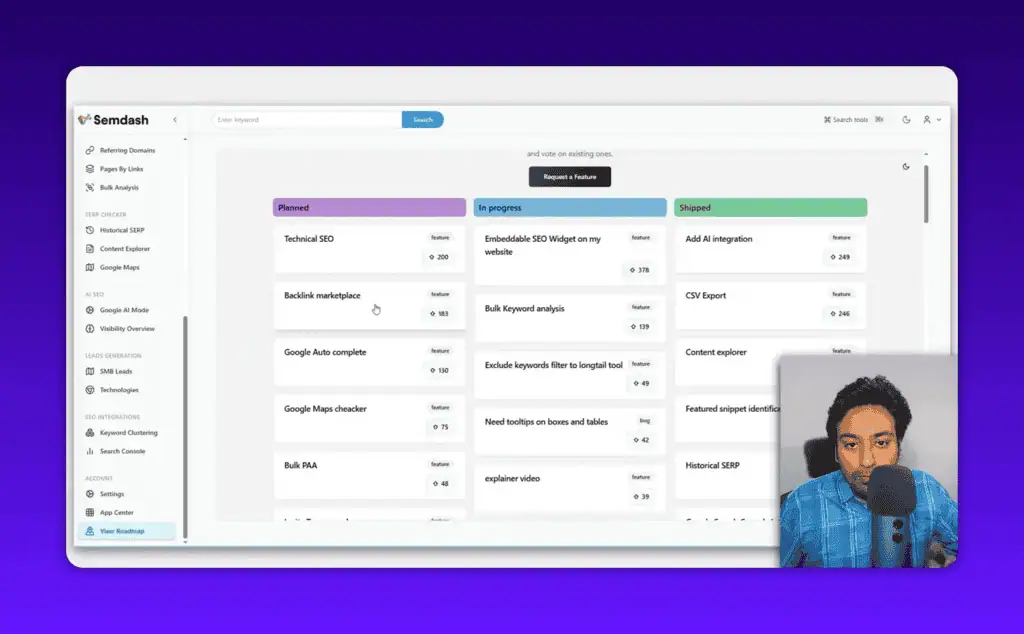
- Active development with public roadmap
- Clean, fast interface
- Search Console integration adds real data layer
- Content explorer for link prospecting
What Is Missing
- Data accuracy lags behind Semrush and Ahrefs
- Credit system limits heavy usage patterns
- AI overview output needs formatting work
- Site audit functionality is basic
- Rank tracking is limited compared to dedicated tools
- Backlink database not as comprehensive as Ahrefs
- Occasional bugs found during testing
I’m skeptical of most AppSumo SEO tools. They promise Semrush-level data for a one-time $69 payment, and they usually deliver… a dashboard full of inaccurate numbers and a support team that ghosts you six months later.
Semdash is a solid Semrush alternative - see how it stacks up against the other AI SEO tools in our tested roundup.
So when Semdash started appearing in my feed with claims of 6.6 billion keywords and 2.7 trillion backlinks in their database, I did what any reasonable person would do: I bought Plan 3 and tested everything I could break.
Here’s what I actually found.
Before we go deep, a quick summary of what Semdash actually is and who it’s for. If you’re already familiar with the tool, jump to the feature-by-feature breakdown or the verdict.
Quick verdict: Semdash is a legitimate all-in-one SEO tool with solid keyword research and competitor analysis capabilities. The data isn’t perfect, but at lifetime deal pricing, the value for budget-conscious site owners is hard to argue with. It’s a strong buy for freelancers, solopreneurs, and small agencies who want Semrush-level workflows without the recurring subscription.
What Is Semdash?
Semdash is an all-in-one SEO research platform that combines keyword analysis, competitor intelligence, backlink research, content gap analysis, and AI-powered insights in a single dashboard. It’s currently available as a lifetime deal on AppSumo, which is what makes it particularly interesting for budget-focused marketers.
The tool positions itself as a direct competitor to Semrush and Ahrefs, which is a bold claim. Their database claims alone are staggering: 6.6 billion keywords and 2.7 trillion backlinks. Whether those numbers hold up in practice is a different question, and I’ll show you exactly where the data is strong and where it falls short.
What makes Semdash stand out in a crowded market of Semrush clones is its focus on AI integration. They’ve built OpenAI-powered features directly into the workflow, including an AI overview tool that generates structured SEO briefs and a traffic share analysis that goes beyond simple keyword data.
Think of Semdash as the SEO toolkit for someone who needs Semrush workflows but can’t justify the $140-$250/month price tag, putting it in the same budget bracket as Neil Patel’s Ubersuggest. It won’t replace enterprise tools for large agencies, but for solo consultants, affiliate marketers, and small business owners doing their own SEO, it covers 90% of what you actually need day to day.
Key Features of Semdash
Let me walk through every major feature I tested personally, the same way I approach all our hands-on tool reviews. This isn’t a marketing overview, it’s what the tool actually does when you put it to work.
Domain Overview
The domain overview is the first place you’ll land when analyzing a competitor or your own site. Enter any domain and Semdash pulls organic traffic estimates, keyword rankings, backlink counts, and top pages.
I ran Copilot AI through the overview to test accuracy against data I already knew. The traffic estimates were in the right ballpark, though exact numbers varied from what I see in GSC for my own sites. That’s normal for third-party SEO tools, including Semrush and Ahrefs. None of them have access to your actual analytics. What matters is directional accuracy, and Semdash delivers that.
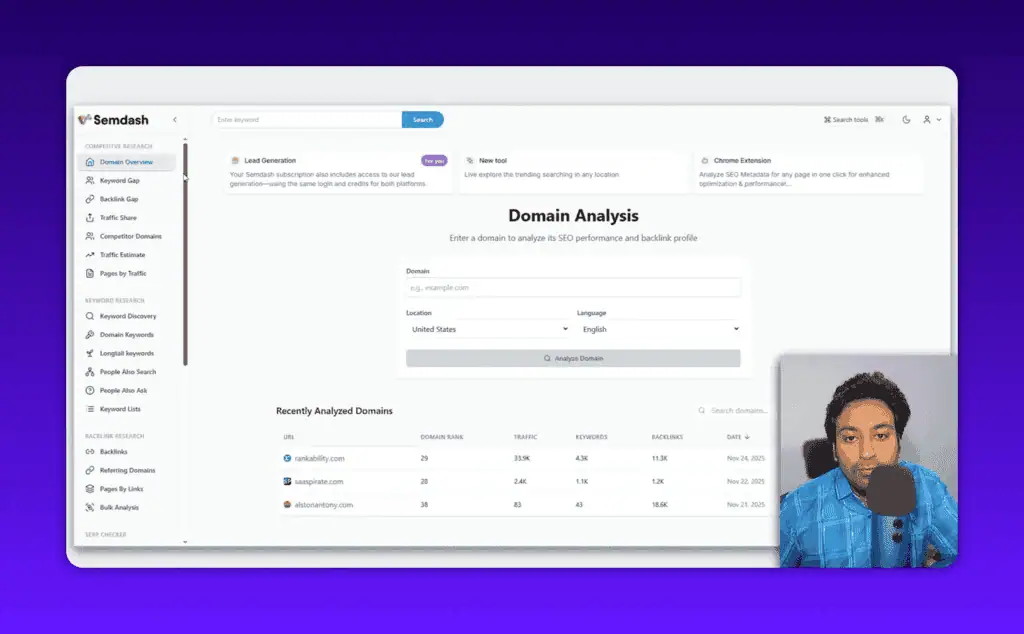
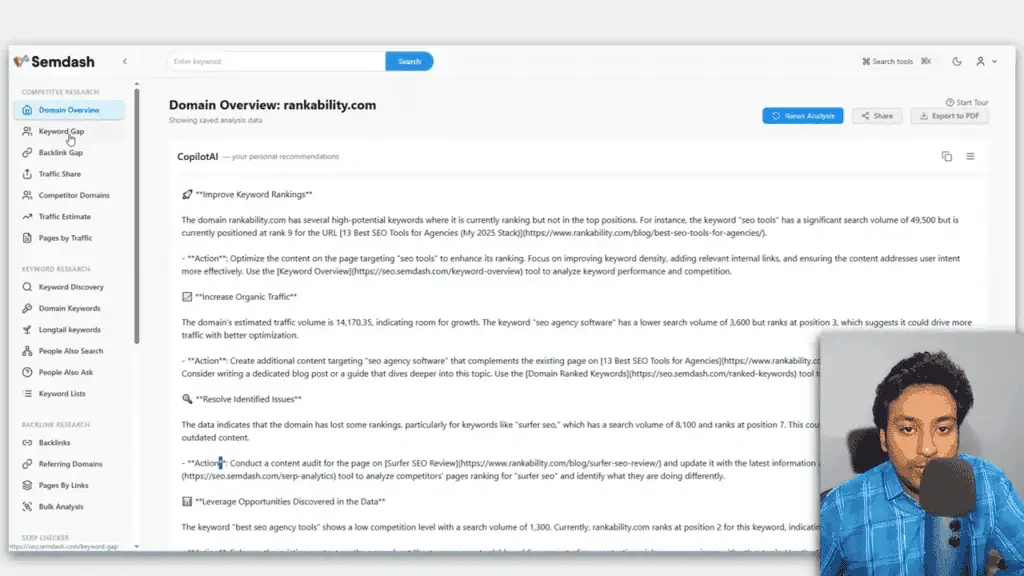
The interface is clean and loads quickly. You get estimated monthly organic visits, total backlinks, referring domains, and the top organic keywords driving traffic. The data refreshes regularly, so you’re not looking at six-month-old snapshots.
One thing I noticed: the domain overview for smaller sites (under 10k monthly visits) can sometimes show inflated numbers. This is a common issue with all third-party SEO tools, not unique to Semdash. For larger domains, the estimates are more reliable.
Keyword Research
This is where Semdash genuinely impressed me. The keyword research module pulls from their 6.6 billion keyword database and gives you search volume, keyword difficulty, CPC, and SERP overview data for any query.
When I searched for competitive SEO keywords, the volume numbers were close to what I see in Ahrefs. Not identical, but directionally accurate. The keyword difficulty scores are calibrated differently from Ahrefs or Semrush, so don’t use them interchangeably. Learn the scale and it becomes useful.
What I liked most: the keyword suggestions are genuinely varied. You get related terms, questions, and long-tail variations that spark ideas you might miss in a narrower tool. For a blogger or affiliate marketer doing keyword discovery, this is plenty of depth, and it pairs well with a free option like our Answer Socrates keyword tool.
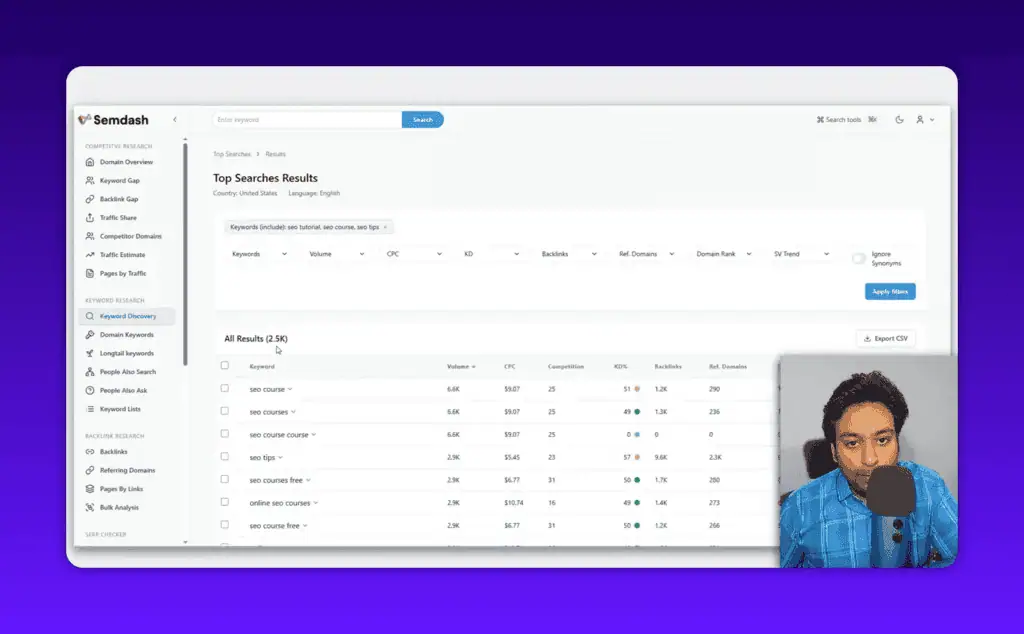
The credit system is worth understanding here. Semdash uses credits for certain report pulls, not unlimited queries. On Plan 3, you get enough credits for serious research work. I didn’t hit a wall during my testing, but if you’re running reports constantly for agency clients, track your usage. The credit refresh schedule means planning batch research days makes sense.
Competitor Analysis and Traffic Share
The traffic share feature is one of Semdash’s most useful differentiators. Instead of just showing you keyword rankings for a single competitor, it lets you enter multiple competitors and see how they divide search visibility across shared keywords.
I tested this with a set of competitors in a niche I know well. The results matched what I expected directionally, showing which domains are dominant for specific keyword clusters and where the traffic concentration is heaviest.
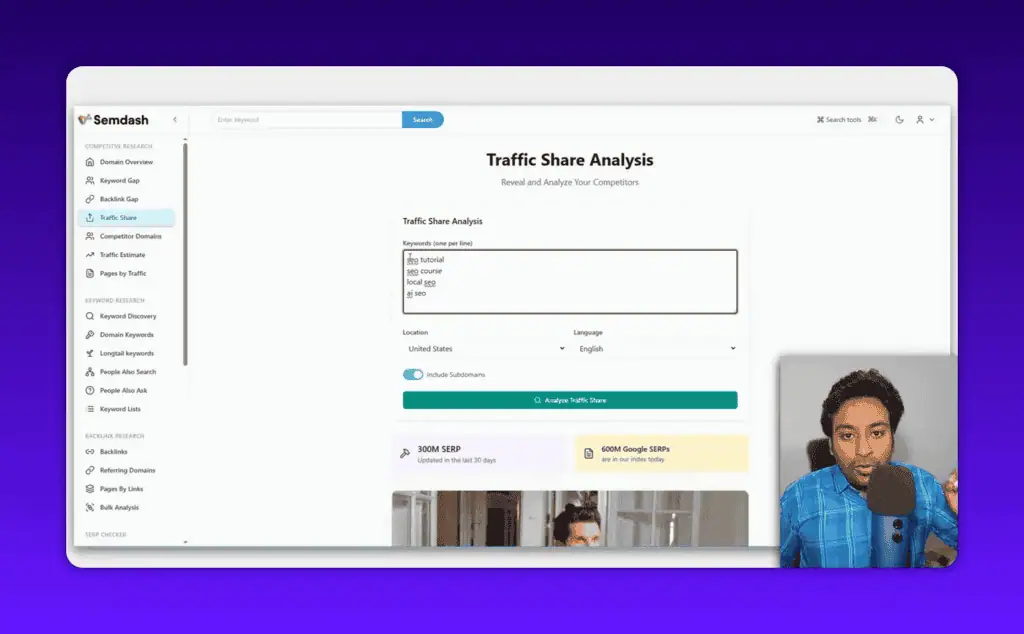
This is particularly useful for content strategy. If you’re trying to understand which content pillars your main competitor owns, traffic share analysis shows you the distribution in a way that raw keyword data doesn’t, and our SEO how-to guides show how to act on it. You can see gaps where no competitor is dominant, which are the easiest ranking opportunities.
The spy-on-competitors angle is central to Semdash’s pitch, and this feature delivers. Whether you’re identifying content gaps, understanding a competitor’s link acquisition strategy, or finding keyword clusters they’re ignoring, the competitive intelligence toolkit is solid.
Backlink Analysis
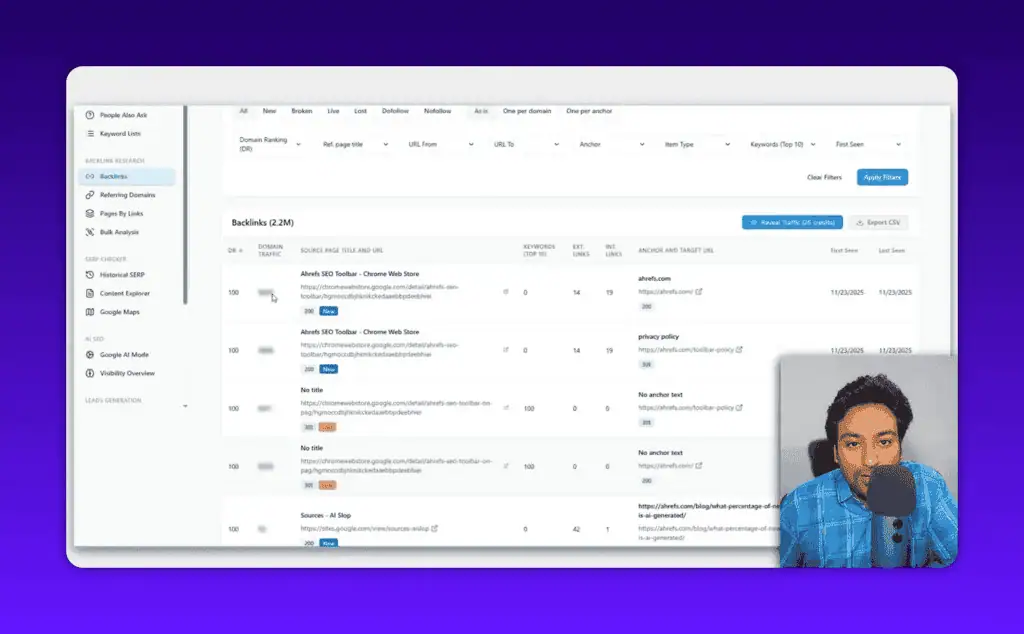
Semdash claims 2.7 trillion backlinks in their database. That’s a large number. In practice, backlink data from any tool other than Google is an approximation, so what matters is whether it’s useful for identifying link opportunities and auditing your own profile.
When I ran backlink reports on sites I know well, the data was reasonable. Not Ahrefs-level comprehensiveness, but good enough for most use cases. You can see referring domains, anchor text distribution, new and lost links, and broken backlinks.
The backlink gap analysis is where things get practically useful. Enter your domain alongside two or three competitors, and Semdash shows you which domains link to your competitors but not to you. These are your highest-priority link building targets because they’ve already demonstrated willingness to link to similar content.
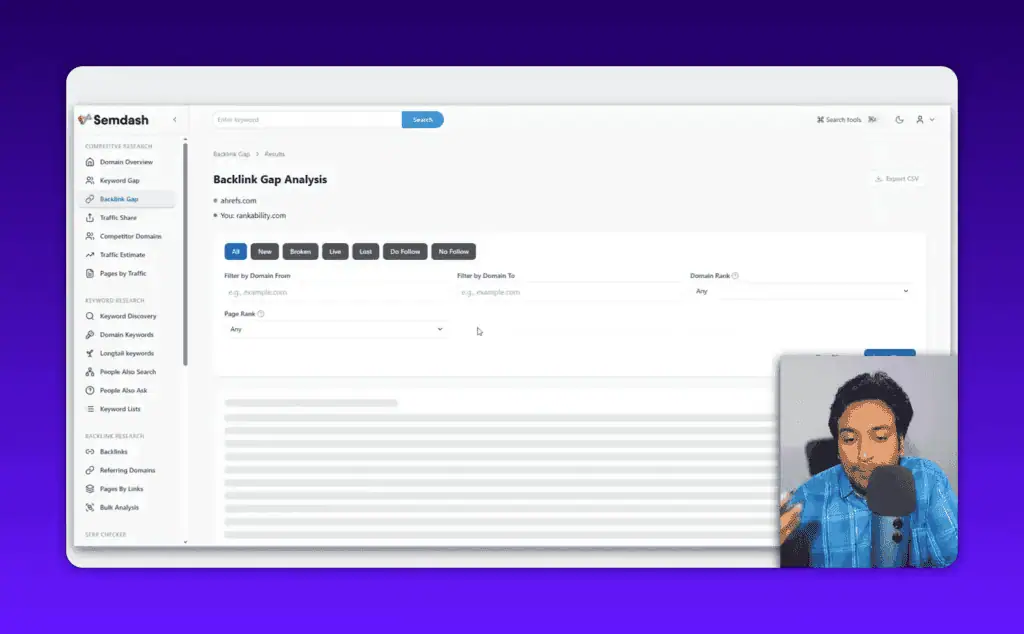
For a tool at this price point, the backlink functionality is genuinely good. It won’t replace Ahrefs if backlink analysis is your primary use case, but it handles the core tasks well.
Top Pages and Rankability Report
The top pages report shows you which pages on any domain drive the most organic traffic, ranked by estimated visits. This is useful for reverse-engineering what’s working for a competitor and identifying what you should create.
What makes Semdash’s version interesting is the rankability score. Each page gets a rankability assessment based on the keyword difficulty of the terms driving traffic to it. High rankability = the competitor is ranking for keywords you could also win. Low rankability = they’re likely ranking because of domain authority you don’t have yet.
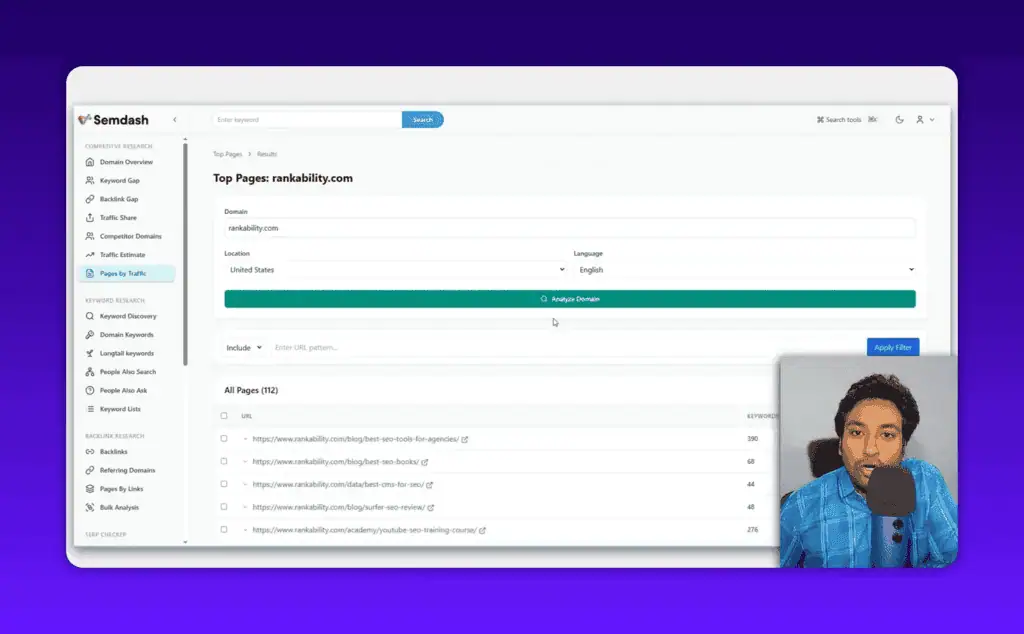
This is practical intelligence for content planning. Instead of just copying competitor topics, you can prioritize by which competitor pages represent winnable opportunities versus entrenched rankings you shouldn’t fight yet.
Content Explorer
The content explorer lets you search across indexed content to find what’s performing well in any topic area. Search a keyword or topic and get a list of pages sorted by traffic, backlinks, or social signals.
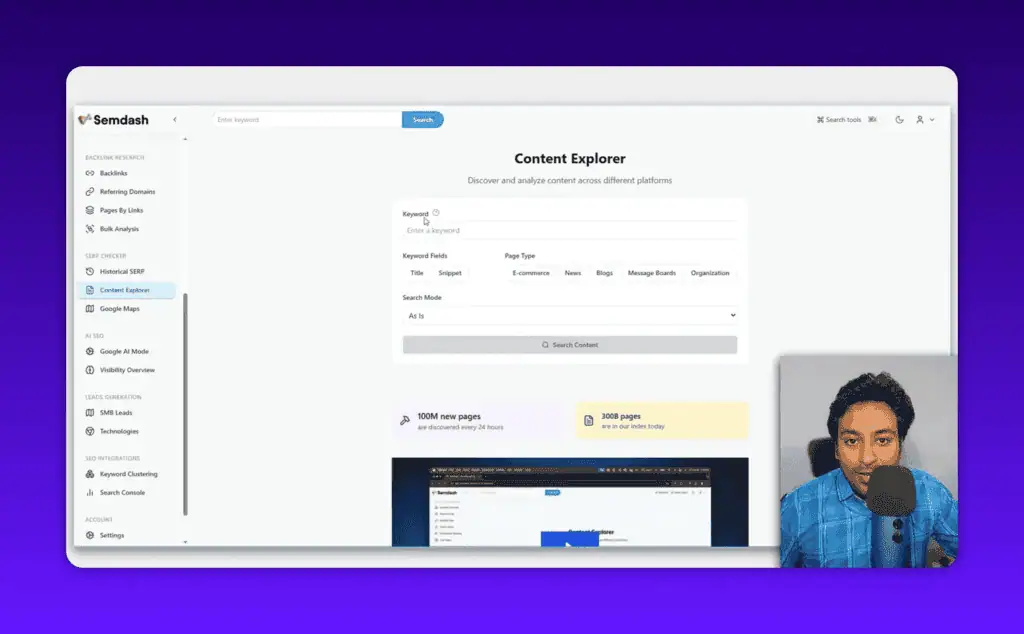
I use content explorer-style features for two things: finding linking targets (what kind of content earns backlinks in my niche?) and identifying content formats that resonate with my audience. Semdash’s version is functional, though not as deep as Ahrefs’ Content Explorer, which has been refined for years.
For basic content research and link prospecting, it’s more than enough.
AI Overview and OpenAI Integration
Here’s where things get interesting, and also where I have to be honest about current limitations.
Semdash has built OpenAI integration directly into the tool for generating AI-powered SEO overviews. The idea is that you can get AI-generated keyword briefs, content outlines, and competitive summaries without leaving the tool.
In my testing, the AI overview feature worked, but the output was unformatted. Raw text without proper structure, which means it needs significant editing before it’s useful in a workflow. The Semdash team is aware of this and it’s on their public roadmap for improvement.
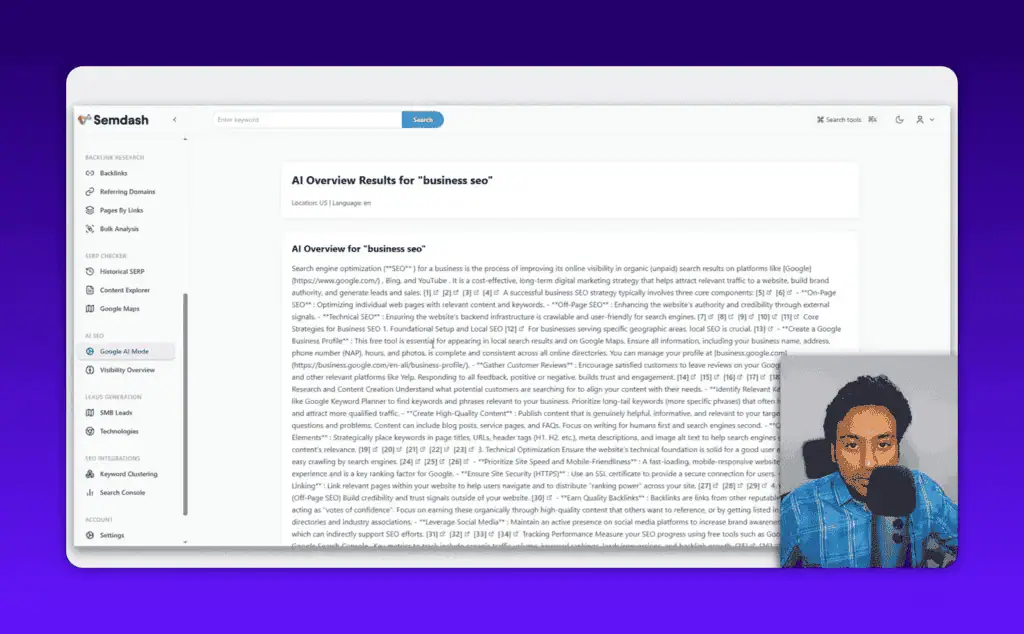
The honest take: the AI integration is in early-stage form. It’s functional but rough. If you’re buying Semdash specifically for the AI features, temper expectations. If you’re buying it for keyword research, competitor analysis, and backlinks, and you see the AI features as a bonus that will improve over time, that’s a more accurate framing.
The roadmap shows active development. The Semdash team is clearly building toward a more polished AI integration, and seeing a public roadmap with specific feature commitments gives me more confidence than tools that promise “coming soon” with no transparency.
Search Console Integration
Semdash offers Google Search Console integration, which lets you blend your actual GSC data with Semdash’s third-party metrics. This is useful because it means you can see real impressions and clicks alongside estimated traffic data, giving you a more complete picture.
The integration is straightforward to set up and makes the domain overview more actionable for sites you own. Instead of relying purely on estimates for your own traffic, you get ground truth from GSC layered in.
Semdash Pricing: Lifetime Deal vs. Monthly Plans
Semdash is currently available on AppSumo as a lifetime deal, which is the primary reason most people are considering it. The LTD pricing tiers at time of writing:
- Plan 1: Entry-level access, limited projects and credits
- Plan 2: Mid-tier with more projects and monthly credit refreshes
- Plan 3: Full access with maximum projects, credits, and API access
I tested Plan 3, which gives the complete experience. The credit system means you need to understand what burns credits versus what’s unlimited. Domain overviews, keyword reports, and standard queries are credit-based. The specific credit costs are shown in the tool before you run a report.
If you’re comparing this to a Semrush subscription, even Plan 1 LTD pays for itself in two to three months against Semrush’s entry plan. At Plan 3 pricing, you’re comparing against six to eight months of Semrush billing before you break even, and then you own it.
For a comparison of other verified AI lifetime deals, we track and test new deals regularly so you can find the best options before they sell out.
Who should stack plans? If you’re managing more than five to ten client sites, Plan 3 stacking gives you expanded project limits and credit pools. Single site owners and freelancers with a few clients don’t need to stack.
Semdash vs. Semrush vs. Ahrefs: Honest Comparison
This is the question everyone asks. Let me give you the straightforward version.
Data quality: Semrush and Ahrefs have larger, more frequently updated databases built over many years. Semdash’s data is good but not at the same depth, particularly for backlinks and historical data. For keyword research in competitive niches, all three will surface the main opportunities. Semdash might miss long-tail variations that Ahrefs catches.
Features: Semrush and Ahrefs have deeper feature sets, particularly for site auditing, rank tracking, and advanced reporting. Semdash covers the core research and competitive intelligence workflows but lacks some of the reporting and project management depth.
Price: This is where the comparison gets obvious. Semrush starts at ~$140/month. Ahrefs starts at ~$129/month. Semdash’s lifetime deal means no recurring cost. For a freelancer or small site owner, that pricing difference is significant.
AI integration: Semdash is actually ahead of legacy tools here in terms of where they’re building. Semrush and Ahrefs have added AI features but Semdash built around AI-powered workflows from the start. The execution needs polish, but the direction is right.
Bottom line: If you need enterprise-grade data accuracy and full-featured auditing for client work, Semrush or Ahrefs is the right call. If you’re a freelancer, blogger, affiliate marketer, or small business owner who needs 80-90% of the functionality at a fraction of the cost, Semdash makes strong sense, as do lighter suites like our Morningscore SEO review.
Who Should Buy Semdash?
You’ll love Semdash if you’re:
- A freelance SEO consultant who can’t bill Semrush costs to every client
- An affiliate marketer or blogger doing your own keyword research
- A small business owner doing in-house SEO for the first time
- Someone looking for an Ahrefs alternative that doesn’t break the budget
- A solopreneur managing 2-5 sites who wants a complete SEO toolkit
Semdash is not right for you if:
- You need audit-grade accuracy for reporting to major clients
- You rely heavily on backlink data for link building at scale
- You need advanced rank tracking across thousands of keywords
- You’re already deeply integrated into the Semrush or Ahrefs ecosystem
Priya runs an affiliate site in the personal finance niche. She was paying $99/month for Semrush Lite and using maybe 20% of the features. After switching to Semdash, she runs the same keyword research and competitor analysis workflows she was doing before, at zero monthly cost. The data isn’t identical, but it’s close enough for her use case, and she reinvested the savings into content production.
That’s the right mental model for Semdash: not a replacement for power users who need every data point, but a very capable tool for the majority of SEO workflows at a price point that makes sense for independent operators.
Semdash Pros and Cons
Pros:
- Comprehensive keyword research with large database
- Strong competitor analysis and traffic share features
- Backlink gap analysis is genuinely useful
- Lifetime deal pricing eliminates recurring costs
- OpenAI integration (early stage but improving)
- Active development with public roadmap
- Clean, fast interface
- Search Console integration adds real data layer
- Content explorer for link prospecting
Cons:
- Data accuracy lags behind Semrush and Ahrefs
- Credit system limits heavy usage patterns
- AI overview output needs formatting work
- Site audit functionality is basic
- Rank tracking is limited compared to dedicated tools
- Backlink database not as comprehensive as Ahrefs
- Occasional bugs (I found a few during testing)
FAQ
Is Semdash a good alternative to Semrush?
For most solo operators and small businesses, yes. Semdash covers keyword research, competitor analysis, and backlink research at a fraction of the cost. The data quality is close enough for practical SEO work. Where Semrush wins is depth of features and data precision for agency-level reporting.
Is Semdash worth the AppSumo lifetime deal?
Yes, if you’re currently paying for an SEO tool subscription or planning to. The break-even against a Semrush subscription is two to three months at Plan 1. If SEO is part of your workflow and you’re not locked into a specific platform, buying the LTD makes financial sense.
How does the credit system work?
Certain reports, like keyword research pulls and domain overviews, consume credits. Standard browsing and navigation don’t. Credits refresh monthly on a schedule depending on your plan tier. The tool shows you the credit cost before running any report, so you won’t get surprised.
Can I connect multiple websites to Semdash?
Yes. The number of projects you can track depends on your plan tier. Plan 3 gives the highest project limits. If you’re managing client sites or multiple owned properties, check the current plan limits on the AppSumo listing before buying.
Does Semdash save my reports automatically?
Reports and analysis are accessible within your account. The tool doesn’t automatically export to PDF or CSV unless you trigger it, but your research history is stored in your account.
Is the OpenAI integration available now?
Yes, but in early form. The AI overview feature is functional but the output is unformatted plain text. It’s on the active roadmap for improvement. Think of it as a beta feature that’s useful now but will get significantly better.
Does Semdash work for local SEO?
Local keyword research is possible, but Semdash is primarily oriented toward organic search at scale rather than local SEO workflows. For local SEO, dedicated tools with location-based search volume are more reliable.
Verdict: Is Semdash Worth It?
Buy if: You’re doing SEO without a dedicated tool, you’re currently paying monthly for a subscription you’re not fully using, or you need a capable backup tool at zero ongoing cost. The value proposition at LTD pricing is genuinely strong.
Wait if: You need maximum data accuracy for agency client reporting or you’re dependent on specific Semrush/Ahrefs features that Semdash doesn’t match yet.
Skip if: You need enterprise-level auditing, advanced rank tracking at scale, or you’re doing serious link building work that requires Ahrefs-grade backlink data precision.
My take after testing Plan 3: Semdash is a real tool that does real work. It’s not a Semrush killer, but it doesn’t need to be. For the target audience, which is budget-conscious SEO practitioners who need core research capabilities without a monthly bill, it’s a solid buy.
The AI features need polish, some data estimates run long, and there are occasional UI bugs. But the development velocity is real, the roadmap is public, and the core functionality is sound.
For anyone managing their own SEO and looking for a capable, cost-effective research toolkit, Semdash earns a buy verdict.
If you’re tracking tested AI lifetime deals to find the best value options before they expire or sell out, we cover new deals as they come to market with honest verdicts.
Disclosure: This review contains affiliate links. If you purchase through my links, I may earn a commission at no extra cost to you. I tested Plan 3 personally and all screenshots are from my own account.
Liked this review? Pin ZPlatform as your Preferred Source.
Pinning us tells Google to make our hands-on AI reviews, verified lifetime deals, and founder interviews more likely to appear prominently for you in Top Stories and eligible AI Search experiences (AI Mode, AI Overviews). Set it once, no account needed on our end.
- 500+ AI tools tested with real budgets
- Verified deals - no dead affiliate links
- Editor: Alston Antony, 15+ years in SaaS & SEO
 Opens Google · takes 2 seconds
Related Posts

I tested AgainstData on 355 pages of Gmail data. Here’s my honest review: bulk unsubscribe, personal data deletion reque...
I ran AI-Text-Humanizer.com through ZeroGPT and AIscan24 with real before and after scores. Here is what works, what it ...
I ran five text samples through AIscan24, including two I wrote by hand. One scored 80% AI. Here is what this free detec...
Starting August 2, 2026, the EU AI Act’s transparency provisions become enforceable. That means if your website uses AI-...

My hands-on Answer Socrates review covering all features, free plan limits, pricing, and how it compares to AlsoAsked. I...
“I’ve spent $4,200 on 118 AppSumo lifetime deals over 5 years. Here’s my honest review: what works, what fails, and whet...