

Verdict: Wait
Every Anyone was Metaphysic’s hyperreal AI avatar generator, launched in 2022 and no longer operational. This historical review draws on archived copies of everyany.one, press coverage from 2022 and 2025, and directory listings, checked on 17 November 2026. We have no hands-on test results, so nothing below is a performance claim.
Every Anyone at a glance
| What it was | An AI avatar generator that turned a photo into a hyperrealistic, editable digital likeness |
| Built by | Metaphysic, a synthetic media company founded in London in 2021 |
| Launched | Announced in March 2022 |
| Pricing | Never published as a plan list; directories showed “contact for pricing” |
| Status | Discontinued. The original avatar service is no longer available |
| Verdict | Worth understanding as an early synthetic identity experiment. Not something you can use today; pick a live avatar tool instead |
What was Every Anyone?
Every Anyone was a consumer AI avatar platform from Metaphysic. Its homepage promised “hyperreal avatars for the metaverse” and described the project as “using AI to build the hyperreal metaverse owned by you”. You took a photo of yourself, the system generated a hyperrealistic synthetic version of your face, and you could edit it and use the result on other platforms.
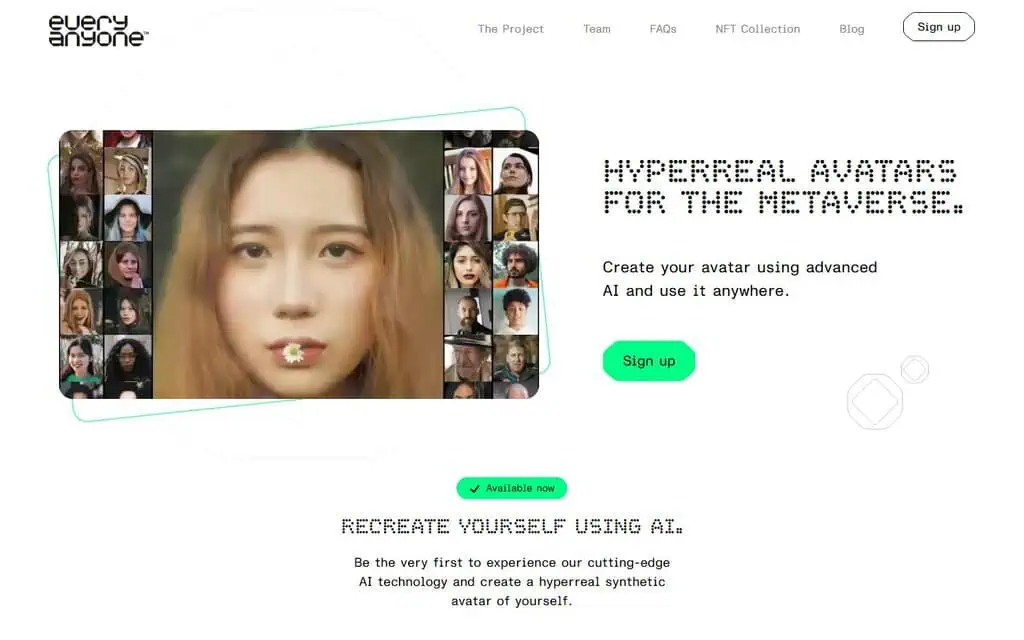
The everyany.one homepage as archived by the Internet Archive on 22 November 2022.
Two things set it apart from the avatar apps of the time:
- Realism over style. Most avatar generators in 2022 produced cartoons, anime portraits or stylised profile art. Every Anyone aimed for a believable version of the real person.
- Ownership as the pitch. The site argued that people should own and control their synthetic likeness and the biometric data behind it, instead of leaving it with whichever platform rendered it.
The site called Every Anyone “a community project initiated by the team at Metaphysic.ai”. Metaphysic was co-founded by AI artist Chris Umé, known for the viral deepfake Tom Cruise videos, and its synthetic performances reached the America’s Got Talent finals in 2022, a pipeline NVIDIA wrote about when it covered the technology behind those avatars. Every Anyone was the consumer front door to that research.
How the Every Anyone avatar generator worked
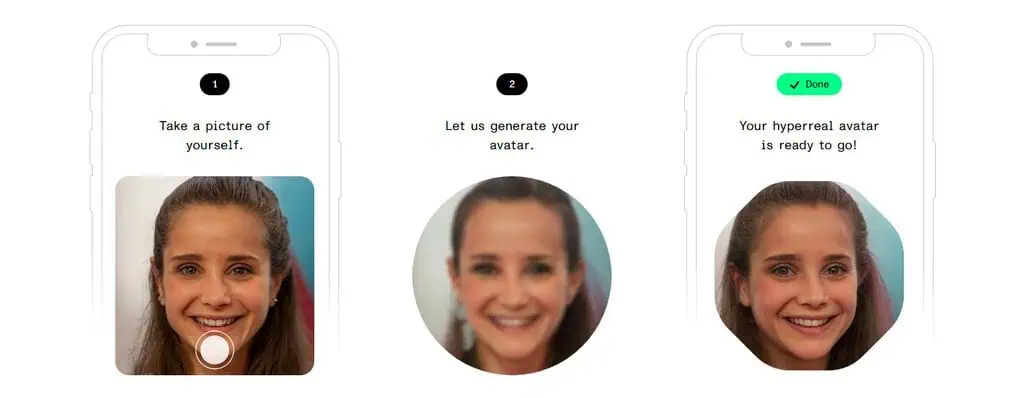
The archived site laid the process out in three steps, followed by an editor:
- Take a picture of yourself. Sign-in was through Twitter, Google or Facebook, and the source was a photo of your face.
- Let the AI generate your avatar. The model produced a hyperrealistic synthetic version of you.
- Your hyperreal avatar is ready. The finished likeness could be saved and, according to the site, used across platforms and apps.
Editing age, mood and smile
The section headed “Play around with your look” showed sliders for Mood, Age and Smile, and was marked “Available now”. Moving a slider changed that attribute on the same face: a younger version, a more neutral expression, a broader smile.
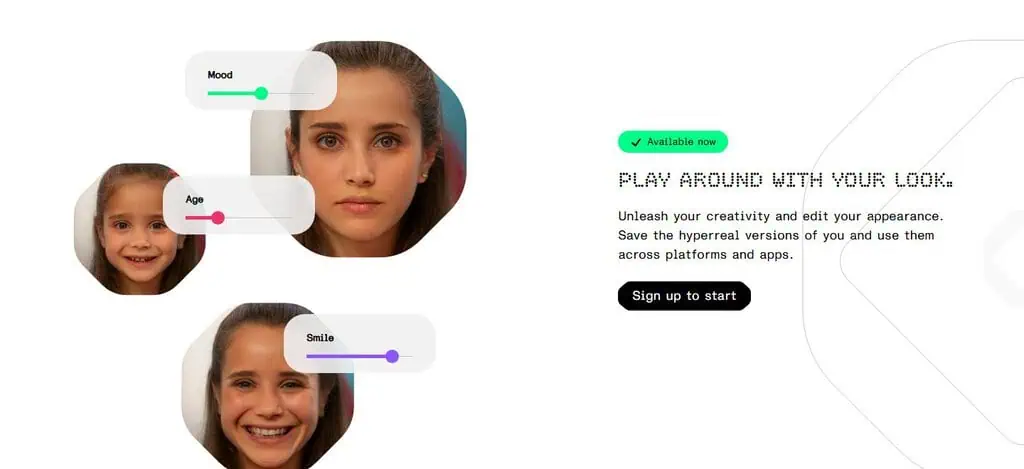
The technique behind this is usually described as facial manipulation in vector space. A generative model represents a face as a point in a mathematical space, where directions correspond to attributes such as age or smile. Moving the point along one direction produces a variation of the same person rather than a new face. NVIDIA’s coverage tied Metaphysic’s work to variants of its StyleGAN models, the family this kind of attribute editing is usually built on, although Metaphysic never published a technical specification for the consumer product.
Documented features versus stated ambitions
The site was unusually clear about what existed and what did not, because it labelled each section “Available now” or “Soon”.
| Marked “Available now” | Marked “Soon” or “coming soon” |
|---|---|
| Creating a hyperreal avatar from a photo | Owning and controlling use of your biometric data |
| Editing mood, age and smile | Avatars as IDs for a Web3 content economy |
| Saving the edited versions of yourself | Animated avatars usable in social media, video calls and games |
| A 10,000-piece NFT “Community Collection” of fictional people | Full details of the ownership model, listed as “coming soon” |
The left column describes a working avatar generator in early access. The right column describes a vision. In the last archived copy of the original site, from December 2023, the ownership and animation sections were still marked “Soon”, and we found no evidence that they shipped.
The synthetic identity and Web3 vision
Every Anyone launched at the peak of the 2022 metaverse and NFT cycle, and the product was framed for it. The pitch ran like this: as more of life moves into virtual spaces, people need to “be in control of who you are”, own their biometric data, and let their hyperreal avatars “become your IDs to web3 content economy”.
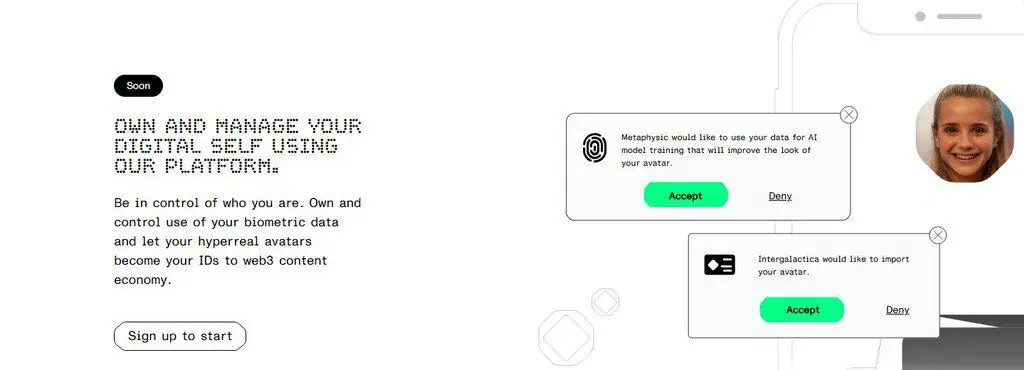
The mock-up shows how that control was meant to feel in practice: consent prompts asking whether Metaphysic could use your data for model training, or whether another app could import your avatar, each with Accept and Deny buttons.
The first public product of that vision was not a personalised avatar at all. The signature NFT collection featured 10,000 AI-generated fictional people who do not exist, described as “version 0.1, the prototypes”, animated by AI so that they aged, changed gender and smiled. The site said it wanted its community to experiment with those before the personalised avatars launched.
The question underneath the pitch has aged better than the mechanism. Generative AI made realistic human images cheap within a couple of years, and consent, deepfakes and control of a person’s likeness are now mainstream concerns. Every Anyone was asking about that problem early, even if the NFT answer it offered did not hold up.
Who Every Anyone was built for
These are the audiences the product was pitched at, not documented customer results:
- Content creators who wanted one recognisable, high-quality face across channels without posting real photos everywhere.
- Social media users curious about a realistic digital version of themselves for profile pictures and messaging.
- Web3 and metaverse participants who wanted an avatar they could treat as an owned, portable asset.
- Privacy-minded people drawn to the idea of controlling how their likeness and biometric data were used.
It was a poor fit for anyone who simply needed a professional headshot, since the identity and ownership layer added nothing to that job, and for businesses that needed published pricing to budget against.
Limitations and what is still unknown
The gaps matter as much as the features, because they decide what can honestly be said about the platform:
- No published pricing. Directories listed Every Anyone as “contact for pricing”, so there is no reliable plan or subscription history to report.
- No independent quality data. We found no benchmark of output quality, processing time or consistency between generations. The site’s own example images are marketing, not evidence of typical results.
- The ownership layer never arrived. Promising that users own their biometric identity is different from showing how that ownership is enforced, and those sections were still labelled “Soon” more than a year after launch.
- Dependence on a fading market. Much of the value proposition rested on metaverse platforms and NFTs, both of which cooled sharply after 2022.
- Hyperreal output carries risk. A realistic synthetic face of a real person is useful for a creator and dangerous in the wrong hands. The public material said little about how misuse would be prevented.
Is Every Anyone still available?
No. The Every Anyone avatar service is no longer operational, and you cannot sign up, generate an avatar or download a previous one. The Internet Archive’s last capture of the original site is from December 2023.
The company behind it has moved on as well. In February 2025, Metaphysic merged into Brahma, the AI and technology business of the visual effects studio DNEG, and its CEO Tom Graham became president of Brahma. By then the company was best known for film work, such as the AI de-ageing in the 2024 film Here, rather than for a consumer avatar app.
The everyany.one domain no longer belongs to the original product. It now redirects to this page.
Live alternatives to Every Anyone
If you arrived here looking for a working AI avatar generator, these cover the same ground today. Prices checked on 17 November 2026.
| Tool | Choose it if you want | Price |
|---|---|---|
| HeyGen | A talking video avatar of yourself for social or marketing videos | Free plan with 3 videos a month; Creator plan $29 a month |
| Synthesia | Presenter-style avatar videos for training or business content | Free Basic plan; paid Starter plan listed at $19 to $29 a month depending on billing and source, so confirm at checkout |
| Free AI portrait generators | A realistic profile picture or headshot without paying | Free options compared in our roundup |
None of these offer Every Anyone’s ownership or NFT layer. For most people that layer was the least practical part of the product anyway, so a modern avatar tool covers the everyday job better than the original platform would have.
Our verdict on Every Anyone
Every Anyone matters more as a marker in the history of synthetic media than as a product. It took research-grade hyperreal face generation, the same lineage as Metaphysic’s stage and film work, and tried to hand it to ordinary people with ownership attached. The avatar generation and editing were real and available. The identity economy around them stayed labelled “Soon”.
Treat it as a case study: an early answer to the question of who should control a person’s digital likeness. Do not treat it as a tool you can use. If you need an AI avatar now, start with one of the live alternatives above.
Frequently asked questions
Was Every Anyone associated with Metaphysic.ai?
Yes. The site described Every Anyone as a community project initiated by the team at Metaphysic.ai, the London synthetic media company led by CEO Tom Graham and co-founded by Chris Umé.
Did Every Anyone sell NFTs?
Its first public collection was a set of 10,000 AI-generated fictional people released as NFTs, described as prototypes. The site presented them as a community experiment to run before its first generation of personalised NFT avatars, and the ownership model behind those was still listed as coming soon in the last archived copy.
What happened to Metaphysic?
Metaphysic merged into Brahma, the AI and technology business of the visual effects studio DNEG, in February 2025. The deal was framed around film and enterprise tools rather than a consumer avatar app.
Related Posts

I tested AgainstData on 355 pages of Gmail data. Bulk unsubscribe, personal data deletion requests, pricing, and whether...

AI-Text-Humanizer.com took a 132-word ChatGPT paragraph from 100% AI to 0% on ZeroGPT but flattens your voice. Buy the $...
AIscan24 is a free, no-signup AI detector: it caught pure ChatGPT text at 100% but scored my handwritten paragraph 80%. ...
Honest Aithenticate review after hands-on testing. Does this AI disclosure badge tool meet EU AI Act requirements? Prici...

Allavsoft review: a Windows and Mac video and music downloader with batch queues, 8K support and format conversion, from...

My hands-on Answer Socrates review covering all features, free plan limits, pricing, and how it compares to AlsoAsked. I...