

The best AI receptionist tools in 2026 depend on how many calls you take and who needs to pick up. Rosie, Goodcall and Frontdesk suit small businesses, RingCentral AI Receptionist suits teams already on its phone system, and Smith.ai adds real people when the AI can’t cope. A single call costs roughly 50 cents to $10, depending on the model.
I’m Alston Antony. I’ve bought and tested 500+ AI and SaaS tools with my own money, but I have not put any of these nine on a live business line, so this compares price, limits and design, not how well each one sounds on a real call. Everything below comes from each vendor’s own pages, checked on 17 November 2026, plus the rules that apply to recording calls and handling health data. It isn’t legal advice.
No vendor paid for a place on this list, and every vendor link is a plain, non-affiliate link. I left out contact-centre platforms that bill per user and hide the price behind a demo, because they answer a different question from “who picks up when I’m with a customer?”
Which AI receptionist tools are worth comparing in 2026?
Nine tools passed one test: a public page I could read for what the tool does and, where the vendor shares it, what it costs. Five are general-purpose receptionists, two are built for restaurants and dental practices, and two are platforms you configure yourself. The table shows the price and limits that matter.
| Tool | Best for | How it’s priced | Entry price | Free option |
|---|---|---|---|---|
| Rosie | Solo owners and small shops | Minutes per month | $49/mo for 250 minutes | 7-day trial |
| Goodcall | Shops with unpredictable call volume | Per unique customer | $79/mo for 100 customers | Free demo agent |
| Frontdesk | Voice, chat and text in one plan | Minutes per month | $99/mo ($79 billed yearly) for 200 minutes | Trial terms vary by plan |
| RingCentral AI Receptionist | Teams on RingCentral | Flat licence, minutes included | $49/mo for 100 minutes | Trial |
| Smith.ai | AI with human backup | Per call | $0 for 25 calls, then $3 a call | Free AI-first plan |
| Slang.ai | Restaurants | Per location | From $399/location/mo | Quote |
| Dentina | Dental practices | Not published | Not published | 30-day trial |
| Retell AI | Developers building their own | Per minute | $0.07 to $0.31/min | $10 in credits |
| Synthflow | Mid-market and enterprise | Annual contract | Not published | None |
Prices checked 17 November 2026 on each vendor’s own site. AI receptionist pricing is rarely like for like: most plans bill monthly or yearly, and several vendors meter by something other than minutes, so the next sections show what each number actually buys.
Can an AI receptionist answer calls, book appointments and transfer callers?
Yes, on the plans that include those features. An AI receptionist, sometimes sold as an AI answering service or a virtual receptionist, is an AI voice agent that answers your business line, understands what the caller wants, and acts on it: it answers questions, takes messages, books appointments and transfers calls. A phone menu makes callers press buttons, and a human answering service takes messages by hand and charges per minute or call. The AI version handles each inbound call in conversation, using conversational AI, so a small business owner can answer calls and questions about business hours and prices without picking up.
Here is what the nine tools do on the vendor pages I read:
- Answer around the clock. These tools answer 24/7, and Rosie notes it handles several calls at once, so a busy morning doesn’t produce a busy signal.
- Book appointments. Rosie books on your calendar from its $149 plan, RingCentral AIR integrates with calendars, and Smith.ai’s AI-first plans include AI scheduling through tools like Calendly.
- Transfer calls. Rosie offers warm transfers (it briefs your team before connecting) and waterfall transfers that try several numbers. Retell lists a call-transfer feature for switching between human and AI.
- Answer questions. A knowledge base or FAQ lets the agent answer questions about hours, prices and services. Rosie takes custom FAQs, and Retell lists a knowledge base.
- Take messages and capture leads. RingCentral AIR uses intake questions you set, and Rosie sends call summaries, transcripts and recordings after each call.
- Work after hours and in other languages. RingCentral AIR lists 10+ languages and switches mid-call, Rosie covers English and Spanish on every call, and Slang.ai’s Premium plan lists 97 languages.
- Text the caller. Rosie can send a text during the call, and RingCentral AIR has an AI SMS agent.
Two limits are worth knowing before you buy, and a human receptionist still has the edge on both. An AI that books appointments needs your calendar and your rules, so a sloppy setup books the wrong thing. And a missed or misheard call is still a missed call, which is why Smith.ai and RingCentral both sell a way to hand off to a person.
Which AI receptionists suit a small business on a budget?
These three are built for service businesses such as plumbers, salons and clinics, with one business phone number and no IT person. They bill differently: Rosie by minutes, Goodcall by unique callers, and Frontdesk by minutes inside a bundle that also covers chat and text.
Rosie: the clearest plans for a solo owner
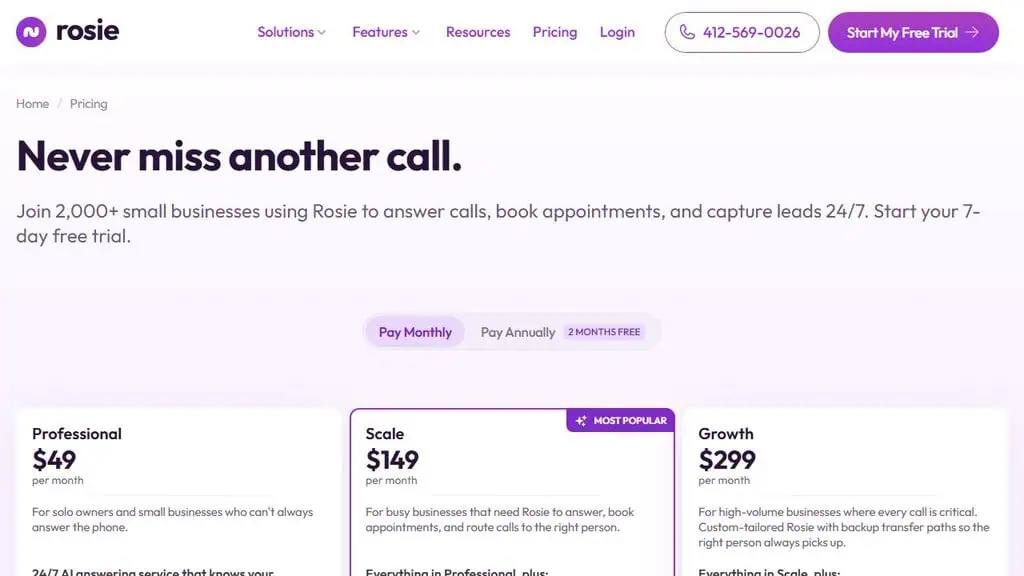
Rosie sells three plans by monthly minutes, and every plan includes a 24/7 answering agent trained from your Google profile and website, 10+ voices, English and Spanish, call summaries and recordings, and a Zapier link to 1,000+ apps. It says 2,000+ small businesses use it, which is the vendor’s figure.
A realistic use is a painter or plumber who can’t answer calls on a ladder and wants every missed caller to get a text with a booking link.
The catch is what each plan unlocks. The $49 plan takes messages and texts appointment links, but booking directly on your calendar and transferring live calls start at the $149 plan. If you need a call to reach a person, you’re paying for Scale.
- Pricing (checked 17 Nov): Professional $49 a month for 250 minutes. Scale $149 for 1,000 minutes (calendar booking, warm and live transfers). Growth $299 for 2,000 minutes (waterfall transfers, custom training). 7-day free trial; paying yearly gives 2 months free.
- Best for: owners who want a predictable bill and a plan they can read in a minute.
Goodcall: you pay per customer, not per minute
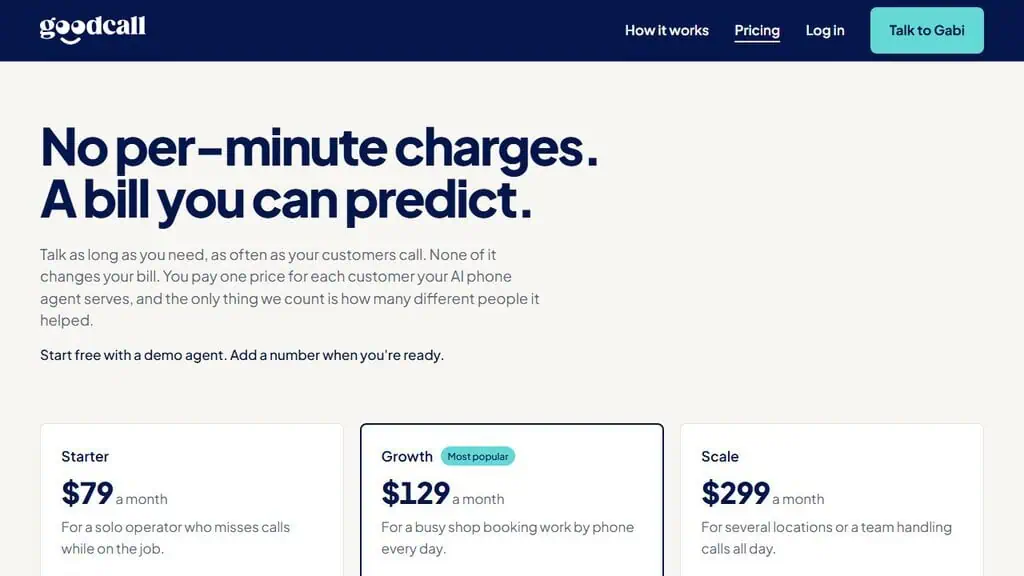
Goodcall, which sells an AI phone agent for call answering, bills by unique callers. A caller who rings five times in March counts once, and spam and wrong numbers don’t count. It never meters minutes, so a 30-second wrong number and a 9-minute booking cost the same.
For example, a salon that gets the same regulars every week pays for each regular once a month, which is a different bill from a minute-metered tool.
The limit is the customer cap. Starter includes 100 unique customers and charges 79 cents for each extra one, so a busy month stays predictable but not flat. The vendor says it will tell you when a bigger plan would be cheaper.
- Pricing (checked 17 Nov): Starter $79 a month for 100 unique customers (about 150 calls). Growth $129 for 500 (about 750 calls, 26 cents each after). Scale $299 for 2,000 (about 3,000 calls, 15 cents each after). A free demo agent lets you build and test before you connect a number.
- Best for: shops where call length varies wildly and a minute meter would be unpredictable.
Frontdesk: voice, chat and text in one plan
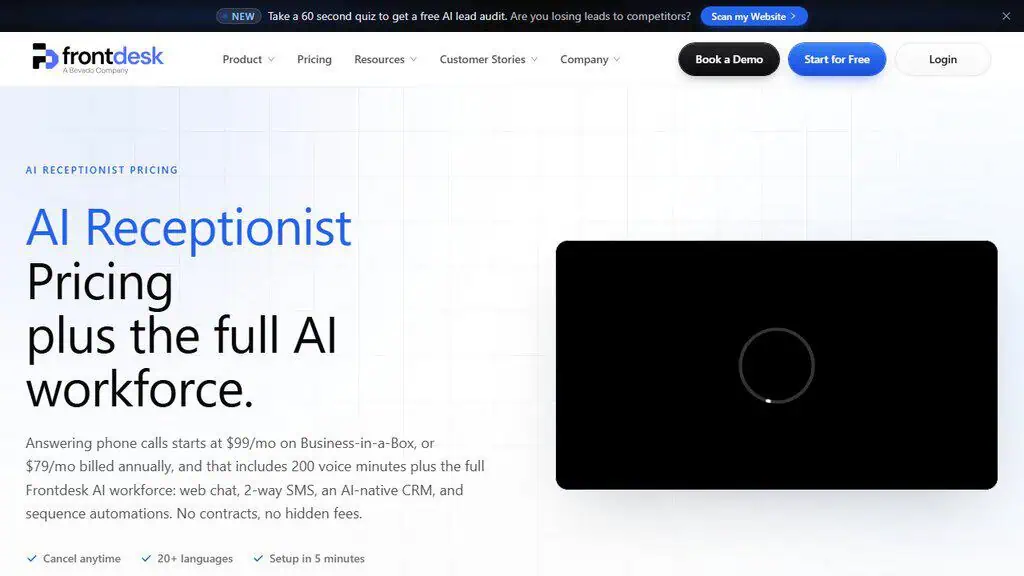
Frontdesk, the product at myaifrontdesk.com, sells a single self-serve plan, Business-in-a-Box, that bundles the phone agent with web chat, two-way SMS, a CRM and automations. Higher volumes go to a custom Partner and Enterprise plan with API access.
A realistic use is a small clinic that wants the phone, the website chat and follow-up texts handled by one tool instead of three subscriptions.
The limit is the minute cap. The plan includes 200 voice minutes a month, which is about 50 calls at four minutes each, and extra use runs on overage credits that auto-reload. Check how fast that bill grows before you point a busy line at it.
- Pricing (checked 17 Nov): Business-in-a-Box $99 a month, or $79 billed annually: 200 voice minutes, 100 chatbot conversations, 400 SMS, Zapier. Partner and Enterprise custom, with voice from 7 credits a minute.
- Best for: a small business that wants phone, chat and text from one vendor.
Phone-system and human-backup picks: RingCentral AI Receptionist and Smith.ai
Two vendors pair the AI with something else. RingCentral ties it to its phone system, and Smith.ai lets you choose between AI-first, hybrid and human-first answering.
RingCentral AI Receptionist: the one to check if you already use RingCentral
RingCentral AI Receptionist (AIR) is AI call handling that sits on its business phone system. It answers calls and texts, books appointments, routes callers with context, and answers on your existing business number. It updates CRMs such as Salesforce, HubSpot and Zoho, and its page lists SOC 2 Type II and HIPAA among its compliance badges.
A realistic use is a practice already running RingCentral phones that wants the AI to take overflow and after-hours calls on the same number.
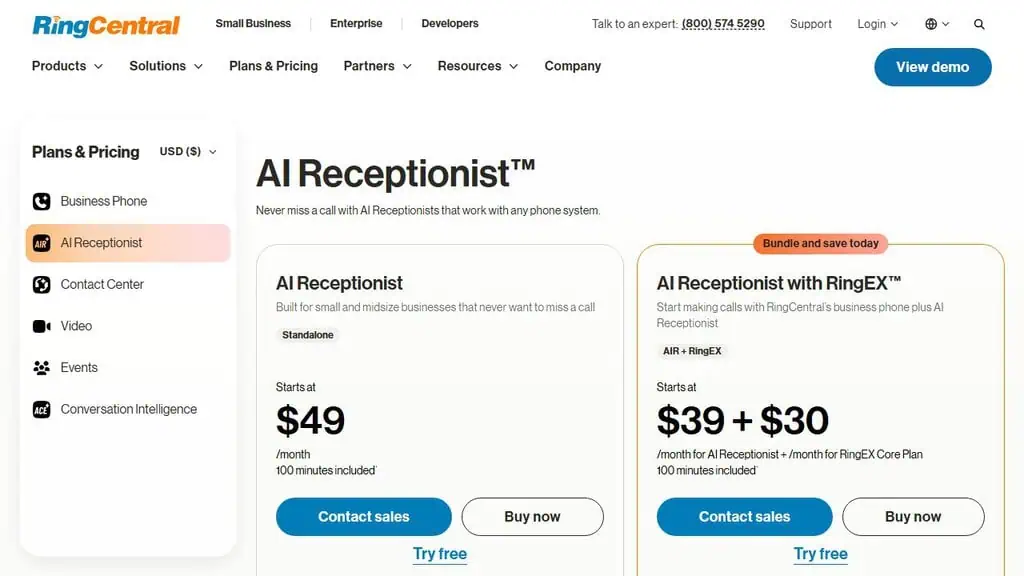
The limit is availability and minutes. It is sold standalone or as an add-on in the US and Canada, and as an add-on only in the UK, Australia and the EU. It includes 100 minutes a month, and I didn’t find the overage rate on the page I read.
- Pricing (checked 17 Nov): $49 a month standalone with 100 minutes included, or $39 a month for AIR plus $30 a month for a RingEX Core plan.
- Best for: businesses already on RingCentral, or those who want a CRM-connected agent on one number.
Smith.ai: AI first, with people available
Smith.ai, which brands its AI plans as an AI front desk, is the only tool here that sells all three modes: AI-first, hybrid, and human-first receptionists. The AI-first plans include a Quality Studio for testing before you go live, 24/7 answering, call recordings and summaries, lead qualification, scheduling and integrations such as Clio and Zapier.
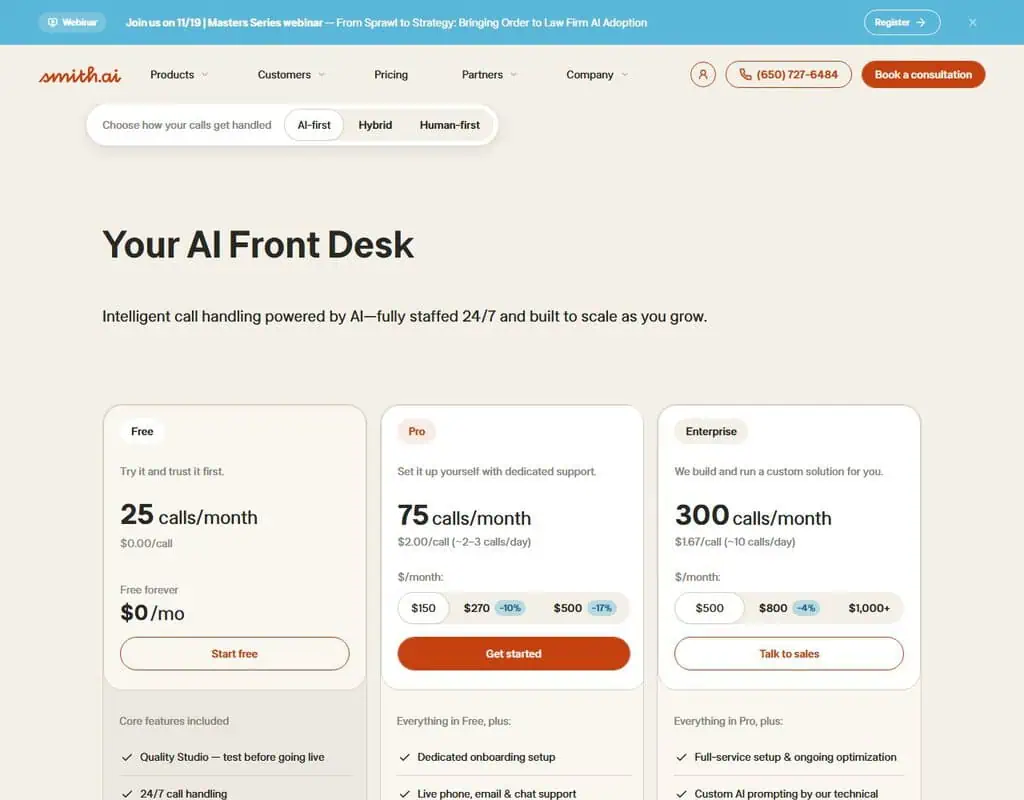
For example, a law office could start on the free AI-first plan, then move to hybrid for the calls where a person should pick up.
The limit is cost once volume grows. The free plan covers 25 calls, then $3 a call. Pro is $150 a month for 75 calls at $2.00 each (its selector also offers $270 and $500 tiers for more calls), and Enterprise is $500 for 300 calls at $1.67. The human-first plans are far pricier per call, as the cost section shows.
- Pricing (checked 17 Nov): AI-first Free $0 for 25 calls ($3.00 each after). Pro $150 a month for 75 calls. Enterprise $500 for 300 calls. Human-first from $300 a month for 30 calls. Hybrid pricing is on its own page.
- Best for: businesses that want AI to start and a person for the calls that matter.
Restaurant and dental picks: Slang.ai and Dentina
Industry-specific tools know the jargon and plug into the systems that run the business. They cost more or hide the price, and they only help if you are that kind of business.
Slang.ai: reservations for restaurants
Slang.ai answers restaurant calls and turns them into reservations. The Core plan covers reservation management, text links and confirmations, VIP call handling, special-request collection and bilingual support. Premium adds 97 languages, custom branding and reservation cross-selling.
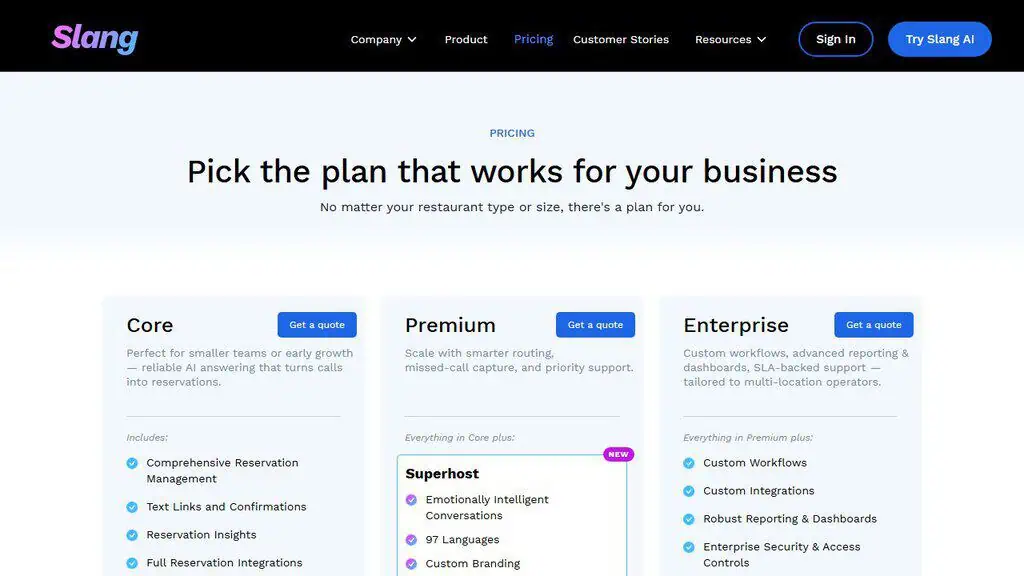
A realistic use is a restaurant that loses covers during the dinner rush because nobody can pick up.
The limit is price per site. Core starts at $399 a month per location and Premium at $599, so a three-location group pays at least $1,197 a month before any extras.
- Pricing (checked 17 Nov): Core from $399 per location a month (quote-based). Premium from $599 per location.
- Best for: restaurants where phone reservations are a real share of covers.
Dentina: a dental receptionist that also makes calls
Dentina calls itself an AI dental receptionist built by a dentist. It books calls you miss and calls patients to confirm appointments and book recalls. It works with Dentrix, Eaglesoft, Open Dental, Curve and Denticon.
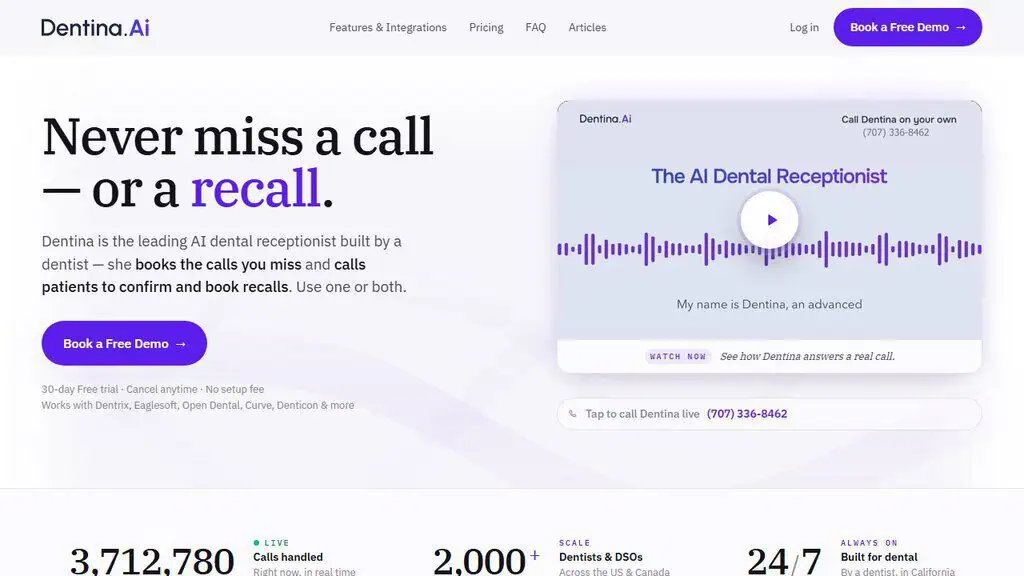
A realistic use is a practice with an empty recall list that wants calls made to patients, not just answered.
The catch is that I found no public price, only a 30-day free trial with no setup fee. The page also says it “typically recovers $16,632+/mo for practices like yours.” Treat that as a sales projection until you run your own numbers.
- Pricing (checked 17 Nov): not published. 30-day free trial, no setup fee, cancel anytime.
- Best for: dental practices that want both inbound answering and outbound recall calls.
Can I build my own AI receptionist with Retell or Synthflow?
Yes, if you can build and test a phone agent. Retell AI is a self-serve platform for developers, and Synthflow sells agents on an enterprise contract. Both give you the building blocks instead of a finished receptionist, which means the setup, testing and compliance are yours.
Retell AI: pay per minute, build it yourself
Retell AI, a voice AI platform, starts at $0 with $10 in free credits and charges $0.07 to $0.31 a minute for voice agents. Its feature list includes call transfer between AI and a human, appointment booking against live availability, a knowledge base, navigating phone menus, post-call analysis and AI quality assurance.
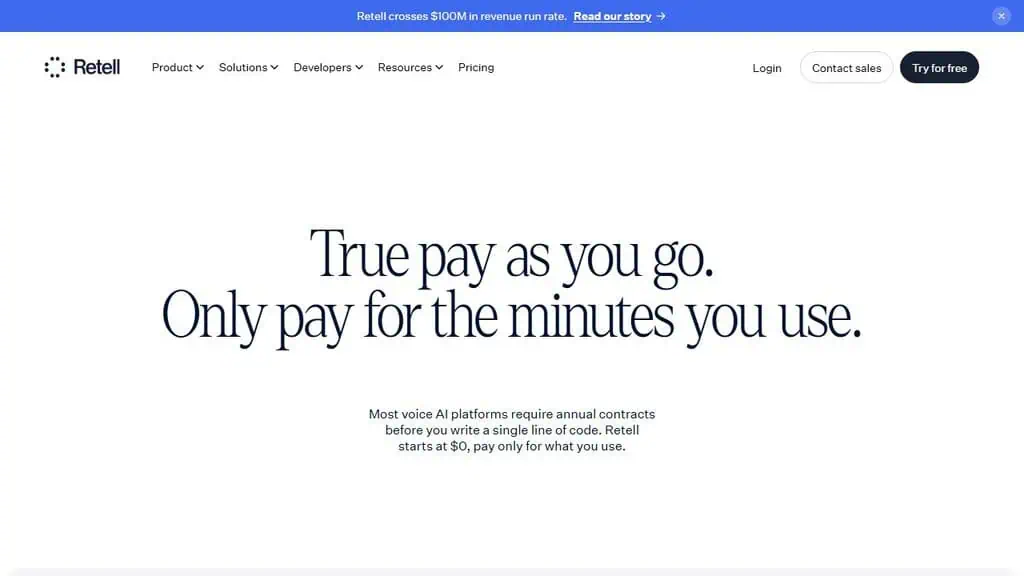
A realistic use is a developer building a receptionist for one niche, say a mobile vet, with custom booking rules a packaged tool can’t offer.
The limit is that you are the product manager. The price depends on the model and voice you pick, and its own example breaks one rate into model, voice and speech costs, so you have to watch the total.
- Pricing (checked 17 Nov): $0 to start, $10 free credits, $0.07 to $0.31 a minute for voice agents.
- Best for: developers who want control and can test an agent properly.
Synthflow: an enterprise contract, not a self-serve plan
Synthflow describes itself as an enterprise voice-agent platform. Every new deployment starts on an annual agreement scoped to call volume, phone system, integrations and security review. It lists no free plan, no trial and no per-minute rate.
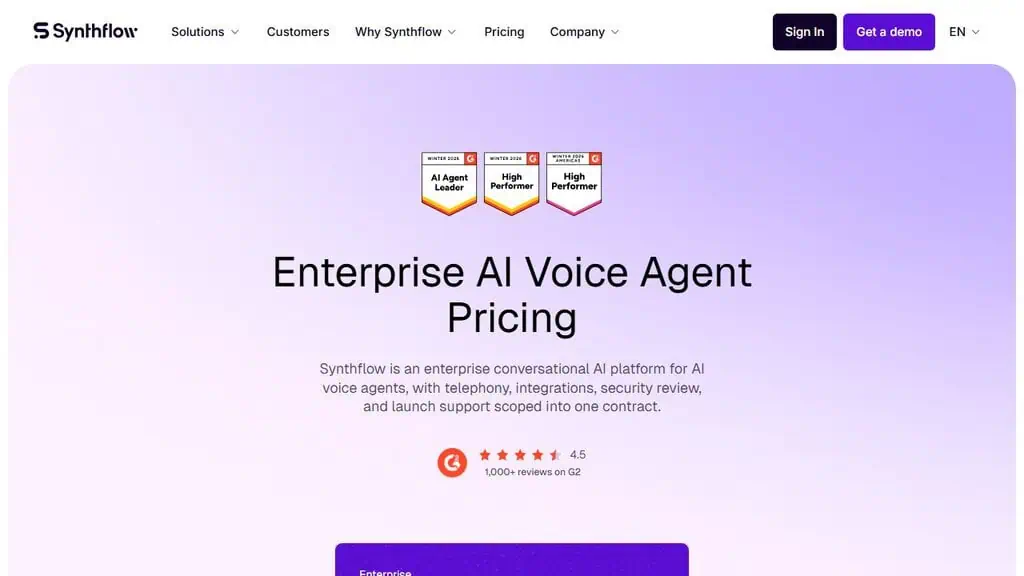
It fits a company deploying voice agents across customer service, sales and support. It doesn’t fit a single-location business that wants an answering agent this week.
- Pricing (checked 17 Nov): quote only, annual enterprise agreement.
- Best for: mid-market and enterprise teams with procurement and security reviews.
A third route is to use a general AI assistant such as ChatGPT to draft your agent’s script, FAQs and booking rules, then load them into a tool above. An assistant can write the words. It can’t answer your phone, so it only covers the writing.
How much do AI receptionist tools cost, and is there a free one?
AI receptionist plans run from free to about $600 a month per location, and the price per call varies tenfold between models. Smith.ai has a free AI-first plan for 25 calls a month. Goodcall lets you build a demo agent for free. Everything else is a trial or a paid plan.
The headline monthly price hides the real unit cost, so here are the numbers per call or per minute. Per-call figures for Goodcall and Rosie are my estimates from each vendor’s own numbers, with a four-minute call assumed for Rosie.
| Plan | Monthly price | What you get | Approx. cost per call |
|---|---|---|---|
| Goodcall Starter | $79 | About 150 calls | About $0.53 |
| Rosie Professional | $49 | 250 minutes | About $0.78 at 4 minutes a call |
| Rosie Scale | $149 | 1,000 minutes | About $0.60 at 4 minutes a call |
| Smith.ai AI-first Pro | $150 | 75 calls | $2.00 |
| Smith.ai AI-first Enterprise | $500 | 300 calls | $1.67 |
| Smith.ai human-first, 300 calls | $2,100 | 300 calls | $7.00 |
| Smith.ai human-first, 30 calls | $300 | 30 calls | $10.00 |
Two things stand out. The AI-first plans cost a fraction of the human-first ones on the same vendor, which is the price of having a person answer. And minute-metered plans only look cheap if your calls are short: a nine-minute booking costs more than a thirty-second wrong number on Rosie, but costs the same on Goodcall.
For scale, Goodcall’s page says a live answering service runs about $1.50 to $1.90 a minute. That is the vendor’s comparison, not an independent figure, but it shows why the per-call gap exists.
Does an AI receptionist pay for itself? The missed-call math
An AI receptionist pays for itself when it recovers more business than it costs, and you can check that before you pay. Take what a new customer is worth to you, count how many calls you really miss, and compare the product of the two with the monthly price. The vendors’ case studies won’t do that sum for you.
I’m wary of the headline claims. My default mode with any tool is doubt, and a vendor’s “hundreds of thousands recovered” figure usually assumes every missed call was a paying customer. As I tell people, if a business owner can’t understand the ROI in 30 seconds, they won’t buy. So here is a 30-second version with your own numbers.
If a new customer is worth $300 to you, which is a hypothetical, then a $149 plan pays for itself when it turns one missed call into one booked job a month. If a typical job is worth $60, the same plan needs three. A cheaper plan changes the break-even without changing the logic:
- Count your missed calls for two weeks. Your phone’s call log has the number.
- Estimate how many would have booked. Most won’t, because some are spam, wrong numbers and people who only wanted opening hours.
- Multiply by what a customer is worth and compare it with the plan.
- Test the tool on your own line. A free plan or trial exists for most of the nine, so you can find out before you commit.
An AI receptionist can still lose you business if it mishears a name or books the wrong slot. That cost is hard to see in a brochure and easy to see on a test call.
Are AI receptionists secure, and are they compliant for health data and call recording?
Security depends on the vendor, and compliance depends on what you do with the calls. A vendor can hold the right certifications and you can still break the rules by recording a caller without consent or by sending patient information to a vendor without a signed agreement.
Three things to check before you go live:
- Call recording consent. The federal rule in the US is one-party consent, but states including California, Florida, Maryland, Massachusetts, New Hampshire and Pennsylvania require all-party consent, per Justia’s 50-state survey. Every tool here records or transcribes calls, so the greeting should say so.
- Health information. HHS says a vendor that performs regulated functions for a covered entity is generally a business associate, and a medical or dental practice needs a business associate agreement in place. RingCentral lists HIPAA on its page, and Dentina is built for dental. Ask for the agreement, not just the badge.
- Outbound calls. The FCC has ruled that calls made with AI-generated voices are “artificial” under the TCPA. That matters if you use a tool for recall or follow-up calls, like Dentina’s recalls or Retell’s outbound features, and it needs prior consent.
A voice agent also becomes part of your security surface, so lock down who can change its script and forwarding rules. I cover how attackers use AI against businesses in how hackers use AI.
Is AI replacing human receptionists?
For routine calls, it already takes much of the work, but it doesn’t replace the front desk. The tools above answer, book, route and take messages. They leave the parts a person does better: calming an upset customer, handling an unusual request, and deciding when to bend a rule.
The vendors’ own product lines show the limit. Smith.ai still sells human-first and hybrid receptionists, RingCentral and Retell both describe handing a caller to a person, and Rosie’s higher plans build in warm and waterfall transfers to your team. A tool that was sure it could replace people wouldn’t sell the escape hatch.
What changes is the volume a small team can handle and what the front desk does all day. Think of the AI as the overflow and after-hours layer, and keep a person for the calls that decide whether a customer stays.
How do I choose an AI receptionist, and what should I test first?
Choose between these AI receptionist options by your use case first, meaning how you take calls, then by how the vendor bills, then by price. Also look at how you set up the call flow, because that is where setup time goes. A business that books appointments needs calendar and transfer features. One that mostly takes messages needs far less. And a metered plan that fits a quiet month can surprise you in a busy one.
| If you are… | Look at | Why |
|---|---|---|
| A solo owner who misses calls on the job | Rosie Professional or Goodcall Starter | $49 to $79 a month, simple setup |
| A shop with short, frequent calls | Rosie | Minutes suit short calls |
| A shop with long, unpredictable calls | Goodcall | No per-minute meter |
| Wanting phone, chat and text from one vendor | Frontdesk | One plan covers all three |
| Already on RingCentral | RingCentral AI Receptionist | Same number, CRM updates, 10+ languages |
| Wanting a person for some calls | Smith.ai | AI-first, hybrid and human-first on one vendor |
| A restaurant | Slang.ai | Built around reservations |
| A dental practice | Dentina | Dental systems, recall calls |
| A developer | Retell AI | Per-minute, full control |
Here is how I’d run a trial. Pick two AI receptionist providers, forward your line to each for a week, and call them yourself from a few different phones. Check four things: did it pick up in time, did it get names and numbers right, did it book into the right slot, and did the handoff reach a human when it should. A free plan, trial or credit exists for seven of the nine (every tool here except Slang.ai and Synthflow), so you can test without a contract.
Whichever of the best AI receptionist tools you pick, write down what a good result looks like before you start: calls answered, jobs booked and callers who had to be handed to a person. If the tool can’t beat your voicemail on those numbers, it isn’t earning its fee.
If you want the same price-and-limits treatment for the rest of your software, I publish tested AI tool reviews and a growing set of best AI tools lists. You can get new ones by email, and our affiliate disclosure explains how the site is funded.
Nothing here is legal, medical or financial advice. Recording, privacy and health-data rules differ by country and state, so check the ones where you operate before you put a voice agent on a customer line.
Related Posts
The 30 best AI SEO tools in 2026, tested with real money: what each costs, which ones track AI visibility and AI Mode, a...

30 AI writing tools tested across free, freemium and paid tiers, every link checked, plus which AI beats ChatGPT for wri...

I tested 60 free and freemium AI image generators and ranked them by real traffic and hands-on quality. Free tiers, limi...

31 social media scheduling tools tested for small business: real pricing, every tool link checked September 2026, and th...
The AI tools for developers I used to build a full-stack app: v0, Cursor, Codex, Snyk and Kuberns. Where each helped, an...
The best agentic video editors for long-form footage are Invideo Editor, Descript, Premiere Pro, Gling AI and CapCut, co...