



Verdict: Wait
What I Like
- Prompt tracking runs daily AI citation checks across ChatGPT, Gemini, and other models, working like rank tracking for AI
- Shows the exact prompts it runs, giving transparency into methodology instead of opaque scores
- Unified dashboard centralizes AI referrer traffic (ChatGPT, Gemini) without building custom GA4 reports
- Audience score gives a fast read on whether AI models understand your site as you describe it
- Setup wizard forces clear thinking about brand and product positioning
- Reasonable bet at one-time lifetime deal pricing versus monthly subscription
What Is Missing
- Citation analysis only shows a brand-mention percentage with no query detail, position, or competitor context
- Competitor tracking is not live yet, only on the roadmap, and is the most significant missing feature
- Trends section surfaces mostly shallow or irrelevant queries for micro-niche sites
- Tool sometimes misidentifies competitor brands as the user's own brand in citation data
- Visibility gap recommendations are often generic and miss the site's actual niche
- Most features can be replicated manually with GA4 and direct AI prompting, so the product mainly sells convenience, not exclusive data
- Product is early-stage, so lifetime access is a bet on future roadmap execution
TL;DR: Knwn is an AI SEO monitoring tool that tracks how AI models like ChatGPT and Gemini perceive and cite your brand. The prompt tracking feature (daily AI citation tracking across models) is genuinely useful. The citation analysis and visibility gap sections need more depth. At a lifetime deal price, it is worth considering if you want a dedicated dashboard for AI visibility, but most features can be replicated manually if you know the right prompts.
Knwn focuses on AI search visibility; for the wider category, see the AI SEO software we tested across keyword research, content, and technical SEO.
Every SEO tool I look at right now is adding “AI SEO” to its feature list. Scale by Sonic, most content research tools, even generic marketing platforms are all racing to slap “GEO” or “AIO” on their dashboards. So when I saw Knwn launch on a lifetime deal, my first instinct was: another one.
But I bought it anyway. I tested it on a real site (zplatform.ai, my AI lifetime deals platform) and ran it through its full feature set. What I found was a tool that is genuinely useful in one specific area, surface-level in a couple of others, and still early-stage overall.
Here is everything I actually saw during my testing.
Key Takeaways
- Prompt tracking is the standout feature. It works like rank tracking for AI, running your target queries daily across ChatGPT, Gemini, and other models to show whether you are being cited or not. For anyone serious about GEO, this is the core reason to consider Knwn.
- The setup wizard matters. The accuracy of every data point inside Knwn depends on how precisely you describe your website, brand, target audience, and products during onboarding. Rush through it and the tool gives you useless results.
- Citation analysis is too thin right now. It shows brand mention percentages but does not give enough context on which queries triggered the mention, what position you appeared in, or what you should actually do differently.
- Trends and visibility gap are works in progress. Both features surface reasonable suggestions, but for micro-niche sites, the query pool is shallow and many recommendations miss the mark.
- Competitor tracking is coming, not live. The founder confirmed during a product livestream that competitor monitoring is on the roadmap. Once that lands, the tool gets significantly more useful.
What Is Knwn?
Knwn is an AI SEO visibility platform. It monitors how AI models currently perceive and cite your brand, and it tracks whether your content shows up in AI-generated answers for the queries that matter to your business.
The core premise is straightforward. Google AI Overviews, ChatGPT, Gemini, Perplexity, and similar tools now answer many search queries directly without sending users to websites. If your brand is not being cited in those answers, you are invisible to a growing segment of search traffic. Knwn exists to measure that invisibility and give you data to act on.
The tool sits in the same space as other GEO monitoring platforms. The question is whether it does that job well enough to justify the investment.
If you are newer to the concept of AI SEO, the short version is this: traditional SEO tracks where you rank in Google’s blue links. GEO tracks whether AI engines cite your brand at all when a potential customer asks a relevant question. Both matter right now, and the tools to measure the second category are still immature across the board.
Setting Up Knwn: Why the Wizard Matters
When you first log in, you hit a setup wizard before you see any data. This is where you configure your website URL, brand name, product or service description, and target audience.
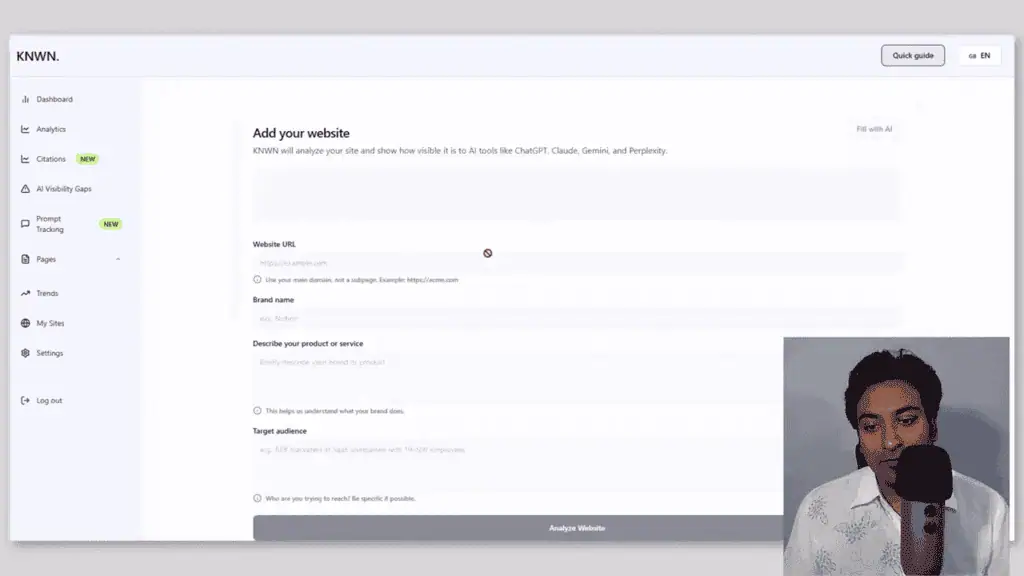
Do not rush this step. Every data point Knwn generates, from your AI visibility score to the prompts it runs on your behalf, is built on what you input here. I noticed during testing that where the tool gave me generic or off-target results, it was usually because a prompt did not fully capture my niche (AI lifetime deals and discounts, not just “AI tools” generically).
If you describe your business as “a platform for AI tools,” you will get broad, unfocused data. If you say “a platform for business owners looking for lifetime deals on AI software,” the queries Knwn runs on your behalf get much closer to what actually matters.
Take ten minutes to write a proper description. It is the highest-leverage action in the whole setup process.
The Dashboard: AI Visibility Score and Audience Score
After setup, the main dashboard shows two primary metrics: your AI visibility score and your audience score.
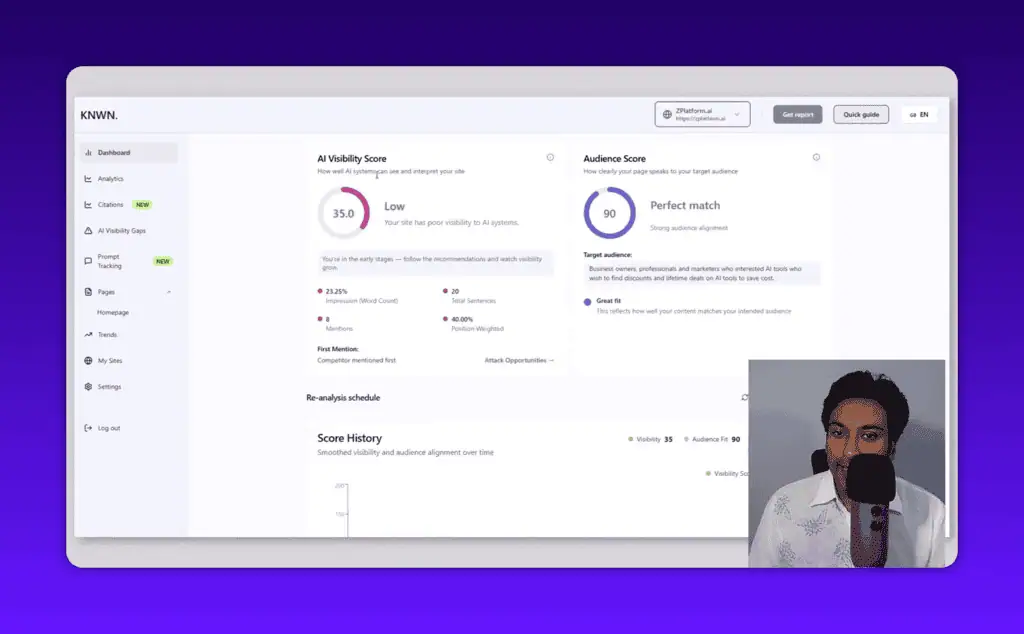
The AI visibility score tells you how visible your website currently is to AI models, rated on a 0-100 scale. For zplatform.ai, which is a relatively new domain, the score came back as poor visibility. That was accurate, not a bug.
The audience score works differently. Knwn takes the target audience you defined during setup, runs queries against AI engines, and checks whether the content on your site aligns with what AI says your audience looks for. Think of it as an AI-generated fit score between your site and your stated target customer.
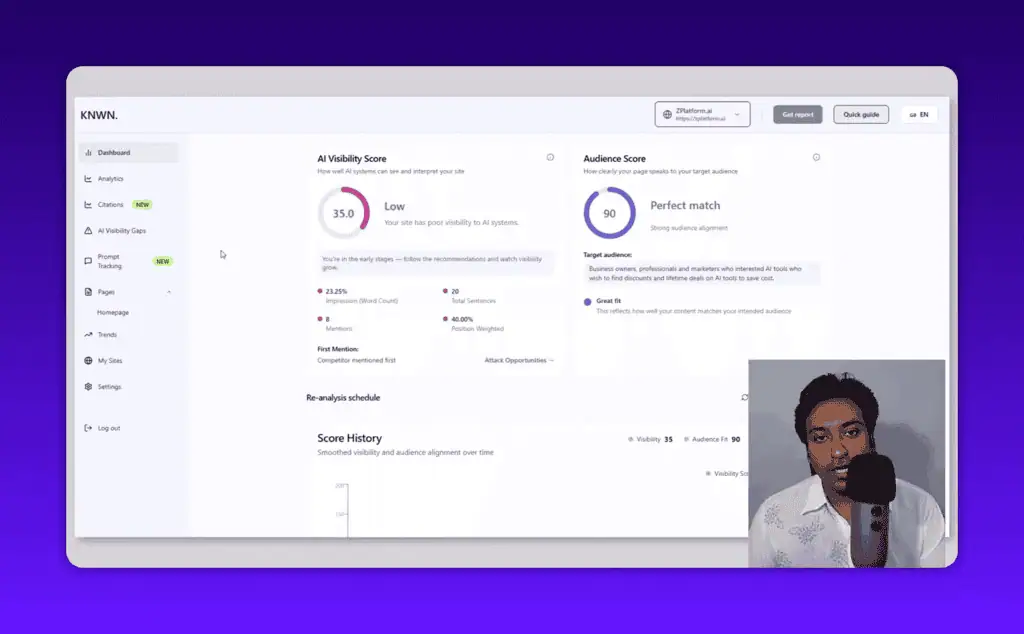
Both metrics are snapshots, not trend lines. They tell you where you stand today. The real value comes from the individual feature sections that sit beneath this overview.
Analytics: Tracking AI-Sourced Traffic
The analytics section is where Knwn gives you a tracking script to install on your site.
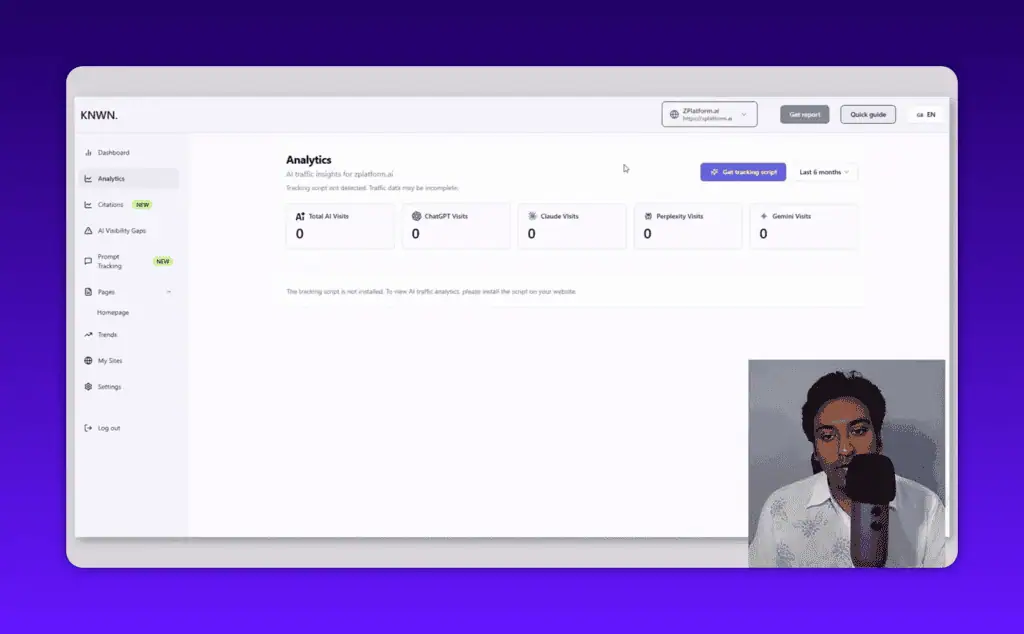
When a user clicks a link that ChatGPT, Gemini, Perplexity, or another AI tool serves them, that click often includes a UTM parameter and a referrer from the AI platform’s domain (like chatgpt.com or gemini.google.com). Knwn captures those signals in a dedicated dashboard so you can see exactly which AI models are sending traffic to your site, and at what volume.
You can get this data from Google Analytics 4 already if you know where to look. The referrer data shows up under traffic acquisition. What Knwn adds is a cleaner, dedicated view without the need to build custom reports or segments. For someone who does not want to dig through GA4, this is a genuine convenience.
Citation Analysis: Is Your Brand Being Mentioned?
This section shows what percentage of AI answers include a mention of your brand.
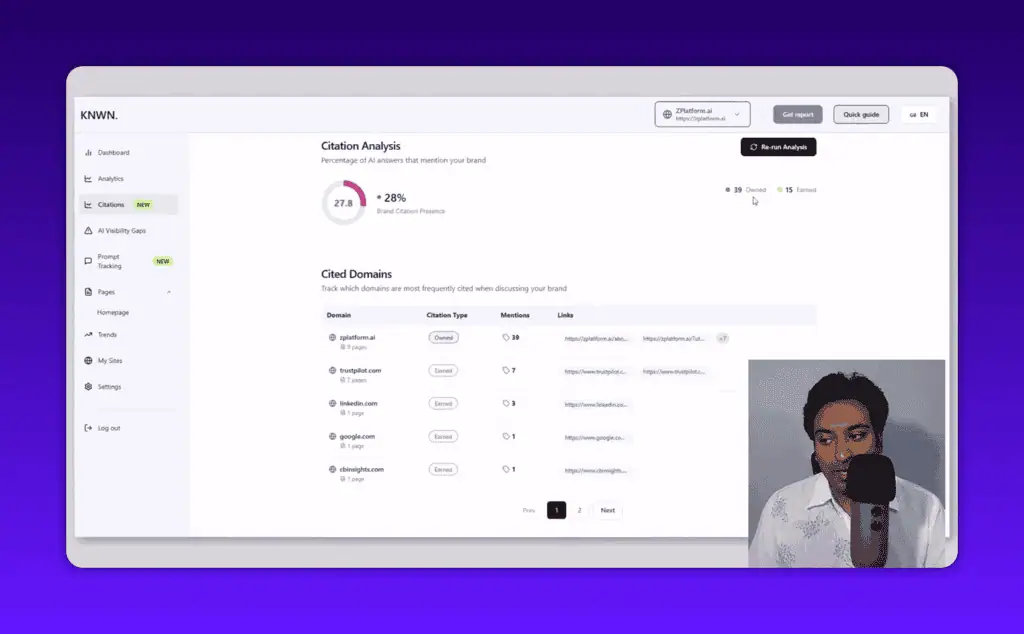
During my testing, zplatform.ai showed around 28-39 percent citation rate depending on which query set Knwn was running. The tool also showed some of the brands appearing alongside mine in those answers, which is useful context.
Here is my honest criticism: the report stops too soon. I can see that I am getting cited in some percentage of answers, but I cannot easily see which specific queries triggered those mentions, what position my brand appeared in relative to competitors, or what the actual AI-generated answer looked like. That context would turn a number into an actionable insight. Right now it is a number.
The tool sometimes also misidentifies brand mentions. During my test, it flagged some results that were referencing other brands in my category rather than ZPlatform specifically. That is a calibration issue the team needs to fix.
AI Visibility Gap: Where Are You Falling Short?
The visibility gap section is Knwn’s attempt to give you actionable content recommendations based on where AI models currently do not associate your brand with relevant topics.
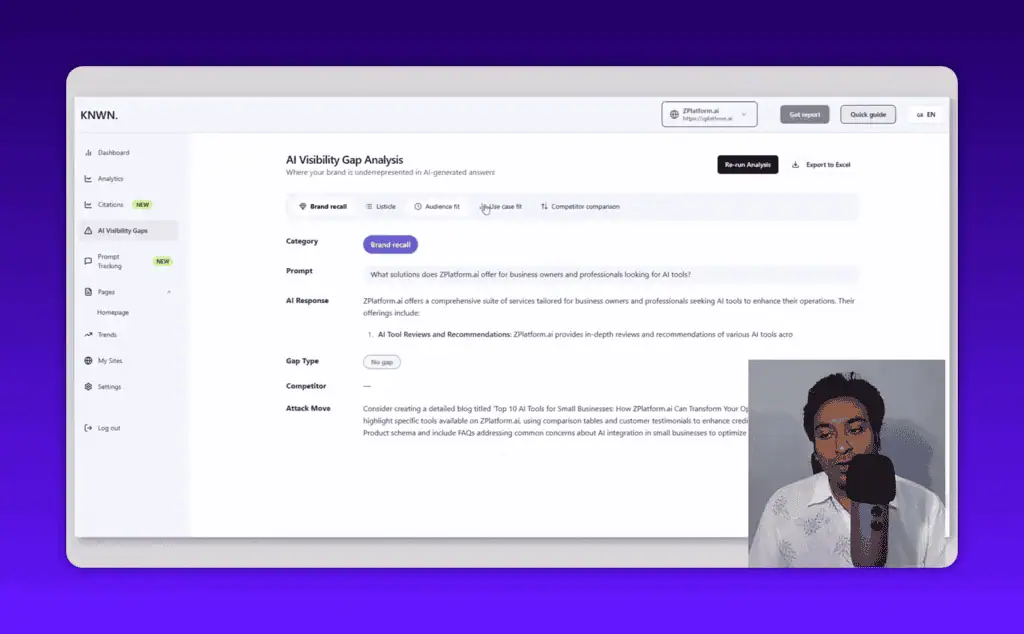
It breaks down gaps into categories: brand recall, listicle mentions, audience fit, use case coverage, and competitor comparisons. For each category, it shows what query AI is running and what the current answer looks like.
The concept is solid. The execution is hit and miss. For zplatform.ai, many of the suggested content ideas did not match my actual niche. The tool recommended I write about “top AI tools for small businesses,” which is a reasonable article topic in general but not specific to AI lifetime deals, which is my actual focus. The descriptions I provided in the wizard apparently needed more specificity.
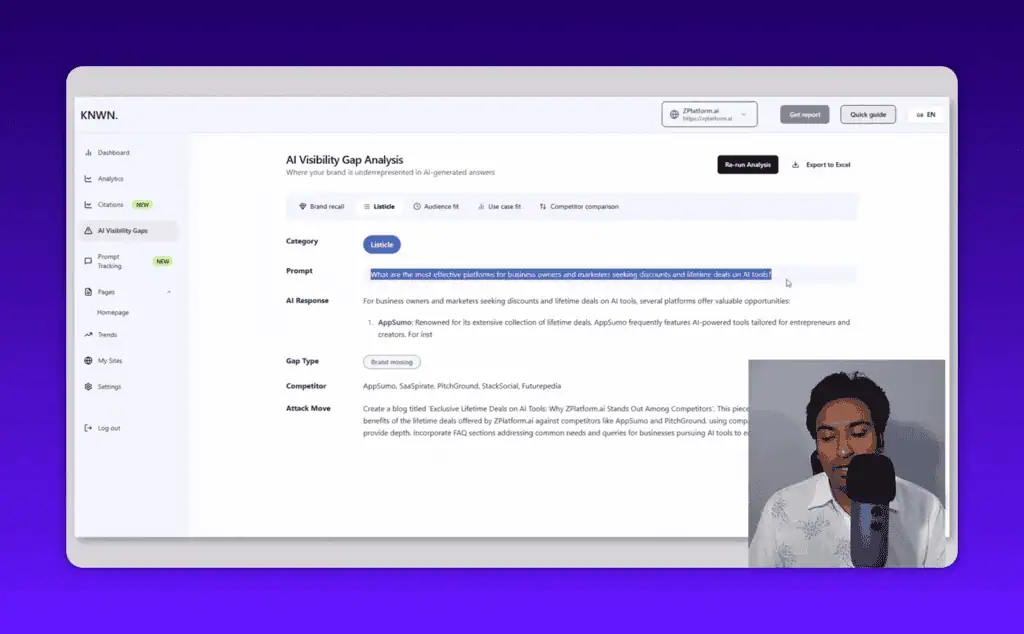
One thing I want to give credit for: Knwn shows you the actual prompt it runs to generate each recommendation. Rather than just saying “write more listicles,” it tells you the exact question it asked the AI model. That transparency is useful and puts it ahead of tools that just throw generic content suggestions at you.
The advice is directionally correct even when it misses my niche. Create comparison articles. Target competitor-adjacent queries. Build content around specific audience use cases. These are real GEO tactics. They just need better calibration to your specific business.
Prompt Tracking: The Feature That Makes Knwn Worth Considering
This is the section that changes my evaluation of the tool.
Prompt tracking works exactly like traditional rank tracking, except instead of monitoring Google positions, it monitors AI citations. You add target queries (what you would call keywords in a standard SEO context), choose which AI models to track them against, and Knwn runs those prompts daily and reports back whether your brand was mentioned, which competitors were cited, and what the AI response actually said.
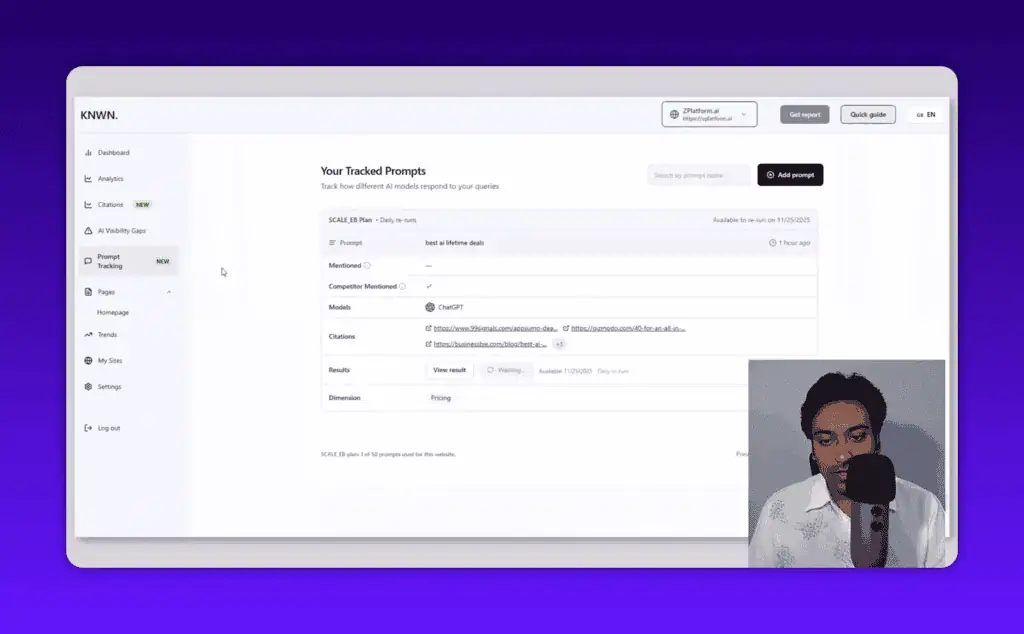
I set up a prompt tracking for “best AI lifetime deal platforms.” The tool ran it across ChatGPT and Gemini, then showed me the full AI response, which brands were cited (AppSumo appeared prominently, as expected), and which position I would need to aim for. zplatform.ai did not appear in that particular answer yet, which was accurate and useful to know.
The plan I tested includes around 50 tracked prompts per day. You can add your own, use the suggested queries Knwn surfaces, or bulk import a list.
You can replicate this manually by asking AI models the same questions every day. The difference is that Knwn automates it, logs the results, and makes changes visible over time. For someone tracking 10-20 queries across 3-4 AI models, doing this manually would take 45 minutes a day. Knwn reduces that to a glance at a dashboard.
If you are serious about GEO and want a systematic way to monitor whether your content investments are actually improving your AI citation rate, this feature alone justifies the tool.
Pages: Individual URL Visibility Tracking
The pages section lets you add specific URLs from your site and track their individual visibility and audience fit scores.
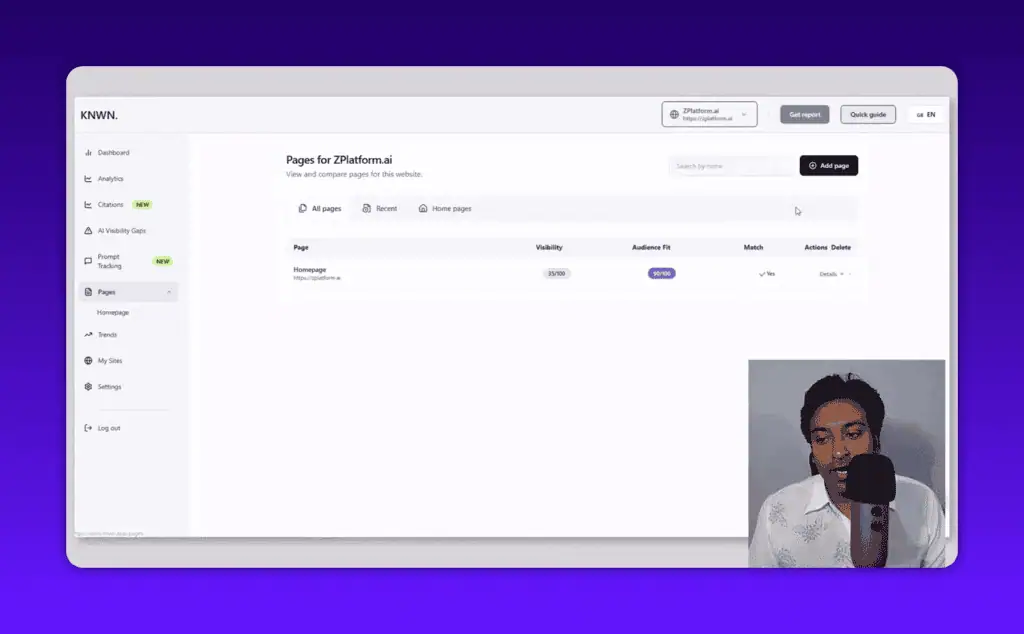
You add a relative path, a page title, and a brief description of what that page covers. Knwn then monitors that specific page’s performance in AI-generated answers.
I did not test this section in depth during my initial review. For a site with a small number of high-value pages, like a product landing page or a pillar article, this could be genuinely useful. You would see at a page level whether your target content is being pulled into AI responses.
Trends: AI Search Query Opportunities
The trends section surfaces queries that are growing in AI search demand within your niche.
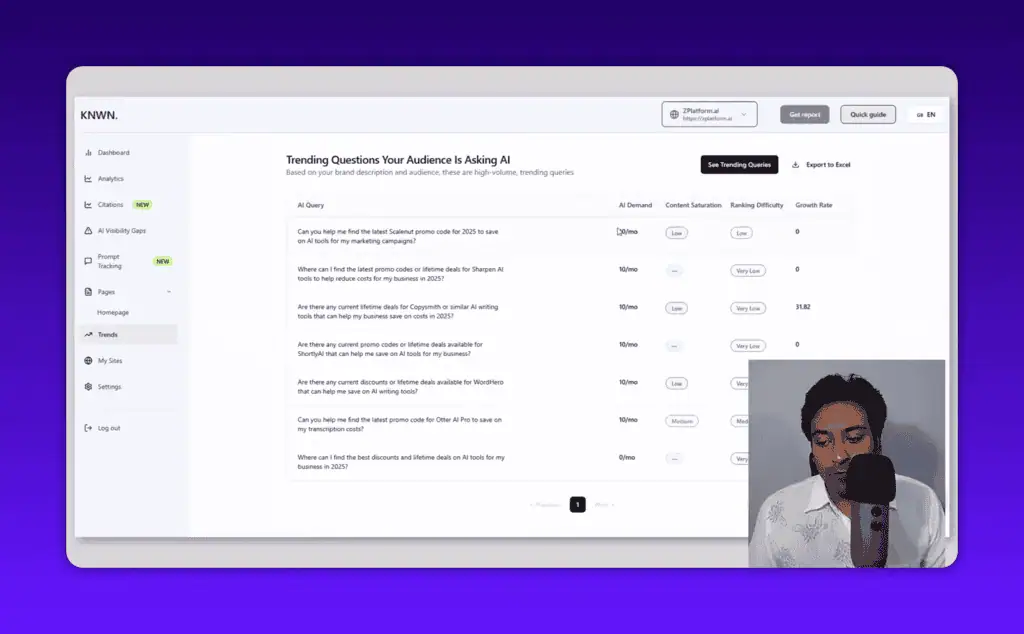
For zplatform.ai, the results here were thin. Most queries showed near-zero growth rates and low AI demand scores. Some were not relevant to my niche at all (promo codes for tools I do not cover, for example). My interpretation is that micro-niches with limited AI search volume are hard for Knwn to surface meaningful trend data for right now.
The feature has more potential than it currently delivers. If they expand the query pool and let you drill into individual trend signals with deeper data, this section could become a useful content planning tool. Right now it is a work in progress.
What Knwn Gets Right
Prompt tracking. Daily automated citation monitoring across multiple AI models is the feature that sets Knwn apart. If you are trying to measure GEO progress systematically, this is genuinely difficult to replicate at scale without tooling.
Transparency about methodology. Showing you the actual prompts it runs, rather than just surfacing opaque scores, is a good design decision. You can evaluate whether the queries are actually relevant to your business.
Unified AI traffic dashboard. Centralizing ChatGPT, Gemini, and other AI referrer data in one place saves time versus building custom GA4 reports.
Clear audience alignment check. The audience score gives you a fast read on whether AI models understand your site the same way you describe it. Misalignment here often points to content gaps on your site.
What Still Needs Work
Citation analysis depth. A percentage is not actionable. Show me the specific queries, the position in the AI response, the surrounding context, and what a competitor is doing differently in the answers where I am not mentioned.
Competitor tracking. This is still on the roadmap as of when I tested. Without it, you can see how you are performing but you cannot benchmark that against the brands winning citations in your space. This is the single most useful feature missing from the current build.
Trends relevance for micro-niches. If your site targets a specific vertical, the current trends panel is likely to surface mostly irrelevant or generic queries.
Calibration errors in brand recognition. The tool occasionally identified competitor brands as my own brand in citation data. That needs to be tighter.
Manual replication is still possible. Most of what Knwn does, you can do yourself with a few hours of setup and the right AI prompts. That is not unique to Knwn, it applies to most first-generation GEO tools. What Knwn sells you is automation and convenience, not exclusive access to data.
Who Should Buy Knwn?
Knwn makes sense for business owners and marketers who:
- Want a dedicated dashboard for AI visibility monitoring rather than piecing it together across GA4, manual prompt testing, and spreadsheets.
- Are running GEO campaigns and need to track whether content investments are improving AI citations over time.
- Have a clear brand and product description to give the tool during setup. If your positioning is vague, the data will be too.
- Are interested in the lifetime deal specifically. At monthly subscription pricing, the current feature set would be harder to justify. At a one-time payment, the risk-reward calculation changes.
Knwn is probably not the right fit if you:
- Expect deep competitor intelligence right now. That feature does not exist yet.
- Have a micro-niche site where AI search volume is genuinely low. The trends and visibility data will not surface much useful signal.
- Are already tracking AI referrer traffic in GA4 and manually running citation checks. The incremental value will feel thin.
Knwn Pricing
Knwn launched with a lifetime deal offer during the period I tested it. The exact pricing tiers change on deal platforms, so check the current deal status at the link below. The plan I tested included approximately 50 tracked prompts per day, one website, and access to all current features.
As with any lifetime deal, factor in the company’s current maturity. Knwn is an early-stage product with a clear roadmap. Buying lifetime access is a bet on that roadmap delivering. The bones of the tool are solid, and the founder seems engaged with user feedback. That is a reasonable bet at a lifetime deal price point.
If you want to explore the current offer, check out Knwn via this link. Some links on zplatform.ai are affiliate links. If you buy through this link, I earn a small commission, which helps me keep creating reviews like this. I also include a non-referral path so you can make that choice yourself.
You can browse more AI lifetime deals here to compare what else is available in the AI SEO category.
Is Knwn Worth the Investment?
For the lifetime deal pricing, yes, with conditions.
The prompt tracking feature alone is worth paying for if you are running a GEO strategy and want automated daily citation monitoring across multiple AI models. That solves a real pain point. The setup wizard forces you to think clearly about your brand positioning. The citation analysis, while thin now, will presumably improve with development.
The tool is not complete. The visibility gap section gives generic advice too often. The trends feature underperforms for niche sites. Competitor tracking is missing entirely.
My honest take: Knwn is a good starting point for AI SEO monitoring, not a complete GEO stack. Buy it if you want automated prompt tracking and a unified AI visibility dashboard and you are comfortable with the tool being early-stage. Skip it if you need deep competitive intelligence or mature reporting today.
I will update this review as the product develops. The roadmap is promising. Whether they execute on it is the question only time answers.
If you want to stay updated on new AI SEO tool reviews and lifetime deals worth considering, join the zplatform.ai deals newsletter and get weekly alerts without the noise.
Frequently Asked Questions
What is Knwn used for?
Knwn tracks how AI models like ChatGPT, Gemini, and Perplexity perceive and cite your brand. It monitors your AI visibility score, tracks whether you appear in AI-generated answers for your target queries, and shows how much traffic is arriving from AI platforms.
Is Knwn suitable for small business owners?
It can be, provided you take the time to configure the setup wizard accurately. The tool is most useful for businesses that are actively trying to improve their presence in AI-generated search answers. If AI SEO is not yet a priority, the tool will not deliver much value yet.
How does Knwn compare to traditional SEO tools?
Traditional SEO tools track Google rankings, backlinks, and organic traffic. Knwn tracks AI citation rates, AI-referred traffic, and how AI models describe your brand. The two tool categories are complementary, not interchangeable. You still need your standard SEO stack alongside Knwn.
Does Knwn track competitors?
Not yet. Competitor tracking is on the product roadmap as of the time I reviewed it, but it was not available during my testing period. This is the most significant missing feature.
What is the best feature of Knwn?
Prompt tracking. The ability to monitor specific queries daily across multiple AI models and see whether your brand appears in the results is the most defensible use case for the tool. It is difficult to replicate that systematically without dedicated tooling.
Can I replicate Knwn’s features manually?
Most features can be replicated manually with enough time and the right AI prompts. The AI traffic data is available in Google Analytics 4. Citation checking can be done by querying ChatGPT and Gemini directly. What Knwn provides is automation and a unified dashboard that saves hours of manual work each week.
Disclosure: Asset-Owned. I purchased access to Knwn with my own money during the lifetime deal launch to test it for this review. The affiliate link above is marked clearly. Non-referral access is also available directly from the Knwn website.
Liked this review? Pin ZPlatform as your Preferred Source.
Pinning us tells Google to make our hands-on AI reviews, verified lifetime deals, and founder interviews more likely to appear prominently for you in Top Stories and eligible AI Search experiences (AI Mode, AI Overviews). Set it once, no account needed on our end.
- 500+ AI tools tested with real budgets
- Verified deals - no dead affiliate links
- Editor: Alston Antony, 15+ years in SaaS & SEO
 Opens Google · takes 2 seconds
Related Posts

I tested AgainstData on 355 pages of Gmail data. Here’s my honest review: bulk unsubscribe, personal data deletion reque...
I ran AI-Text-Humanizer.com through ZeroGPT and AIscan24 with real before and after scores. Here is what works, what it ...
I ran five text samples through AIscan24, including two I wrote by hand. One scored 80% AI. Here is what this free detec...
Starting August 2, 2026, the EU AI Act’s transparency provisions become enforceable. That means if your website uses AI-...

My hands-on Answer Socrates review covering all features, free plan limits, pricing, and how it compares to AlsoAsked. I...
“I’ve spent $4,200 on 118 AppSumo lifetime deals over 5 years. Here’s my honest review: what works, what fails, and whet...