

Verdict: Buy
Visby AI is a GEO (Generative Engine Optimization) platform that tracks how your brand appears in AI chatbot responses across ChatGPT, Gemini, and Claude. The LLM prompt visibility feature is genuinely useful, the dashboard is clean and fast, and it connects directly to Google Analytics and Google Search Console.
The main friction points are a 30-day data refresh cycle and a report builder still in beta. At the AppSumo lifetime deal price, it is a solid buy for SEO professionals and agencies already thinking about AI search visibility. At the standard monthly rate, the value equation gets tighter.
I bought Visby AI with my own money after spotting it on AppSumo. My reaction when I first hit the landing page was the usual one: skeptical.
I have reviewed well over 500 SaaS tools and most “AI SEO” products launched in 2025 and 2026 fall into two buckets: thin wrappers around existing data, or genuinely useful tools priced for enterprise budgets, the same split I document across our AI tool reviews. Visby AI turned out to be neither. It is purpose-built for one thing that actually matters right now: figuring out whether AI chatbots are mentioning your brand, and what those chatbots are actually saying.
For context, ChatGPT now serves over 800 million weekly active users. Google AI Overviews reach over 2 billion monthly users.
If your brand does not appear in AI-generated answers for your target prompts, you are invisible to a growing segment of buyers who never reach traditional search results. That is the problem Visby AI is designed to solve.
In this review, I will walk through every feature I tested, the pricing, the real limitations, and who should and should not spend money on this tool.
Note: I purchased this tool independently. No sponsorship, no vendor editorial control.
What is Visby AI?
Visby AI is a complete AI visibility platform built to help businesses monitor and improve their presence in AI-generated answers. It tracks how AI engines like ChatGPT, Gemini, and Claude respond to prompts relevant to your business, which competitors they mention instead, and what content gaps are preventing your brand from appearing.
The tool integrates with Google Analytics and Google Search Console to show your traditional SEO traffic alongside AI-sourced traffic in one dashboard. It also includes GEO task generation, a report builder for client-facing deliverables, review sentiment tracking, and a content brief generator.
Visby describes itself as “the first complete AI visibility platform.” That is marketing language, but the core functionality is real and addresses a visibility gap that AI tools like Semrush, Ahrefs, and SE Ranking do not cover natively. As buyers shift from traditional search engine results to AI-generated answers, this gap is growing quickly, and dedicated AI SEO visibility tools are racing to fill it.
Watch my full Visby AI walkthrough
I recorded a full walkthrough of all the features after setting it up on my own site. Watch it before reading further if you prefer video:
Visby AI dashboard: First impressions
When you first sign in, Visby runs you through a wizard that asks for your domain, identifies competitors, and collects project details automatically. You can edit everything it suggests. The whole setup takes under five minutes.
After setup, the dashboard gives you an immediate snapshot: SEO score, GEO score, pending tasks by category, and traffic overview. If you have connected Google Analytics, you can see organic traffic, ChatGPT traffic, Gemini traffic, Claude traffic, Perplexity traffic, and Copilot traffic broken out in one chart.
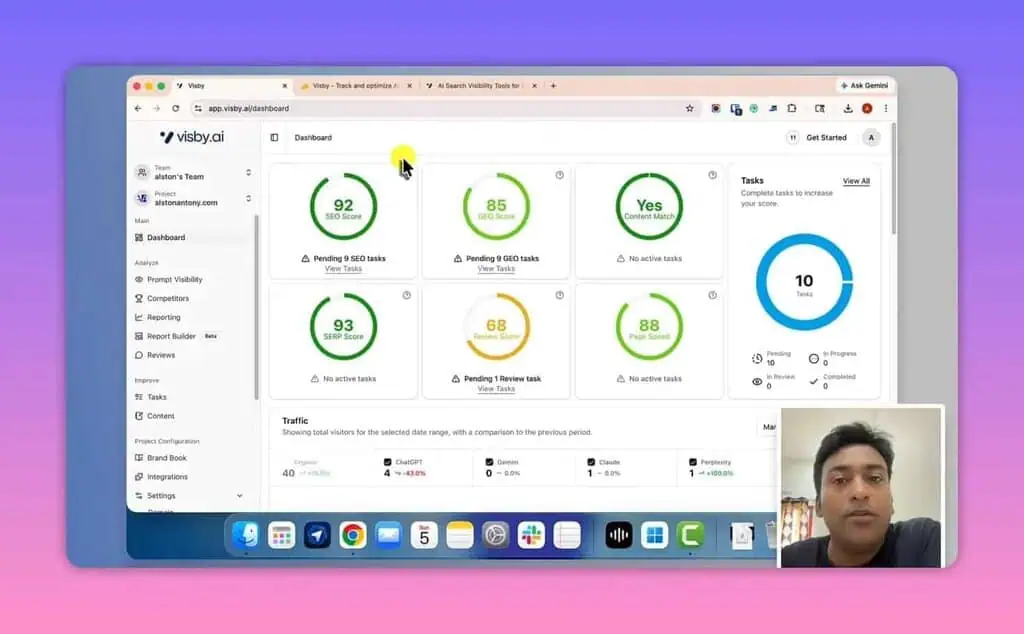
The interface is fast. No long loading delays, no heavy animations. I have used several GEO tools that feel slow or clunky, and Visby AI does not have that problem.
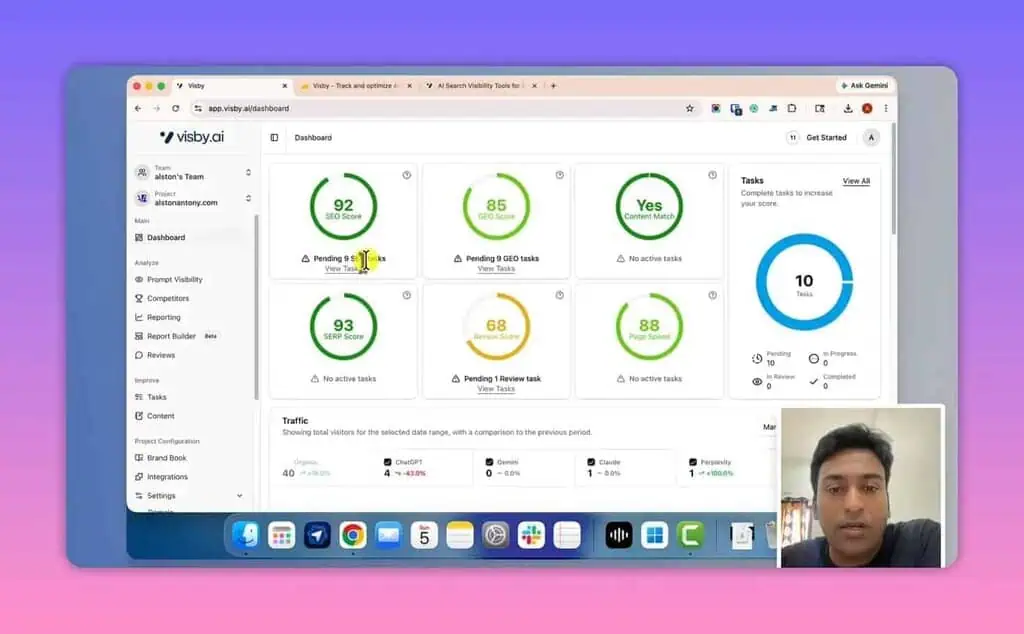
One thing I appreciated immediately: the data is organized around action. The dashboard does not dump raw metrics at you.
It tells you what needs to be done across SEO, GEO, and page speed, and gives you a count of pending tasks in each bucket. That framing matters for anyone who has to prioritize where to spend time.
LLM prompt visibility: The core feature
This is the reason to buy Visby AI.
The LLM prompt visibility section lets you track specific prompts across AI platforms and see exactly how each AI engine responds to those prompts. You add prompts relevant to your business (Visby AI also suggests prompts based on your domain automatically), assign them a funnel stage, and the tool monitors how AI models respond over time.
When you click into any tracked prompt, you see the actual responses from ChatGPT, Gemini, and Claude side by side. You can see which brands appear in the response, which sources are cited, and whether your brand is mentioned.
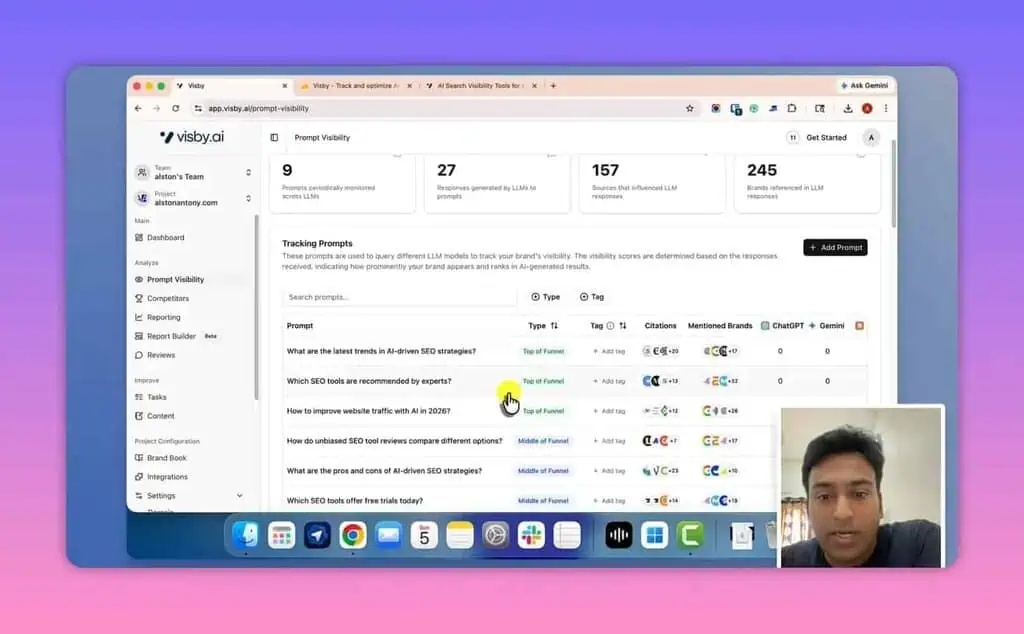
The funnel-stage organization is a feature I did not expect to like as much as I did. You categorize each prompt as top of funnel (awareness), middle of funnel (consideration), or bottom of funnel (conversion). This gives you a layered view of your AI visibility across the buyer journey.
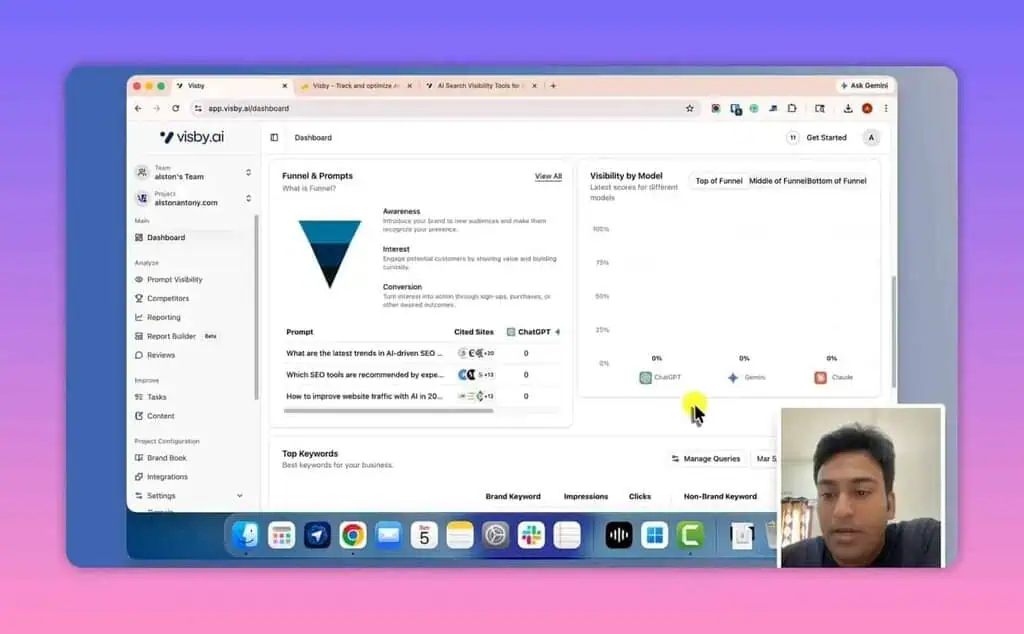
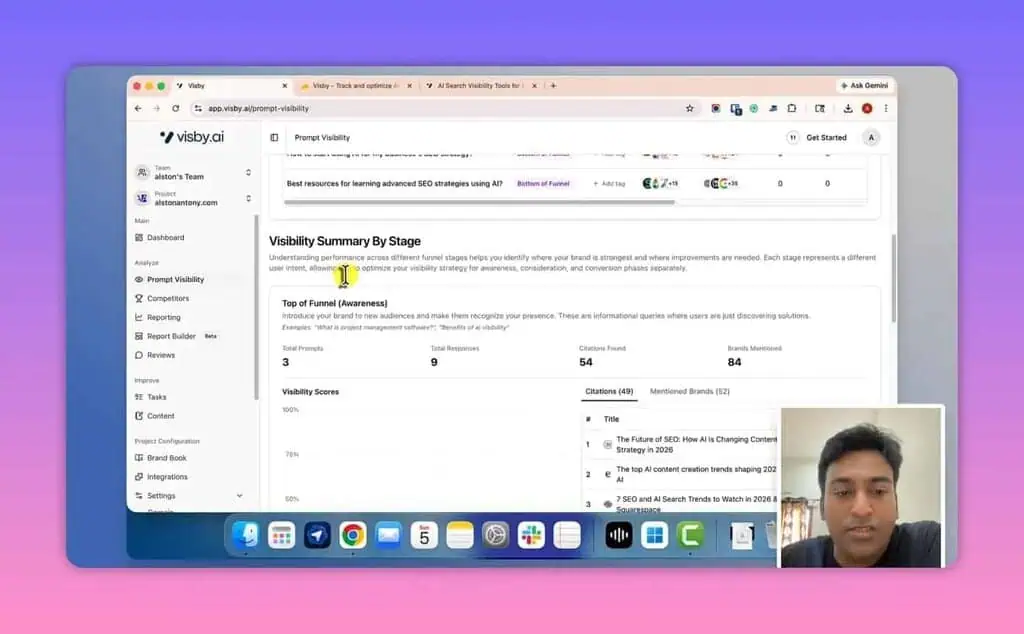
For an agency managing a client’s brand, this is immediately reportable. You can tell a client: “You appear in 30% of bottom-of-funnel ChatGPT responses and 0% of top-of-funnel Gemini responses.” That is a concrete, actionable insight.
The 30-day refresh problem
The standout weakness of this feature is the refresh cycle. Data updates every 30 days.
If you make changes to your content strategy to improve AI visibility, you wait a month to see whether those changes had any effect. That is a real constraint. Competitors like Otterly update more frequently, though their pricing reflects that.
For a lifetime deal purchase where you are managing a slow-burn GEO strategy, 30 days is tolerable. For agencies with clients expecting frequent reporting, it can be frustrating.
Competitor analysis: Share of voice in AI responses
The competitor tab shows how your brand compares to competitors in AI-generated responses for your tracked prompts. Visby calls this “share of voice” across AI platforms.
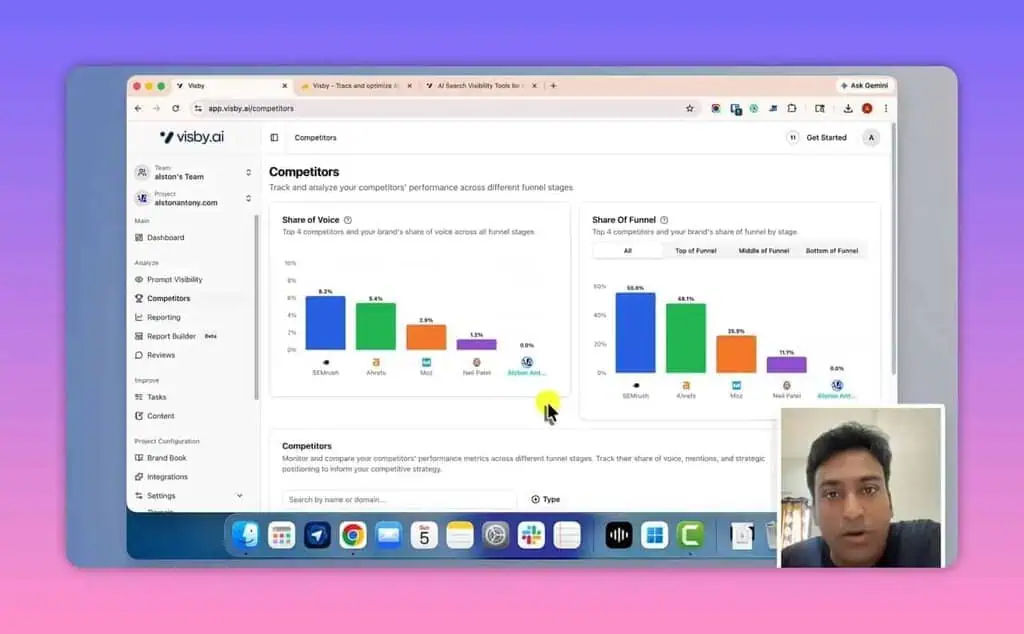
You can add competitors as direct competitors, indirect competitors, or companion websites. The table view shows which brands dominate which funnel stages in AI responses.
I tested this on my site, which is currently recovering from an algorithm penalty, so my share of voice numbers were predictably low. But the data structure is clear, and for a site with active AI traffic, this view would be genuinely useful for understanding which competitors are winning in AI answers and why.
One small but useful detail: the competitor analysis breaks down share of voice by funnel stage, not just overall. You might dominate top-of-funnel awareness prompts but lose at the bottom of funnel to a competitor who has better product comparison coverage. Visby surfaces that split directly.
Reporting dashboard: Unified analytics
The reporting section pulls together traffic data from all connected sources: Google Analytics, Google Search Console, and Bing Webmaster Tools. You get a unified view of organic traffic alongside AI-sourced traffic broken down by platform.
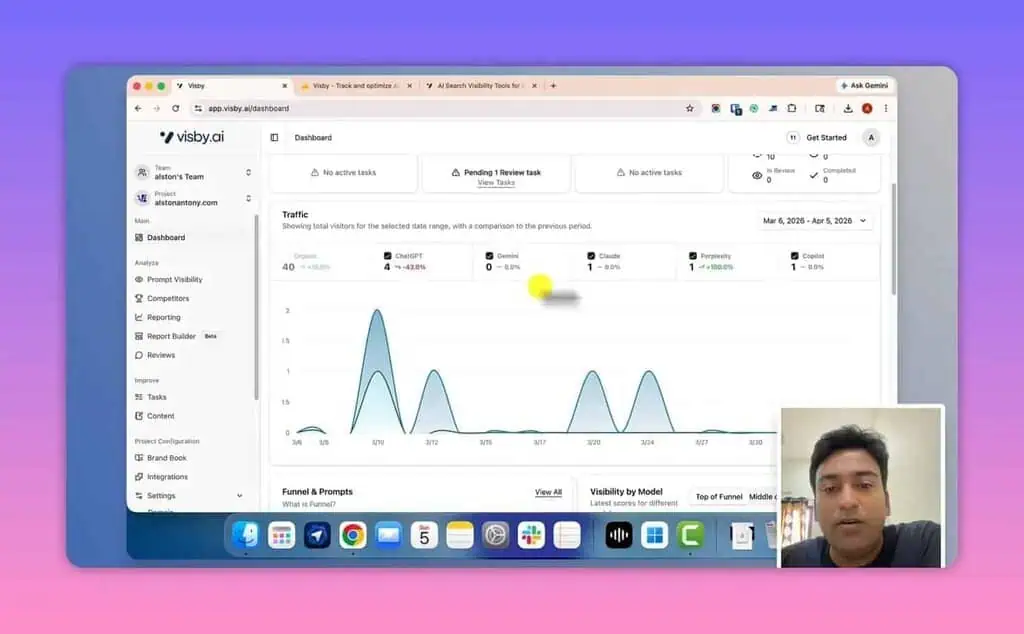
For many users, this data is already available natively in GA4 with a custom segment. But Visby packages it into one screen without requiring you to build reports from scratch. For non-technical users or marketers who do not want to configure GA4 custom dimensions, this is a genuine convenience.
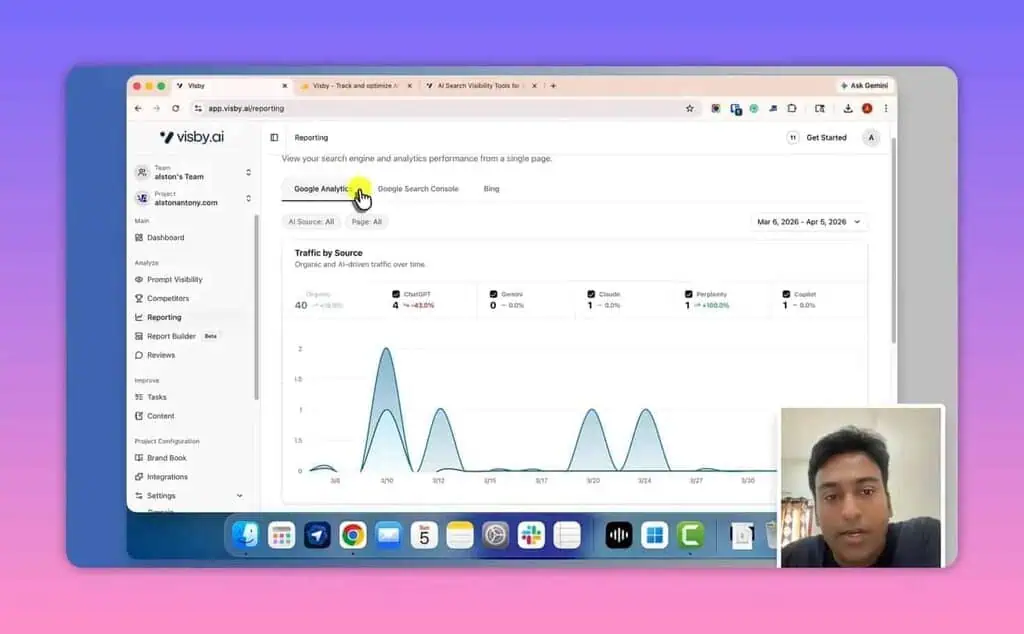
The limitation is date range flexibility. You can select preset ranges, but the options are narrower than I would want. An “all time” view would be useful, especially for benchmarking against a baseline.
Report builder: useful, but beta-stage
The report builder is designed for agency use. You create a Google Slides-style report with widgets pulling in live data from your connected sources: SEO score, GEO score, content score, review score, page speed, and more.
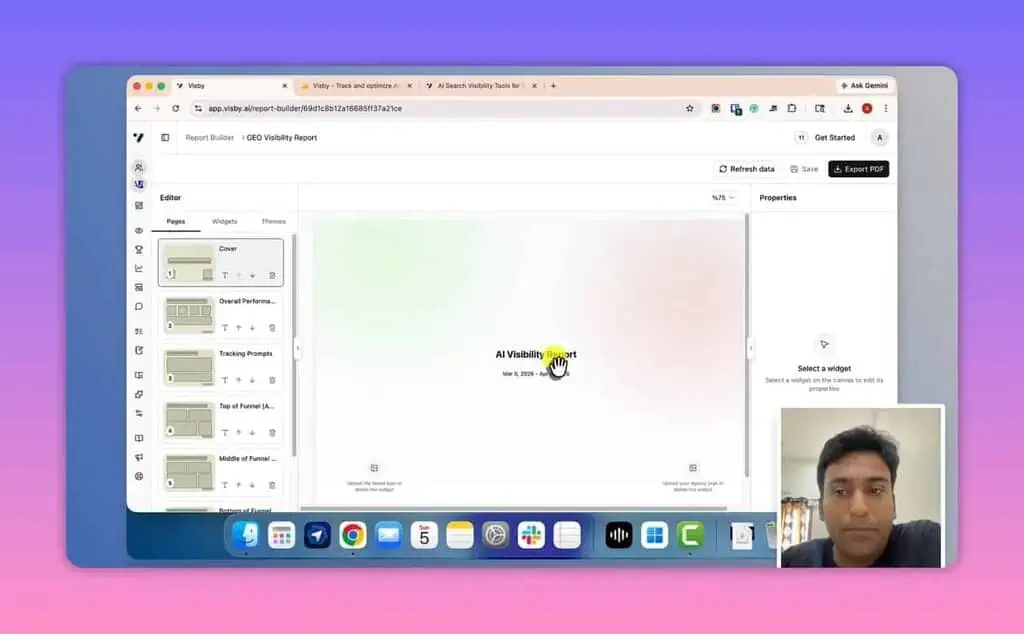
The editor is responsive and not clunky. You can move widgets around, edit text, control the theme, and export to PDF. When I tested the PDF export, the data populated correctly and the output looked presentable enough for client delivery.
However, this is clearly an early-stage feature. Several important widgets are still locked: competitor data widget, Google Analytics widget, and Google Search Console widget are all missing at the time of writing.
Brand logo upload and custom templates are also not available. The template options are limited to “blank” or “full report.”
For professional client reporting today, this feature is not ready. The framework is promising, but the missing widgets make it unsuitable as your primary reporting tool. I expect these gaps to close over the next few development cycles.
Content gap and content brief generation
The content section identifies topics missing from your content based on tracked AI prompts. When an AI engine responds to a prompt and your brand is not cited, Visby marks it as a gap and suggests content you should create to improve your visibility.
You can generate a content brief automatically (Visby creates it based on the gap it identified) or create one manually. When I tested the auto-generated brief, it understood my site’s niche and produced a reasonable starting point. For my site, it suggested creating a piece on “How AI is Transforming SEO Strategy in 2026” based on the prompts I was tracking.
The practical value here is clear: instead of guessing what content to produce to improve GEO performance, you have a data-backed signal pointing at specific gaps. Whether the AI-generated briefs are good enough to publish is a separate question, and the answer is: they are a reasonable starting point, not a finished product.
Review sentiment tracking
Visby monitors brand reviews across the web and categorizes the sentiment: positive, negative, neutral, or mixed.
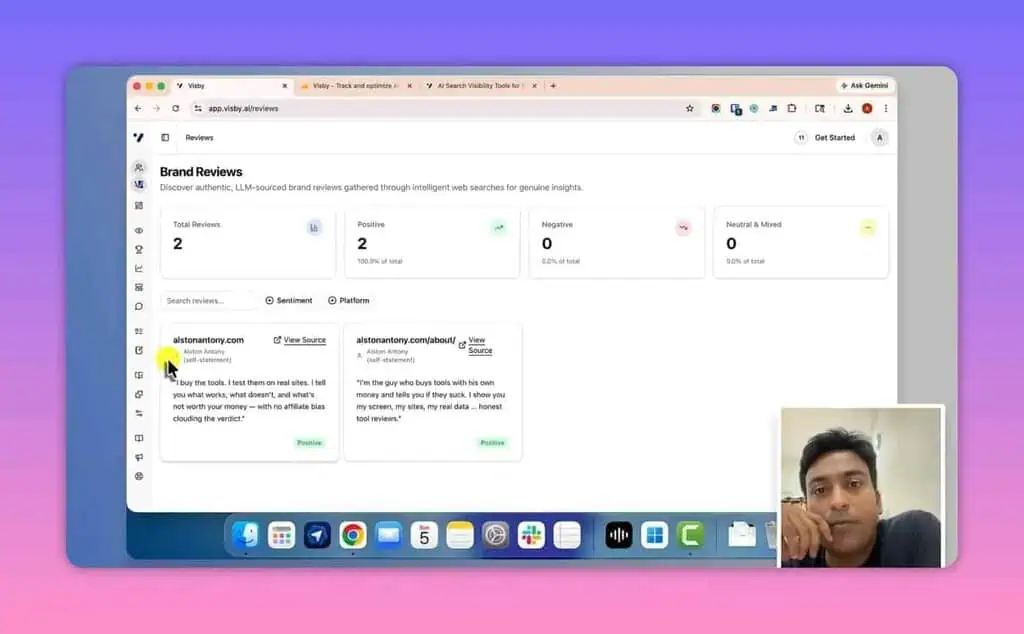
The idea behind this feature is solid. AI engines like ChatGPT and Gemini train on and are influenced by public reviews on platforms like G2, Trustpilot, and Reddit.
If your brand has a pile of negative reviews on G2, those reviews may be shaping what AI engines say about you. Monitoring review sentiment as part of a GEO strategy is not a stretch.
In practice, this feature provides minimal value for brands with low review volume. If your brand does not have substantial third-party reviews indexed, the sentiment data will be sparse. For established SaaS brands or products with active review profiles on G2 or Trustpilot, it could be more useful.
GEO tasks: Recommendations without enough implementation detail
The tasks section is a Kanban board (similar to Trello) with columns for Pending, In Progress, In Review, and Done. Visby generates recommendations based on your site’s GEO and SEO analysis and turns them into tasks you can track, though tools like ClickRank’s AI SEO automation go further and implement changes for you.
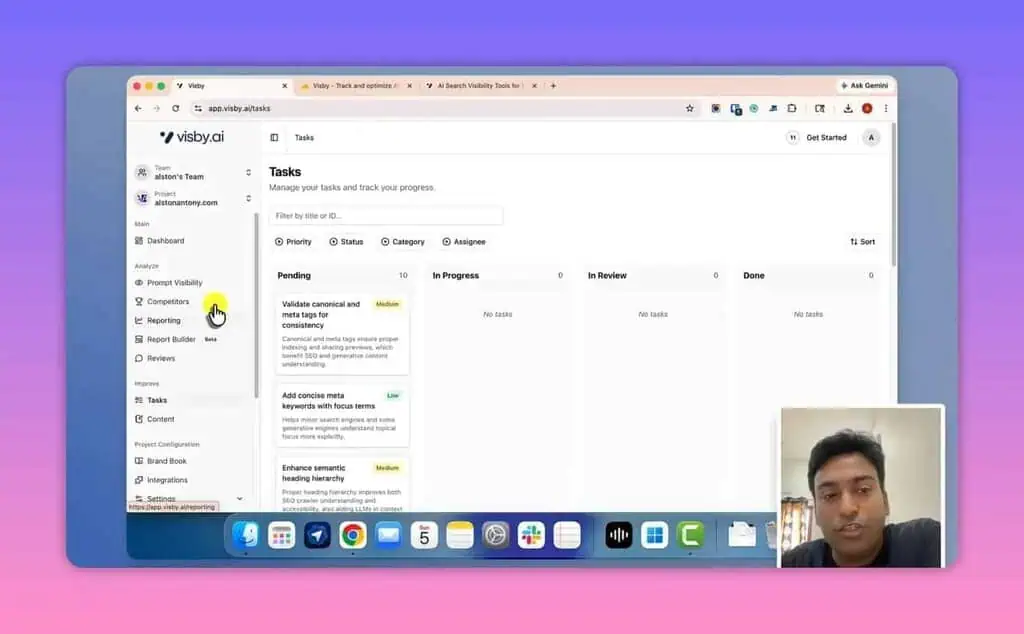
The task management feature is useful as a to-do list. The gap I noticed is implementation depth.
Visby might tell you to “add structured data schema markup” or “enhance semantic coverage” but does not give you the code, a template, or a step-by-step guide to actually do it. For experienced SEO professionals, that is fine. For smaller business owners without a technical background, it leaves them with a recommendation they cannot easily act on.
This is a feature that needs more context-driven guidance. A one-line recommendation is not the same as an actionable instruction.
Status updates are manual, and there is no automated recheck to confirm when a task has been completed. I would like to see both: richer implementation guidance and automated verification.
Integrations: Google and Bing now, Shopify coming soon
Visby connects to Google Analytics, Google Search Console, and Bing. Shopify integration is listed as “coming soon” but unavailable at the time of writing.
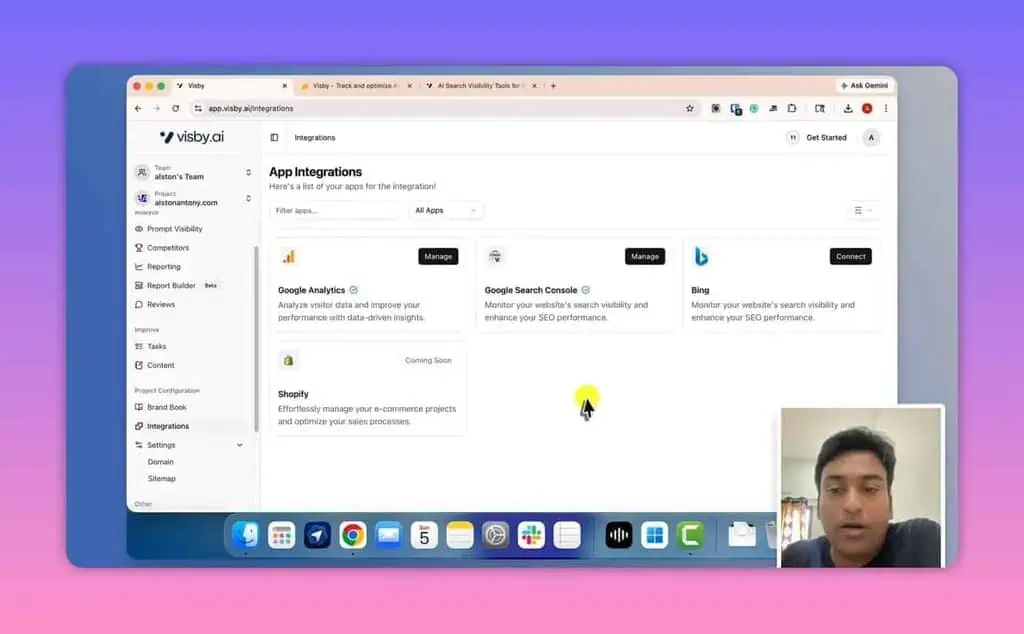
The Google integrations work well and are the backbone of the reporting features. Setting up the connections during onboarding was smooth. Once connected, the data populates quickly into the dashboard.
The missing Shopify integration matters for ecommerce brands. If you are running a Shopify store and want to track AI visibility for product-level prompts, you will need to wait for that integration or connect through a workaround.
Visby AI pricing: $79 Starter, $199 Growth and the AppSumo lifetime deal
Standard plans
| Plan | Price | Domains | Tracked Prompts | AI Answers/Month | Article Generations | Seats |
|---|---|---|---|---|---|---|
| Starter | $79/month | 1 | 15 | 45 | 5 | 1 |
| Growth | $199/month | 3 | 90 | 270 | 15 | 3 |
| Enterprise | Custom | 5+ | 250+ | 750+ | 25 | 10+ |
All plans cover ChatGPT, Claude, and Gemini tracking. The Growth plan’s math works out to $66/month per domain if you have three active sites, which is reasonable for an agency context. The Starter plan at $79/month for one site is harder to justify for a solo SEO practitioner unless GEO tracking is a core deliverable for clients. Prices checked on 25 September 2026.
For context, dedicated enterprise GEO tracking tools can run $200 to $500 per month or more, and our best AI SEO tools roundup maps the affordable end of that range. Visby’s pricing is competitive for the mid-market, but the monthly subscription model adds up.
AppSumo lifetime deal
At the time I purchased, Visby AI was available on AppSumo as a lifetime deal with three tiers based on the number of projects, tracked prompts, and data refresh frequency. If you are reading this while the AppSumo deal is live, it represents significantly better value than the monthly plans, especially for agencies managing multiple client sites.
Check the best AI lifetime deals page to see whether the Visby AI AppSumo deal is still active, or browse current AI deals for comparable options.
Who should buy Visby AI, and who should wait
You should buy Visby AI if:
You are an SEO professional or agency already thinking about GEO. If your clients ask “are we showing up in ChatGPT results?” and you currently have no good answer, Visby AI gives you that answer with a dedicated dashboard. The funnel-stage breakdowns and competitor share-of-voice data are immediately reportable.
You manage multiple sites and want a unified AI visibility view. The Growth plan’s three-domain coverage works well for an agency handling a handful of clients in the same workspace.
You are comfortable with an evolving product. Visby is clearly in active development. The changelog shows regular improvements. If you buy during the AppSumo lifetime deal window, you are locking in access at a price that will not scale with the platform.
You want to connect AI visibility data to content strategy, something our GEO and AI search guides break down step by step. The content gap feature is a practical bridge between what prompts say AI is missing from your site and what you should write next.
You should wait or skip if:
You need real-time or weekly data updates. The 30-day refresh cycle means you cannot use Visby for rapid testing of GEO changes. If you are in an active campaign and need to see the impact of specific content within days, this tool will not serve you.
You need polished, client-ready reporting now. The report builder is beta-stage. Key widgets are missing. Do not buy Visby expecting a finished reporting module.
You are a beginner to SEO who has not yet built a traditional SEO foundation. Visby AI makes much more sense once your site is ranking in traditional search and you are extending your strategy into AI visibility. If your organic traffic is near zero and you have not addressed basic on-page SEO, start there first.
You need deep Shopify integration. Ecommerce brands tracking product-level AI visibility will need to wait for that feature.
Visby AI vs Otterly, SE Ranking and manual prompt testing
| Feature | Visby AI | Otterly | SE Ranking | Manual Testing |
|---|---|---|---|---|
| LLM Platform Coverage | ChatGPT, Gemini, Claude, Perplexity, Copilot | Yes (varies) | Limited | All (manual) |
| Funnel-Stage Breakdown | Yes | No | No | Manual |
| GA/GSC Integration | Yes | Partial | Yes | N/A |
| Content Brief Generation | Yes (AI) | No | No | Manual |
| Data Refresh | 30 days | More frequent | Varies | On demand |
| Client Report Builder | Beta | No | Yes | N/A |
| Pricing | $79-199/month | Varies | $129-279/month | Free (time cost) |
Otterly is the closest direct competitor. It focuses purely on brand monitoring in AI responses and refreshes more frequently than Visby. If real-time AI response monitoring is your priority and you do not need content gap tools, report builder, or GA integration, Otterly is worth evaluating.
SE Ranking has added some AI visibility features but its LLM tracking is not the core product. If you are already on SE Ranking and only need light GEO monitoring, that may be sufficient. If you need depth, Visby’s specialized focus wins.
Manual testing (running prompts yourself in ChatGPT and Gemini) is free and on-demand, but it does not scale across multiple prompts, platforms, and time periods. It is how most teams monitor AI visibility today. Visby replaces that with a structured, repeatable system.
Does Visby AI replace Semrush or Ahrefs?
No. Full stop.
Visby AI monitors brand visibility in AI-generated responses. It does not do keyword research, backlink analysis, technical site audits, rank tracking, or the dozens of other functions that Semrush and Ahrefs cover, which budget suites like Wope’s SEO research platform handle instead. Think of Visby as a layer that sits alongside your existing SEO stack, not one that replaces it.
That framing is the right one. If you go in expecting Visby to replace your primary SEO platform, you will be disappointed. If you go in expecting it to add a GEO intelligence layer on top of your existing setup, you will get exactly what it promises.
An easy buy at the lifetime price, a harder one at $79 to $199 a month
Visby AI solves a real and growing problem. As AI engines become a primary interface for product discovery, knowing whether your brand appears in AI-generated answers is becoming as important as knowing your Google rankings. Visby AI is the most practical tool I have found at this price point for answering that question.
The 30-day refresh cycle and the beta-stage report builder are genuine limitations, not minor caveats. They matter for specific use cases. But the core LLM prompt visibility, the funnel-stage breakdowns, the competitor share-of-voice data, and the GA and GSC integration work well and deliver actionable insights.
At the AppSumo lifetime deal price, the ROI calculation is easy. At $79-199 per month on the standard plans, you need to be actively using GEO tracking for clients or managing multiple sites before the numbers work out.
Ready to check out the current deal status? See the Visby AI listing or browse all AI visibility and GEO tools on the platform.
Frequently Asked Questions
What is Visby AI and what does it do?
Visby AI is an AI visibility platform that tracks how your brand appears in responses from AI engines like ChatGPT, Gemini, and Claude. It monitors which prompts mention your brand, which competitors appear instead, and what content you need to improve your AI visibility. It also integrates with Google Analytics and Google Search Console to show AI-sourced traffic alongside traditional organic traffic.
Which AI platforms does Visby track?
Visby AI tracks brand visibility across ChatGPT, Gemini, Claude, Perplexity, and Copilot. All five platforms are monitored from a single dashboard, allowing you to compare AI visibility across AI engines simultaneously.
How often does Visby refresh AI visibility data?
Data refreshes every 30 days. This is the tool’s most significant limitation. You cannot use Visby for rapid iteration testing or weekly reporting without manual supplementation. The 30-day cycle is tolerable for long-term strategy monitoring but constraining for active campaign management.
Does Visby AI replace Semrush, Ahrefs, or traditional SEO tools?
No. Visby AI does not do keyword research, backlink analysis, technical audits, or rank tracking. It is built specifically to monitor brand visibility in AI-generated answers. Use it alongside your existing SEO stack, not as a replacement.
What are GEO tasks in Visby AI?
GEO tasks are recommendations Visby generates based on your site’s AI visibility analysis. They appear on a Kanban board organized into Pending, In Progress, In Review, and Done columns.
Tasks cover actions like adding structured data, improving semantic content, or filling specific content gaps. The current limitation is that tasks provide recommendations without detailed implementation guidance or code templates.
Can agencies manage multiple client accounts in Visby AI?
Yes. The Growth plan covers three domains and includes three user seats. The Enterprise plan covers five or more domains with custom pricing. For agencies that purchased the AppSumo lifetime deal, tier limits on projects apply based on the code purchased.
Is Visby AI worth buying on AppSumo?
For SEO professionals and agencies serious about GEO tracking, yes. The lifetime deal removes the ongoing $79-199/month cost and locks in access as the platform develops.
The 30-day data refresh and beta report builder are real limitations, but at a one-time price, the ROI threshold is low. Evaluate based on whether you are actively delivering GEO-focused work to clients or managing multiple sites.
What is the difference between Visby AI and Otterly?
Both tools track brand mentions in AI-generated responses. Otterly focuses primarily on real-time brand monitoring and refreshes more frequently.
Visby AI adds funnel-stage visibility breakdowns, content gap analysis, a report builder, review sentiment tracking, and GA and GSC integration. Visby is the more comprehensive platform; Otterly is more focused on rapid monitoring. Your choice depends on whether you need the broader GEO platform or just fast brand-mention tracking.
Looking for more AI deal reviews? Check out the AI deals directory for verified lifetime deals and the AI affiliate programs directory to see the Visby AI affiliate program details.
Pricing and company details: see the Visby AI profile.
Related Posts

I tested AgainstData on 355 pages of Gmail data. Bulk unsubscribe, personal data deletion requests, pricing, and whether...

AI-Text-Humanizer.com took a 132-word ChatGPT paragraph from 100% AI to 0% on ZeroGPT but flattens your voice. Buy the $...
AIscan24 is a free, no-signup AI detector: it caught pure ChatGPT text at 100% but scored my handwritten paragraph 80%. ...
Honest Aithenticate review after hands-on testing. Does this AI disclosure badge tool meet EU AI Act requirements? Prici...

My hands-on Answer Socrates review covering all features, free plan limits, pricing, and how it compares to AlsoAsked. I...
I’ve spent $4,200 on 118 AppSumo lifetime deals over 5 years. Here’s my honest review: what works, what fails, and wheth...