

Loop Voice at a glance
| Field | Detail |
|---|---|
| What it is | Loop Voice, an AI voice agent platform that calls shoppers after store events (abandoned checkout, order, lapsed customer, failed payment) and answers a store’s support line 24/7 |
| Works with | Shopify, WooCommerce, BigCommerce, Magento, Shopline and Checkout Champ |
| Price | Free plan with 10 credits (Shopify listing). Starter $119 a month, Growth $399, Scale from $975, Enterprise $3,790. 20% off yearly. Checked 26 November 2026. |
| What a credit buys | About two thirds of an answered conversation. A call nobody answers costs nothing. |
| Setup time | About 15 minutes for me, through a guided chat, without connecting a store |
| Best for | US-facing stores with an average order of $50 or more and 100+ abandoned checkouts a month, which is Loop Voice’s own fit test |
| Not for | Stores with low order values, international-only traffic, or under about 50 abandoned carts a month |
| My score | 7 out of 10 as a platform. The tooling is strong; the agent it builds for you needs work before it should call anyone. |
I tested Loop Voice on 26 November 2026 on a free account I created with a work email. I set up a demo store selling one product, an office chair at $349, and wrote its shipping, returns, fit and discount rules into the agent’s knowledge. I then went through the whole onboarding, opened the flows and the agent builder, ran four AI shoppers through the Simulator and chatted with the support agent myself. I may earn a commission if you sign up through my link, at no extra cost to you.
What I tested and what I did not. Onboarding, the flow canvas, the agent builder, the Simulator and the text chat test: tested. A live call to my own phone: skipped. Real shoppers, real orders and attribution: not tested, because I did not connect a store and the agents never dialled anyone. Everything I say about recovered revenue comes from Loop Voice’s own published figures, and I label it that way.
What Loop Voice does
Loop Voice is an AI phone and text agent built only for online stores. It is not a toolkit you wire up yourself. It listens for store events and starts a flow: by default, a call 10 minutes after a checkout is abandoned, a text with the checkout link if nobody picks up, a second call four hours later, and a stop the moment the order comes in. The same platform runs post-purchase upsell calls, win-back campaigns to a Klaviyo or Shopify segment, failed-payment calls, review requests and an inbound agent that answers order status, returns and sizing questions around the clock.
It is made by Loop Voice Inc., a Delaware company that says it is opening a Los Angeles office in Q1 2027. The Shopify App Store lists the developer as Loop Voice LLC, with a launch date of 21 November 2025, a 5.0 rating and 10 reviews when I checked. That is a young product with a small review base, which matters more for a tool that phones your customers than for most apps.
The pitch against developer platforms such as Vapi, Retell AI and Bland is that those sell the parts (voices, speech recognition, telephony, an agent builder) by the minute, and you build the store layer: the Shopify events, consent rules, texts and revenue tracking. Loop Voice sells that layer finished and bills per answered conversation instead.
Setting up Loop Voice: a 15-minute chat with Loop IQ
Sign-up asks for a work email (Gmail and Outlook addresses are refused) or Google. There is no setup form after that. An assistant called Loop IQ interviews you in a chat, and a sidebar tracks eight steps: your business, connecting a store, voice and style, phone number, knowledge, flows, review and build, and plan.
The questions were short and mostly multiple choice: business name, where most customers are, their time zone, rough monthly revenue (with “rather not say” allowed) and how I heard about Loop. Then it offered to connect a store. Connecting adds 20 free credits on top of the free plan. I skipped it, and the phone number step was skipped with it.
The first choice that shapes the agents is how hard they sell, on a 1 to 10 slider from “very gentle” to “hard closer”. It draws a curve of orders recovered against complaints and opt-outs and marks where most stores land, which is the default of 5. It says plainly that no level uses false urgency or false claims, and that the inbound support agent is not affected.
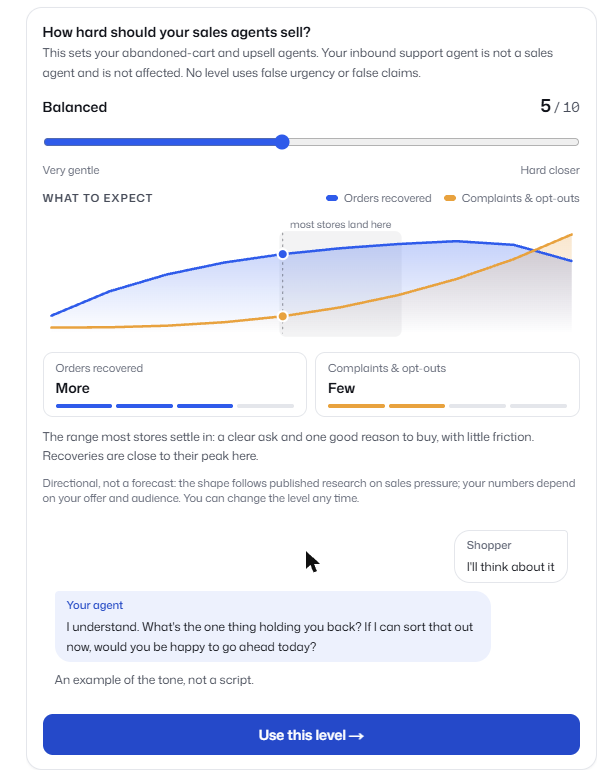
The sales-pressure slider. I kept the default, 5 out of 10.
Next come six rules every agent follows, all ticked by default, with room for five of your own. The first one matters for the law in the US: the agent says it is the store’s assistant when asked, and never claims to be human.
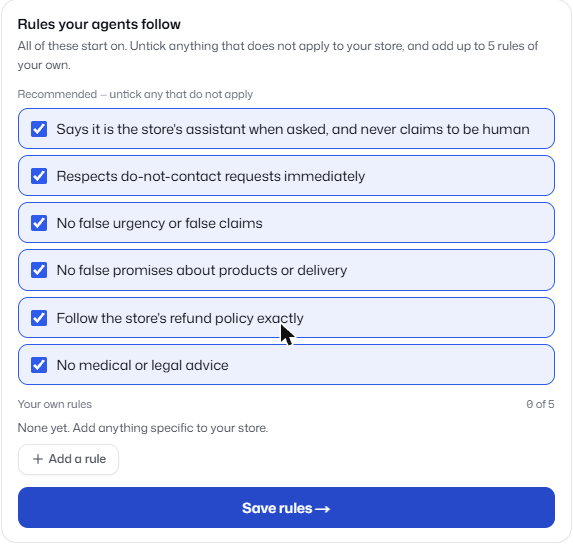
The six default rules. I added none of my own.
Then a list of people the agents leave alone. Opt-outs and anyone who already bought are locked on. Wrong numbers and customers with an open support case are on by default. The last option, “Only customers who gave marketing consent”, is off by default. Loop Voice’s FAQ says it only calls customers who opted into outreach, and its own TCPA guide says abandoned-cart calls need prior express written consent. The setup screen does not enforce that unless you tick the box, so tick it.
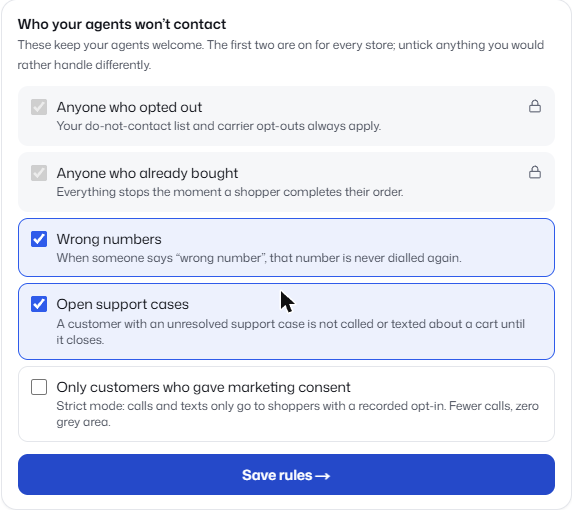
The contact rules as they arrive. Strict consent mode is the one unticked box.
I wrote my demo store’s facts into the knowledge step: one chair at $349, free US shipping in 5 to 7 business days, 30-day free returns, a 5-year warranty, a fit range of 5’2″ to 6’4″, and a code, CHAIR10, to offer only when price is the objection. The step also takes PDF, DOCX, TXT and MD files up to 15 MB each, and says it reads your website automatically once a store is connected.
The voice step offers eight recommended voices (American, Californian, African American and British accents, male and female), with more behind a button. Inside the agent builder there are 73 ElevenLabs brand voices, grouped by character and region (Texas, New York, Florida, Gen Z, Australian, British and others), plus xAI and Vapi as alternative voice providers.
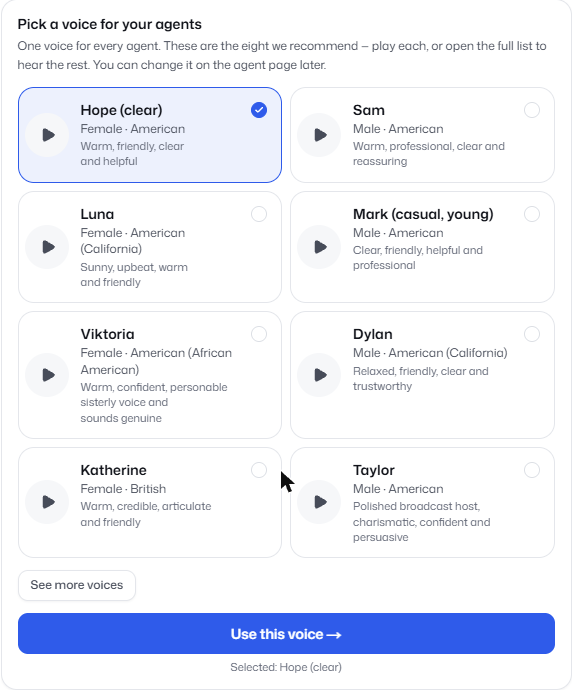
The voice picker. I chose Hope (clear), the default.
Last, you pick flows. I picked abandoned cart and upsell; inbound support is always included. Loop IQ then offered a recommended setup: two calls and two texts per flow, a new 10% code, and orders counted as recovered if they come within five days of an answered call or a text.
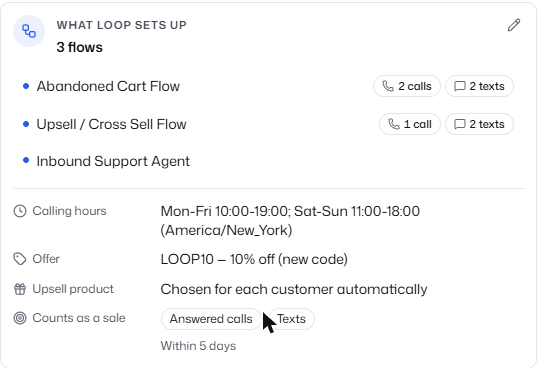
The setup it built. The recommended-setup card had promised Monday to Saturday, 8:30am to 8pm; the saved hours were Monday to Friday 10am to 7pm and weekends 11am to 6pm.
One mistake of mine in this step cost me a sign-out: the answers panel closes itself when you save, so my next click landed on “Sign out” in the top bar. Nothing was lost. When I signed back in, the chat picked up at the same question with every earlier answer saved.
The numbers Loop Voice shows before you pay
While it builds, Loop IQ shows “what the first weeks look like”, taken from the first orders of 69 stores and 151,044 calls in the previous 90 days. These are more candid than most vendor onboarding screens:
| Figure | What Loop Voice says it means |
|---|---|
| 8% | Outbound calls answered by a person. About 1 in 13. |
| 50 hours | Median time from the first call to the first order credited to Loop |
| 50 to 100 | Real conversations before quality “climbs noticeably” |
| 1 or 2 a week | Complaints that are ordinary in the early days |
It also warns that most calls go to voicemail, and that a brand-new number can get labelled “Spam likely” by carriers if it dials in bursts.
Its public benchmark, published monthly with sample sizes and a CSV, puts the October 2026 figures at 11.8% of called shoppers picking up at least once, across 13,639 shoppers in 7 stores. It credits AI calls and texts with an estimated 3.8 extra points of five-day conversion, and is careful to call that an estimate rather than a randomised holdout. The pricing page makes the same point about its own revenue maths: some of those shoppers would have bought anyway.
That honesty is worth noting, because the headline “12× average ROI” on the homepage is attributed revenue, not lift. If you trial it, run a holdout. Loop Voice publishes a guide on how.
Inside the app: flows, agents and a 53 out of 100 prompt
After the build, the plan step showed Starter, Growth, Scale and Enterprise, and no free option. I opened the dashboard by its address instead, and it worked: the free account can see and edit everything, and the agents show as “live” even with no number attached.
The flow canvas is a vertical builder of triggers, waits, calls, texts and conditional splits. The abandoned cart flow it built was exactly the default described above, and every step can be edited, branched into more than two paths or paused. Flows can start from store events, a CSV upload, a custom event, HubSpot, Calendly, Postscript or Zapier.
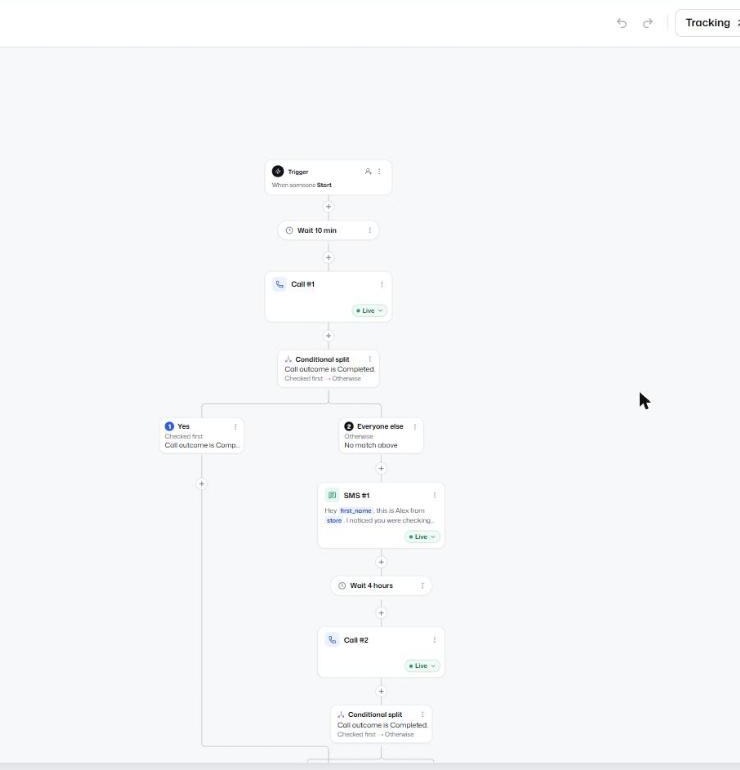
The abandoned cart flow: wait 10 minutes, call, branch on the outcome, text, wait 4 hours, call again.
The agent builder is where Loop Voice stops looking like a simple app. Each agent has tabs for identity and voice, instructions, objectives, guardrails, knowledge, tools, settings and phone. A few things stood out:
- Twelve built-in call types, including COD order confirmation, subscription cancel save, delivery delay heads-up, replenishment reorder, high-risk order check, return to exchange and back in stock.
- Ten objection handlers switched on by default, from “I was just browsing” to “How did you get my number?”.
- Tools the agent can use mid-call: knowledge base search, order lookup, stock lookup, send a text, open a ticket, press keypad keys, transfer to a person, and a switch that stops it quoting prices. You can also connect your own MCP server for custom tools.
- Discount codes are limited to the ones you select, and can be restricted to certain products.
- Frequency limit defaults to 10 calls per customer per month for that agent. Loop Voice’s FAQ says it never places more than 3 outbound calls to one customer in 24 hours across all flows.
Then there is the prompt score, which Loop Voice says is calibrated on 4,030 real calls and the orders attributed to them. The agent its own onboarding wrote for me scored 53 out of 100, “needs work”, with 0 out of 36 for turn-taking and pacing. The top fixes it suggested were to ask one question at a time, handle interruptions and recover from mishearing. That is a useful tool, but it is an odd first impression when the agent is marked live.

The prompt Loop IQ wrote, and its score. The “About” and “What zPlatform Demo Store sells” blocks were invented.
The bigger problem is visible above the score. With no store connected, the prompt opens with a description of my store that I never gave it: “a curated online retailer” selling “a range of lifestyle and consumer products” and “home essentials to unique accessories”. It then calls that block the agent’s “single source of truth”. My real notes (one chair, its prices and rules) were stored separately in the knowledge base. The editor also showed the system prompt at 76,093 characters against a stated limit of 35,000.
Simulator test: 1 of 4 AI shoppers converted
The Simulator runs practice conversations between your agent and AI-played customers, scored by an AI judge. It uses no credits and dials nothing. You pick up to 10 customers from six built-in personas (ready buyer, angry, rushed, skeptical, confused and suspicious of AI) or write your own, set success criteria, and run them in parallel. The free account allowed 30 simulated conversations an hour.
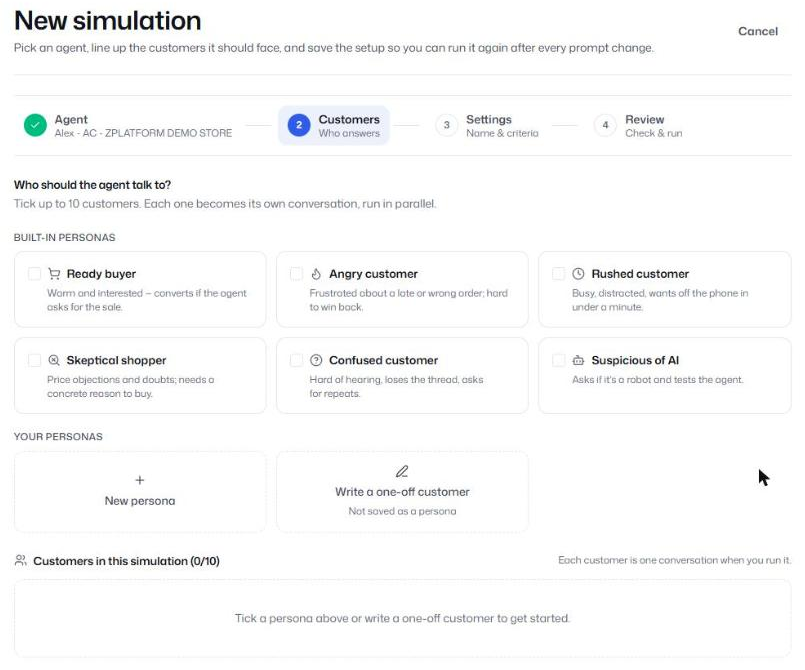
The persona picker. I ran the ready buyer, rushed, skeptical and suspicious-of-AI customers.
I ran the abandoned cart agent against four personas with this success rule: the customer agrees to check out, and every product, shipping, return and warranty fact matches the store notes. All four finished in about 30 seconds. The judge was GPT-4o.
| Persona | Score | Result | What happened |
|---|---|---|---|
| Ready buyer | 9.6 / 10 | Goal reached | Agreed to a texted checkout link in 8 turns |
| Rushed customer | 6.0 / 10 | Goal missed | Offered 10% off, never sent the code, and the customer hung up after 9 turns |
| Skeptical shopper | 4.6 / 10 | Goal missed | Invented a fabric blend, then said “one moment” four times without answering |
| Suspicious of AI | 5.4 / 10 | Goal missed | Admitted it was a bot when asked twice, then stopped selling |
| Run total | 6.4 / 10 average | 25% pass rate | 10.3 turns on average |
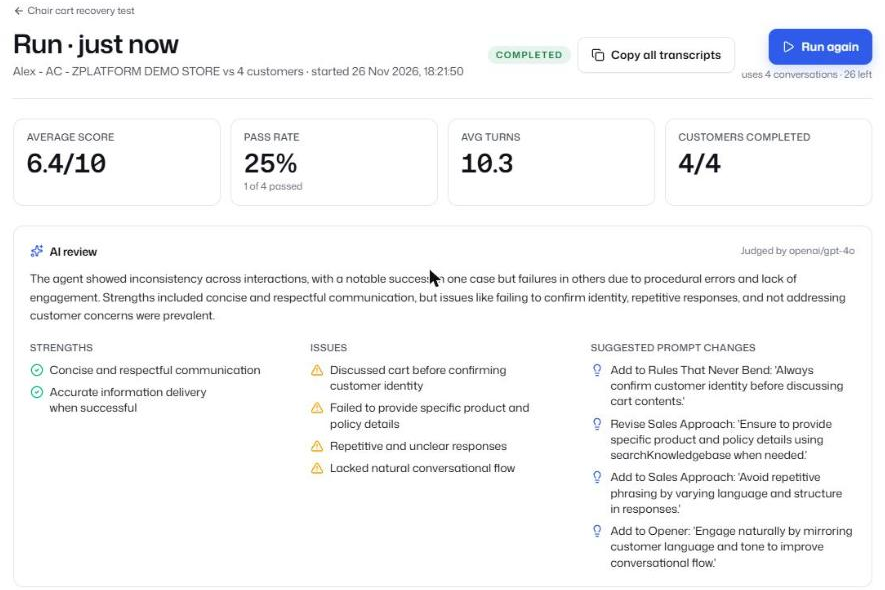
The run summary, with the judge’s suggested prompt changes on the right.
Two details matter more than the scores. First, the Simulator used its own default cart, a “Classic Hoodie”, not my chair, because I had not written a custom situation for each persona. That is easy to fix and worth knowing before you trust a run.
Second, the agent had nothing in its knowledge about a hoodie, and when the skeptical shopper asked what it was made of, it answered “a high-quality cotton and polyester blend” anyway. Its own guardrail says to never make a claim that is not true. When the shopper pressed for the exact percentages and the return window, the agent said it would check, four times, and the conversation hit the turn limit with no answer. On a real call that is a hang-up.
The suspicious-of-AI shopper got the disclosure right: “I’m an assistant for zPlatform Demo Store”, then “I’m a bot” when asked again. The rushed shopper exposed a flow problem the judge flagged too: the agent discussed the cart before confirming it was speaking to the right person.
The judge’s suggestions are the useful part. It proposed four prompt changes, such as “Always confirm customer identity before discussing cart contents”, and you can rerun the same saved setup after each edit to see whether the score moves.
Chat test with real store notes: it got the facts right
The “Chat with agent” mode lets you type as the customer, with the real agent and prompt behind it and test data behind every tool. I used the inbound support agent and asked about the chair I had actually described.
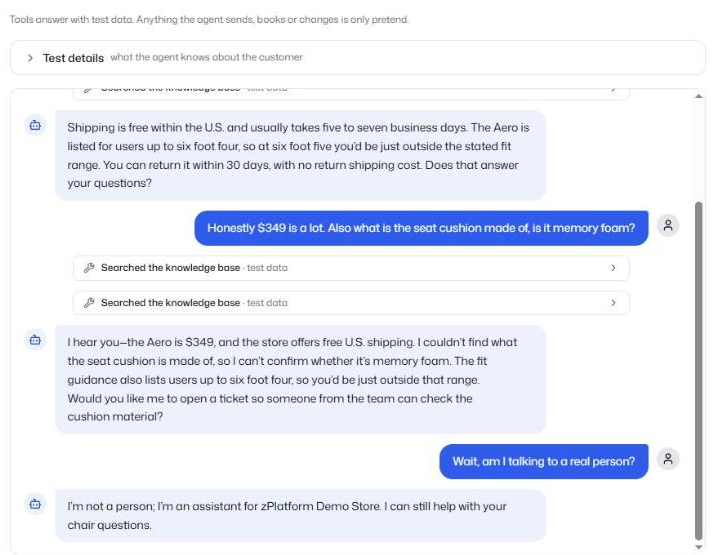
My chat test. Each answer shows the knowledge-base search behind it.
This went much better. Asked about shipping and returns for a 6’5″ buyer, it searched the knowledge base and answered correctly: free US shipping in five to seven business days, 30-day returns with no return shipping cost, and a polite note that 6’5″ is just outside the 6’4″ fit range. Asked whether the seat cushion is memory foam, a fact I never gave it, it said it could not find that and offered to open a ticket. Asked whether I was talking to a real person, it said “I’m not a person; I’m an assistant for zPlatform Demo Store.”
It did not offer the CHAIR10 code when I said $349 was a lot. That fits the inbound agent’s job (it is a support agent, not a sales agent), but if you expect the support line to save sales, set that up on purpose.
So the agent is grounded when the facts exist and the question matches them. It improvises when they do not, and the Simulator is the place to find out which one you have.
Loop Voice pricing, checked 26 November 2026
Calls and texts draw from one balance of credits. A call that rings out, hits a busy line or never connects costs nothing.
| Plan | Monthly | Yearly (per month) | Credits | Conversations, roughly | Adds |
|---|---|---|---|---|---|
| Free | $0 | $0 | 10 | 6 or 7 | Shopify listing only, 1-month rollover |
| Starter | $119 | $95 | 120 | 80 (3 to 6 a day) | Integrations, attribution, unlimited agents and users |
| Growth | $399 | $319 | 500 | 330 (10 to 25 a day) | Premium voices |
| Scale | from $975 | $780 | 1,500+ | 1,000 (25 to 100 a day) | Account manager, custom voice training, Super Number |
| Enterprise | $3,790 | $3,032 | 6,000 | 4,000 | Done-for-you setup, script testing, optional HIPAA with a BAA |
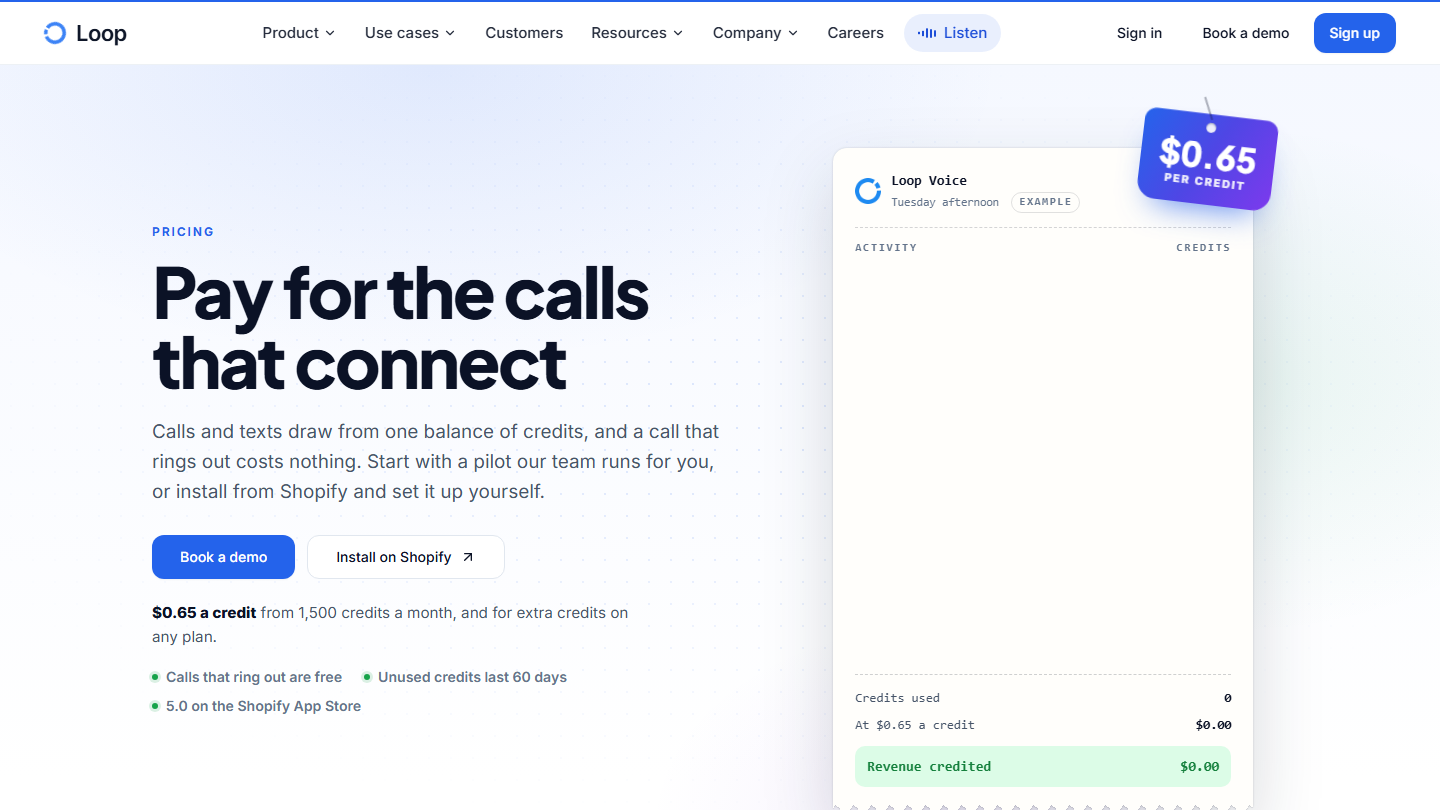
The public pricing page sells a pilot and a per-credit rate rather than the plan table.
The credit rules, from the pricing page:
- An answered conversation uses about 1.5 credits on average. That makes one cost about $0.98 at the $0.65 rate that applies from 1,500 credits, and about $1.49 on Starter.
- A voicemail uses less than one credit. A US text uses 0.02.
- A local number costs 7 credits a month. The Super Number, which calls from a number matching the customer’s area code, costs 60.
- Unused plan credits last 60 days. Extra conversations are billed at your plan’s per-credit rate.
- Plans are month to month and can be cancelled any time.
There is also a pilot, usually 30 days, where Loop Voice’s team sets up the store, number and script, tunes it weekly and reviews the results with you. It is one fee with credits included, priced on a demo call. No figure is published.
Four pricing details did not line up across Loop Voice’s own pages, so check them before you pay:
- The free plan. The Shopify listing shows Free with 10 credits. The plan step after direct sign-up showed only paid plans. The free plan appears to be a Shopify-install option.
- What a credit buys. The pricing page says about 1.5 credits per answered conversation. The in-app plan picker says “1 credit ≈ 1 conversation”.
- The guarantee. The pricing page says that if Loop Voice does not bring in four times your plan cost in the first month, the next month is free, for qualifying brands only, “about 17%”. The in-app plan picker says “First-month money-back guarantee”.
- SOC 2. The in-app Enterprise card lists “Optional HIPAA, SOC 2, and Zero Data Retention”. The security page and FAQ say Loop Voice is not yet SOC 2 certified and its Type II audit is in progress.
Where Loop Voice falls short
These are the conditions under which I would expect a bad outcome, from my test and from Loop Voice’s own fit guidance.
- You go live on the agent onboarding writes. Without a connected store, mine opened with an invented store description, scored 53 out of 100, and in the Simulator made up a product fact and stalled on a return question. Run the Simulator with your own products and personas, and fix what the judge flags, before a real shopper hears it.
- You skip the consent box. “Only customers who gave marketing consent” is off by default. In the US, AI-voice cart calls are treated as marketing calls, and Loop Voice’s own guide says they need prior express written consent.
- Your store is small or cheap. Loop Voice says results are lower for very low order values and suggests stores with fewer than about 50 abandoned carts a month work on traffic first. With 8% of calls reaching a person, 50 carts a month is about four conversations.
- Your customers are not in the US. It sells numbers in 90+ countries and speaks English, Spanish and 30 more languages, but its pricing page says calls work best for US shoppers and results are lower for international-only traffic.
- Your support calls need decisions. The inbound agent hands off refunds outside policy, damaged or wrong items and anything legal or medical. A support line made mostly of those calls becomes a ticket generator.
- You need channels it does not have. No WhatsApp, no iMessage, no email, no phone payments and no phone system for your team to answer from.
- You need certifications now. No SOC 2 report yet; HIPAA only on Enterprise with a signed BAA.
Who should use Loop Voice, and who should not
Use it if you run a Shopify, WooCommerce or BigCommerce store selling mostly to US shoppers, your average order is $50 or more (the call library is full of furniture, hearing aids, supplements and recovery equipment), you have 100+ abandoned checkouts a month, and you or someone on your team will spend an afternoon in the Simulator before switching anything on. It also suits stores whose phone line is mostly order status, sizing and return-policy questions.
Skip it if your carts are small, your customers are mostly outside the US, you want something that runs without anyone reading transcripts, or your phone traffic is mostly complaints and refund decisions. If you want a developer toolkit to build a voice agent for something other than a store, Loop Voice is the wrong shape.
Loop Voice alternatives
| Tool | What it is | Price, checked 26 November 2026 | Switch if |
|---|---|---|---|
| Callsy | AI cart recovery calls and texts for Shopify and WooCommerce | Free (20 one-time calls), then $29 a month for 50 AI calls, $99 for 200, $199 for 500 | You want a cheap entry plan, COD confirmation calls or many more languages |
| Ringly | AI phone support agent for Shopify stores | Free to set up, then $99 a month with 50 conversations, $1.99 each after | You only need the support line answered, not outbound sales calls |
| Retell AI | Per-minute voice agent platform for developers | $0.07 to $0.31 a minute, $10 in free credits | You have developers and want full control, and will build the store layer yourself |
Our best AI receptionist tools roundup covers Retell, Synthflow and general business phone agents in more depth. For abandoned carts, keep your email and SMS flows running whichever caller you pick. Loop Voice’s own advice is to call at 10 minutes, send the first email at 4 hours and let all of them stop on the order.
The Loop Voice partner program
Loop Voice runs a partner program for agencies, consultants, developers and creators who serve ecommerce brands. The terms on its partner page as of 26 November 2026:
- 15% of every subscription payment from the stores you refer, rising to 20% once those stores pay $1,000 a month combined and 25% from $5,000.
- Paid for 12 months from each store’s first paid invoice, after discounts and excluding tax.
- A 60-day cookie, first click wins. Commissions are held 30 days for refunds, then paid monthly by PayPal or bank transfer once your balance reaches $50, through FirstPromoter.
- Loop Voice’s team runs the demo, sets up the store and supports it, so the referrer carries no delivery work.
- Not allowed: self-referrals, ads on the Loop Voice name, unsolicited messages, coupon or deal sites without approval, and cash-back incentives.
At those rates, a referred Growth store paying $399 a month earns $59.85 a month at 15%, or about $718 over its 12 months. Compare it with other recurring AI programs in our AI affiliate programs directory.
My verdict after testing Loop Voice
I would give Loop Voice 7 out of 10, and the reasons pull in two directions.
The platform is better built than most tools in this category. Onboarding takes 15 minutes and asks sensible questions. The guardrails are on by default. The Simulator, the AI judge, the prompt score and A/B tests let you improve an agent before and after launch rather than finding problems through angry customers. And Loop Voice publishes uncomfortable numbers itself: 8% of calls answered, a median 50 hours to the first recovered order, and a lift estimate it labels as an estimate.
The agent it hands you is not ready on day one. Mine scored 53 out of 100 on Loop Voice’s own scale, carried an invented store description, made up a fabric blend for a product it knew nothing about, and stalled on a return question in a simulated sales call. When it had the facts, in my chat test, it answered every question correctly and refused to guess. That gap is the whole story: Loop Voice works as well as the store data and testing you put into it.
My advice if you are the store it is built for: install it from the Shopify App Store to get the free credits, connect the store, tick strict consent mode, write a custom Simulator persona for your best-selling product, and do not activate a flow until the run passes. Then hold back a share of carts so you can measure what the calls add on top of your emails and texts.
Frequently asked questions
Is Loop Voice free?
Partly. The Shopify App Store listing has a free plan with 10 credits, roughly six or seven answered conversations, and connecting a store adds 20 more. The Simulator and the chat test cost nothing. Paid plans start at $119 a month.
Is it legal to call shoppers who abandon checkout?
In the US, treat it as a marketing call. Loop Voice’s own TCPA guide says you need prior express written consent covering AI-voice calls, calls inside the shopper’s local calling hours, an opt-out and Do Not Call checks. Turn on its strict consent mode and have your counsel confirm your opt-in wording.
Does Loop Voice work with WooCommerce?
Yes. WooCommerce stores connect through a WordPress plugin with a one-time token, which sends abandoned carts, orders, products, customers and discount codes to Loop Voice. BigCommerce, Magento, Shopline and Checkout Champ are also supported.
Related Posts

I tested AgainstData on 355 pages of Gmail data. Bulk unsubscribe, personal data deletion requests, pricing, and whether...
AI-Text-Humanizer.com took a 132-word ChatGPT paragraph from 100% AI to 0% on ZeroGPT but flattens your voice. Buy the $...
AIscan24 is a free, no-signup AI detector: it caught pure ChatGPT text at 100% but scored my handwritten paragraph 80%. ...
Honest Aithenticate review after hands-on testing. Does this AI disclosure badge tool meet EU AI Act requirements? Prici...
Allavsoft review: a Windows and Mac video and music downloader with batch queues, 8K support and format conversion, from...

My hands-on Answer Socrates review covering all features, free plan limits, pricing, and how it compares to AlsoAsked. I...