


Verdict: Buy
What I Like
- One API key replaces dozens of individual MCP setups and subscriptions
- Google Maps and Google Search demos returned clean, structured data with no proxy or block issues
- Parallel tool execution handles multiple tool calls from one prompt efficiently
- AI Co-Pilot builds custom MCP servers from any API with zero code
- Credit model is fair since failed tool calls don't consume credits
- Wide client support across Claude, Cursor, Windsurf, and CLI agents
- Free plan with 100 credits lets you validate the workflow before paying
What Is Missing
- Overkill if you only need one or two MCP servers, where free alternatives suffice
- Lower tiers can burn through credits quickly with chatty workflows
- Routes your data calls through a third-party gateway, adding a vendor dependency
- Catalog depth is uneven across the 104 tools, so some servers are more polished than others
- Newer platform in a young, fast-moving space carries some platform risk
Quick Verdict (4/5): BUY if you build Claude Code or Cursor workflows that pull from multiple data sources and you’re tired of wiring up a separate API, subscription, and config for every single one. WAIT if you only need one or two MCP servers, because then the free MCPs already out there will do the job for nothing.
I’ve been living inside Claude Code for months now. The model itself is impressive, but the real power shows up the moment you connect it to outside data through MCP servers. That’s also where the pain starts. Every tool wants its own API key, its own subscription, and its own setup, and managing that across multiple projects and clients turns into a maintenance job nobody asked for.
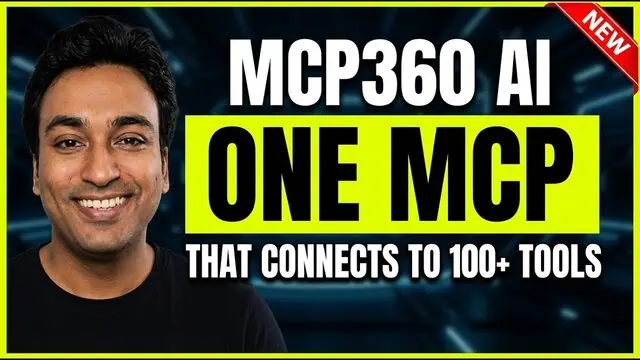
MCP360 is built to kill that exact headache. It bundles 38 ready-made MCP servers (104 tools at the time of testing) behind one dashboard and one API key, covering web scraping, Google Search, Google Maps, YouTube, Google Trends, Amazon, and a long list more. In this MCP360 review, one of many hands-on AI tool reviews I run, I’ll show you exactly what I tested live, where it genuinely saved me time, the custom MCP builder that surprised me, the real pricing, and who should skip it.
Key Takeaways
- MCP360 is a unified MCP gateway, not a single tool. One API key connects Claude Code, Cursor, Windsurf, and other clients to 100+ pre-built data tools instead of 100+ separate setups. That consolidation is the whole point, and it works.
- The live demos held up. I connected the Google Maps and Google Search MCPs inside Claude Code and pulled real AI Overview data, autocomplete suggestions, and related searches in one parallel run. No proxy juggling, no IP blocks, no scraping scripts to babysit.
- The AI Co-Pilot is the sleeper feature. I turned a raw public postal-code API into a working custom MCP server in a few minutes without writing code. If you regularly wrap internal APIs for agents, this alone can justify the subscription.
- Pricing is credit-based and reasonable. A free plan gives you 100 credits to test. Paid plans run from $19/month (Starter) to $399/month (Advanced), with roughly two months free on annual billing. Failed tool calls don’t burn credits.
- It’s not magic, and it’s not for everyone. If you only need one MCP server, free options already exist. MCP360 earns its keep when you’re running several data sources across multiple projects or clients.
The best AI tool is the one that removes a repeated task from your week, not the one with the longest feature list. (Alston Antony)
What Is MCP360?
[tool-card id=”mcp360″]
MCP360 is a unified gateway and marketplace that connects AI coding agents to 100+ external data tools through a single integration. Instead of installing, authenticating, and maintaining a separate MCP server for every data source, you connect once and get access to the whole library from one dashboard with one API key.
Quick definition for anyone newer to this: MCP stands for Model Context Protocol, the open standard Anthropic introduced so AI models can talk to external tools and data in a consistent way. An MCP server is basically a connector that gives your AI agent a new capability, like reading Google Search results or querying a maps database. You can read the full spec at modelcontextprotocol.io if you want the technical detail.
Here’s the part that matters for buyers. You can absolutely build these connectors yourself inside Claude Code. The model is capable enough to scaffold a skill and wire up an API, something our AI how-to guides walk through. The problem isn’t capability, it’s overhead. When you use each data source individually, you set everything up individually, for every project and every client. You manage each subscription separately. Each one carries its own API cost and its own maintenance burden. Multiply that across a real workload and you’ve built yourself a second job.
MCP360 collapses that into one place. As Alston put it in the video, “now you don’t need to worry about everything because everything is in one single place, and you can use it to get started using MCP very fast.” That speed-to-value is the core promise.
Want to test the idea before you read further?
You don’t need to take my word for any of this. MCP360 has a free plan with 100 credits, which is enough to connect one or two servers and see whether the workflow clicks for you. If you’re exploring the wider toolset first, our roundup of the best AI tools for 2026 is a good place to map where something like MCP360 fits in your stack.
Who Is MCP360 For?
MCP360 makes the most sense for a specific kind of builder. After testing it, here’s who I’d actually point toward it:
- Claude Code and Cursor power users building multi-step workflows that need live external data, not just code generation.
- Agencies and freelancers managing AI setups across several clients who can’t afford to maintain dozens of individual MCP configs and subscriptions.
- SEO and marketing teams that want Google Search, Trends, Maps, YouTube, and rank-tracking data flowing straight into their agents.
- Developers wrapping internal APIs who want a fast, low-code path from “we have an API” to “our agent can use it.”
- Solo founders who’d rather pay one predictable bill than stitch together five free MCPs and debug them at midnight.
It’s the wrong fit if you only need a single data source, if you’re a hobbyist running one experiment, or if you have a strong in-house reason to self-host every connector. In those cases, the free MCP ecosystem covers you. Being honest about that is the whole reason I review tools the way I do.
The Real Problem: MCP Server Sprawl
MCP server sprawl is what happens when every data source your AI agent needs arrives as a separate install, a separate API key, a separate subscription, and a separate config file. It feels manageable with two tools. It becomes a maintenance tax with ten.
Think about the actual workload. Imagine Priya, a freelance automation consultant with four clients. Client one needs YouTube and Google Trends data for content planning. Client two wants Amazon and Walmart product scraping. Client three needs Google Maps and local rank tracking. Client four wants Google Search with AI Overview extraction. Done the individual way, that’s roughly eight separate MCP servers, each with its own signup, billing, and setup, repeated inside four different project environments. When one API changes its auth, Priya finds out the hard way, in production, on a Friday.
This is the friction MCP360 targets. Web scraping, Google properties, and marketplace data are all aggressively protected against automated access. You hit IP blocks, captchas, and proxy problems the moment you try to pull that data yourself. A managed MCP gateway handles that access layer for you, so your agent just asks for “restaurants in Coimbatore” and gets clean structured data back instead of a 403 error, the same headache a dedicated Google Maps scraper like Outscraper solves on its own.
Quick gut check before you buy: count the data sources your agents actually touch in a month. One or two? Stick with free MCPs. Five or more across multiple projects? That’s exactly the workload MCP360 was designed to absorb, and that’s where it starts paying for itself.
Inside the Dashboard: 38 Servers, 104 Tools
The dashboard is genuinely clean, and I don’t say that lightly because most developer tools bury you in panels. It opens on popular MCPs and a browse view of everything available. At the time of my test, MCP360 listed 38 MCP servers spanning 104 individual tools, and the team is actively adding more, far more than you’ll find in most standalone MCP server directories.
The catalog reads like a wish list for anyone doing data-driven work. A few that stood out:
- Search and visibility: Google Search (with AI Overview extraction), an LLM prompt tracker for AEO and AI visibility, Bing, Google News, Google Images.
- SEO and research: keyword research tool, on-page SEO checker, Google Rank Tracking, Google Trends.
- Local and commerce: Google Maps, Google Shopping, Amazon product search, eBay, Walmart, Google Hotels, Google Flights, Google Jobs.
- Utility: web scraping, email verification, currency converter, crypto service, weather.
Each server bundles several tools. The Google Search MCP, for example, isn’t just “search.” It’s almost a full replica of a search-data tool, with web results, autocomplete, and related searches available as separate callable tools. That depth per server is why 38 servers stretch into 104 tools.
You also get a choice in how you connect. You can wire up servers one by one, or use a single universal MCP endpoint that exposes the whole library at once, or pull in just the individual skill you care about. That flexibility matters because it lets you keep your agent’s tool list lean instead of dumping 104 tools into one context window, which would slow your model down and confuse its tool selection.
Setting Up an MCP Server in Claude Code
Setup is where a lot of these tools fall apart, so I paid close attention. The integration page gives you ready-made connection instructions for the popular clients: Claude (desktop and Code), Cursor, Windsurf, OpenAI-style CLI agents, and others. You generate an API key tied to your account, and that key authenticates your calls to the MCP endpoint.
In the Google Maps walkthrough, there were two paths. You can paste the connection command straight into Claude Code, or you can drop the JSON config in yourself. Alston’s preference, and mine too, is the JSON config route. It just feels more reliable and easier to version-control across projects, though that’s personal taste, not a rule.
The config points Claude Code at the MCP360 remote connection URL with your API token. Once added, Claude Code prompts you to restart so it can register the new server. After that, the agent knows it has a Google Maps capability available. When you ask it something maps-related, it routes the request through the MCP server instead of trying to hit the website directly and running into blocks.
This is the difference between a fragile scraping script and a stable data pipe. Your prompt stays plain English. The plumbing happens underneath.
Want a broader view of where AI tooling is heading?
If you’re building out a full agent stack and weighing what to pay for versus what to run free, it’s worth browsing current AI deals and discounts before you commit to monthly subscriptions across the board. Locking in annual pricing on the few tools you’ll actually use every week usually beats five impulse signups.
Live Demo: Google Maps MCP in Action
The first real test was a simple, honest query: find the best restaurants in Coimbatore on Google Maps and return all the details. With the Maps MCP connected, Claude Code recognized it had the right tool, routed the request through MCP360, and came back with structured restaurant data, the kind of result that would normally require a Places API setup or a scraper that gets blocked half the time.
On its own, a single Maps lookup doesn’t feel earth-shaking. The power shows up when this becomes one node in a bigger workflow. As Alston framed it, the value lands “when you’re integrating these data flows within your existing workflows,” like connecting Google Search Console, Bing, YouTube, and Google Trends into a single multi-layer research agent. At that point every connected MCP compounds the others, and you’re orchestrating real intelligence instead of running one-off lookups.
That compounding effect is the actual sell here. One MCP is a convenience. Ten MCPs flowing into one agent is a capability you couldn’t easily build by hand.
Live Demo: Google Search MCP With AI Overview Extraction
The Google Search demo is where I leaned in. The instruction was deliberately layered: find the best SEO tools from Google Search, get autocomplete suggestions for a keyword, and pull related searches, all in one go, the sort of query a standalone SEO research tool like Semdash would need its own dashboard for. That’s three distinct tools inside the same MCP, fired together.
Claude Code identified all three tool calls, asked for permission on each, and then ran them in parallel. The output was genuinely useful: AI Overview data extracted from the SERP, organic results, top autocomplete opportunities with relevance notes, and related searches, all pulled cleanly through the MCP360 Google server. It even surfaced an angle worth chasing, flagging where free-focused queries dominated the results.
For SEO and content work, this is the kind of grounded data that makes an AI agent actually trustworthy. Instead of the model guessing what people search for, it’s reading live SERP signals. If AI search visibility is on your radar, the LLM prompt tracker in the same catalog is worth a look too, much like the dedicated GEO and LLM visibility tracker I reviewed, since tracking how you show up in AI answers is quickly becoming as important as classic rankings. We cover that shift in our breakdown of free AI tools worth trying for anyone building on a budget.
The AI Co-Pilot: Build a Custom MCP With Zero Code
This is the feature that moved my rating from “useful” to “genuinely impressive.” Beyond the pre-built catalog, MCP360 lets you create custom MCP servers from any API or code. There’s a manual path for technical users, and there’s an AI Co-Pilot for everyone else.
Here’s the test that sold me. There’s a free public API that returns Indian postal code and post office branch details. Normally, wrapping that into an MCP server means writing a connector, handling auth, defining the tool schema, and deploying it. With the Co-Pilot, the process looked more like building a custom GPT than writing software.
The prompt didn’t even need to be precise. Alston literally copy-pasted two lines from the API’s own documentation, an instruction and the endpoint detail, and asked it to create a postal-code MCP for developers. The Co-Pilot asked sensible questions in plain language: what should the server be named, is this an API or custom code, what’s the endpoint and method. When prompted for the endpoint, it suggested the right one automatically. Then it built the tool, opening a browser-style automation flow and configuring everything without manual touching.
Adding a second tool to the same server was just as easy. He typed “add second” and the Co-Pilot suggested the second endpoint on its own. Two tools, one custom MCP, a few minutes, zero code.
Testing the custom MCP live
A builder that doesn’t work is just a demo. So the custom postal MCP got tested directly inside MCP360’s own test panel, connecting the API and querying a real PIN code (a home address as the default). It returned all the expected data cleanly. From there, the only remaining step is dropping that MCP’s connection details and API key into Claude Code, and the agent has a brand-new capability built specifically for your use case.
If you regularly wrap internal or niche APIs for your agents, sit with that for a second. The slowest part of agent development is often the integration glue. This feature attacks exactly that. For developers, that’s the strongest reason on this page to try MCP360.
MCP360 Pricing: Plans and Real Value
MCP360 uses a credit-based model where credits map to successful MCP call operations. Failed tool calls don’t consume credits, which is a fair and increasingly rare touch. Here’s the current pricing, verified directly from the official pricing page:
| Plan | Monthly | Annual (per month) | Credits / month | Key limits |
|---|---|---|---|---|
| Free | $0 | $0 | 100 | 1 project, basic MCP access, community support |
| Starter | $19 | $16 | 2,000 | 2 projects, 2 members, email support |
| Professional | $99 | $83 | 10,000 | 10 projects, 10 members, premium MCPs, advanced analytics |
| Advanced | $399 | $333 | 100,000 | Unlimited projects and members, dedicated support, SLA |
Annual billing gives you roughly two months free versus paying monthly. For most solo builders and small teams, the Starter or Professional tier is the realistic landing spot. The Free plan is genuinely useful for validating the workflow before you spend anything, which is exactly how I’d recommend approaching it.
How do you judge whether the credits are worth it? Apply the same math I use for any AI lifetime deal or subscription: compare the monthly cost against what you’d spend on the individual APIs and the hours you’d lose maintaining them. If you’re currently paying for three or four separate data APIs and burning time on setup, consolidating into one $19 to $99 bill usually wins on both cost and sanity. If you’d only use it occasionally, the per-credit value won’t pencil out, and you should skip it.
Affiliate disclosure: the deal link in the companion video is an affiliate link. I keep my recommendations honest regardless, and the verdict here would be identical without it.
What I Liked About MCP360
After hands-on testing, these are the genuine strengths:
- Real consolidation. One API key replacing dozens of individual setups isn’t a marketing line, it’s the actual experience. The maintenance reduction is the headline benefit.
- The demos work. Google Maps and Google Search both returned clean, structured, usable data inside Claude Code without proxy or block issues.
- Parallel tool execution. Firing multiple tools from one prompt and getting results back together is fast and practical for research workflows.
- The AI Co-Pilot. Turning a raw API into a working MCP without code is the standout feature and a real time-saver for developers.
- Fair credit model. Failed calls not counting against your balance shows the pricing was designed by people who’ve actually used these tools.
- Wide client support. Claude, Cursor, Windsurf, and CLI agents are all covered, so you’re not locked into one environment.
The Downsides and Honest Caveats
No tool is flawless, and a review that pretends otherwise isn’t worth reading. Here’s where I’d temper expectations:
- It’s overkill for single-source needs. If you only need one MCP, the free ecosystem already covers you. MCP360’s value depends on you running several data sources.
- Credit anxiety is real on lower tiers. 100 free credits and 2,000 on Starter go quickly if your workflows are chatty. You’ll want to watch usage with the project-based tracking before committing to heavy automation.
- You’re trusting a gateway. Routing your data calls through a third party is convenient, but it does mean one more vendor in your pipeline. For most use cases that’s fine, but security-sensitive teams should weigh it.
- Catalog depth varies. With 104 tools, some servers are deeper than others. Test the specific ones you need on the free plan rather than assuming every server is equally polished.
- It’s a newer player. The MCP gateway space is young and moving fast. The roadmap looks active, but as with any young tool, factor in some platform risk.
MCP360 vs Doing It Yourself
The honest alternative to MCP360 isn’t a competitor, it’s the do-it-yourself route. Here’s the real comparison.
| Factor | MCP360 | DIY individual MCPs |
|---|---|---|
| Setup time | One connection, reuse everywhere | Separate setup per tool, per project |
| Billing | One predictable bill | Multiple separate API subscriptions |
| Maintenance | Handled by the gateway | You patch every breakage |
| Data access (scraping, SERP) | Managed, block-resistant | You handle proxies and blocks |
| Custom APIs | AI Co-Pilot, low-code | You write the connector |
| Cost at small scale | Subscription even for light use | Often free |
| Best for | Multi-source, multi-client builders | Single-source or hobby use |
The pattern is clear. DIY wins on cost when you need almost nothing. MCP360 wins decisively the moment your data needs spread across multiple sources, projects, or clients, because it converts a recurring maintenance problem into a single line item. If you want help mapping which tools deserve a paid slot in your stack, our AI affiliate programs and tools directory is a useful cross-reference for what’s worth standardizing on.
Who Should Buy MCP360 (and Who Shouldn’t)
Buy it if you’re a Claude Code or Cursor power user, an agency juggling client setups, or a developer who regularly wraps APIs for agents. The time savings on setup and maintenance, plus the Co-Pilot, will pay back the subscription fast at that level of use.
Wait or skip if you only need one or two data sources, you’re experimenting casually, or you have a hard requirement to self-host everything. The free MCP ecosystem serves you better there, and you shouldn’t pay for consolidation you don’t need.
That split is the entire verdict in one paragraph. The tool is good. Whether it’s good for you depends almost entirely on how many data sources your agents touch.
Final Verdict: Is MCP360 Worth It?
MCP360 earns a solid 4 out of 5 from me. It does the one thing it promises, killing MCP server sprawl, and it does it well. The live demos pulled real data without drama, the pricing is fair with a genuinely usable free tier, and the AI Co-Pilot is the kind of feature that quietly changes how fast you can ship agent capabilities. The point off is for the platform’s youth and the fact that its value is conditional on your scale rather than universal.
Here’s your concrete next step, not vague advice. Sign up for the free plan, connect just the Google Search MCP inside Claude Code, and run one real query from your actual work. You’ll know within ten minutes whether the consolidation clicks for your workflow. If it does, the annual Starter or Professional tier is where the value lives. If it doesn’t, you’ve spent nothing.
For anyone building serious Claude Code and Cursor workflows in 2026, MCP360 is worth the test. Watch the full hands-on walkthrough in the video above to see every demo run live, and check the current deal before you decide.
Frequently Asked Questions
What is MCP360 used for?
MCP360 is a unified MCP gateway that connects AI coding agents like Claude Code and Cursor to 100+ pre-built data tools through one API key. It’s used to skip the individual setup, subscription, and maintenance of separate MCP servers for things like Google Search, Maps, YouTube, Trends, and web scraping.
Is MCP360 free?
Yes, MCP360 has a free plan with 100 credits per month, one project, and basic MCP access. It’s enough to connect a server or two and validate the workflow. Paid plans start at $19/month (or $16/month billed annually) for the Starter tier.
Does MCP360 work with Claude Code?
Yes. MCP360 provides ready-made connection instructions for Claude Code, Claude desktop, Cursor, Windsurf, and OpenAI-style CLI agents. You generate an API key, add the MCP endpoint via command or JSON config, restart the client, and the agent can use the connected tools.
Can I build my own MCP server with MCP360?
Yes, and this is one of its best features. The AI Co-Pilot lets you turn any API or code into a custom MCP server without writing code. You provide an instruction and endpoint details in plain language, and it configures, builds, and tests the server for you.
How much does MCP360 cost?
MCP360 has four tiers: Free ($0, 100 credits), Starter ($19/month or $16 annual, 2,000 credits), Professional ($99/month or $83 annual, 10,000 credits), and Advanced ($399/month or $333 annual, 100,000 credits). Failed tool calls don’t consume credits.
Is MCP360 worth it?
It’s worth it if you run multiple data sources across several projects or clients, where the consolidation saves real setup and maintenance time. It’s not worth it if you only need one or two MCP servers, since free options already cover that. I rate it 4 out of 5.
Liked this review? Pin ZPlatform as your Preferred Source.
Pinning us tells Google to make our hands-on AI reviews, verified lifetime deals, and founder interviews more likely to appear prominently for you in Top Stories and eligible AI Search experiences (AI Mode, AI Overviews). Set it once, no account needed on our end.
- 500+ AI tools tested with real budgets
- Verified deals - no dead affiliate links
- Editor: Alston Antony, 15+ years in SaaS & SEO
 Opens Google · takes 2 seconds
Related Posts

I tested AgainstData on 355 pages of Gmail data. Here’s my honest review: bulk unsubscribe, personal data deletion reque...

I ran AI-Text-Humanizer.com through ZeroGPT and AIscan24 with real before and after scores. Here is what works, what it ...
I ran five text samples through AIscan24, including two I wrote by hand. One scored 80% AI. Here is what this free detec...

Starting August 2, 2026, the EU AI Act’s transparency provisions become enforceable. That means if your website uses AI-...

My hands-on Answer Socrates review covering all features, free plan limits, pricing, and how it compares to AlsoAsked. I...

“I’ve spent $4,200 on 118 AppSumo lifetime deals over 5 years. Here’s my honest review: what works, what fails, and whet...